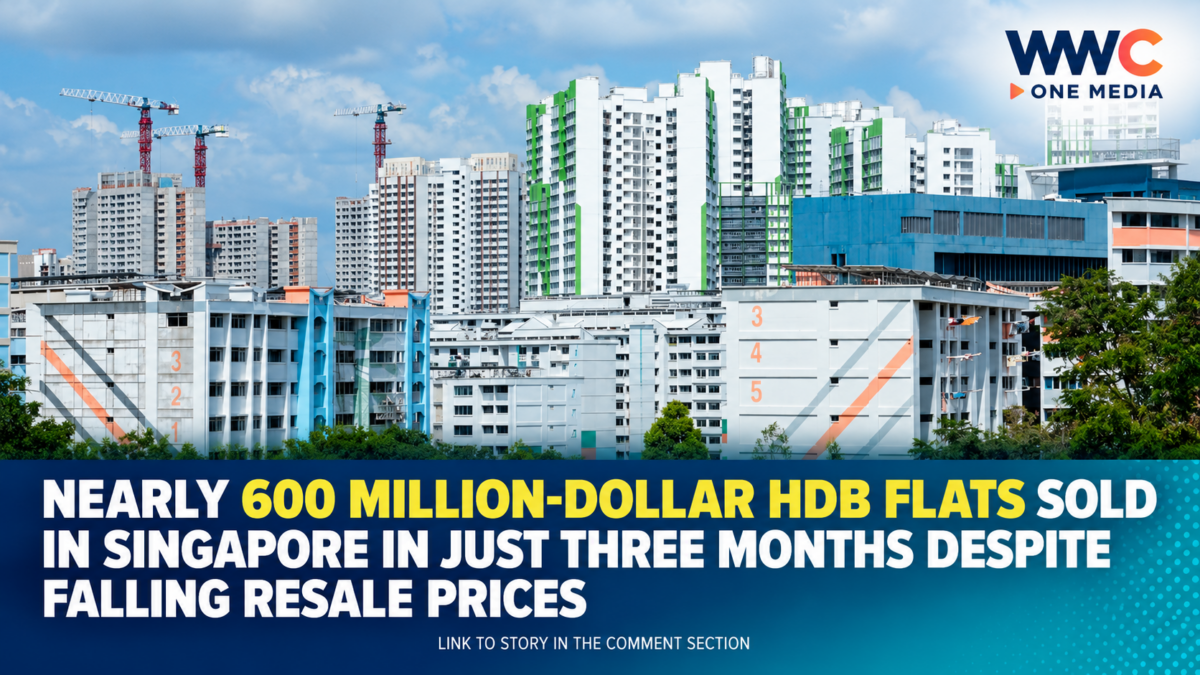
Singapore’s public housing market is showing an unusual trend: nearly 600 Housing and Development Board (HDB) resale flats were sold for at least S$1 million in just three months, even as overall resale prices continued to decline.
The latest figures for the third quarter of 2026 reveal a property market moving in two different directions. While more buyers are completing resale transactions, the broader market is experiencing a gradual price correction, raising questions about affordability, demand and the future of Singapore’s million-dollar HDB flats.
According to data released by Singapore’s Housing and Development Board (HDB) on October 23, resale flat prices declined by 0.1 per cent in the third quarter, marking the third consecutive quarterly decrease this year.
Prices previously fell by 0.1 per cent in the first quarter and another 0.3 per cent in the second quarter. Overall, the HDB Resale Price Index has dropped approximately 0.5 per cent during the first nine months of 2026.
Despite the downward movement in prices, resale transactions increased significantly.
A total of 7,645 HDB resale flats changed hands between July and September, representing a 19.5 per cent increase from the 6,396 transactions recorded in the second quarter. Sales were also 5.9 per cent higher than the 7,221 transactions recorded during the same period in 2025.
The increase represents the highest quarterly resale transaction volume since the third quarter of 2024, indicating that buyers remain active even as property prices begin to stabilise.
Million-Dollar HDB Transactions Reach New Quarterly Record
One of the biggest developments in Singapore’s housing market was the sharp increase in million-dollar resale flat transactions.
According to property market figures cited by ERA Singapore, 596 HDB resale flats were sold for at least S$1 million during the third quarter. This represents a 21.6 per cent increase from the 490 million-dollar transactions recorded in the previous quarter.
The figure establishes a new quarterly record, highlighting continued demand for larger flats and properties in highly sought-after locations.
However, million-dollar transactions still represent a relatively small portion of the overall market. These properties accounted for approximately 7.8 per cent of all HDB resale transactions during the quarter.
The premium segment also saw more expensive deals. Twenty-six resale flats changed hands for at least S$1.5 million, compared with 16 transactions in the first quarter and 15 in the second quarter.
Locations such as Queenstown, Bishan, Clementi, Toa Payoh and the Central Area featured among the areas recording these high-value transactions.
The growing number of expensive HDB transactions demonstrates that buyers are still willing to pay substantial premiums for desirable locations, larger living spaces and attractive property attributes.
Larger Flats Attract More Buyers
Another significant development was the increase in transactions involving five-room and executive flats.
According to property market analysis, 1,867 five-room flats were sold during the third quarter, representing a 26.7 per cent increase from the previous quarter.
Executive and multi-generation flat transactions also climbed sharply to 545 units, up 41.6 per cent from the second quarter.
The increase suggests that larger properties are attracting more attention, particularly from households seeking additional living space and private property owners considering a move into public housing.
Singapore also removed the 15-month wait-out period for private residential property owners and former owners purchasing non-subsidised HDB resale flats on July 28, 2026.
Previously, affected private property owners generally had to wait 15 months after selling their private homes before becoming eligible to purchase certain HDB resale flats.
The removal of the restriction was expected to provide greater flexibility for private homeowners looking to downgrade or right-size their housing arrangements.
However, HDB said it had not observed a significant increase in either resale prices or the number of flats purchased by private property owners and former owners following the policy change.
More Housing Supply Could Keep Prices Under Control
Property analysts believe the expanding supply of public housing could help prevent another sharp increase in resale prices.
More HDB flats are expected to reach their minimum occupation period (MOP), making them eligible for resale and gradually increasing the number of available properties in the secondary market.
At the same time, the government continues to expand its Build-To-Order (BTO) housing programme.
HDB is expected to offer approximately 7,960 BTO flats in its November 2026 sales exercise, providing additional opportunities for eligible first-time buyers and households seeking new public housing.
The monthly household income ceiling for BTO applicants was also increased from S$14,000 to S$16,000 in August 2026, potentially allowing more households to qualify for new subsidised flats.
These developments could reduce some of the pressure on the resale market, particularly among buyers who are willing to wait for newly built homes rather than purchase existing flats at higher prices.
Singapore’s Property Market Shows Two Different Trends
The latest HDB figures highlight an important distinction between transaction activity and property prices.
More flats are being sold, but that does not necessarily mean prices are increasing. Instead, buyers appear to be taking advantage of a market where prices have become more moderate, while sellers continue to find purchasers for properties with attractive locations and features.
The situation also reflects the growing divide between ordinary resale flats and premium properties capable of commanding million-dollar prices.
While the number of million-dollar transactions continues to climb, the broader HDB resale market has recorded three consecutive quarters of price declines.
For prospective buyers, the trend could offer greater negotiating opportunities, although affordability remains a major consideration.
For existing homeowners, particularly those who purchased properties at higher prices in previous years, the changing market could influence decisions about when to sell or upgrade.
Singapore’s housing market is therefore entering an important period of adjustment. With more resale flats becoming available, additional BTO projects coming online and buyers continuing to pursue premium properties, the coming quarters will reveal whether prices stabilise or continue their downward movement.