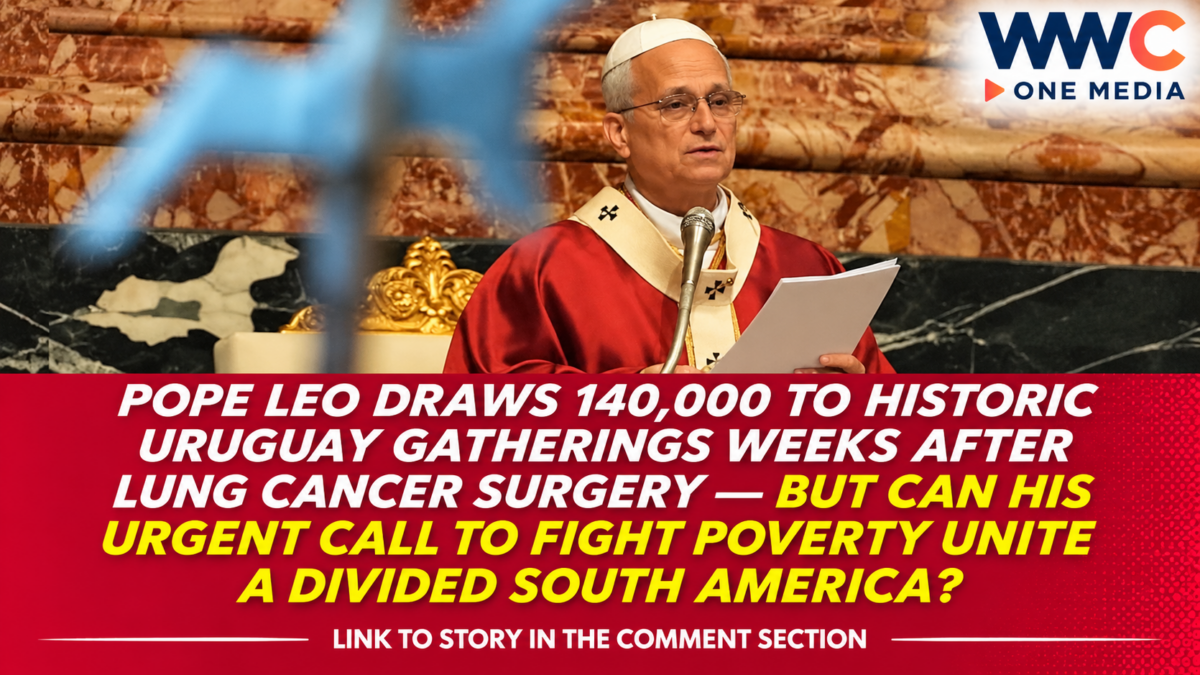
MONTEVIDEO, URUGUAY — Pope Leo XIV has delivered a powerful message against poverty, inequality and political division as enormous crowds welcomed him to Uruguay during his first major South American tour since becoming head of the Roman Catholic Church.
On Saturday, November 7, approximately 40,000 worshippers gathered for an outdoor Mass in Paysandú, near the Argentine border, despite heavy rain and difficult weather conditions.
Later that evening, an estimated 100,000 people participated in a prayer vigil at Montevideo’s historic Centenario Stadium and surrounding areas.
The extraordinary turnout came in one of Latin America’s most secular countries, where Catholics represent a minority of the adult population.
But the Pope’s message extended far beyond religious celebration.
During a visit to Casavalle, an impoverished area of Montevideo affected by violence and drug-related crime, Leo called on communities and political leaders to confront the suffering of vulnerable families.
He warned against indifference toward children facing hunger, mothers struggling to provide for their families and residents living with insecurity.
The central message was clear: unity must be measured not only through speeches and ceremonies, but through concrete efforts to help those who are suffering.
His remarks came at a particularly significant moment.
The 71-year-old pontiff is undertaking a demanding 12-day journey through Uruguay, Argentina and Peru less than a month after undergoing surgery for lung cancer.
His decision to continue the trip has turned the visit into a story of religious leadership, personal resilience and growing international attention.
And as the Pope prepares to meet political leaders across South America, a larger question is emerging.
Can his appeals for solidarity produce meaningful action in a region facing deep political divisions, economic inequality and social insecurity?
40,000 Defy Heavy Rain to Welcome Pope Leo in Paysandú
Pope Leo traveled from Montevideo to Paysandú, a city on the Uruguay River near the border with Argentina.
The city was selected as the location for his first Mass in South America because of its accessibility to pilgrims from neighbouring countries.
Many worshippers arrived from Uruguay, Argentina and Brazil.
Some had waited overnight despite heavy rain.
Others traveled long distances to participate in what became a historic religious gathering.
The Mass was celebrated at Parque París Londres.
According to the Vatican Press Office, local authorities estimated attendance at approximately 40,000.
As the Pope arrived in his open-sided vehicle, worshippers waved flags and handkerchiefs, cheered and greeted him enthusiastically.
The event carried additional significance because no pope had previously visited Paysandú.
For many residents, the visit represented a rare opportunity to see the head of the Catholic Church without traveling abroad.
It also marked a major public appearance for Leo following his recent medical treatment.
Pope Uses Uruguay-Argentina Bridge as Symbol of Unity
During the Mass, Pope Leo drew attention to the nearby General Artigas International Bridge.
The structure connects Paysandú with Colón, Argentina, allowing people and goods to move between the two countries.
Rather than speaking only about the physical crossing, the pontiff used it as a symbol of cooperation.
He encouraged communities to overcome divisions and strengthen relationships.
The message was particularly relevant to South America, where political disagreements and economic pressures have created tensions within and between societies.
But Leo’s appeal was broader than partisan politics.
He emphasized that bridges can represent openness, communication and the willingness to encounter others.
The comparison also reflected the international nature of the gathering.
Many Argentine pilgrims had crossed the border to attend.
The Pope’s message suggested that differences in nationality, politics and personal experience should not automatically become barriers to solidarity.
In a region where public debates can become deeply confrontational, he presented cooperation as both a religious and social responsibility.
Pope Leo Calls for Action Against Poverty in Montevideo
One of the most powerful moments of the trip took place away from the enormous crowds.
Leo visited Casavalle, a disadvantaged community in northern Montevideo.
The neighbourhood has struggled with problems involving poverty, gang violence and drug trafficking.
At Our Lady of Guadalupe Parish, the Pope met residents and listened to people who had experienced serious hardship.
He heard testimonies involving homelessness, insecurity and the challenges of raising children in difficult conditions.
One woman became emotional while describing her experience of raising a child while homeless.
The pontiff embraced her.
The encounter illustrated the personal consequences of poverty, which can become obscured when public debate focuses only on statistics.
Leo emphasized that societies cannot ignore vulnerable people.
He also challenged communities to examine why children continue to face hunger, educational disadvantage and violence.
His message was not limited to government policy.
He called for cooperation among religious organizations, civil society and individuals willing to provide practical support.
The Pope’s Warning: Poverty Is More Than a Lack of Money
Leo’s visit highlighted the many ways poverty can affect daily life.
A family may struggle to afford food.
A child may face unsafe conditions while traveling to school.
A parent may lack stable housing or employment.
A person recovering from addiction may need community support and opportunities to rebuild their life.
These challenges often reinforce one another.
Limited educational opportunities can reduce access to employment.
Unemployment can make housing more difficult to afford.
Insecurity can prevent children from attending school consistently.
That is why Leo’s remarks emphasized human dignity alongside material assistance.
He argued that communities must recognize the suffering of people who may otherwise remain invisible.
For the Church, his message placed social responsibility at the centre of religious practice.
For political leaders, it raised questions about whether existing policies are sufficiently protecting the most vulnerable.
Church Projects Offer Practical Help in Casavalle
The Pope’s visit also highlighted community programmes already operating in the neighbourhood.
According to the Associated Press, Catholic organizations in Casavalle have supported housing construction, addiction recovery and employment opportunities.
At Our Lady of Guadalupe Parish, church groups have helped provide homes and assistance to residents attempting to rebuild their lives.
Some projects have received support from charitable donors, including The Papal Foundation.
The initiatives illustrate how local religious organizations can contribute to social programmes.
But the projects do not eliminate the broader problems facing the community.
Poverty, violence and unequal educational outcomes remain significant challenges.
The Pope’s visit drew international attention to these issues while recognizing the work of people already providing assistance.
His message emphasized sustained involvement rather than temporary attention generated by a high-profile visit.
Why Uruguay’s Education Gap Is a Serious Concern
The Associated Press reported that Uruguay has broad access to primary education, but the proportion of students completing secondary school remains a major concern.
Citing the country’s National Institute for Educational Evaluation, AP reported that approximately half of Uruguayans complete high school.
The gap is especially pronounced between households with different economic circumstances.
Among students from the poorest families, only about one in four completes high school.
Among those from the wealthiest households, the rate approaches nine in ten.
Those disparities demonstrate how educational opportunities can be shaped by family resources.
They also help explain why Leo focused on children facing insecurity and deprivation.
Education is closely linked to long-term employment prospects and economic mobility.
When disadvantaged children leave school early, existing inequalities can persist across generations.
The Pope did not unveil a new national education programme.
Instead, he urged communities and institutions to confront the conditions preventing children from enjoying a dignified future.
100,000 Gather for Historic Prayer Vigil in Montevideo
The day’s second major gathering took place at Centenario Stadium in Montevideo.
According to the Vatican and Associated Press, approximately 70,000 people attended inside the stadium, while another 30,000 followed the event from outside.
That brought the estimated participation to 100,000.
The stadium is one of Uruguay’s most famous sporting landmarks.
It also hosted Pope John Paul II during his 1988 visit.
The November 7 gathering was especially notable because Uruguay has a relatively secular society compared with many neighbouring Latin American countries.
Only about a third of adults identify as Catholic, according to the demographic estimate cited in the original reporting.
Despite that context, Leo attracted enormous crowds.
During the vigil, he encouraged Catholics not to confuse their relatively small numbers with a lack of importance.
His message focused on faith, community responsibility and the contribution believers can make to society.
The turnout demonstrated the Pope’s ability to attract attention even in a country where religious affiliation is less widespread than elsewhere in the region.
However, attendance at a papal event should not be interpreted as evidence that everyone present belongs to the Catholic Church.
Large public gatherings can attract people motivated by faith, curiosity, cultural interest or the historic importance of the occasion.
A Pope’s Return to South America After Cancer Surgery
The Uruguay visit is also attracting attention because of Leo’s recent health challenges.
On October 13, the pontiff underwent surgery at Rome’s Gemelli Hospital to remove a cancerous tumour from his right lung.
He was subsequently discharged and gradually resumed public duties.
As WWC ONE MEDIA reported in its October 19 coverage of the Pope’s return to the Vatican, doctors expressed confidence that he could recover sufficiently to undertake the planned South American journey.
The trip was nevertheless demanding.
It involves multiple cities, international flights and large public events.
For the Vatican, the schedule requires balancing the Pope’s pastoral commitments with his recovery.
The fact that he traveled to Uruguay and presided over the November 7 gatherings confirms that he was able to resume substantial public activity.
But public appearances alone do not establish the absence of all medical limitations.
His health remains subject to professional medical monitoring.
Doctors Said Pope Leo Needed No Additional Cancer Treatment
Further medical information released after surgery provided reassurance.
On October 21, the Vatican announced that examinations indicated the cancer was localized and that additional cancer-directed treatment was not required at that stage.
As WWC ONE MEDIA reported in its detailed coverage of the medical findings, doctors found no indication requiring immediate additional therapy.
That assessment was important for the planned international tour.
However, it should not be interpreted as a guarantee that the Pope will never need future medical evaluation.
Follow-up monitoring remains part of appropriate cancer care.
The Vatican has continued managing his schedule with the demands of recovery in mind.
For Catholics following his health, the Uruguay visit represents a significant public milestone after the operation.
Why This Visit Is a Homecoming for Pope Leo
Leo’s South American tour carries considerable personal meaning.
Although he is the first pope born in the United States, he spent decades serving as a missionary and bishop in Peru.
He later obtained Peruvian citizenship.
His years in Latin America helped shape his pastoral experience and understanding of the social challenges facing local communities.
The Vatican has therefore described his return to the region as a homecoming.
That background helps explain why poverty and inequality are central themes of the journey.
Leo has spent substantial periods working among communities facing economic and social hardship.
His November 2026 tour is not simply an international ceremonial visit.
It also provides an opportunity to revisit a region closely associated with his religious vocation.
The final stop in Peru will be especially significant because of his longstanding ties to the country.
Pope Leo’s Message Echoes His Earlier Appeal for Unity in Paris
The Uruguay gatherings are not the first major public events in which Leo has emphasized unity and community responsibility.
In September, he celebrated an open-air Mass in central Paris before an estimated 800,000 people.
As WWC ONE MEDIA reported in its coverage of the historic gathering, the pontiff encouraged Catholics to share their faith and engage with questions involving human dignity, peace and society.
The Paris and Uruguay events took place in very different cultural environments.
France and Uruguay both have strong secular traditions, although their histories and institutions differ.
The large turnouts nevertheless demonstrated the global visibility of the papacy.
In both locations, Leo used religious gatherings to discuss issues extending beyond church attendance.
His focus on unity, dignity and social responsibility has become a recurring theme of his public leadership.
Pope Leo’s Concerns Also Extend to Artificial Intelligence
The pontiff has addressed several other issues affecting modern society.
These include the rapid development of artificial intelligence and its potential implications for human dignity.
During his September visit to France, Leo warned that concerns raised by AI specialists should not be dismissed without serious consideration.
As WWC ONE MEDIA reported in its coverage of the Pope’s response to Donald Trump’s comments about AI risks, Leo urged policymakers and technology leaders to examine possible dangers responsibly.
The AI discussion is separate from his Uruguay statements on poverty.
However, both reflect a wider concern about the consequences of social and technological change for vulnerable people.
The Pope has repeatedly emphasized the importance of ensuring that progress benefits society rather than deepening exclusion.
For religious leaders, this approach combines traditional social teaching with contemporary economic and technological questions.
Political Divisions Loom Over the Pope’s Next Stop in Argentina
The Pope is scheduled to leave Uruguay for Argentina on Sunday, November 8.
The next stage of the visit will bring him into contact with President Javier Milei.
Argentina remains politically divided over economic reforms, public spending and the government’s broader policy direction.
Milei is also known for his close relationship with US President Donald Trump.
The Pope’s visit therefore carries potential political significance.
But the Vatican has not announced that the purpose of the meeting is to endorse or condemn Argentina’s government.
Leo’s public appeal for unity should not be treated as support for a particular political party.
His emphasis has been on cooperation, social responsibility and the dignity of vulnerable people.
The challenge for political leaders will be deciding whether those appeals translate into practical commitments.
A South American Journey With Global Implications
The Pope’s itinerary runs from November 6 to 17 and includes Uruguay, Argentina and Peru.
The journey is expected to address a range of issues affecting South America.
These include poverty, environmental degradation, regional instability and threats involving organized crime and arms trafficking.
The region contains countries with different political systems, economic conditions and social priorities.
But many communities face common challenges involving inequality and access to opportunity.
Leo’s approach is to encourage cooperation without presenting the Church as a replacement for elected governments.
Religious organizations can provide assistance and influence public debate.
However, governments remain responsible for developing and implementing public policy.
A successful response to poverty requires coordination involving public institutions, civil society, community organizations and private resources.
The Pope’s remarks highlight that responsibility.
What His Message Means to Catholics in the Philippines
The Pope’s emphasis on poverty and solidarity is also relevant to the Philippines, where millions of people identify as Catholic.
Many Filipino households continue facing challenges involving food prices, housing, employment and access to essential services.
The Church operates schools, healthcare facilities, charities and community assistance programmes across the country.
But the need for social support remains significant.
Leo’s comments in Uruguay could resonate with Filipino Catholics who are involved in programmes assisting disadvantaged communities.
The broader message is that religious belief should encourage practical concern for others.
However, events in Uruguay should not be treated as evidence that the Pope has announced a new policy specifically for the Philippines.
His statements were directed to the communities he visited, while expressing principles with wider relevance.
What Happens Next for Pope Leo’s South American Tour?
Following his Uruguay engagements, Leo is expected to continue to Argentina on November 8.
His itinerary will then take him to Peru before the journey concludes on November 17.
The upcoming events will provide further opportunities for the pontiff to address political leaders, religious communities and vulnerable populations.
The Vatican will also continue monitoring the demands of the itinerary following his October surgery.
No evidence in the reviewed reporting suggests the Uruguay gatherings were cancelled or reduced because of a new medical emergency.
The central question now concerns the impact of his message.
Large crowds can generate international headlines.
But long-term progress on poverty and inequality depends on actions continuing after the Pope leaves.
The Bottom Line: Pope Leo Draws Huge Crowds but Demands More Than Celebration
Pope Leo XIV attracted an estimated 40,000 people to Mass in Paysandú on November 7.
Later the same day, approximately 100,000 participated in a prayer vigil at Montevideo’s Centenario Stadium and surrounding areas.
The extraordinary turnout marked a major moment during his 12-day South American journey.
But the Pope’s strongest message concerned those who were not necessarily visible in the enormous crowds.
During his visit to Casavalle, he drew attention to families experiencing poverty, children facing insecurity and communities affected by violence.
He encouraged religious organizations, public institutions and individuals to move beyond indifference.
The visit also represented an important stage in his public recovery following lung cancer surgery in October.
His next destination is Argentina, followed by Peru.
The journey places questions of faith, social responsibility and political division at the centre of international attention.
And as Pope Leo draws enormous crowds across South America while challenging governments and communities to confront poverty, one question remains: Will his powerful message inspire lasting cooperation and real improvements in people’s lives—or will the calls for unity fade once the historic papal tour ends?