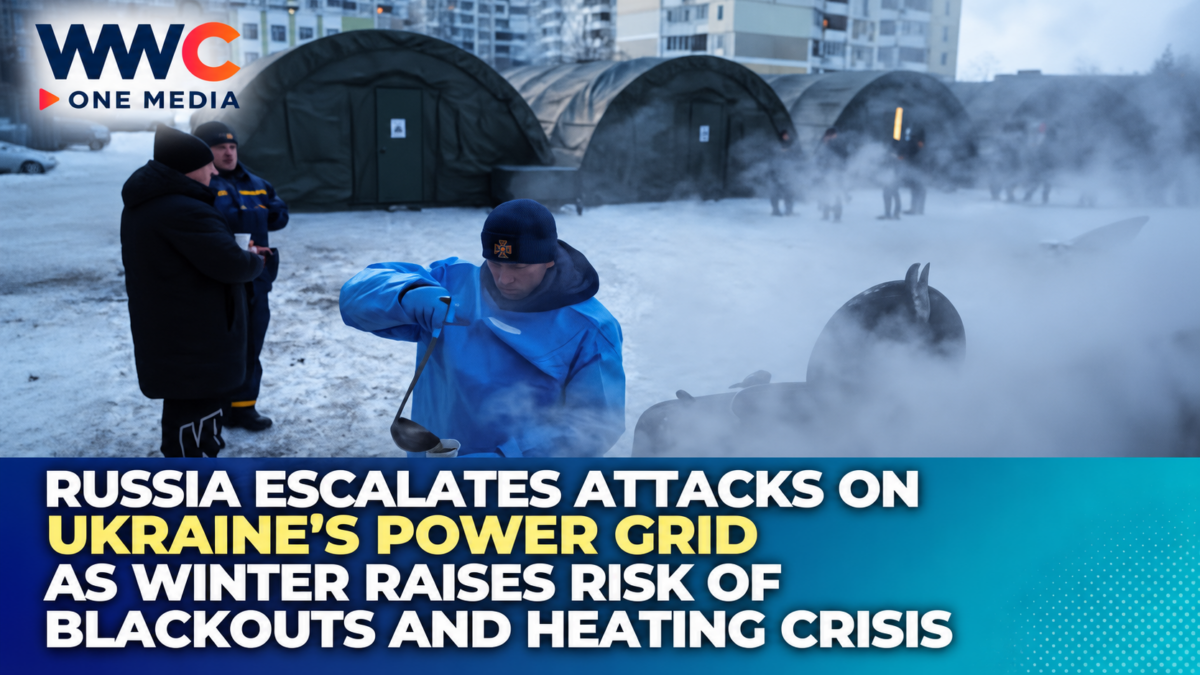
KYIV — Russia has sharply intensified attacks on Ukraine’s energy system just as colder weather approaches, hitting power infrastructure around Kyiv and other regions in one of the heaviest combined assaults on the grid in months and forcing emergency blackouts in the capital for the first time since spring.
The latest barrage has revived fears of another winter campaign aimed at weakening Ukraine not only on the battlefield, but also by disrupting the electricity, heating, water and transport systems civilians depend on every day.
Ukrainian officials said seven people were killed, including a child, during the September 30 attack, while critical infrastructure was damaged across multiple regions.
State grid operator Ukrenergo imposed emergency power cuts in Kyiv and three surrounding regions, highlighting how quickly damage to a limited number of energy sites can ripple through the wider system.
And with freezing nighttime temperatures approaching, the timing could hardly be worse.
RUSSIA LAUNCHES BIGGEST ENERGY ATTACK IN MONTHS
Russia used a large combination of drones and missiles in the attack.
Ukraine’s air force said it had intercepted 254 of 285 Russian drones deployed through early evening, while ballistic missiles were also launched.
A large number of the drones were reportedly jet-powered models, which are faster and more difficult for Ukraine’s cheaper interceptor systems to destroy.
Prime Minister Sergii Koretskyi said Russia had escalated to “massive” attacks on the country’s energy infrastructure and that there had been almost no day since summer without some form of strike on energy assets.
But he said the scale of this latest combined assault had not been seen since the end of the previous heating season.
KYIV SUFFERS POWER CUTS FOR FIRST TIME SINCE SPRING
The blackout impact was immediate.
Parts of Kyiv lost electricity.
Some trams and trolley buses stopped operating.
Water pressure also fell as pumping systems were affected by power disruptions.
Those disruptions illustrate why energy infrastructure is such a powerful wartime target.
Electricity does far more than keep lights on.
It also supports:
Water pumping
Public transport
Hospitals
Telecommunications
Food storage
Heating
and
Emergency services.
When the grid fails, several other systems can begin failing with it.
THIS COULD BE THE START OF ANOTHER WINTER ENERGY CAMPAIGN
Ukraine and its allies have been warning for months that Russia could again focus heavily on power infrastructure as temperatures fall.
Last winter, Russian attacks damaged electricity and heating networks during exceptionally cold weather.
Ukrainian Foreign Minister Andrii Sybiha accused Moscow of again trying to turn “cold, darkness and disruption” into weapons against civilians.
Russia says it targets military-related and energy facilities supporting Ukraine’s war effort and denies deliberately targeting civilians.
But strikes on power infrastructure inevitably have major civilian consequences.
That makes winter one of the most vulnerable periods for Ukraine.
WHY WINTER MAKES THE GRID SO MUCH MORE IMPORTANT
Electricity demand typically rises during colder months.
At the same time, homes and public buildings require reliable heating.
If power plants, substations or transmission equipment are damaged, the impact can become much more severe than during warmer seasons.
A major blackout during winter can mean:
Homes without heat
Frozen water systems
Hospitals relying on generators
Public transport failures
and
Businesses shutting down.
Ukraine has adapted after years of attacks by installing generators, batteries and decentralized energy systems.
But repeated damage continues to erode resilience.
UKRAINE IS SHORT OF AIR DEFENSE
One of Kyiv’s biggest problems is not simply repairing damaged energy assets.
It is preventing them from being hit again.
Ukraine has been asking Western allies for additional air-defense systems, especially Patriot interceptors, which can help destroy ballistic missiles.
But supply remains constrained.
Russia is also expanding its use of faster drones designed to overwhelm or evade cheaper defenses.
That creates an uncomfortable economic equation.
A relatively inexpensive Russian drone can force Ukraine to use a much more expensive interceptor.
If dozens or hundreds arrive at once, air defenses can become saturated.
RUSSIA IS USING NEWER JET-POWERED DRONES
Ukraine says many recent Russian attacks have included faster, higher-flying jet-powered drones.
These models are more difficult for conventional mobile anti-drone teams to intercept.
The September 30 attack included a particularly large number of these faster systems, according to Ukrainian reporting cited by Reuters.
That suggests Moscow is evolving its tactics.
The goal may not necessarily be to destroy every energy facility.
It can be enough to force Ukraine to spend scarce interceptors, repair damaged infrastructure repeatedly and keep large parts of the population under constant threat.
ATTACKS HAVE SPREAD BEYOND POWER STATIONS
Russia’s recent campaign has not been limited to energy infrastructure.
A school in Kyiv was struck on October 1, although more than 100 students reportedly escaped serious harm because they were sheltering during the attack.
The Southern Bridge across the Dnipro River was also hit, disrupting transport.
A nuclear research institute in Kyiv was struck as well, although no radiation threat was reported.
That broader pattern suggests Russia is targeting multiple systems that keep major cities functioning.
UKRAINE IS CHECKING BACKUP POWER SYSTEMS
In response, Ukraine’s government has ordered local authorities to review backup-power readiness at critical facilities.
That includes generators and other emergency power systems used by:
Hospitals
Water utilities
Government buildings
and
Communications infrastructure.
Ukraine has also spent months reinforcing energy sites with protective barriers and concrete structures.
The European Bank for Reconstruction and Development is helping finance some of those efforts.
EBRD IS FUNDING HARDENED ENERGY INFRASTRUCTURE
The EBRD said it expects to provide around €2.7 billion in financing to Ukraine in 2026, close to last year’s record level.
Energy infrastructure protection is one of its major priorities.
The bank is financing reinforced concrete shelters designed to protect critical Ukrenergo equipment from drones and missile fragments.
According to the EBRD, some of those structures have already demonstrated resilience during repeated attacks.
It is also supporting approximately 1.4 gigawatts of renewable-energy projects.
Decentralized renewable generation can make Ukraine less dependent on a smaller number of large power plants that are easier to target.
DECENTRALIZATION HAS BECOME A SURVIVAL STRATEGY
Ukraine’s energy system was historically built around large centralized power stations.
That model is efficient in peacetime.
In wartime, it creates vulnerability.
A single successful strike on a major plant or substation can remove large amounts of capacity.
Ukraine has therefore been moving toward smaller and more distributed sources such as:
Solar power
Wind
Gas generators
Battery storage
and
Local cogeneration.
These systems cannot fully replace large national power plants.
But they can make it harder for one attack to disable electricity across an entire city or region.
RUSSIA HAS ALREADY DESTROYED A LARGE SHARE OF UKRAINE’S ENERGY CAPACITY
Years of war have taken a heavy toll.
Ukraine has lost large amounts of thermal, hydroelectric and transmission infrastructure since Russia’s full-scale invasion began in February 2022.
Some major plants have been destroyed.
Others have been repeatedly damaged and repaired.
The result is a power system operating with far less spare capacity than before the war.
That makes each new strike more dangerous.
A grid with excess reserve can absorb failures.
A damaged grid operating close to its limits has much less room for error.
NUCLEAR POWER IS NOW EVEN MORE IMPORTANT
Ukraine relies heavily on nuclear generation.
Because many coal and gas plants have been damaged, the country’s remaining nuclear reactors provide a major share of dependable electricity.
That gives the transmission infrastructure surrounding those plants enormous strategic importance.
Damage to substations or high-voltage lines can force nuclear reactors to reduce output even if the reactors themselves are not hit.
This is one reason energy officials are especially worried about attacks on grid infrastructure surrounding nuclear facilities.
ZAPORIZHZHIA REMAINS OUT OF UKRAINE’S CONTROL
Ukraine’s largest nuclear facility, the Zaporizhzhia Nuclear Power Plant, remains under Russian occupation.
Its reactors are not generating normal commercial electricity for Ukraine.
That means the country cannot rely on what was once one of its most important sources of power.
The plant’s continuing loss adds pressure to the rest of Ukraine’s system.
UKRAINE IS HITTING RUSSIA’S ENERGY SYSTEM TOO
The energy war runs in both directions.
Ukraine has increasingly attacked Russian oil refineries and other energy infrastructure, seeking to reduce Moscow’s fuel production and war revenues.
Those attacks have contributed to damage at Russian refineries and disruptions in fuel exports.
Russia recently extended restrictions on diesel exports through October amid domestic supply concerns.
Kyiv argues that Russian energy infrastructure directly supports Moscow’s military effort.
The result is an increasingly intense energy conflict stretching far beyond the battlefield.
UKRAINIAN STRIKES ARE NOW AFFECTING GLOBAL FUEL MARKETS
Attacks on Russian refineries matter globally because Russia is one of the world’s biggest exporters of refined fuels.
When production drops, international diesel supplies tighten.
That has contributed to the current worldwide refining crunch and rising fuel prices.
So attacks in Ukraine and Russia can eventually affect:
European diesel prices
U.S. fuel markets
Shipping costs
and
Inflation worldwide.
The energy war is no longer contained within national borders.
MOLDOVA, POLAND AND ROMANIA ARE BEING PULLED INTO THE SECURITY RISK
The latest Russian attack also produced spillover beyond Ukraine.
Moldova said three drones crossed into its airspace.
NATO members Poland and Romania scrambled military aircraft, while flights at Polish airports in Lublin and Rzeszow were temporarily suspended.
That highlights another danger.
Large missile and drone barrages near NATO territory increase the risk of an accidental incident involving neighboring states.
KYIV’S DAILY LIFE IS BEING DISRUPTED
For Kyiv residents, the issue is no longer simply whether electricity disappears.
Repeated air-raid alerts and drone attacks are disrupting almost every aspect of ordinary life.
Schools move students into shelters.
Public transport pauses.
Businesses close temporarily.
Workers spend hours underground during alerts.
And residents frequently wake to explosions.
Reuters reported that around a dozen people had been killed in drone attacks in Kyiv over roughly a week leading up to the latest barrage.
That psychological pressure is part of the broader impact of the campaign.
POWER CUTS CAN ALSO DAMAGE UKRAINE’S ECONOMY
Energy shortages directly reduce economic output.
Factories cannot operate normally.
IT companies and offices depend on backup power.
Retailers lose refrigeration.
Manufacturers miss production targets.
The EBRD recently cut its 2026 Ukrainian growth forecast to 1.5% from 2.2%, citing increased uncertainty and the impact of continued Russian attacks.
The longer the energy disruption continues, the more difficult Ukraine’s economic recovery becomes.
INTERNATIONAL SUPPORT IS BECOMING MORE ABOUT INFRASTRUCTURE SURVIVAL
Western support for Ukraine is often discussed in terms of weapons.
But energy support is increasingly just as critical.
Ukraine needs:
Transformers
Generators
Turbines
Power cables
Grid equipment
Air defenses
and
Financing for repairs.
These systems allow cities to keep functioning even when strikes continue.
Europe has already provided large amounts of replacement equipment, but the repeated destruction means demand remains high.
REPAIR TEAMS ARE IN A CONSTANT RACE
Ukrainian engineers have become remarkably fast at restoring damaged power systems.
But every repaired facility remains vulnerable to another strike.
That creates an exhausting cycle:
Russia attacks
Ukraine repairs
Russia attacks again.
Replacement equipment such as high-voltage transformers can take months to manufacture.
Some components are also difficult to source because they were designed specifically for Soviet-era grid systems.
That makes repeated attacks particularly damaging over time.
THE REAL WINTER RISK IS CUMULATIVE DAMAGE
One single strike is unlikely to collapse Ukraine’s national energy system.
The bigger threat is cumulative.
If Russia repeatedly damages:
Generation
Transmission
Substations
Heating plants
and
Fuel infrastructure
over several months, Ukraine’s ability to repair everything simultaneously becomes much harder.
That is how a series of individual strikes can eventually create widespread blackouts.
THE BIGGER STORY: RUSSIA IS TURNING ENERGY INTO ANOTHER FRONT OF THE WAR
After more than four years of full-scale war, Ukraine’s power system has become a battlefield of its own.
Russia is trying to destroy or exhaust the infrastructure that keeps Ukrainian cities functioning.
Ukraine is trying to defend, repair and decentralize that system while simultaneously striking Russian energy assets.
The latest barrage shows that the winter energy war has already begun.
Kyiv has emergency generators.
Europe is providing money.
Engineers have become exceptionally experienced at restoring power.
But Ukraine is entering the cold season with less spare capacity, limited air-defense ammunition and an adversary using larger numbers of increasingly sophisticated drones.
That leaves the most important question unanswered:
Can Ukraine repair its power grid faster than Russia can damage it once winter temperatures arrive?