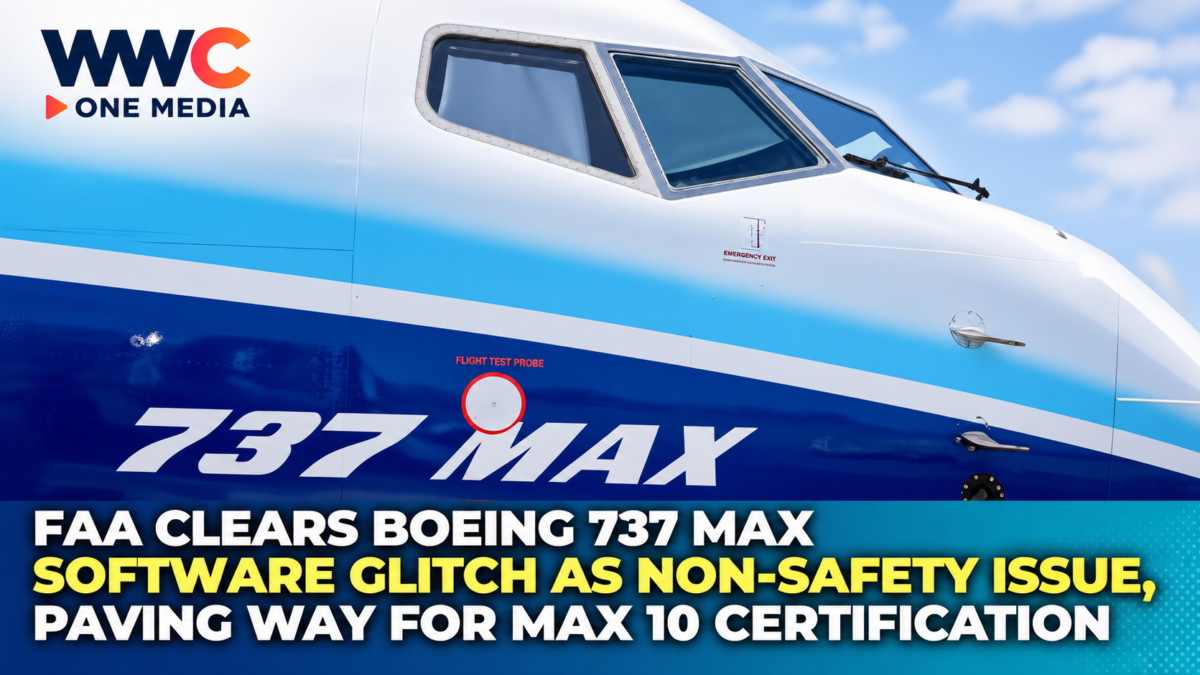
WASHINGTON — Boeing has cleared one of the biggest remaining obstacles facing its long-delayed 737 MAX 10 after U.S. aviation regulators concluded that a recently disclosed flight-management software glitch does not create an immediate flight-safety risk.
The U.S. Federal Aviation Administration completed a Corrective Action Review Board assessment and determined that pilots remain able to control the aircraft safely even if the affected automated navigation function becomes unavailable during a specific missed-approach scenario.
The finding is a major relief for Boeing because the FAA had temporarily paused certification of the 737 MAX 10, the largest member of Boeing’s best-selling MAX family, while regulators investigated the issue.
Certification could now potentially resume quickly, with Reuters reporting that approval could come as early as later in October 2026.
That would unlock deliveries of an aircraft for which Boeing has accumulated roughly 1,500 orders, making the software ruling important not only for the manufacturer but also for airlines including United, Alaska, Ryanair and other major customers planning fleet expansions around the MAX 10.
WHAT EXACTLY WENT WRONG?
The software issue involves Boeing’s updated flight management system, specifically a version known as U14/U14.1.
The problem can occur during an unusual landing scenario known as a missed approach.
A missed approach happens when pilots abandon a landing attempt—for example because weather, traffic or runway conditions make landing unsafe—and climb away to try again or divert.
Under certain conditions, if the crew modifies the published missed-approach route inside the flight management computer, the aircraft’s automatic Vertical Navigation, or VNAV, can disengage.
That means the aircraft may no longer automatically follow the expected vertical flight path.
Pilots then have to intervene manually or use alternative pitch-control modes.
FAA SAYS PILOTS REMAIN IN CONTROL
That distinction is central to the FAA’s decision.
The agency determined that the software anomaly does not remove the pilots’ ability to safely fly the aircraft.
Cockpit indications make the loss of automated vertical guidance apparent, allowing trained pilots to intervene.
U.S. Transportation Secretary Sean Duffy had already signaled before the formal review that the government did not view the issue as requiring the MAX fleet to be grounded.
Duffy compared the correction to a software update and said regulators did not see evidence of a broader flight-safety emergency.
That does not mean the glitch is being ignored.
Boeing is developing a permanent software correction, while the FAA is preparing additional guidance for operators.
THE FAA PLANS A SPECIAL AIRWORTHINESS BULLETIN
The regulator is expected to issue a Special Airworthiness Information Bulletin, or SAIB, to airlines and international aviation authorities.
Such bulletins alert operators to conditions regulators believe deserve attention even when they do not rise to the level requiring an emergency grounding or mandatory airworthiness directive.
Boeing is also preparing interim procedures pilots can follow until updated flight-management software becomes available.
That means the resolution will involve both:
A software fix
and
temporary operating guidance.
WESTJET FIRST DISCOVERED THE ISSUE IN 2024
One of the more surprising details is that the problem was not discovered in 2026.
Canadian airline WestJet first reported the anomaly to Boeing in 2024 during an entry-into-service validation flight.
Its pilots noticed the unusual behavior and provided Boeing with flight data documenting what had happened.
The issue later became particularly important because the newer software version is needed for Boeing’s latest 737 MAX variants.
The flaw had remained largely out of public view until late September 2026, when reports of the software problem emerged as Boeing approached MAX 10 certification.
WHY DID THE ISSUE SUDDENLY DELAY THE MAX 10?
Existing 737 MAX operators often have another option.
Boeing has been able to deliver some 737 MAX 8 and MAX 9 aircraft using an earlier flight-management software version that does not contain the newly identified anomaly.
But the MAX 10 relies on the newer software configuration.
That made the glitch more consequential for certification.
The FAA said September 28 that it would hold off approving the MAX 10 until regulators understood and resolved the issue.
Boeing shares dropped almost 7% after the delay became public, demonstrating just how much investors are counting on MAX 10 approval.
The latest FAA determination removes much of that uncertainty.
THE MAX 10 IS BOEING’S BIGGEST 737
The MAX 10 is the largest aircraft in the 737 MAX family.
Its larger fuselage allows airlines to carry more passengers than on the MAX 8 or MAX 9 while retaining the economics of a single-aisle aircraft.
That makes it especially attractive for high-density routes.
For Boeing, the aircraft is strategically crucial because it competes most directly with the enormously successful Airbus A321neo.
Airbus has dominated the upper end of the single-aisle market for years, and the MAX 10 is Boeing’s primary response.
Every additional certification delay therefore gives Airbus more time to extend that advantage.
AROUND 1,500 MAX 10 ORDERS ARE WAITING
Reuters says Boeing has roughly 1,500 MAX 10 aircraft on order.
Those orders represent tens of billions of dollars in future aircraft deliveries.
Customers include major airlines planning to use the aircraft to replace older jets and add capacity without moving to expensive widebody aircraft.
The MAX 10’s economics depend on carrying more passengers while keeping fuel burn and operating costs relatively low.
That is particularly valuable as airlines face higher fuel prices.
ALASKA AIRLINES ORDERED 105 MAX 10S THIS YEAR
One of Boeing’s biggest recent wins came from Alaska Airlines.
In January 2026, Alaska placed the largest aircraft order in its history, including:
105 Boeing 737 MAX 10s
with
options for another 35.
The order brought Alaska’s total 737 MAX backlog to 174 aircraft.
The airline plans to use the larger jets on high-demand routes as it expands its network.
For Alaska, further certification delays could complicate fleet planning.
That makes the FAA’s latest decision particularly significant.
RYANAIR HAS 150 FIRM MAX 10 ORDERS
Europe’s Ryanair is another critical customer.
The airline has a firm order for 150 MAX 10 aircraft, with options for another 150.
CEO Michael O’Leary said Ryanair still expects its first 15 MAX 10s in spring 2027 and had hoped the latest certification delay would last only days rather than months.
The MAX 10 is central to Ryanair’s long-term growth because the larger aircraft can carry more passengers while spreading fuel and crew costs across more seats.
Ryanair has previously said it expects the aircraft to become a core part of its fleet through the next decade.
UNITED IS ALSO DEPENDING ON THE AIRCRAFT
United Airlines has been one of the MAX 10’s most important U.S. customers.
The airline originally planned major fleet growth around the aircraft but has already had to adjust schedules repeatedly because certification took longer than Boeing expected.
Additional delays would force United and other carriers to rely more heavily on smaller MAX variants or alternative aircraft.
That creates higher fleet costs and capacity-planning challenges.
BOEING’S MAX 10 HAS ALREADY BEEN DELAYED FOR YEARS
The software issue is only the latest obstacle.
The MAX 10 originally had been expected to enter commercial service years earlier.
Certification was repeatedly pushed back by:
Stricter FAA scrutiny after the original MAX crashes
Engine anti-ice system redesign requirements
Flight-control reviews
Cockpit-alerting requirements
and
Manufacturing and quality-control problems.
The FAA has deliberately avoided committing to Boeing’s certification timelines.
Regulators have repeatedly said approval will occur only when all safety requirements are satisfied.
THE MAX 7 ONLY WON APPROVAL IN AUGUST
The smaller 737 MAX 7 finally received FAA certification on August 3, 2026, after years of delays.
The FAA said its review included extensive analysis of:
Flight controls
Human factors
Crew alerting
System safety
and
The redesigned engine anti-ice system.
The MAX 10 shares many of those systems.
That means much of the certification work had already been completed before the latest software problem emerged.
This is one reason approval could now move relatively quickly once the FAA accepts Boeing’s mitigation plan.
BOEING IS UNDER FAR MORE SCRUTINY THAN BEFORE
Any software issue involving the MAX inevitably attracts attention because of the aircraft family’s history.
Two crashes involving earlier MAX aircraft—Lion Air Flight 610 and Ethiopian Airlines Flight 302—killed 346 people in 2018 and 2019.
Investigations identified problems involving Boeing’s MCAS flight-control system, pilot information, certification processes and regulatory oversight.
The global MAX fleet was grounded for about 20 months.
The FAA eventually required multiple design changes before allowing the aircraft to return to service, including new flight-control software, additional cockpit alerts and revised pilot procedures.
That history explains why regulators are extremely cautious whenever a new MAX software issue appears.
THIS GLITCH IS NOT MCAS
It is important not to confuse the current software problem with the MCAS system involved in the earlier crashes.
The newly identified glitch concerns the flight-management system and automated vertical navigation during a specific missed-approach scenario.
The FAA says pilots retain control of the aircraft and receive clear cockpit indications.
There is no evidence from the regulator’s review that the condition produces the type of uncontrolled flight-control behavior associated with the earlier MCAS accidents.
That distinction is essential for accurate reporting.
BOEING HAS ALSO FACED MANUFACTURING PROBLEMS
Software certification is only one part of Boeing’s broader recovery.
The company has spent the past several years addressing manufacturing-quality problems after the January 2024 Alaska Airlines 737 MAX 9 door-plug blowout.
The FAA intensified oversight of Boeing production following that incident.
In September 2025, the regulator proposed more than $3.1 million in fines against Boeing, citing hundreds of quality-system violations and other alleged safety shortcomings.
That period significantly changed the relationship between Boeing and its regulator.
FAA ONLY RECENTLY GAVE BOEING BACK MORE CERTIFICATION AUTHORITY
There are signs of improvement.
In July 2026, the FAA allowed Boeing to resume issuing airworthiness certificates for all newly produced 737 MAX and 787 aircraft after months of additional oversight.
The regulator said eight months of data demonstrated consistent improvements in production quality.
That was an important milestone.
It showed that the FAA had regained some confidence in Boeing’s manufacturing controls.
But the agency also said inspectors would remain closely involved.
BOEING JUST AVOIDED ANOTHER POTENTIAL SETBACK
The certification program received another piece of good news this week.
Around 17,000 Boeing engineers, scientists, designers and technical workers approved a new four-year labor agreement on October 1, averting a potential strike that could have begun October 7.
Those employees work directly on programs including:
737 MAX 10
and
777X.
A strike could have slowed certification and engineering work even if the FAA had cleared the software issue.
The labor agreement therefore removes another major near-term risk.
MAX 10 APPROVAL COULD NOW COME THIS MONTH
Reuters reported that certification could potentially occur later in October, assuming Boeing completes remaining work and the FAA is satisfied.
That would mark one of Boeing’s most important certification milestones in years.
It would allow the company to begin preparing the first customer deliveries.
But certification and delivery are separate steps.
Aircraft still need to be manufactured, inspected, configured for customers and individually cleared for service.
Airlines therefore may not receive large numbers immediately after approval.
THE SOFTWARE FIX STILL MATTERS
The FAA’s ruling does not mean Boeing can simply forget the glitch.
The manufacturer still has to update the software and make sure every affected configuration operates correctly.
Airlines also need clear procedures for handling the issue before the permanent update reaches the fleet.
For Boeing, execution matters.
The company needs to demonstrate that it can resolve the software problem without creating another delay—or introducing an unexpected secondary issue.
WHY THE MAX 10 MATTERS SO MUCH TO BOEING
Boeing’s commercial-aircraft recovery depends heavily on the 737 family.
The MAX 10 gives it a product capable of carrying substantially more passengers than the MAX 8 while remaining within the single-aisle category airlines use on thousands of short- and medium-haul routes.
Without the MAX 10, Boeing has a much weaker answer to Airbus’s A321neo and A321XLR.
That affects:
Aircraft sales
Market share
Cash flow
Airline relationships
and
Boeing’s broader financial recovery.
So while the software problem may look technically narrow, its commercial implications are enormous.
THE BIGGER STORY: THE FAA SAID IT ISN’T A SAFETY CRISIS — BUT BOEING STILL HAS SOMETHING TO PROVE
The FAA’s latest finding gives Boeing exactly what it needed:
regulators do not consider the flight-management glitch an immediate safety threat.
That should allow the MAX 10 certification process to restart without another lengthy redesign.
But the episode is also a reminder of Boeing’s changed regulatory environment.
A software anomaly discovered by one airline two years earlier was enough to stop certification of Boeing’s most important new narrowbody aircraft while regulators conducted a formal safety review.
That level of scrutiny reflects the lessons of the MAX crisis.
For Boeing, clearing the glitch is therefore only one milestone.
The much bigger objective is proving that the world’s most closely watched aircraft manufacturer can deliver a new MAX variant safely, predictably and without another last-minute surprise.