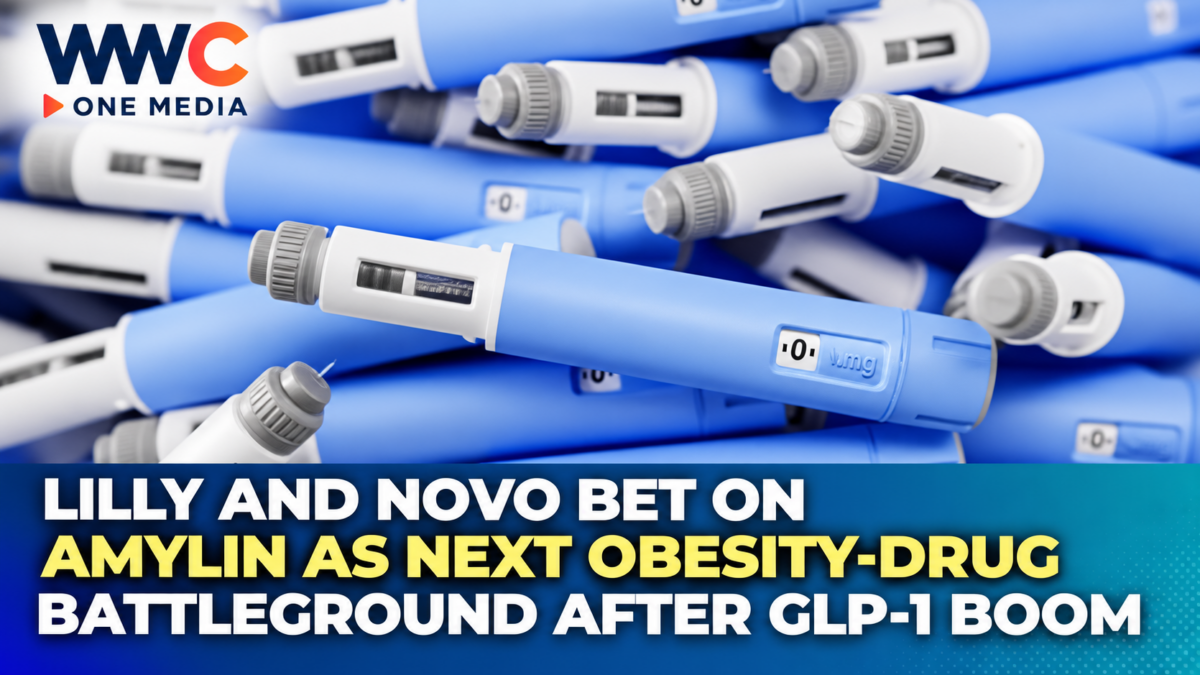
NEW YORK/COPENHAGEN — Eli Lilly and Novo Nordisk are racing toward the next major frontier in obesity treatment, betting that a hormone called amylin could push weight loss beyond today’s blockbuster GLP-1 drugs and potentially reshape a market that analysts expect could eventually generate more than $100 billion a year.
The emerging strategy is not necessarily to replace drugs such as Zepbound, Mounjaro, Wegovy and Ozempic.
Instead, pharmaceutical companies are increasingly testing whether amylin-based medicines can work alongside GLP-1 or GIP drugs to suppress appetite more strongly, improve metabolic health and offer another option for patients who do not get enough benefit from existing therapies.
The approach received a major boost this week when Eli Lilly reported that its experimental combination EloraTZP produced substantially greater weight loss than high-dose tirzepatide alone in a mid-stage clinical trial.
But the results also came with an important warning:
more weight loss was accompanied by more treatment discontinuations and gastrointestinal side effects.
WHAT IS AMYLIN?
Amylin is a naturally occurring hormone released by the pancreas after eating, alongside insulin.
It helps regulate:
Appetite
Fullness
Food intake
and aspects of blood-sugar control.
Amylin-receptor agonists are designed to mimic or activate those biological signals, potentially helping patients feel full sooner and eat less.
That makes amylin different from GLP-1 drugs, even though the two systems can complement each other.
The pharmaceutical industry’s emerging idea is simple:
if one hormone pathway already produces major weight loss, combining it with another appetite-regulating pathway may push results even further.
LILLY’S NEW COMBINATION PRODUCED 23.3% WEIGHT LOSS
The strongest new evidence came from Lilly.
Its experimental treatment EloraTZP combines:
Eloralintide, a selective amylin-receptor agonist,
with
Tirzepatide, the GIP/GLP-1 drug used in Zepbound and Mounjaro.
In a Phase 2b trial involving 367 adults with obesity or overweight and Type 2 diabetes, the highest-dose combination produced an average 23.3% reduction in body weight over 48 weeks.
Patients receiving tirzepatide alone at 15 milligrams lost an average 14.8%.
That translates into an average reduction of about:
54.1 pounds with EloraTZP
versus
34.4 pounds with tirzepatide alone.
For patients with Type 2 diabetes, those figures are particularly notable because people with diabetes generally lose less weight on obesity drugs than people without the condition.
BLOOD-SUGAR CONTROL ALSO IMPROVED
The combination did more than reduce weight.
Patients taking EloraTZP lowered their A1C by as much as 2.9 percentage points, compared with around 2.4 percentage points for tirzepatide alone.
A1C measures average blood sugar over several months and is one of the key indicators used in diabetes treatment.
That means Lilly is trying to develop the combination as both an obesity and metabolic-disease treatment rather than simply a weight-loss injection.
BUT SIDE EFFECTS ARE THE BIG QUESTION
The results came with a significant drawback.
Treatment discontinuation rates in the combination groups reached as high as 27%, largely because of gastrointestinal side effects during dose escalation.
Typical side effects associated with this broader class of medicines include:
Nausea
Vomiting
Diarrhea
and
Constipation.
Lilly believes different dosing schedules could improve tolerability in future studies.
But that remains to be proven.
This is one reason the Phase 2 findings should not be interpreted as proof that EloraTZP will ultimately become superior to currently approved treatments.
PHASE 3 TRIALS ARE NEXT
Lilly plans to begin Phase 3 trials of EloraTZP in the fourth quarter of 2026.
Those studies will involve larger groups of patients and provide stronger evidence on:
Weight-loss effectiveness
Side effects
Treatment discontinuation
Blood-sugar control
and
Longer-term safety.
Eloralintide itself is also being tested as a standalone once-weekly obesity treatment.
It remains experimental and has not yet been approved for routine obesity treatment.
NOVO NORDISK IS ALREADY DEEP INTO THE AMYLIN RACE
Lilly is not entering an empty field.
Novo Nordisk has spent years developing its own amylin-based obesity treatments.
Its leading candidate is CagriSema, a once-weekly combination of:
Cagrilintide, an amylin analogue,
and
Semaglutide, the GLP-1 ingredient used in Wegovy and Ozempic.
Novo filed for the first U.S. regulatory approval of CagriSema in late 2025 and has continued running extensive Phase 3 programs across obesity and Type 2 diabetes.
CAGRISEMA HAS ALREADY SHOWN 20%+ WEIGHT LOSS
In Novo’s earlier REDEFINE 1 obesity trial, CagriSema produced average weight loss of 22.7% after 68 weeks among patients who adhered to treatment, compared with 2.3% with placebo.
More than 40% of participants achieved at least 25% weight loss.
In a later head-to-head trial, CagriSema produced about 23% weight loss over 84 weeks, but it failed to meet the study’s primary statistical goal of demonstrating non-inferiority to tirzepatide.
That result was viewed as a disappointment because Novo had hoped to show its combination could match or beat Lilly’s tirzepatide.
NOVO HAS SINCE PRODUCED MORE ENCOURAGING DATA
More recent results have helped restore some momentum.
Novo reported in September that lower-dose CagriSema produced 12.4% weight loss versus 9.1% for tirzepatide 5 mg in adults with Type 2 diabetes in the REIMAGINE 5 trial.
The company also said another study showed 21% weight loss versus placebo in adults with overweight or obesity.
These different trials used different patient groups, doses and comparators, so the percentages should not be compared directly across studies.
But collectively they suggest that amylin-based combinations can produce substantial weight loss.
CAGRISEMA MAY ALSO CHANGE HOW THE BRAIN RESPONDS TO FOOD
Novo is trying to show that the value of amylin goes beyond the number on the scale.
At the European Association for the Study of Diabetes meeting, the company presented research suggesting CagriSema changed brain responses to high-calorie foods in regions associated with:
Cravings
Reward
and
Self-control.
Novo also reported reductions in harmful fat around organs such as the liver and pancreas.
The company said early findings suggested bone health was preserved despite substantial weight loss.
These findings remain part of ongoing research, but they highlight how obesity-drug competition is shifting beyond total kilograms lost.
THE NEXT WAR MAY BE ABOUT QUALITY OF WEIGHT LOSS
That shift is becoming increasingly important.
Some patients using powerful weight-loss drugs lose not only fat but also lean tissue, including muscle.
The next generation of obesity drugs may therefore be judged on questions such as:
How much fat is lost?
How much muscle is preserved?
What happens to the liver and heart?
Does physical function improve?
How sustainable is the treatment?
Recent research presented at the same European diabetes meeting showed pharmaceutical companies increasingly competing on those broader health outcomes rather than weight alone.
AMYLIN COULD ALSO OFFER AN OPTION WITHOUT GLP-1
Another major opportunity is amylin as a standalone treatment.
Some patients cannot tolerate GLP-1 drugs or do not want them.
An effective amylin-only medicine could provide another pathway.
Lilly’s eloralintide is specifically designed as a selective amylin receptor agonist, targeting the AMY1 receptor rather than combining several incretin mechanisms inside a single molecule.
Other drugmakers are pursuing similar approaches.
That could eventually produce a market where doctors choose among multiple biological mechanisms instead of relying overwhelmingly on GLP-1s.
OTHER DRUGMAKERS ARE JOINING THE RACE
The obesity market is expanding far beyond Lilly and Novo.
Companies including:
Roche
Amgen
Pfizer
Merck
Viking Therapeutics
Boehringer Ingelheim
and
AstraZeneca
are developing obesity treatments using different combinations of hormones, pills and injections.
Some are trying to improve weight loss.
Others are trying to reduce side effects.
Others are focused on monthly injections or oral treatments that are easier for patients to use.
That creates an increasingly crowded competitive landscape.
PILLS COULD CHANGE THE MARKET TOO
Amylin is only one part of the next phase.
Novo Nordisk believes oral obesity medicines could eventually represent as much as 50% of the weight-loss drug market by 2030.
Its Wegovy pill has already gained strong early prescription share.
Lilly is also pushing oral treatments through drugs such as Foundayo, while both companies continue developing injectable therapies.
The future market may therefore divide into several categories:
Weekly injections
Daily pills
Amylin drugs
GLP-1 combinations
and potentially
Longer-acting treatments requiring less frequent dosing.
RETATRUTIDE ADDS ANOTHER THREAT TO THE COMPETITION
Lilly also has another powerful experimental treatment called retatrutide.
The drug targets three hormone pathways:
GLP-1
GIP
and
Glucagon.
Lilly has reported substantial late-stage weight loss with retatrutide, giving the company multiple next-generation candidates beyond Zepbound.
That means Novo is not only competing against Lilly’s current tirzepatide franchise.
It is competing against an entire pipeline of new mechanisms.
THE MARKET COULD REACH $100 BILLION TO $150 BILLION
The financial prize is enormous.
Analysts cited by Reuters expect the global obesity-drug market could eventually generate $100 billion to $150 billion in annual sales by around 2030.
That makes obesity one of the biggest pharmaceutical opportunities in decades.
Millions of patients remain untreated.
Others cannot tolerate current medicines.
Still others stop treatment because of price, side effects or inconvenience.
Every improvement in:
effectiveness
tolerability
dosing
or
cost
could unlock another large group of patients.
LILLY HAS ALREADY TAKEN MOMENTUM FROM NOVO
Novo Nordisk pioneered the modern GLP-1 obesity boom through Wegovy and Ozempic.
But Lilly has increasingly challenged—and in some parts of the market overtaken—Novo with tirzepatide products such as Zepbound and Mounjaro.
That has forced Novo to accelerate its pipeline.
CagriSema, higher-dose semaglutide, oral Wegovy, amylin candidates and other next-generation treatments are all part of its response.
The competition is therefore becoming less about one blockbuster medicine and more about who can build the strongest portfolio.
THE NEXT OBESITY DRUG MAY NOT BE ONE DRUG AT ALL
The new results point toward an important possibility.
Future obesity therapy may increasingly involve combinations tailored to different patients.
One person might respond well to GLP-1 alone.
Another could receive GLP-1 plus amylin.
Another might prefer a pill.
Another might require a triple-hormone drug.
That would make obesity treatment look more like other major chronic diseases, where several drug classes are available and treatment is individualized.
BUT MORE WEIGHT LOSS IS NOT AUTOMATICALLY BETTER
There is also a limit to the race for bigger percentages.
Clinical researchers increasingly emphasize that the goal of obesity treatment is better health—not simply the largest possible drop in body weight.
A treatment producing 25% weight loss may not necessarily be preferable if it causes:
more severe side effects
high discontinuation rates
greater muscle loss
or
poor long-term adherence.
That is why future trials will increasingly examine cardiovascular health, liver disease, mobility, bone health and other outcomes.
COST WILL STILL BE A MAJOR BARRIER
Even if amylin medicines prove highly effective, access remains another problem.
Current branded obesity drugs can be expensive without insurance coverage.
Global access is also uneven.
New combination therapies involving multiple active ingredients could potentially be even more costly to manufacture and prescribe.
Drugmakers therefore have to solve two different problems:
Can the medicines work better?
and
Can enough patients actually afford them?
THE BIGGER STORY: GLP-1 MAY HAVE STARTED THE REVOLUTION — BUT IT MAY NOT FINISH IT
Wegovy and Zepbound fundamentally changed expectations for medical weight loss.
Losing 15% or 20% of body weight with medication would once have seemed extraordinary.
Now pharmaceutical companies are asking whether combining multiple appetite and metabolic pathways can push those numbers even higher.
Amylin is emerging as one of the leading candidates.
Lilly’s new EloraTZP data show how powerful that approach could become.
Novo’s CagriSema program shows the same biological strategy can work through a different combination.
But neither company has solved the central trade-off yet.
More powerful medicines can mean more side effects.
And dramatically higher weight loss means little if patients cannot tolerate, access or remain on treatment.
The obesity-drug race is therefore moving beyond one question:
“How much weight can this drug help people lose?”
The next question may matter even more:
“How much more can patients lose without making the treatment harder to live with?”