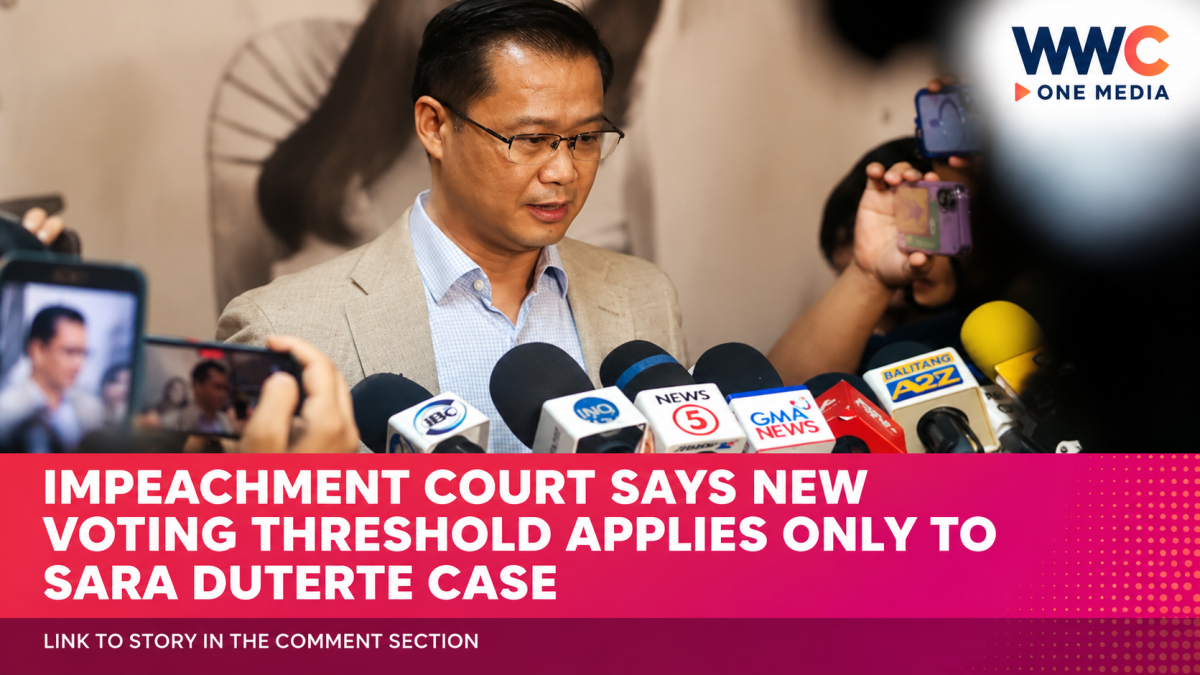
The Senate Impeachment Court has clarified that its revised formula for determining the number of votes needed to convict Vice President Sara Duterte applies only to her ongoing impeachment trial and does not establish a binding rule for future impeachment cases.
The clarification came a day after senator-judges voted 13-1 to overturn an earlier ruling that required 16 votes, or two-thirds of the full 24-member Senate, for a conviction. Six senator-judges did not participate in the threshold vote.
Under the new interpretation, the constitutional requirement of a two-thirds vote remains unchanged. What changes is the group of senators counted in calculating that two-thirds threshold. The court ruled that senators who are legally and factually unable to participate in the proceedings may be excluded from the denominator.
The court’s ruling does not establish a permanent numerical threshold. Instead, the number of votes required for conviction will be determined at the time of the final judgment, after the court establishes which senator-judges remain legally and factually capable of participating.
For example, if 20 senator-judges are ultimately determined to be eligible to participate, two-thirds would be 13.33, meaning 14 votes would be required for conviction. Under the previous calculation based on all 24 senators, 16 votes were required.
The ruling also identified circumstances that could justify excluding a senator from the calculation, including detention, suspension or other legal restrictions, physical or medical incapacity, being beyond the Senate’s coercive authority, or similar circumstances. The court will determine whether any senator falls into these categories based on sufficient evidence at the time of the vote.
House prosecutors welcomed the clarification but stressed that the change should not be interpreted as an indication of how the impeachment trial will ultimately end. Lead prosecutor Gerville Luistro said the threshold ruling concerns procedure, while the prosecution still has to present evidence supporting the impeachment allegations.
The threshold decision followed arguments from both the prosecution and defense and consultations with retired Supreme Court justices who participated as amici curiae. Presiding officer Francis Escudero opposed the change but said he would implement the court’s decision.
The ruling has also prompted legal challenges and renewed debate over how the constitutional phrase requiring two-thirds of “all the Members of the Senate” should be interpreted. A petition has been filed before the Supreme Court seeking to challenge the Senate court’s revised threshold ruling.
The impeachment trial itself will continue, with prosecutors expected to resume presenting witnesses and documentary evidence. The threshold ruling settles the immediate procedural question for Duterte’s case, but the senator-judges will still have to evaluate the evidence before reaching a final verdict.