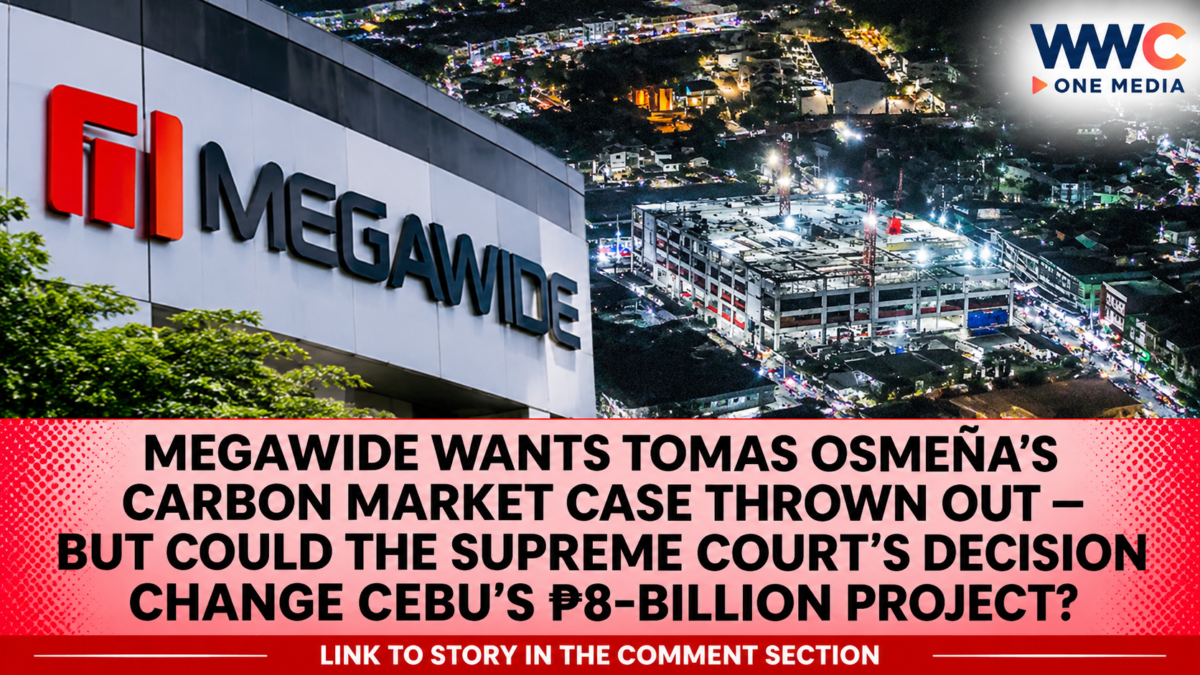
The legal battle over Cebu City’s massive Carbon Public Market redevelopment has reached another critical stage after Megawide Construction Corp. and its subsidiary asked the Supreme Court (SC) to dismiss Vice Mayor Tomas Osmeña’s petition challenging the legality of the controversial project.
In a 52-page comment submitted to the Supreme Court’s Second Division, Megawide, Cebu2World Development Inc. (C2W) and C2W chief executive officer Louie Ferrer urged the High Court to uphold the dismissal of Osmeña’s case by the Cebu City Regional Trial Court (RTC) Branch 58.
The developers argued that Osmeña’s petition raises substantially the same legal issues already being examined in an earlier lawsuit filed by market vendors and taxpayers in 2021. They invoked the legal principle of litis pendentia, which generally prevents separate cases involving substantially identical parties, issues and requested reliefs from proceeding simultaneously when an earlier case remains pending.
The latest filing adds another chapter to the dispute surrounding the redevelopment of one of Cebu City’s most important public markets—a project that has drawn attention over its financial terms, the selection of its private-sector partner, land ownership questions and the future of thousands of vendors.
The developers are also asking the Supreme Court to reject Osmeña’s request for a permanent injunction that would stop the redevelopment. SunStar Publishing Inc.+1
Why Megawide Wants Osmeña’s Petition Dismissed
At the center of Megawide’s argument is the existence of an earlier lawsuit filed in August 2021 by market vendors, vendors’ associations, urban poor organizations and taxpayers.
The case, pending before Cebu City RTC Branch 16, is commonly referred to as the Carbon case. It challenges the joint venture agreement (JVA) between the Cebu City Government and Megawide, including questions about the legality of the redevelopment, the selection of the private partner, the city’s authority over properties covered by the project and concerns about vendor displacement.
Megawide maintains that Osmeña’s petition seeks substantially the same outcome: the invalidation of the agreement.
The company argues that allowing both cases to continue could result in conflicting court decisions involving the same redevelopment project.
The developers also cited a third lawsuit filed in October 2025 by community members before RTC Branch 18. According to their submission, that case challenges zoning and land-use measures and certain legislative actions connected to the redevelopment.
These arguments are part of the developers’ position before the Supreme Court. They do not mean the High Court has already agreed that Osmeña’s petition must be dismissed. SunStar Publishing Inc.+1
How Osmeña’s Carbon Market Case Reached the Supreme Court
Osmeña originally questioned the legality and constitutionality of the Carbon Market joint venture agreement in a case filed before Cebu City RTC Branch 58 in 2022.
His challenge raised questions about whether the city government had sufficient legal authority to enter into the agreement and whether the required procedures had been followed.
The case experienced procedural setbacks. The original petition was dismissed in January 2023 because it was unsigned, but the court later allowed an amended petition to be filed in June 2023.
In July 2024, the RTC denied Osmeña’s application for a preliminary injunction, which sought to temporarily stop the redevelopment while the legal dispute was being resolved.
The court subsequently dismissed the case in November 2025. Osmeña challenged that outcome before the Supreme Court through a petition for review on certiorari filed on January 16, 2026.
The Supreme Court issued a resolution on July 14, 2026, directing the respondents to answer Osmeña’s petition and application for injunctive relief. Megawide said it received the resolution on September 21 and later obtained an extension to file its comment by October 31.
The developers’ latest submission is their response to that Supreme Court directive. The High Court’s eventual action will determine whether Osmeña’s challenge proceeds or is dismissed on the grounds raised by the respondents. The Freeman+1
The ₱8-Billion Carbon Market Project and the ₱50-Million Annual Payment Dispute
One of the biggest issues raised by Osmeña concerns the financial arrangement between the Cebu City Government and the private developer.
The redevelopment originally carried an estimated project value of ₱5.5 billion. A supplemental agreement signed in 2022 increased the reported project value to approximately ₱8 billion.
Osmeña has questioned the city’s guaranteed annual payment of ₱50 million under the agreement. He previously compared that amount with the approximately ₱58 million reportedly generated by the market in 2021.
He has argued that the financial terms could place the city at a disadvantage, particularly if the market could generate greater revenue under a different arrangement.
The developers, however, maintain that the joint venture was entered into legally and in accordance with applicable local laws and procedures.
The comparison between the reported 2021 market revenue and the guaranteed annual payment is an argument raised in the dispute. It does not, by itself, establish the full financial value of the agreement, which would require examining its complete terms, obligations, costs and revenue arrangements.
For taxpayers, the central question remains whether the agreement provides Cebu City with a fair and sustainable return while ensuring that the public market continues to serve its intended purpose. SunStar Publishing Inc.+1
Developers Defend the Bidding and Selection Process
Megawide also challenged allegations that the joint venture selection process was irregular.
In its Supreme Court comment, the company outlined the timeline of its proposal and the city government’s evaluation:
- October 11, 2019: Megawide submitted an unsolicited proposal to redevelop Carbon Public Market and nearby areas.
- March 2020: The city’s Joint Venture Selection Committee accepted the proposal for evaluation.
- September and October 2020: The city published invitations for other interested parties to submit competing proposals.
- January 6, 2021: The Cebu City Council authorized then-Mayor Edgardo Labella to sign the joint venture agreement.
- January 11, 2021: The agreement was finalized.
The developers said a competing submission was found non-compliant and that the selection process followed Cebu City Ordinance No. 2154 and applicable provisions of the Local Government Code.
They also argued that the agreement is a contractual joint venture under the city ordinance, rather than a build-operate-transfer arrangement governed by Republic Act No. 6957, as amended by Republic Act No. 7718.
These are the respondents’ legal arguments, and their validity remains subject to judicial review. SunStar Publishing Inc.+1
Land Ownership and City Authority Remain Major Legal Questions
Another major issue involves the properties included in the redevelopment.
Osmeña has questioned whether the Cebu City Government had the authority to include all the properties covered by the agreement, particularly areas allegedly belonging to the national government or involving the Cebu Port Authority.
The developers countered that questions about land ownership, property classification and valuation require evidence and should be examined through appropriate proceedings.
They argued that disputes involving particular parcels of land do not automatically invalidate the entire joint venture agreement.
This distinction is important because the Carbon redevelopment covers a complex area involving public-market operations, adjoining properties and questions about the legal authority of different government entities.
The Supreme Court is being asked to determine the legal issues raised in Osmeña’s petition, not to automatically treat every allegation about the project as an established fact.
Thousands of Vendors Have a Stake in the Outcome
The legal dispute is not simply about a contract between the city government and a private company. It also affects the people who depend on Carbon Market for their livelihoods.
Previous reports have highlighted concerns among vendors about possible displacement, stall arrangements, rental costs and the disruption that redevelopment could bring to established businesses.
WWC ONE MEDIA previously reported that Carbon Market vendors requested a March 2027 transfer to the new facility rather than moving during the busy Christmas, Sinulog and Valentine’s Day trading periods.
Read more: Carbon Market Vendors Ask to Move to New Facility in March.
The proposed transfer illustrates how the redevelopment affects everyday commercial activity, not just construction schedules. For vendors, the location of their stalls, access to customers and the cost of operating in the new facility could determine whether their businesses remain viable.
Another WWC ONE MEDIA report covered the arrest of two men accused of collecting ₱50,000 in exchange for a Carbon Market stall, highlighting the need for vendors to verify stall-allocation arrangements directly with authorized city offices.
Read more: 2 Arrested in ₱50,000 Carbon Market Stall Deal in Cebu.
The case is separate from the Supreme Court dispute, but it underscores the importance of transparent vendor allocation and safeguards against unauthorized transactions.
Construction Continues While the Legal Battle Moves Forward
Despite the pending legal challenges, redevelopment work at Carbon Public Market continues.
The project is intended to modernize the historic market and provide upgraded facilities for vendors and shoppers. However, its implementation remains under scrutiny because of the competing claims about the agreement’s legality, financial terms and impact on existing market communities.
The developers have opposed a permanent injunction, arguing that the Supreme Court should not resolve factual disputes—such as land valuation, financial arrangements and vendor relocation—as though it were a trial court.
They also maintain that a permanent injunction should not be granted without a full trial establishing a clear legal right that requires protection.
Separately, RTC Branch 16 denied the vendors’ request for a temporary restraining order in the earlier Carbon case on April 23, 2026. That ruling is distinct from the legal questions now raised in Osmeña’s Supreme Court petition. SunStar Publishing Inc.+1
Why the Supreme Court’s Decision Could Have Major Consequences for Cebu
The Supreme Court’s handling of Osmeña’s petition could have significant implications for the future of the Carbon redevelopment.
If the Court dismisses the petition on procedural grounds, Osmeña’s particular challenge could end without the High Court resolving every substantive allegation he raised. That would not automatically mean that all other lawsuits challenging the project would also be dismissed.
If the Court allows the petition to proceed, the legal questions surrounding the joint venture could receive further examination. Any decision on the merits could influence how the agreement is implemented and how the city’s authority over the project is assessed.
The separate 2021 Carbon case also remains important because it involves market vendors, organizations and taxpayers challenging the same redevelopment agreement.
For Cebu City residents, the broader issue is accountability: whether a major public-market redevelopment can modernize an important commercial landmark while protecting public interests, vendor livelihoods and the city’s financial position.
WWC ONE MEDIA has also examined other major decisions and development proposals involving Cebu City, including the city’s efforts to address infrastructure and public-service concerns.
Related reports:
- Cebu City Names Acting Little Mayor as City Hall Administration Faces Fresh Questions
- Private Firm Pitches ₱470-Million Waste Processing System to Cebu City
These developments reflect the wider responsibility facing Cebu’s local government as it manages public assets, private-sector partnerships and projects that directly affect residents.
The Bigger Question Is Who Ultimately Benefits From Carbon’s Redevelopment
Megawide and Cebu2World are asking the Supreme Court to dismiss Osmeña’s petition, arguing that it duplicates issues already pending before another court and that the joint venture complied with applicable laws.
Osmeña’s challenge, meanwhile, raises questions about the city’s authority, the financial terms and the legal basis of the redevelopment.
Neither side’s position should be mistaken for a final ruling. The Supreme Court has yet to decide the merits of the petition or grant the requested permanent injunction based on the information reported in the latest filing.
As construction continues and the legal proceedings move forward, Cebu residents and thousands of market vendors are watching closely.
The outcome could shape not only the future of Carbon Public Market but also the standards of transparency, public accountability and vendor protection expected from major public-private development projects.