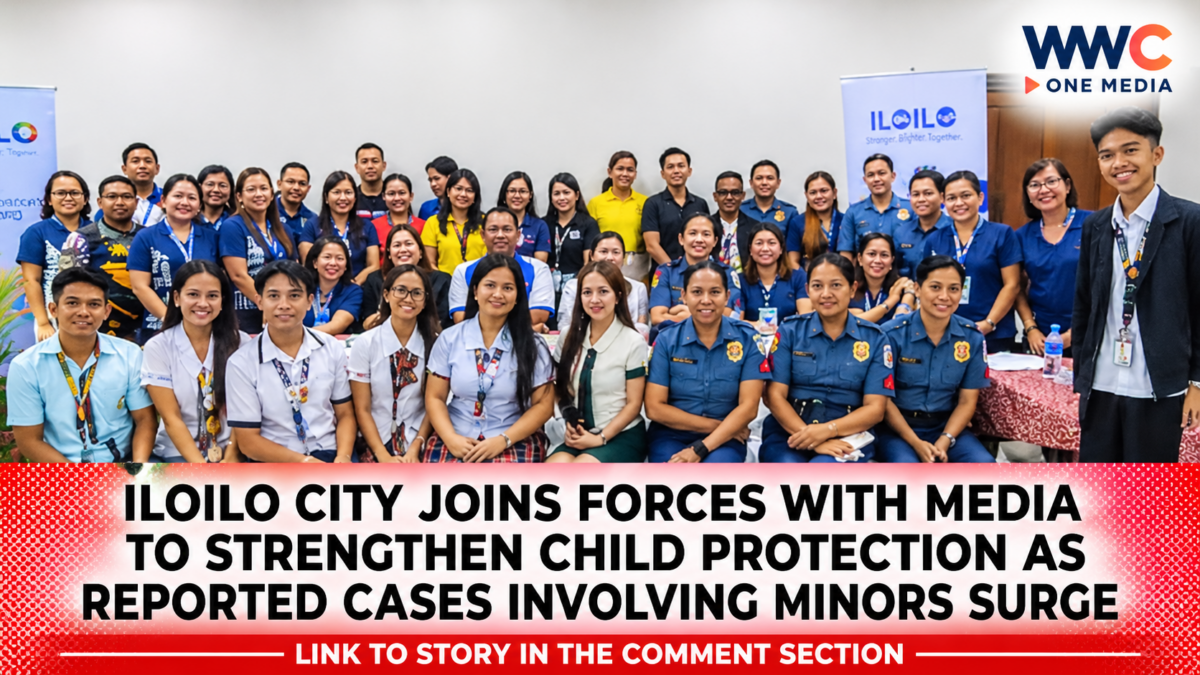
Iloilo City is calling for stronger cooperation between government agencies, law enforcement, social workers and journalists to protect children from abuse, exploitation and other threats, as newly presented figures reveal a sharp increase in reported cases involving children at risk and children in conflict with the law.
The call was highlighted during the 2026 National Children’s Month Media Forum on Child Protection, where city officials and members of the Iloilo City Hall Press Corps discussed existing child-welfare programs, police interventions and the responsibility of media practitioners when reporting cases involving minors.
The forum, held on November 9, carried the theme “Manindigan, Tumugon at Kumalinga: Sa Batang Handa, Mas Ligtas ang Bansa.”
Beyond presenting government programs, the gathering focused on an important issue: how to report crimes and incidents involving children without exposing their identities, compromising investigations or causing further harm to victims.
Councilor Frances Grace Parcon, chairperson of the City Council Committee on Women, Children, and Family, also invited media practitioners to participate in an upcoming committee hearing as the city works to update its Children’s Code.
The proposed revisions include broader recognition of fathers and father figures in child-rearing and family protection, as well as provisions addressing the accountability of media practitioners who violate existing laws and guidelines on reporting cases involving children. SunStar Publishing Inc.+1
Reported Cases Involving Children at Risk Jump From 615 to 1,596
One of the most concerning developments presented during the forum was the increase in cases involving children at risk (CAR) and children in conflict with the law (CICL).
Police Lieutenant Ruth Laudato, officer-in-charge of the Iloilo City Police Office Women and Children’s Protection Desk, reported the following figures for January to October:
- Children-at-risk cases increased from 615 in 2025 to 1,596 in 2026.
- Cases involving children in conflict with the law rose from 16 to 40.
- Reported violence-against-children cases increased from eight to 17.
- Reported violations under the Special Protection of Children Against Abuse, Exploitation and Discrimination Act increased from 93 to 96.
The increase in children-at-risk reports is particularly significant, representing more than double the previous year’s recorded figure.
However, Laudato cautioned against automatically interpreting the increase as proof that abuse and offending incidents have risen by the same proportion.
She explained that more reports may reflect improved public awareness, increased willingness to report incidents and stronger efforts by authorities to identify children who need assistance.
In other words, the figures represent cases that reached authorities. They do not necessarily capture every incident occurring in the community.
Still, the numbers indicate that more children are coming into contact with the city’s protection and intervention systems, reinforcing the need for sufficient personnel, accessible reporting channels and effective community-based programs. Philippine News Agency+1
Project Gabay Targets 200 Children at Risk and 80 Children in Conflict With the Law
The city’s child-protection campaign also includes Project Gabay, an initiative being implemented by the City Social Welfare and Development Office (CSWDO) and the Iloilo City Council for the Protection of Children.
Launched on October 13, 2026, the program aims to strengthen community-based interventions for children at risk and children in conflict with the law.
According to Assistant City Social Welfare and Development Officer Merlyn Gison, Project Gabay is designed to reach:
- 200 children at risk aged 10 to below 17, particularly those vulnerable to street activities, gang recruitment, substance abuse and truancy.
- 80 children in conflict with the law undergoing community-based intervention or diversion proceedings.
- 250 families, including parents and guardians who need support in strengthening their responsibilities toward children.
- 82 Barangay Councils for the Protection of Children.
The project also provides capacity-building activities for community mentors, including Sangguniang Kabataan officials, child representatives, parent leaders and barangay volunteers.
The objective is to identify problems earlier and provide appropriate interventions before situations escalate into more serious cases requiring residential rehabilitation or other intensive services.
Gison said the city wants to reduce the need for tertiary intervention because Balay Dalayunan, its residential facility for boys in conflict with the law, has a capacity of only 30 children.
The approach places greater emphasis on prevention, family responsibility and barangay-level involvement. Philippine News Agency
Balay Dalayunan Focuses on Rehabilitation, Not Simply Punishment
The forum also featured testimonies from former residents of Balay Dalayunan, the city’s residential facility for boys in conflict with the law.
Their experiences highlighted the importance of providing young people with opportunities to rebuild their lives through guidance, rehabilitation and education.
Gison said many children currently staying at the facility are out of school.
The city intends to reintegrate them into regular classes whenever possible. Those who cannot return to formal schooling may instead be enrolled in the Department of Education’s Alternative Learning System.
This reflects the principles of the Juvenile Justice and Welfare Act, or Republic Act No. 9344, which emphasizes rehabilitation, restorative justice and the protection of children who come into conflict with the law.
The law recognizes that children require a different approach from adult offenders. Depending on their age and circumstances, they may qualify for intervention and diversion rather than ordinary criminal prosecution.
The city’s approach also recognizes that a child’s future should not be defined entirely by an incident or offense committed during childhood.
Education, family support and community reintegration are important parts of helping young people return to a safer and more productive path. Philippine News Agency
Iloilo Has 142 Public Child Development Centers and Nine Supervised Play Sites
The forum also presented the city’s existing early-childhood support infrastructure.
Merlyn Gison reported that Iloilo City operates 142 Public Child Development Centers (CDCs), which provide early childhood development services to young children in their respective communities.
The city also has nine barangays with Supervised Neighborhood Play (SNP) sites, providing children with opportunities for supervised play and social development.
These facilities are important because child protection is not limited to responding after abuse or neglect has occurred.
Accessible early-childhood programs can help communities identify developmental concerns, strengthen family support and provide safe spaces where children can learn and interact.
However, the existence of facilities alone does not guarantee that every child receives adequate assistance. Their effectiveness also depends on trained personnel, sufficient resources, regular monitoring and coordination with families and social welfare offices. SunStar Publishing Inc.
Media Practitioners Urged to Put the Child Before the Story
A major focus of the forum was the role of journalists in reporting incidents involving abused children, exploited minors and young people accused of committing offenses.
Anna Karla Villanueva, secretariat of the Regional Juvenile Justice and Welfare Committee Region VI, discussed media guidelines for covering cases involving women and children.
The message was clear: reporting must inform the public without sacrificing a child’s privacy, dignity and safety.
Journalists should avoid publishing identifying details that could expose a minor, including names, photographs, school information, home addresses and other clues that could reveal the child’s identity.
Care is also necessary when interviewing children. Questions should not pressure victims to recount traumatic experiences unnecessarily, and media exposure should never take priority over their welfare.
These principles are consistent with the Council for the Welfare of Children’s Guide for Media Practitioners on Reporting and Coverage of Children, which emphasizes five key principles: privacy, agency, participation, dignity and sensitivity.
The guide’s central principle is that the child must come first and the story second.
It also addresses the risks of live coverage, digital footprints and the possibility that careless reporting could expose children to stigma, harassment or further victimization.
Importantly, the guide is intended as a practical ethical reference. It does not independently create new criminal penalties, although existing Philippine laws may apply when children’s rights are violated. Daily Guardian+1
Proposed Children’s Code Update Could Strengthen Media Accountability
Parcon’s invitation for journalists to participate in an upcoming committee hearing signals that Iloilo City wants media practitioners involved in discussions on updating its Children’s Code.
Among the proposed changes is a broader recognition of the roles of fathers and father figures in child-rearing and family protection.
The city also plans to examine provisions concerning media practitioners who violate laws and guidelines when reporting cases involving children.
This is a sensitive area because responsible journalism must balance the public’s right to information with the legal rights and welfare of minors.
The goal should not be to prevent legitimate reporting on child abuse, exploitation or juvenile justice. Instead, the city needs clear standards that allow journalists to report matters of public interest while protecting children from unnecessary exposure.
Any new accountability provisions will need to be carefully aligned with existing laws, constitutional protections and established media standards.
The proposed changes are still part of the legislative updating process and should not be treated as already enacted rules. SunStar Publishing Inc.+1
Iloilo’s Child Protection Efforts Extend Beyond the Media Forum
The forum comes amid broader efforts by government agencies to improve how child-abuse and exploitation cases are handled across Western Visayas.
On October 22, 2026, the Department of Justice announced the launch of the revised Protocol for the Case Management of Child Victims of Abuse, Neglect, Exploitation, and Discrimination, known as the CANE+D Protocol.
The initiative brought together the DOJ, Iloilo provincial government and other partners to strengthen coordination in responding to children who need protection.
Under the agreement, the DOJ’s Committee for the Special Protection of Children will provide technical guidance, capacity-building support and supplemental guidelines to help local governments implement the revised protocol.
The provincial government committed to supporting its rollout among local government units and encouraging consistent child-protection policies.
The initiative is important because cases involving children often require several agencies to work together, including social workers, police, health professionals, prosecutors and local officials.
A coordinated response can help prevent children from being repeatedly interviewed or forced to recount traumatic experiences to multiple authorities without proper safeguards. Department of Justice Philippines
Online Exploitation Adds Another Layer to the Child-Safety Challenge
Child protection is no longer limited to homes, schools and public spaces.
Children increasingly face risks through social media, messaging applications, online games and other digital platforms.
These risks can include cyberbullying, grooming, sexual exploitation, harassment, identity exposure and the circulation of abusive material.
Iloilo’s wider child-safety efforts have already included discussions involving major technology platforms.
WWC ONE MEDIA previously reported on the province’s initiative bringing Meta, TikTok and Roblox into the child-online-safety conversation, with discussions covering digital privacy, cyberbullying, harmful content and the responsibilities of technology companies.
Read more: Iloilo Brings Meta, TikTok and Roblox Into the Child-Safety Conversation.
The issue is also part of a wider national debate over stronger online protections for minors.
Another WWC ONE MEDIA report examines the proposed restrictions on children’s access to social media and online gaming, including the differences between the Senate and House approaches.
Read more: Philippines Moves Toward Under-18 Social Media Restrictions as Child Online Abuse Concerns Grow.
These discussions underline the need for cooperation between families, schools, local governments and digital platforms. Online safety cannot depend on parents alone, particularly when children encounter harmful material through services designed and operated by large technology companies.
Local Governments Are Being Asked to Strengthen Protection in Communities
The responsibility for protecting children also extends to barangays and local officials.
WWC ONE MEDIA previously reported on House Speaker Faustino “Bojie” Dy III’s call for local governments to strengthen child protection both in schools and online.
Read more: Dy Urges Local Governments to Strengthen Protection for Children in Schools and Online.
Barangay officials are often among the first people who can identify children experiencing neglect, abuse, family difficulties or exposure to dangerous environments.
That makes Barangay Councils for the Protection of Children important partners in prevention, early identification and referral.
Iloilo’s Project Gabay reflects this approach by training community mentors and strengthening barangay-level mechanisms rather than relying entirely on police intervention after incidents occur.
The city will need sustained coordination to ensure that local protection councils are active, properly trained and able to refer children to qualified professionals.
Why the Increase in Reports Must Be Taken Seriously
The increase in reported cases involving children at risk and children in conflict with the law presents a complicated picture.
Some of the increase may reflect stronger reporting and improved identification. But regardless of the reasons behind the numbers, the cases reaching authorities require appropriate attention.
The city must ensure that children who report abuse are protected, that those accused of offenses receive the safeguards required by law, and that families can access social services before problems become more serious.
The figures also highlight the importance of reliable data.
Authorities need to distinguish between reported incidents, unique children, repeat referrals and cases that have already been resolved. Without those distinctions, public discussions can misinterpret the scale and nature of the problem.
The same care must be applied to media reporting. Statistics should be explained accurately, without sensationalizing individual cases or exposing the children involved.
The Bigger Challenge Is Building a System That Protects Children Before Harm Occurs
Iloilo City’s partnership with media practitioners is an important reminder that child protection is a shared responsibility.
Government agencies can establish policies and provide services. Police can investigate reported offenses. Social workers can support vulnerable children and families. Schools can identify warning signs. Journalists can inform the public while protecting minors’ identities.
But these efforts must work together.
Project Gabay’s targets, the city’s 142 Public Child Development Centers, the proposed Children’s Code revisions and the collaboration with media practitioners all form part of a wider effort to strengthen the city’s child-protection system.
The real test will be whether these initiatives lead to earlier interventions, better support for victims, effective rehabilitation for children in conflict with the law and safer communities.
For Iloilo City, the message from the National Children’s Month forum is clear: protecting children requires more than responding to incidents after they happen. It requires communities that listen, institutions that act and media coverage that never forgets the rights of the child.