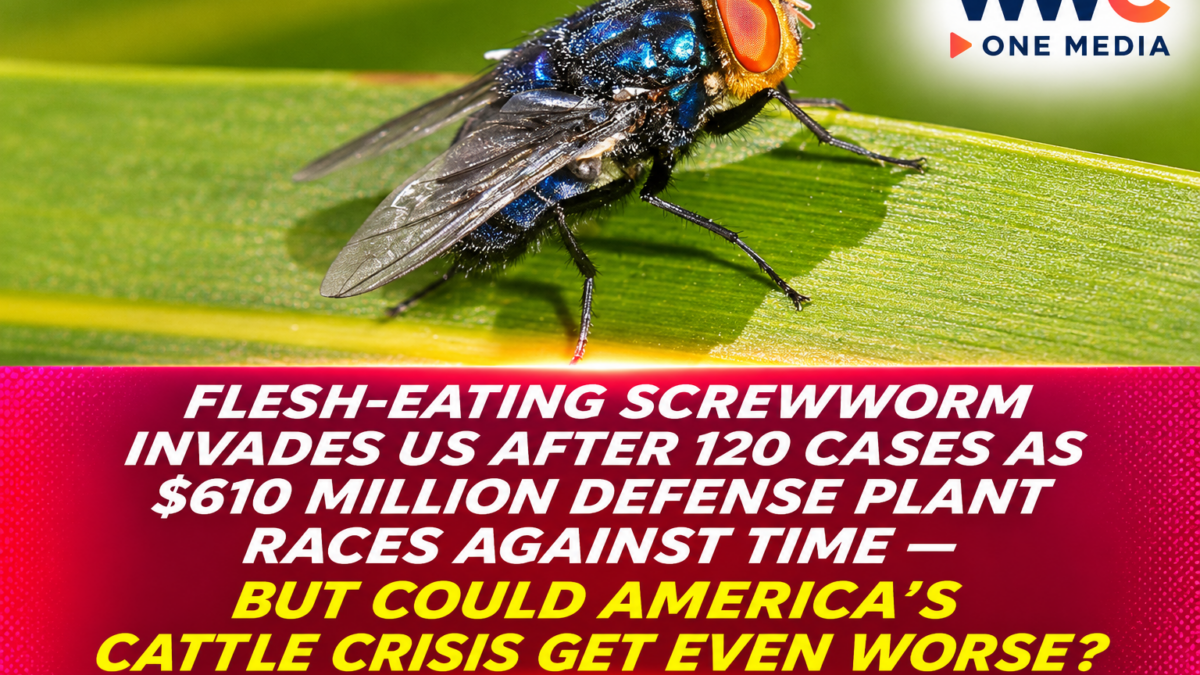
WASHINGTON, D.C. / MEXICO CITY — November 10, 2026 — A flesh-eating parasite once eliminated from the United States has returned, exposing serious weaknesses in North America’s livestock defenses after years of delayed investments, bureaucratic obstacles and a critical shortage of the sterile flies needed to stop its spread.
The New World screwworm outbreak has already affected tens of thousands of animals across Mexico and reached the United States, where approximately 120 animal cases have been recorded since the parasite’s reappearance in June.
And the situation could become more difficult before it improves.
An investigation published by Reuters on November 9, based on interviews with 15 current and former government officials and experts, found that efforts to expand sterile-fly production repeatedly lagged behind the outbreak.
The region is currently producing approximately 150 million sterile flies per week, compared with the 500 million weekly used during the historic US eradication campaign of the 1960s.
The shortage has complicated efforts to control the pest across Central America, Mexico and the southern United States.
Meanwhile, restrictions on Mexican cattle imports have disrupted a multibillion-dollar livestock trade and added pressure to an American beef industry already struggling with historically tight cattle supplies.
The United States is constructing a new sterile-fly production facility in Texas under a reported $610-million contract, but production is not expected to begin until 2027.
The most troubling question is whether governments can scale up biological defenses quickly enough to prevent a more extensive livestock emergency.
What Is the New World Screwworm, and Why Is It So Dangerous?
The New World screwworm, scientifically known as Cochliomyia hominivorax, is a parasitic fly whose larvae feed on the living tissue of warm-blooded animals.
Unlike many fly larvae that consume decaying organic material, screwworm larvae invade wounds and feed on healthy tissue.
Female flies lay their eggs in exposed wounds and other vulnerable areas.
Once the eggs hatch, the larvae burrow into living tissue, causing painful injuries that can become progressively worse.
Severe infestations may result in secondary infections, extensive tissue damage and death if left untreated.
The parasite primarily affects livestock, including cattle, but it can also infest pets, wildlife and people.
A single female fly can lay thousands of eggs during her lifetime.
That reproductive potential makes controlling the population particularly difficult once the parasite becomes established.
The outbreak is therefore a serious concern for ranchers, veterinarians and animal-health authorities.
However, the threat should not be confused with a widespread human epidemic.
The CDC stated in its October 29 assessment that the current risk to the general US population remained very low.
There had been no reported cases of people acquiring New World screwworm infestations within the United States.
How a Parasite Eliminated in 1966 Returned to America
New World screwworm was once a major problem for the American livestock industry.
The United States successfully eliminated established screwworm populations in 1966 through a coordinated campaign using a technique known as sterile insect release.
For decades, the strategy helped protect North American livestock.
The program involved breeding massive numbers of screwworm flies, sterilizing the males through irradiation and releasing them over areas where wild flies were present.
When sterile males mated with wild females, the resulting eggs failed to hatch.
Because female screwworm flies generally mate only once, the process significantly reduces reproduction.
Repeated releases can eventually suppress and eliminate local populations.
The strategy was also extended through Mexico and Central America, establishing a defensive barrier in Panama.
But that barrier was breached in early 2023.
The parasite began spreading northward, eventually reaching Mexico and then the United States.
According to Reuters, the outbreak exposed a fundamental vulnerability: the sterile-fly program lacked enough production capacity to respond rapidly when the containment system failed.
Panama’s 2023 Outbreak Was the First Major Warning
The crisis began accelerating in Panama’s Darién region in early 2023.
By late February of that year, officials were confronting approximately 800 screwworm cases in an area that had long served as a crucial defensive barrier for North America.
The Panama-United States Commission for the Eradication and Prevention of Screwworm, known as COPEG, was responsible for maintaining the biological defense system.
In April 2023, officials decided to increase sterile-fly production from approximately 20 million to 100 million weekly.
However, reaching that capacity required significant time.
Panama declared a screwworm emergency in July 2023, introducing additional surveillance, livestock controls and sterile-fly releases.
The administration of then-President Joe Biden announced nearly $110 million in additional funding in December 2023 to strengthen detection and production capabilities.
But the Panama facility did not reach its expanded target of 100 million flies weekly until November 2024.
By then, the outbreak had already advanced substantially.
That same month, Mexico confirmed screwworm cases in Chiapas, the southern state bordering Guatemala.
The spread demonstrated that the expanded production capacity was insufficient to keep the parasite contained.
Mexico’s Response Was Delayed as the Parasite Spread Across 27 States
Mexico became the next major battleground.
Officials initially considered converting an existing fruit-fly production facility in Metapa, Chiapas, into a sterile-screwworm facility.
But the transition between the administration of Andrés Manuel López Obrador and President Claudia Sheinbaum complicated the planning process.
According to Reuters’ investigation, a Mexican official familiar with the response said the government transition delayed the project by approximately three to four months.
The incoming administration needed time to organize funding and complete the proposal.
In May 2025, the United States announced $21 million in support for the Metapa project.
The facility was expected eventually to produce between 60 million and 100 million sterile flies weekly.
However, it was not inaugurated until June 27, 2026.
That was more than 18 months after Mexico’s first confirmed cases.
By then, screwworm had spread across 27 Mexican states, including major cattle-producing regions.
Reuters reported approximately 51,000 confirmed cases in Mexico by November 2026.
Chiapas remained the hardest-hit state, with roughly 8,200 confirmed infestations.
The delay illustrates one of the central findings of Reuters’ investigation: the biological defenses expanded more slowly than the parasite spread.
America Records 120 Cases as the Parasite Crosses the Border
The United States confirmed its first animal case of the current outbreak on June 3, 2026.
The detection involved a calf in Texas.
It was a major development because the country had spent decades relying on sterile-fly containment farther south to prevent the pest from becoming established.
As of Reuters’ November 9 reporting, approximately 120 screwworm cases had been recorded in the United States.
The figures primarily concern confirmed animal infestations and should not be presented as human infections.
US authorities have intensified surveillance, veterinary inspections and sterile-fly releases to limit further spread.
The USDA maintains maps showing confirmed detections and designated treatment areas, while the CDC monitors the potential public-health implications.
The current risk to humans remains very low, according to federal health officials.
However, the livestock threat is significant because screwworm can spread among susceptible animals and create costly treatment and containment requirements.
The presence of confirmed cases does not establish that the parasite is spreading uncontrolled nationwide.
Nevertheless, the outbreak has ended a long period during which the United States was largely protected by containment measures farther south.
Why America Does Not Have Enough Sterile Flies
The central weakness identified by Reuters involves production capacity.
Panama and Mexico currently produce a combined total of approximately 150 million sterile screwworm flies every week.
That is less than one-third of the 500 million weekly benchmark associated with the historic eradication campaign.
Experts argue that much larger production volumes may be necessary to establish a sustainable containment barrier farther south.
For now, all available sterile flies from the facilities in Panama and Mexico are being concentrated on northern Mexico and the United States, according to USDA statements cited by Reuters.
The strategy is designed to stop the parasite from moving farther north before control efforts gradually push the infestation southward again.
However, concentrating sterile flies near the US border leaves many affected regions in Mexico and Central America more dependent on surveillance and treatment.
That approach may be necessary when supplies are limited, but it demonstrates the difficult choices facing authorities.
A shortage of sterile flies means governments cannot simultaneously maintain strong biological barriers across every affected region.
Texas A&M University entomologist Sonja Swiger warned that the shortage was apparent early in the outbreak.
The problem has persisted despite funding commitments and efforts to expand production.
A $610 Million Texas Facility Could Become America’s Biggest Defense
The United States is now constructing a new sterile-fly production facility at Moore Air Base in Edinburg, Texas.
The location has historical significance because an earlier facility there contributed to the successful US eradication campaign.
The Trump administration awarded a reported $610-million contract in March 2026 to construction company M.A. Mortenson.
The project is intended to establish domestic sterile-fly production capacity and reduce America’s dependence on facilities in Panama and Mexico.
USDA officials originally considered a much longer construction timeline.
But the administration accelerated the project amid growing pressure from the livestock industry.
At a September meeting of the Texas A&M University System Board of Regents, Agriculture Secretary Brooke Rollins said the Department of Defense and Army Corps of Engineers had prioritized construction.
Additional spending and accelerated work were intended to move the timeline forward.
According to Reuters, officials discussed the possibility of beginning production around spring 2027.
However, the exact opening date remains subject to construction, commissioning and operational readiness.
Until the Texas plant begins operating, the United States remains dependent on sterile flies produced outside the country.
For a livestock industry worth billions of dollars, that dependence has become a significant biosecurity concern.
US-Mexico Cattle Trade Disrupted for More Than 15 Months
The outbreak has also created serious economic consequences.
In May 2025, the Trump administration halted imports of Mexican cattle to reduce the risk of introducing additional screwworm infestations.
The restrictions remained in place for more than 15 months before selected border crossings began reopening in 2026.
Mexico is an important supplier of feeder cattle to the United States.
American ranchers and feedlots purchase animals from Mexico, raise them to market weight and eventually supply meat-processing companies.
When that trade is interrupted, US businesses can face tighter livestock supplies.
The restrictions added to an already difficult cattle-market environment caused by drought, herd reductions and other production challenges.
The result has been higher costs for cattle buyers and greater uncertainty across the beef supply chain.
In related reporting, WWC ONE MEDIA examined how Tyson Foods’ potential recovery depended partly on improved Mexican cattle imports after screwworm restrictions disrupted livestock supplies.
The analysis highlighted why reopening the border could support the beef industry, but not immediately resolve America’s cattle shortage.
Imported feeder cattle still require time before they are ready for slaughter.
Therefore, even a successful reopening would not instantly restore normal market conditions.
USDA Begins Reopening Selected Border Crossings
By the second half of 2026, US authorities had begun gradually reopening selected ports for livestock imports under stricter biosecurity protocols.
According to USDA’s October updates, the phased schedule included:
- Douglas, Arizona — reopened August 24.
- Santa Teresa, New Mexico — reopened September 24.
- Columbus, New Mexico — reopened October 26.
- Nogales, Arizona — scheduled for November 30, subject to conditions.
The reopening process includes inspections and other animal-health safeguards.
Not every border crossing has reopened.
The agency continues assessing screwworm detections and the risk of further spread.
The partial reopening demonstrates how authorities are trying to balance disease prevention with the economic importance of cattle trade.
A complete closure may reduce some movement-related risks but can impose substantial costs on ranchers and meat processors.
Reopening trade helps relieve those pressures but requires rigorous surveillance and treatment.
The decision therefore involves both veterinary science and economic policy.
Could Screwworm Drive Beef Prices Even Higher?
The parasite outbreak is occurring during an already difficult period for American beef consumers.
The US cattle herd has been reduced by years of drought, high production costs and weak incentives for producers to expand.
That has limited the availability of animals for slaughter and contributed to higher beef prices.
Restrictions on Mexican cattle imports created another supply constraint.
An October 29 analysis from the University of Missouri’s Food and Agricultural Policy Research Institute found that reduced cattle trade between the United States and Mexico would tend to increase cattle and beef prices compared with a scenario in which trade returned to earlier levels.
The report also indicated that the disruption could shift more beef production toward Mexico and reduce efficiency across the broader North American market.
However, the screwworm outbreak is not the only factor influencing US beef prices.
Weather, feed costs, cattle inventories, processing capacity, demand and trade policies all matter.
That distinction is important because attributing every increase in supermarket beef prices to the parasite would exaggerate its role.
Nevertheless, prolonged animal-health restrictions could make an already tight supply situation more difficult.
Trump’s Beef Policies Face Another Major Test
The outbreak arrives as the Trump administration attempts to address high beef prices and strengthen domestic cattle production.
In September, the president signed executive orders covering meat-processing competition, livestock producers and related agricultural policies.
The measures included efforts to support smaller processors and strengthen oversight of the meatpacking industry.
They also addressed cattle producers’ concerns about livestock predators and country-of-origin labeling.
In previous coverage, WWC ONE MEDIA examined Trump’s beef-industry executive orders and the challenge of lowering prices while protecting American ranchers.
However, regulatory changes alone cannot eliminate a parasite.
Controlling screwworm requires a coordinated combination of sterile-fly releases, veterinary treatment, animal surveillance and cross-border cooperation.
The USDA told Reuters that it had acted urgently and pursued practical options to increase sterile-fly availability.
The agency’s response reflects the administration’s position that it has been working to accelerate production despite difficult circumstances.
The Reuters investigation, meanwhile, found that delays occurred under different governments and across several countries.
Responsibility for the shortage cannot be attributed solely to one administration or individual.
JBS and Tyson Face Another Complication in the Beef Recovery
Major meat-processing companies are also affected by changes in cattle availability.
Tyson Foods has faced pressure from high livestock procurement costs and limited cattle supplies.
JBS, one of the world’s largest meat processors, has also been adjusting operations as cattle-market conditions change.
The reopening of Mexican livestock trade could gradually improve supply conditions.
But there are limits to how quickly cattle markets can recover.
The US herd cannot be rebuilt overnight.
Breeding and raising cattle require substantial time, land, feed and financing.
Additional screwworm detections could also lead authorities to reconsider trade restrictions if veterinary risks increase.
In related reporting, WWC ONE MEDIA examined JBS’s third-quarter profit collapse and its expectation that improving US cattle supplies could support a recovery in 2027.
The company’s outlook illustrates how disease-control measures can influence meat-industry profitability.
However, better access to imported cattle would be only one part of the recovery.
Meat processors must also manage labor, processing capacity, international demand and livestock costs.
Are Humans at Risk From New World Screwworm?
Although the parasite primarily affects livestock, human infestations are possible.
New World screwworm larvae can enter wounds or vulnerable tissue and cause a condition known as myiasis.
People with untreated wounds or prolonged exposure in affected areas may face greater risk.
However, federal health officials have emphasized that the current risk to the general US population remains very low.
As of the CDC’s October 29 update, there were no reported locally acquired human infestations in the United States.
The CDC’s broader regional data included more than 209,400 reported animal cases and 2,850 human cases across Mexico and Central America.
Those regional totals should not be confused with US case counts.
The public-health agency recommends appropriate wound care, avoiding unnecessary exposure to infested animals and seeking professional medical attention when an infestation is suspected.
For livestock owners, early veterinary treatment and prompt reporting remain essential.
An animal with suspicious wounds should be examined by a veterinarian rather than treated through unverified home remedies.
The most important public-health message is awareness without panic.
The parasite is dangerous, but the current US situation does not constitute a widespread human outbreak.
Could It Take a Decade to Push the Parasite Back to Panama?
One of the most troubling findings from Reuters’ investigation concerns the possible duration of the crisis.
Some experts believe returning the screwworm containment barrier to Panama could take as long as a decade.
That estimate reflects the scale of the infestation and the difficulty of eliminating the parasite across large geographical areas.
Even when fly populations are reduced locally, containment requires repeated sterile-fly releases.
A temporary interruption in production or delivery could allow remaining wild populations to reproduce.
Authorities must also monitor livestock movement and prevent new infestations from being transported into areas where the pest has been suppressed.
Effective control therefore requires sustained cooperation among the United States, Mexico and Central American governments.
The timeline is an expert assessment, not an official prediction that the outbreak will necessarily last ten years.
A faster response may be possible if production capacity expands and containment efforts succeed.
But continued delays could prolong economic and veterinary risks.
The Bigger Picture: North America’s Food Security Depends on a Fragile Biological Supply Chain
The return of New World screwworm to the United States has exposed a vulnerability that remained largely out of public view for decades.
America’s protection depended on a continuous supply of sterile insects produced largely outside its borders.
When the defensive barrier in Panama failed, that system lacked sufficient capacity to respond rapidly.
The parasite advanced through Central America and Mexico before reaching the United States.
Political transitions, administrative delays, funding problems and disagreements between governments complicated the response.
More than three years after the outbreak accelerated, sterile-fly production remains far below the historical level experts identify as a useful containment benchmark.
The US government is now investing in new production capacity, but the Texas facility is not expected to begin operating until 2027.
Meanwhile, ranchers face additional biosecurity costs, livestock trade remains subject to restrictions and the American beef industry is still recovering from years of supply shortages.
The challenge goes beyond controlling an insect.
It concerns how governments maintain the infrastructure needed to protect agriculture, food supplies and cross-border commerce.
The United States once eliminated screwworm through an extraordinary scientific campaign. But after decades of dependence on a limited sterile-fly production network, can North America rebuild its defenses before the parasite spreads further—or could the next failure turn an already costly cattle crisis into a much larger agricultural emergency?