
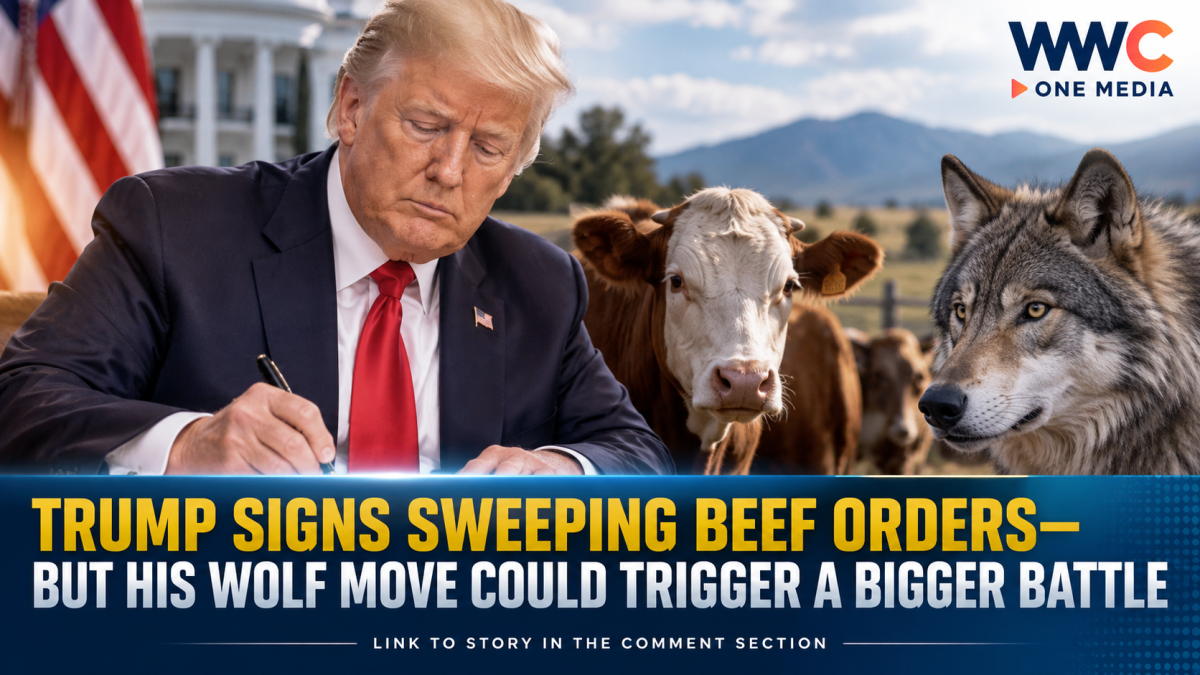
WASHINGTON — U.S. President Donald Trump has signed a pair of executive orders aimed at reshaping the American beef industry, giving ranchers greater support against livestock predators, expanding access to meat processing and putting mandatory country-of-origin labeling back on the policy agenda.
The actions, signed on September 4, come as U.S. beef prices remain at record levels and the national cattle herd sits at a 75-year low. The administration is under pressure to bring grocery costs down while also responding to ranchers who say imports, processing bottlenecks and production costs are hurting domestic producers.
Wolf protections face a new review
One of the most politically and environmentally sensitive parts of the package involves gray wolves and Mexican wolves.
Trump’s order directs Interior Secretary Doug Burgum to determine within 90 days whether the two wolf populations have met the recovery criteria needed for delisting or downlisting under the Endangered Species Act.
If federal officials determine that the recovery requirements have been met, the administration is directed to begin the delisting or downlisting process. The order also calls for recommendations on changing federal rules governing lethal wolf removal and improving the government’s response when wolves threaten livestock or human safety.
That distinction is important: the executive order itself does not immediately remove wolves from the Endangered Species Act or authorize unrestricted killing.
Gray wolves remain federally protected across much of the United States, while management differs in states where federal protections have already been removed. Mexican gray wolves, meanwhile, remain under federal protection.
Conservation groups have criticized the administration’s move, warning that reducing protections could put vulnerable wolf populations at risk. The Center for Biological Diversity called the order an effort to strip protections from both gray and Mexican wolves.
Ranching organizations, however, argue that producers need faster and more practical tools to respond to livestock predation.
The U.S. Cattlemen’s Association said it supports the administration’s focus on predator control, while also warning that lasting changes could require action by Congress and federal agencies.
Trump targets meatpacking power
The second executive order focuses on competition in livestock markets and the country’s meat-processing system.
It directs the U.S. Department of Agriculture to strengthen enforcement of the Packers and Stockyards Act, increase investigative resources and work more closely with the Justice Department on potential antitrust cases involving meatpackers and other covered businesses.
The administration is also seeking to make it easier for ranchers and smaller processors to get meat products into interstate commerce.
The order calls for expanded technical assistance and training for small and very small processors, greater participation in state-federal inspection programs and modernization of meat inspection procedures.
USDA is also directed to establish a guaranteed-loan program intended to help small and regional beef processors remain open and expand their operations.
The broader objective is to give cattle producers more alternatives to the country’s dominant meatpacking companies.
Country-of-origin labeling returns to the spotlight
Another major piece of the policy package is country-of-origin labeling, or COOL.
Trump’s order directs USDA to examine whether existing legal authorities could be used to establish mandatory country-of-origin labeling for beef and to conduct an economic analysis of its potential effects.
But mandatory labeling is not being restored immediately.
Congress repealed mandatory country-of-origin labeling requirements for beef and pork in 2015 following disputes at the World Trade Organization. Reuters reported that Trump’s latest order therefore stops short of simply reinstating the previous requirement.
The administration could ultimately pursue regulatory changes where legally permitted or seek legislation from Congress.
For ranchers who have long argued that consumers should know whether their beef is American-produced or imported, the issue could become a major political fight.
The beef-price problem behind the orders
The moves come against the backdrop of a severe supply squeeze.
The U.S. cattle herd has fallen to its lowest level in roughly 75 years, with drought and wildfires contributing to the decline. At the same time, strong consumer demand has kept pressure on beef supplies and prices.
The administration has already taken steps to increase beef supplies through imports.
On August 26, Trump signed a proclamation temporarily increasing access to lower-tariff imports of lean beef trimmings by 300,000 metric tons, a move the administration said was intended to address what it described as unreasonably high beef prices.
That decision angered some domestic cattle producers, who fear cheaper imported beef could make it harder for U.S. ranchers to rebuild their herds.
The latest executive orders appear designed to address that backlash by simultaneously supporting domestic producers, increasing processing options and pursuing greater transparency over where beef comes from.
What happens next?
The immediate impact of Trump’s latest orders will depend heavily on what federal agencies and Congress do next.
USDA has been given deadlines to report on meat-processing barriers and enforcement efforts, while the Interior Department has 90 days to assess the recovery status of gray and Mexican wolves.
Mandatory country-of-origin labeling could require congressional action, and any attempt to substantially change federal wolf protections could face legal and political challenges.
The U.S. Cattlemen’s Association welcomed the administration’s attention to labeling, predator management, meat processing and enforcement—but cautioned that ranchers ultimately need durable policies rather than temporary changes.
For American consumers, the biggest question remains whether these measures can eventually translate into lower beef prices at the grocery store without making it even harder for U.S. ranchers to rebuild the nation’s depleted cattle herd.
That is the part of Trump’s beef strategy that remains unresolved—and it could determine whether these executive orders become a lasting change for America’s cattle industry or another short-term response to a much deeper supply problem.
WWC ONE MEDIA J.M.S

Leave a Reply