
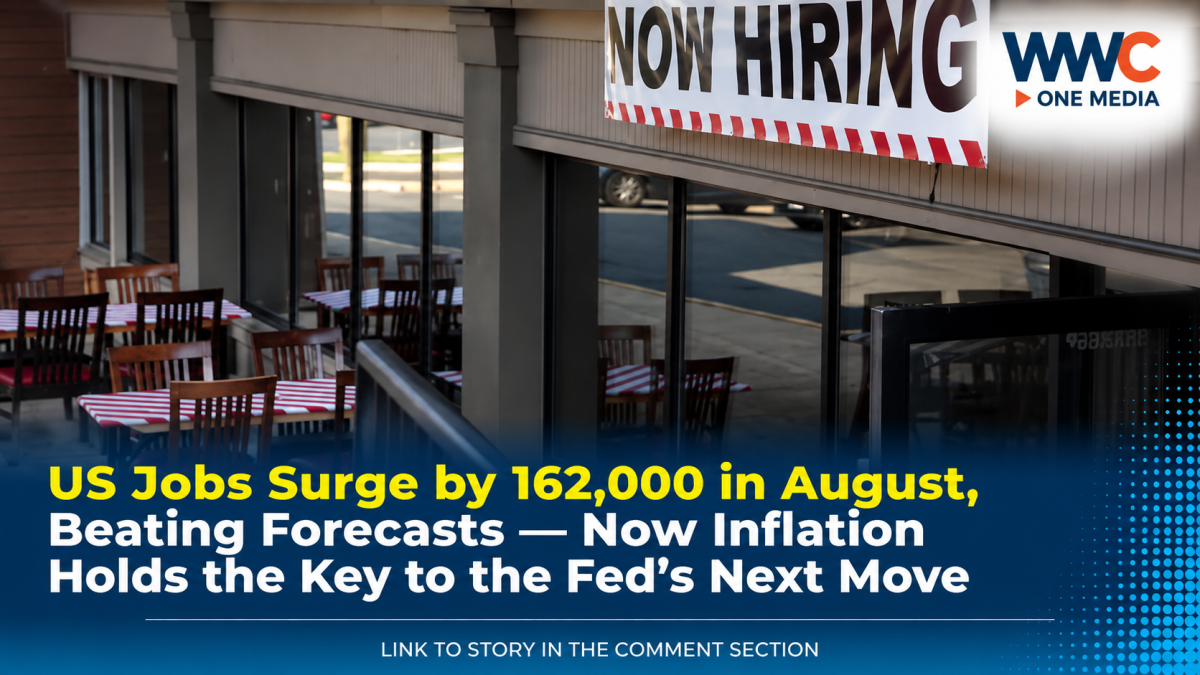
WASHINGTON — September 5, 2026 — The US labour market delivered a surprise burst of strength in August, with employers adding 162,000 jobs, dramatically exceeding economists’ expectations and potentially complicating the Federal Reserve’s next interest-rate decision.
The August increase was nearly triple the 56,000 jobs forecast by economists surveyed by Reuters and far above the 65,000 median expectation in a FactSet poll cited by The Associated Press. The unemployment rate remained at 4.1%.
The unexpectedly strong report immediately pushed financial markets to increase bets that the Federal Reserve could raise interest rates at its Sept. 15–16 meeting.
But there is another number the central bank will be watching closely.
Wage growth slowed to 3.1% over the year through August, its weakest annual increase since 2021, while inflation remains above the Fed’s 2% target.
That leaves the central bank facing a difficult question: is the economy strong enough to withstand higher borrowing costs, or is inflation finally cooling enough for policymakers to leave rates unchanged?
Hiring rebounds after a weak summer
The August employment report represents a sharp reversal from the weakness seen earlier in the summer.
July payroll growth was revised upward to 21,000, from an initially reported decline of 23,000.
June was also revised higher, with payroll growth increased by 11,000 to 31,000.
Together, the June and July revisions added 55,000 jobs to previously reported figures.
The three-month average gain through August reached approximately 71,000 jobs a month, compared with an average monthly loss of 9,000 over the same period in 2025, according to Reuters.
Still, the labour market is not returning to the extraordinary pace seen after the pandemic.
August’s 162,000 increase compares with an average monthly gain of roughly 166,000 in 2023 and 2024 and an extraordinary 491,000 monthly average during the 2021–2022 hiring boom.
Restaurants and government education drive the rebound
The August increase was not evenly distributed across the economy.
The biggest contribution came from food services and drinking places, which added 59,000 jobs.
Local government education added another 42,000, largely reversing the decline recorded in July.
Construction employment increased by 22,000, manufacturing added 16,000, and healthcare employment rose by 13,000.
Overall government employment increased by 35,000.
Together, leisure and hospitality and government accounted for more than 60% of the month’s payroll increase, according to Reuters.
The concentration of the gains is one reason some economists are cautious about declaring a broad-based acceleration in hiring.
The labour force is growing again
Another encouraging signal came from the household survey.
The US labour force increased by 683,000 people in August, after declining during June and July.
The labour-force participation rate rose to 61.6%, up from 61.4% in July.
Household employment increased by 569,000.
At the same time, the number of people unemployed remained around 7 million, leaving the unemployment rate unchanged at 4.1%.
That combination — more people entering the labour force while employment also rises — helped prevent the unemployment rate from falling further.
But the jobs report is not entirely positive
Beneath the headline 162,000 gain are signs that the labour market still faces structural challenges.
The number of Americans unemployed for at least 27 weeks increased by 159,000, while the median duration of unemployment climbed to 11.4 weeks, from 10.5 weeks in July.
The information industry also shed 23,000 jobs in August and has lost approximately 97,000 positions since the beginning of the year, according to Reuters.
Financial activities also declined by 11,000 jobs.
Economists have pointed to artificial intelligence as one factor affecting some information and financial-sector roles, although the employment data itself does not establish that AI caused those losses.
Wage growth gives the Fed some breathing room
The strongest argument against an immediate rate increase may come from wages.
Average hourly earnings for private-sector workers increased 0.3% in August, or 10 cents, to US$37.75.
On an annual basis, wages were up 3.1%, down from 3.2% in July.
That was the weakest annual wage increase since 2021, according to Reuters.
Moderating wage growth is important because rapidly rising labour costs can contribute to persistent inflation.
The latest report therefore gives Fed officials two competing signals:
Hiring is stronger than expected, but wage pressures are easing.
That makes the inflation data coming next week especially important.
Inflation is now the deciding factor
The Fed’s preferred inflation measure remains above its 2% target.
AsiaOne reported the rate at approximately 3.7%, while Fed officials have repeatedly stressed the importance of making further progress toward the central bank’s 2% goal.
Fed Governor Christopher Waller said before the jobs report that he was inclined to support keeping rates unchanged if incoming data showed inflation pressures were cooling.
The new employment numbers could strengthen the argument of officials who believe the economy can tolerate higher rates.
But Waller’s position also means inflation data remains decisive.
The August Producer Price Index is due Thursday, followed by the Consumer Price Index on Friday.
Reuters reported that economists expected core CPI to ease to approximately 2.4% year over year, from 2.5% in July.
If inflation comes in hotter than expected, the pressure for another rate increase could intensify.
If inflation shows convincing signs of cooling, the strong employment report may not be enough by itself to force a hike.
Rate-hike expectations jump
Financial markets reacted almost immediately to the employment figures.
Reuters reported that futures markets were pricing roughly a 62% probability of a quarter-percentage-point rate increase at the Sept. 15–16 Fed meeting, compared with about 49% before the data.
Another Reuters market report put the probability around 59%, illustrating that the exact market pricing moved throughout the session.
The important point is the direction: expectations for a September hike increased sharply after the jobs report.
The Fed’s current benchmark overnight rate is 3.50% to 3.75%, following its July decision to leave the target range unchanged.
The dollar reacts, Treasury yields rise
The jobs surprise also affected financial markets beyond interest-rate futures.
The US dollar initially jumped after the employment figures were released before giving back some of its gains as investors turned their attention to next week’s inflation data.
Treasury yields also moved higher as traders reassessed the possibility of a Fed rate increase.
The rise in yields matters for consumers and businesses because government bond yields influence borrowing costs across the economy, including mortgages and corporate financing.
Reuters reported that the 30-year fixed mortgage rate had already reached 6.71%, a more-than-one-year high, during the week.
A stronger economy can be a problem for interest rates
Normally, stronger employment is good news.
More jobs mean more income, more spending and greater economic resilience.
But the Fed has a dual mandate: maximum employment and price stability.
If the economy remains strong while inflation stays elevated, policymakers may conclude that borrowing costs are not restrictive enough.
That is why an unexpectedly strong employment report can paradoxically be negative news for borrowers and some financial markets.
Higher interest rates can eventually slow consumer spending, business investment and housing demand.
Trump welcomes the jobs numbers
The strong report also arrived in a politically sensitive period.
With the US midterm elections roughly two months away, President Donald Trump welcomed the employment figures.
He described the numbers as exceeding expectations in a social-media post on Friday.
But the jobs report does not settle the broader economic debate.
Households continue to face elevated prices, particularly for energy, while wage growth has slowed.
For workers, a strong headline employment number therefore does not necessarily mean that household purchasing power is improving at the same pace.
Immigration policy adds another complication
The labour market is also being reshaped by changes in the available workforce.
The Trump administration’s immigration restrictions and the retirement of baby boomers are contributing to a smaller pool of available workers, according to economists cited by Reuters and AsiaOne.
That matters because a lower supply of workers can keep unemployment relatively low even if hiring slows.
Economists estimate the number of jobs the economy needs to create each month merely to keep pace with growth in the working-age population at somewhere between zero and 50,000, according to Reuters.
That means today’s 162,000 gain is substantially above the estimated break-even level.
AI is reshaping the labour market too
Artificial intelligence is adding another layer of uncertainty.
The information industry has experienced significant job losses this year, while businesses are increasingly looking to technology to improve productivity.
Companies facing labour shortages may choose to invest in automation and AI rather than expand headcount.
That could allow the economy to grow without generating the same level of employment growth seen in previous cycles.
It also creates a more complicated labour-market picture: overall unemployment can remain low while particular occupations experience significant disruption.
The next five days could be more important than the jobs report
For markets, the employment report may have changed the conversation — but it has not ended it.
The Fed now has to weigh three competing signals.
First, the economy created 162,000 jobs, far more than expected.
Second, unemployment remained at 4.1%, while labour-force participation increased.
Third, annual wage growth slowed to 3.1%, suggesting that the labour market may not be generating the kind of wage pressure that would necessarily require aggressive monetary tightening.
Then comes inflation.
That data could determine whether the September meeting produces another rate increase or another pause.
For now, the August jobs report has removed some of the urgency surrounding fears of a rapidly deteriorating US labour market.
But it has simultaneously revived a different fear:
If American hiring is this resilient, and inflation refuses to fall fast enough, the Fed may have little choice but to keep rates higher for longer.
And that is why next week’s inflation numbers could matter even more than Friday’s blockbuster jobs report.
WWC ONE MEDIA J.M.D




Leave a Reply