
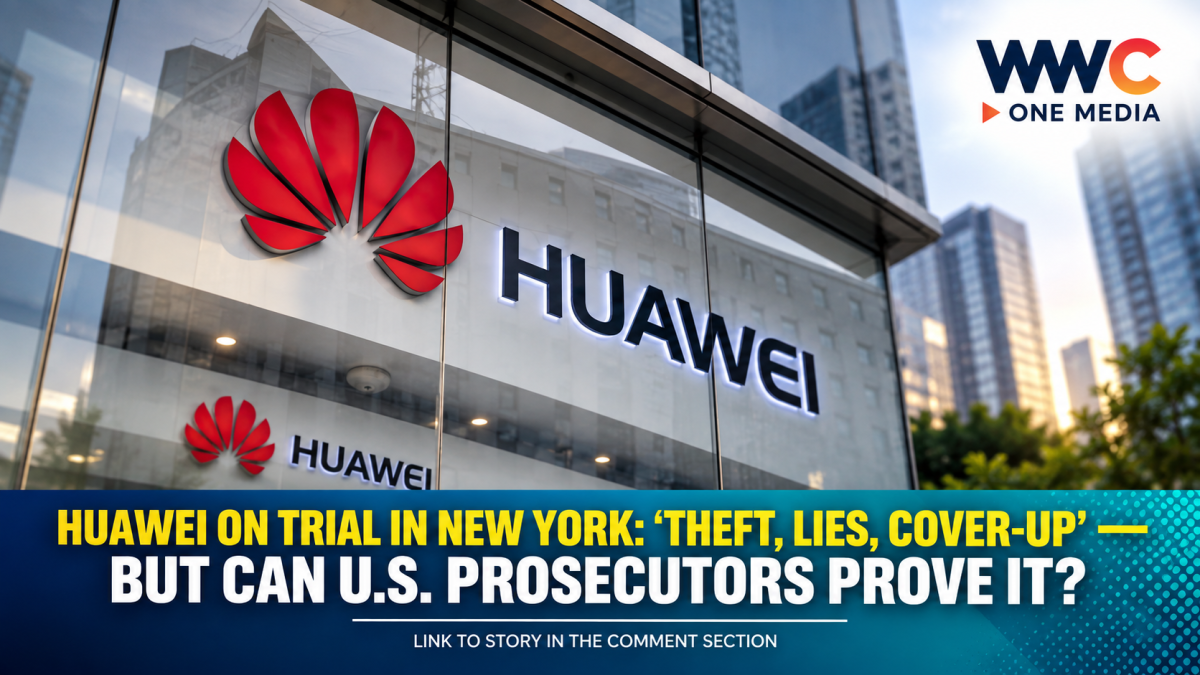
NEW YORK — One of the biggest and most closely watched U.S. criminal cases involving a Chinese technology company has finally reached trial.
A federal jury in Brooklyn began hearing opening arguments on Wednesday, September 9, in the racketeering case against Huawei Technologies, with U.S. prosecutors accusing the telecom giant of carrying out a yearslong pattern of theft, deception and sanctions violations.
Huawei has denied the allegations, arguing that U.S. prosecutors are taking isolated incidents involving individual employees and portraying them as evidence of a companywide criminal conspiracy.
TWO DECADES OF ALLEGED WRONGDOING
U.S. Department of Justice prosecutor Taylor Stout told jurors that Huawei’s alleged misconduct stretched across roughly two decades.
The government’s case centers on accusations that Huawei and affiliated companies stole trade secrets from American technology firms, misled financial institutions about business involving Iran and operated in countries subject to U.S. sanctions.
Prosecutors are attempting to connect those incidents into what they describe as a broader racketeering enterprise, rather than a collection of unrelated employee actions.
Among the alleged targets of trade-secret theft are Cisco Systems, Motorola Solutions, Fujitsu, Quintel Technology, T-Mobile and CNEX Labs, according to court documents and reporting by The New York Times. The alleged information included source code, technical material and other proprietary technology.
Reuters reported that prosecutors have also pointed to an alleged Huawei “competition management group” that rewarded employees for obtaining valuable information from competitors.
THE T-MOBILE ROBOT INCIDENT
One of the more unusual allegations involves T-Mobile.
Prosecutors say a Huawei employee attempted to obtain technology from a T-Mobile laboratory, including a robotic arm used for testing smartphones.
The government is expected to present evidence surrounding the incident as part of its argument that the alleged theft was not merely accidental or isolated.
Huawei’s defense has a different interpretation.
Attorney Brian Heberlig argued that prosecutors are “cherry-picking” incidents involving individual employees and using them to construct a conspiracy that, according to the defense, never existed.
He cited an example involving a Huawei employee who photographed a competitor’s equipment at a trade show, saying the employee was promptly fired and that the incident did not demonstrate a companywide policy.
IRAN DEALINGS AT THE CENTER OF THE CASE
Another major part of the prosecution’s case involves Huawei’s business dealings in Iran.
U.S. authorities have accused Huawei of concealing the nature of its Iranian operations and misleading banks about those dealings in order to move money through the U.S. financial system despite sanctions.
The allegations involve Skycom, a company that prosecutors say was connected to Huawei’s Iranian operations.
The case dates back years. Reuters’ earlier investigations into Huawei’s relationship with Skycom helped bring the issue into the spotlight before the U.S. government eventually charged Huawei.
MENG WANZHOU’S ROLE RETURNS TO THE SPOTLIGHT
The trial also brings renewed attention to Huawei CFO Meng Wanzhou, whose 2018 arrest in Canada became a major flashpoint in U.S.-China relations.
Meng was arrested at the request of U.S. authorities while facing allegations connected to Huawei’s dealings with Iran. After nearly three years in Canada, she reached a deferred prosecution agreement with U.S. prosecutors in 2021 and returned to China.
In a statement of facts connected to that agreement, Meng acknowledged misleading a financial institution regarding Huawei’s compliance with U.S. sanctions and export-control requirements.
A U.S. judge ruled in June 2026 that those admissions could be introduced as evidence against Huawei in the company’s criminal trial.
That decision could become particularly significant as prosecutors attempt to establish what Huawei’s senior management knew about its Iranian business.
NORTH KOREA AND SURVEILLANCE ALLEGATIONS
The case goes beyond trade secrets and Iran.
The indictment also accuses Huawei and some of its subsidiaries of conducting business involving North Korea despite U.S. sanctions.
Prosecutors have further alleged that Huawei equipment was involved in surveillance capabilities used by Iranian authorities during the 2009 protests in Iran.
One witness, Parham Baheshti, testified that he encountered Huawei personnel while working in Iran and became concerned about proposals involving the analysis of Iranian citizens’ online behavior.
These allegations remain prosecutorial claims that Huawei is contesting in court, not established findings of guilt.
HUAWEI: ‘INNOVATION, NOT CRIME’
Huawei’s defense is expected to be just as aggressive.
Attorney Brian Heberlig told jurors that the case is fundamentally about competition and innovation, not a coordinated criminal conspiracy.
He argued that Huawei’s global growth was driven by engineering, investment and research and development, while prosecutors are allegedly taking isolated actions by individual employees and presenting them as evidence of a corporate strategy.
Huawei has also characterized the broader U.S. campaign against the company as politically motivated and has repeatedly rejected accusations that it operates as a criminal enterprise. Chinese officials have likewise criticized U.S. restrictions on Chinese companies as economic suppression.
WHY THIS TRIAL MATTERS
The case is much bigger than one technology company.
Huawei has long been at the center of the U.S.-China technology conflict. Washington has restricted Huawei’s access to American technology and barred its telecommunications equipment from U.S. carrier networks over national-security concerns.
Despite those restrictions, Huawei has continued expanding in areas including smartphones, telecommunications, artificial intelligence and semiconductor technology.
The trial therefore arrives at a particularly sensitive moment for the global technology industry.
It also comes as Washington and Beijing remain locked in a broader struggle over advanced semiconductors, artificial intelligence and technological independence.
A CASE EIGHT YEARS IN THE MAKING
The criminal proceedings trace back to charges filed in 2018, making this an exceptionally long-running case.
Jury selection began on September 8, followed by opening statements the next day. Reuters reported that the trial is expected to last approximately three months, while other reports have suggested it could extend longer depending on the evidence and testimony.
The verdict could have major implications for Huawei, U.S. technology companies and the already strained relationship between Washington and Beijing.
But for now, the most important distinction is this:
Huawei is on trial — it has not been found guilty.
The jury must ultimately determine whether prosecutors have proved that the alleged acts formed the criminal enterprise described by the government, or whether, as Huawei’s defense argues, prosecutors have transformed isolated employee misconduct and ordinary international business activities into a conspiracy that never existed.
And that leaves the biggest question hanging over the Brooklyn courtroom:
Was Huawei’s extraordinary global rise fueled by innovation and competition — or did prosecutors finally uncover a corporate pattern of theft and deception?
The jury will decide.



Leave a Reply