
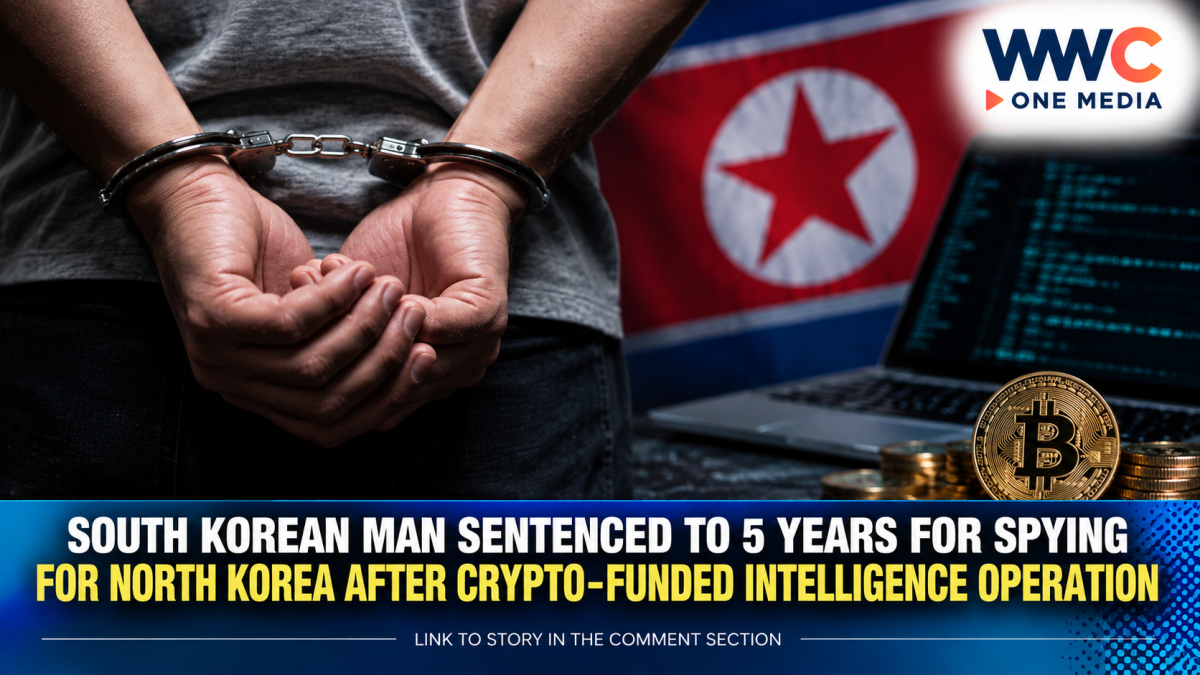
SEOUL, South Korea — A South Korean man has been sentenced to five years in prison after a court found that he gathered information on North Korean defectors and active-duty military personnel under instructions from a North Korean operative.
The Seoul Central District Court’s Criminal Division 21 sentenced the 43-year-old man, identified only as A, on charges including espionage under South Korea’s National Security Act. He was also given five years’ suspension of civil rights, according to South Korean media reports citing Yonhap and court-related sources.
The case is drawing particular attention because investigators said the operation involved Telegram communications, cryptocurrency payments, North Korean defectors and surveillance of an active-duty South Korean officer.
The operation allegedly began with cryptocurrency
According to investigators, A operated a virtual-asset investment company and received approximately 660 million won (about US$479,000) in cryptocurrency from a North Korean operative in May and June 2021.
The money was reportedly presented as operating funds for his cryptocurrency investment business.
During the same period, investigators said the North Korean operative instructed A through Telegram to identify North Korean defectors who were critical of Pyongyang and gather information about their identities and activities.
The alleged operation then moved beyond online communications.
A approached the head of a North Korean defector organization and offered to provide financial support. He asked the organization to create a cryptocurrency wallet and passed the wallet address to the North Korean operative.
The operative subsequently sent approximately 1 million won worth of Bitcoin, described as a donation. Investigators said A then obtained photographs and videos showing the organization distributing anti-Pyongyang leaflets.
A defector-turned-YouTuber was also approached
Investigators also said A contacted a North Korean defector who had previously worked for North Korea’s State Security Department and later became a YouTuber.
According to court-related reporting, A presented himself as someone interested in North Korean human-rights issues and used the contact to obtain the person’s mobile phone number.
The episode became significant because South Korean authorities said information concerning anti-Pyongyang defectors could potentially expose them—and relatives still living in North Korea—to retaliation.
Then the target list turned to South Korean soldiers
In July 2021, investigators said A received another set of instructions from the North Korean operative.
This time, the target was seven active-duty South Korean military officers.
The information allegedly supplied to A included the officers’ names, military units and resident registration numbers. He was instructed to verify additional information and attempt to recruit them for espionage.
One officer, identified in reports only as Captain C, became the subject of more extensive surveillance.
A reportedly obtained photographs of the officer from social media, including images showing his face and military uniform.
He then hired a private investigation agency.
The private detective trail
According to court reporting, A told the private investigator that he wanted background information on someone allegedly involved with his daughter.
The investigator subsequently gathered information about the officer’s military unit, residence, military housing, schedule and movements.
A reportedly paid the agency approximately 2.5 million won in Bitcoin for the information.
The case also involved an attempt to approach another active-duty officer.
Between August and September 2021, investigators said A contacted the officer through Telegram and offered money in exchange for military information, including an organizational chart.
That officer reportedly rejected the offer.
Why the court considered the information sensitive
The court said information about North Korean defectors engaged in anti-Pyongyang activities could qualify for protection because disclosure could potentially allow North Korea to track or harm them or retaliate against family members who remain in the North.
The ruling therefore treated the collection of photographs, contact information and activity records as information with practical security value.
The court also reportedly placed significant weight on the large amount of cryptocurrency A received from the North Korean operative and the fact that he carried out activities according to the operative’s instructions.
This was not his first conviction linked to the same operative
The latest five-year sentence is not the only prison term connected to the case.
South Korean reports say A had previously been prosecuted for approaching an active-duty military officer and leaking military secrets at the request of the same North Korean operative.
In that separate case, the Supreme Court finalized a four-year prison sentence in December 2025, along with four years’ suspension of civil rights.
The two sentences arise from separate proceedings, so they should not automatically be described as a simple nine-year sentence without confirming how Korean sentencing rules apply to the terms.
A case reflecting the changing face of espionage
The case also illustrates how modern espionage investigations can involve tools far removed from the traditional image of secret meetings and physical documents.
Here, according to investigators and court reporting, the alleged activities involved encrypted messaging, cryptocurrency, social-media information, a private investigator and attempts to recruit military personnel.
The use of cryptocurrency is particularly notable. Investigators said hundreds of millions of won in virtual assets were transferred to A, while smaller Bitcoin payments were allegedly used in connection with the collection of information.
That does not mean cryptocurrency itself was the source of the espionage threat. Rather, investigators said it was allegedly used as part of the financial mechanism connecting the North Korean operative with A.
The wider security backdrop
The conviction comes amid continuing tensions on the Korean Peninsula.
South Korea continues to face security concerns involving North Korea even as President Lee Jae Myung has publicly called for conditions that could eventually allow dialogue between Washington and Pyongyang to resume.
Reuters reported earlier this week that Lee has advocated moving away from confrontation toward a framework centered on peace and cooperation, although direct U.S.-North Korea contact had not been confirmed.
At the same time, South Korean intelligence assessments have pointed to continuing efforts by North Korea to strengthen the authority of leader Kim Jong Un, while Pyongyang maintains a hardened position toward Seoul.
Against that backdrop, cases involving alleged espionage inside South Korea remain especially sensitive.
The unanswered questions
The court case provides a detailed picture of what South Korean investigators said A did, but there are important limits to what can be concluded publicly.
The identity of the alleged North Korean operative has not been disclosed in the reports reviewed. And while investigators said A collected sensitive information under the operative’s instructions, the published reports do not establish that every piece of information he obtained was successfully delivered to North Korea.
What the case does establish is that a South Korean court convicted A under the National Security Act and imposed a five-year prison term after finding the conduct sufficiently serious to warrant punishment.
For South Korean authorities, the case is another reminder that espionage can exploit ordinary digital platforms, financial technology and publicly available personal information.
And for the people targeted—particularly defectors and military personnel—the case demonstrates how seemingly ordinary pieces of personal information can become security-sensitive when assembled and directed toward a hostile intelligence operation.
What began with Telegram messages and cryptocurrency ultimately led to a South Korean prison sentence—and exposed just how quietly a modern espionage operation can take shape.



Leave a Reply