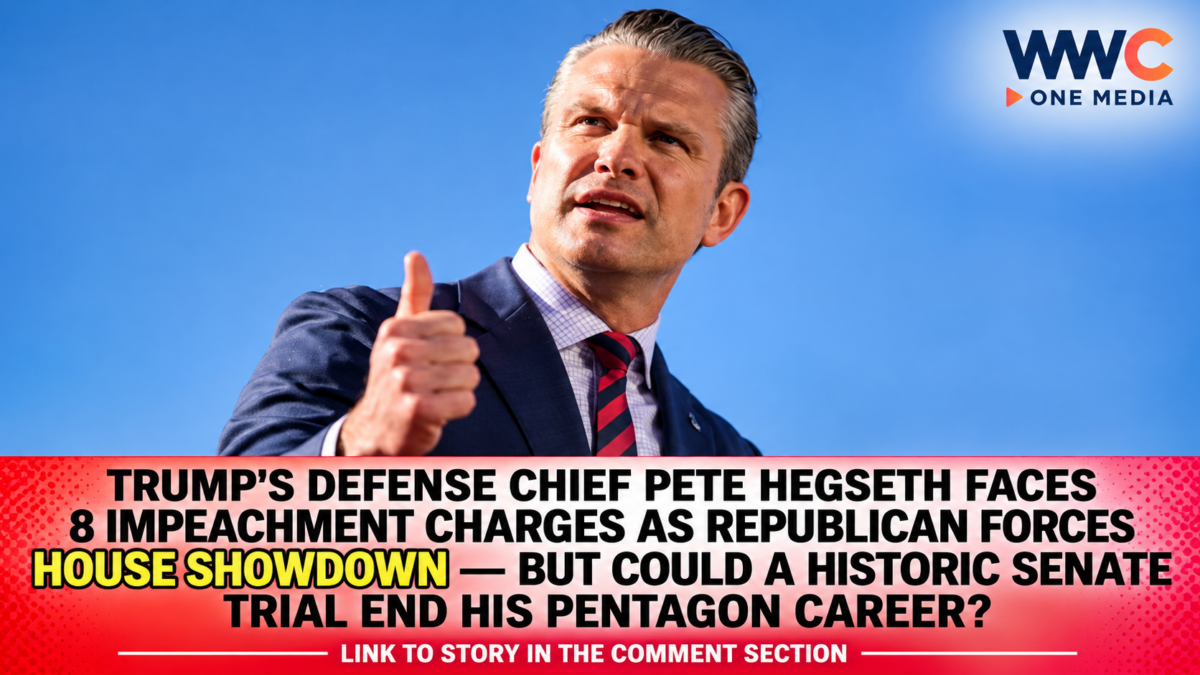
WASHINGTON, D.C. — November 10, 2026 — US Defense Secretary Pete Hegseth is facing a potentially historic impeachment confrontation after a Republican lawmaker moved to force Congress to consider eight charges involving the Iran war, deadly American military strikes and alleged abuses of constitutional authority.
The showdown could begin within days.
Republican Representative Thomas Massie of Kentucky introduced the impeachment resolution on November 9, setting up a possible House vote as early as Wednesday, November 11.
If the House approves even one article of impeachment, Hegseth would become only the third US Cabinet secretary in history to be impeached.
But impeachment would not automatically remove him.
Under the US Constitution, the House can impeach a federal official by a simple majority, while conviction and removal require a two-thirds majority of senators present.
That distinction could determine whether Hegseth survives the political crisis now confronting President Donald Trump’s administration.
The impeachment initiative comes after Democrats secured victories in the November 3 midterm elections, positioning them to take control of both chambers of Congress in January 2027.
And although Hegseth retains Trump’s public support, growing opposition to the Iran war has created an increasingly difficult political environment for the Pentagon chief.
Why Is Pete Hegseth Facing Impeachment?
Massie’s impeachment resolution accuses Hegseth of serious misconduct in the exercise of his powers as defense secretary.
The eight articles focus on the administration’s conduct of military operations and its treatment of legal restrictions on the use of force.
Three articles concern the Iran war, including allegations that the administration continued hostilities without appropriate congressional authorization.
Another focuses on the protection of civilians during military operations.
Additional charges address attacks on suspected drug-trafficking vessels, alleged retaliation against Senator Mark Kelly, military action involving Venezuela and operations in Yemen.
These are accusations contained in the impeachment resolution, not proven criminal offenses or findings of guilt.
Hegseth disputes the allegations and describes the impeachment effort as politically motivated.
President Trump has also defended his defense secretary and the administration’s military decisions.
The latest developments follow an earlier wave of Republican criticism surrounding the Iran conflict.
As previously reported by WWC ONE MEDIA in its coverage of the growing Republican revolt against Pete Hegseth, the Pentagon chief has faced questions from lawmakers within Trump’s own party.
Massie’s formal impeachment initiative represents a significant escalation because it creates the possibility of a direct congressional vote.
What Are the Eight Impeachment Charges?
Massie’s resolution outlines the following allegations:
- Unauthorized war against Iran: Conducting hostilities without the congressional authorization Massie argues was legally required.
- Disregarding congressional war-powers action: Continuing military operations despite congressional action calling for the withdrawal of American forces.
- Exceeding war-powers time limits: Maintaining hostilities beyond the statutory period set out in the War Powers Resolution.
- Failing to protect civilians: Allegedly weakening safeguards intended to minimize civilian casualties, including in connection with an attack on an Iranian school.
- Unlawful strikes on suspected drug vessels: Authorizing lethal operations against suspected traffickers in the Caribbean and eastern Pacific, including disputed actions involving survivors.
- Retaliation against Senator Mark Kelly: Allegedly using official authority to punish or intimidate a lawmaker for protected political expression.
- Unauthorized Venezuela operation: Participating in the military operation to capture Nicolás Maduro and Cilia Flores.
- Unauthorized military action in Yemen: Conducting operations that Massie argues lacked adequate congressional authorization.
The allegations raise distinct constitutional, statutory and international-law questions.
Not every disagreement over military policy constitutes an impeachable offense.
Some of the legal issues, particularly the interpretation of the War Powers Resolution, remain contested.
Determining whether Hegseth committed impeachable misconduct is ultimately a decision for Congress under the constitutional impeachment process.
How Does the House Impeachment Vote Work?
The US Constitution gives the House of Representatives the exclusive authority to impeach federal civil officers, including Cabinet secretaries.
Impeachment is comparable to formally bringing charges against an official.
It is not the same as removal from office.
The process ordinarily begins when a lawmaker introduces articles of impeachment, which may be referred to the House Judiciary Committee for investigation and consideration.
A committee can examine evidence, hear testimony and recommend whether articles should be adopted.
However, lawmakers can also attempt to bring certain impeachment measures directly to the House floor.
Massie has used a privileged-resolution procedure that can require the House to act within two legislative days, assuming the resolution is determined to qualify under the applicable rules.
This does not guarantee that lawmakers will vote directly on Hegseth’s guilt or innocence.
Republican leaders have several procedural options.
They could allow a direct vote on the impeachment articles.
They could move to table the measure, preventing it from advancing.
Or they could seek to refer it to a committee for further consideration.
If the House votes directly on impeachment, a simple majority of members voting is sufficient to approve an article, provided the chamber has a quorum.
With all 435 House seats filled and all members voting, that would mean at least 218 votes.
The actual threshold can be lower if fewer members participate.
Impeachment on any one article would be sufficient to send the case to the Senate.
Could Republicans Join Democrats to Impeach Hegseth?
The impeachment effort is politically unusual because a Republican is leading it against a defense secretary serving a Republican president.
Democratic House leader Hakeem Jeffries has expressed strong support for impeachment.
That backing gives Massie a potential coalition extending across party lines.
According to PolitiFact’s November 9 assessment, if every House Democrat supports the measure, approximately three Republican votes would be needed for adoption under the chamber’s reported composition.
But that calculation depends on attendance and how lawmakers actually vote.
House Republican leaders could also try to defeat the measure procedurally before a direct impeachment vote occurs.
Speaker Mike Johnson has opposed pursuing impeachment while American forces remain involved in overseas hostilities.
The administration argues that its military operations serve legitimate national-security objectives.
For lawmakers, the immediate decision is therefore not just whether they believe Hegseth should remain defense secretary.
It is also whether Congress should escalate the allegations into a formal impeachment case.
What Happens if the House Impeaches Pete Hegseth?
If the House approves at least one article, Hegseth would be impeached.
The case would then move to the Senate, which possesses the constitutional power to try impeachments.
The House would appoint impeachment managers to present the allegations.
The Senate would determine how proceedings should be conducted, including arrangements for evidence, arguments and possible witness testimony.
Hegseth would have an opportunity to defend himself through the process established by the Senate.
However, an impeachment proceeding is not an ordinary criminal trial.
The Senate is not required to follow every rule that applies in federal criminal courts.
The process is constitutional and political, with senators deciding whether the allegations justify conviction and removal.
Because Hegseth is a Cabinet secretary rather than the president, the chief justice of the United States is not constitutionally required to preside.
The Senate’s regular presiding officer or another officer selected under Senate procedures could oversee the proceedings.
The Senate may also use a trial committee to gather evidence and report findings, although the full Senate retains responsibility for the final conviction decision.
How Many Senate Votes Are Needed to Remove Hegseth?
The decisive constitutional threshold is a two-thirds vote of senators present.
If all 100 senators participate, at least 67 must vote to convict.
A simple majority is not enough.
Even if Democrats control the Senate when the new Congress begins in January 2027, they would still need substantial Republican support to reach the required supermajority.
That makes conviction significantly more difficult than impeachment in the House.
The Senate could also consider procedural moves to dismiss an impeachment case or refer matters to committee, depending on the applicable rules and votes.
Such an outcome would not be equivalent to a full trial ending in conviction.
If the Senate convicts Hegseth, he would be removed from office.
The Senate could also separately consider whether to disqualify him from holding future federal office.
Impeachment proceedings do not themselves impose a prison sentence or criminal fine.
Any criminal prosecution would be a separate legal process.
Has a US Cabinet Secretary Ever Been Impeached Before?
Impeachment of Cabinet officials is exceptionally rare.
Only two Cabinet secretaries have previously been impeached by the House of Representatives.
The first was Secretary of War William Belknap in 1876.
Belknap resigned before the House voted to impeach him over allegations of corruption involving government contracts.
The Senate later conducted a trial but did not reach the required two-thirds majority for conviction.
The second was Homeland Security Secretary Alejandro Mayorkas in 2024.
House Republicans impeached Mayorkas over his handling of immigration and border enforcement.
The Democratic-controlled Senate subsequently dismissed the articles without conducting a full evidentiary trial.
Neither official was removed from office by a Senate conviction.
If the House impeaches Hegseth, he would become the third Cabinet secretary to face that historic designation.
Whether the Senate would hold a full trial is a separate and still-unresolved question.
Why the Iran War Is Central to the Impeachment Fight
The war with Iran has become one of the defining political controversies of Trump’s second presidency.
Massie argues that the administration exceeded constitutional and statutory limits governing the use of American military force.
The War Powers Resolution of 1973 requires the president to report certain military deployments to Congress and generally provides a 60-day limit on unauthorized hostilities, with provisions governing withdrawal and other exceptions.
Massie’s allegations include claims that the administration continued operations beyond permissible limits and disregarded congressional attempts to end the conflict.
The administration rejects the suggestion that its conduct warrants impeachment.
Supporters argue that the president and defense secretary were responding to national-security threats and carrying out legitimate military objectives.
The legal debate is complicated by longstanding disagreements over the relative war-making powers of Congress and the presidency.
Courts have not definitively resolved every issue surrounding the War Powers Resolution’s application.
The impeachment debate could therefore become a broader confrontation over how much authority a president may exercise without congressional approval.
Why the November Midterm Elections Change Everything
Republicans remain in control of the outgoing Congress, but the November 3 elections have altered the balance of political power.
Democrats are preparing to assume control of the House and Senate when the new Congress convenes on January 3, 2027.
The election results could give Democrats greater authority to investigate Pentagon decisions, issue subpoenas, examine military spending and pursue oversight of the Iran war.
As WWC ONE MEDIA reported in its examination of Democrats’ five-front congressional offensive, the incoming majority is preparing scrutiny of the administration across defense, government spending and other policy areas.
That political shift matters even if the current impeachment initiative fails.
A defeated or tabled resolution would not necessarily prevent lawmakers from launching a new investigation or introducing fresh articles during the next Congress.
However, any new impeachment attempt would still require House approval.
And regardless of which party controls the Senate, the constitutional two-thirds threshold would remain.
What if Congress Adjourns Before the Impeachment Is Completed?
The timing of the impeachment process is especially important because the current Congress is approaching the end of its term.
If the House fails to adopt the articles before the current Congress expires, an impeachment proposal could be introduced again in the new Congress.
A House impeachment already approved before the end of a Congress is a different matter.
The Senate has historical precedent for completing impeachment proceedings after a new Congress begins.
One example involved federal judge Alcee Hastings, who was impeached by the House in 1988 and convicted by the Senate in 1989.
That precedent demonstrates why a change in congressional membership does not necessarily terminate an impeachment case already approved by the House.
It also highlights why the political composition of the next Senate could matter if proceedings continue into 2027.
Could Trump Remove Hegseth Before a Senate Trial?
There is another possible outcome that does not require a successful congressional impeachment effort.
President Trump could decide to replace Hegseth.
The president generally possesses the authority to remove the defense secretary from office.
Hegseth could also resign.
Either outcome would end his current tenure without requiring a Senate conviction.
However, resignation or dismissal would not necessarily resolve every question raised by the impeachment allegations.
The Senate’s historical treatment of former officials, including Belknap, demonstrates that disputes over impeachment jurisdiction can persist after someone leaves office.
Whether Congress would continue proceedings against a former secretary would depend on the circumstances and the Senate’s decisions.
For now, Trump continues publicly defending Hegseth.
The defense secretary has not announced his resignation.
The Iran War’s Economic Fallout Adds to the Political Pressure
The impeachment confrontation is unfolding amid broader concern about the economic consequences of military conflict in the Middle East.
Higher energy prices, uncertainty over shipping routes and fears of further escalation have affected global financial markets.
The political pressure has intensified as Americans confront higher fuel costs.
In related reporting, WWC ONE MEDIA documented the sharp fall in oil prices after Trump’s midterm defeat raised expectations of a possible shift in Iran policy.
More recently, WWC ONE MEDIA covered Brent crude’s fall toward $92 amid indications that Washington could pause additional strikes against Iran.
The market developments underline how military decisions in the Middle East can influence energy costs well beyond the countries directly involved.
But changes in oil prices do not establish whether Hegseth committed an impeachable offense.
Those constitutional questions must be evaluated separately from the economic consequences of the conflict.
What Happens Next? Three Scenarios for Hegseth
The immediate future of the impeachment effort depends on congressional decisions.
Scenario One: The House blocks impeachment.
Republican leaders could successfully table the resolution or refer it to committee, preventing an immediate House vote adopting the articles.
Hegseth would remain in office, although political pressure and further investigations could continue.
Scenario Two: The House impeaches, but the Senate does not convict.
A bipartisan House coalition could approve one or more articles.
The Senate could then conduct proceedings but fail to reach the two-thirds conviction threshold, or resolve the case through another permissible procedural route.
Hegseth would not be removed by a failed conviction vote.
Scenario Three: Hegseth leaves office before proceedings conclude.
Trump could dismiss him, or Hegseth could resign.
Such a decision would represent a major political development, although the impeachment and legal implications would depend on subsequent congressional action.
None of these outcomes should be treated as inevitable.
As of November 10, no completed House impeachment vote or Senate conviction has been established.
The Bigger Picture: A Historic Test of Congress, Trump and the Pentagon
The Pete Hegseth impeachment confrontation is more than a dispute over one Cabinet official.
It raises fundamental questions about the president’s authority to wage war, Congress’s constitutional responsibilities, the protection of civilians and accountability for military decisions.
Massie’s eight articles present serious allegations, but they remain allegations.
Hegseth disputes the charges, and Trump continues to defend his leadership.
The House could decide the immediate fate of the resolution within days.
Even if impeachment advances, removing Hegseth would require a far more difficult Senate vote.
The incoming Democratic-controlled Congress could increase scrutiny of the administration, but it would not automatically possess the votes needed for conviction.
For Trump, the political challenge is whether to continue standing firmly behind his defense secretary as opposition intensifies.
For Congress, the question is whether disagreements over the Iran war and military operations justify invoking one of the Constitution’s most consequential accountability mechanisms.
And with a rare Cabinet impeachment confrontation approaching, the question now gripping Washington is this: Will Republican lawmakers protect Trump’s Pentagon chief—or could a historic House vote open the door to a Senate trial that threatens his political future?