MANILA, Philippines — November 10, 2026 — Manila Water Company Inc., the listed water utility backed by billionaire Enrique Razon Jr., is facing a growing financial balancing act after its nine-month profit fell despite stronger revenues, higher water tariffs and improved operating earnings.
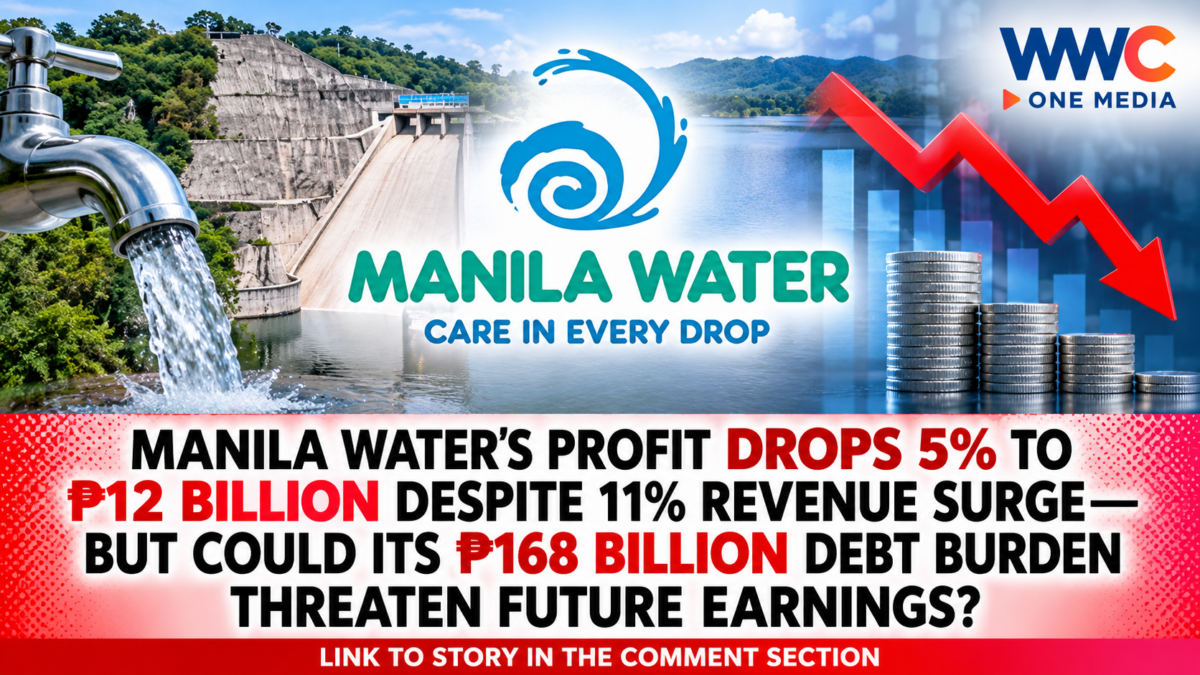
The company reported ₱11.99 billion in net income attributable to shareholders from January to September 2026, down 5% from ₱12.67 billion during the same period last year.
Consolidated revenue, however, climbed 11% to ₱33.4 billion from ₱30.05 billion, highlighting a widening gap between the utility’s operational growth and the earnings ultimately delivered to shareholders.
The biggest pressure came from financing costs.
Interest expenses surged 93% to ₱4.83 billion as Manila Water borrowed more to finance infrastructure expansion, improve water security and integrate investments in its Wawa water supply venture.
Meanwhile, depreciation and amortization expenses rose as newly completed infrastructure projects entered service.
For investors, the contrasting financial figures raise an important question: Can Manila Water’s multibillion-peso investment program generate enough long-term returns to overcome rising debt costs?
And for consumers, will higher regulated water rates translate into better and more reliable water services?
Manila Water Revenue Rises 11% as Higher Tariffs Support Sales
Manila Water’s core East Zone business remained the primary driver of revenue growth.
The concession serves millions of customers across eastern Metro Manila and parts of Rizal province.
During the first nine months of 2026, the company’s average water tariffs in its East Zone operations increased approximately 11%, while billed water consumption remained relatively stable.
Higher tariffs helped boost revenue even without a comparable increase in water volumes.
According to its financial disclosures, water and used-water revenues increased 12% to ₱31.69 billion.
The company implemented the fourth tranche of its approved rate rebasing adjustment in January 2026.
That included a 6.96% adjustment to the existing basic charge and a 0.68% consumer price index adjustment.
These approved adjustments helped support the company’s infrastructure financing requirements.
However, higher average tariffs do not necessarily mean that all customers experienced identical changes to their bills.
Household charges depend on consumption, applicable customer categories, tariff structures and other billing components.
The key distinction is that Manila Water’s stronger sales were primarily supported by rates rather than a significant increase in demand.
Why Did Manila Water’s Profit Fall Despite Higher Revenue?
Manila Water’s financial performance illustrates how rising revenue can coexist with declining shareholder earnings.
The company’s operating results improved, but several costs increased substantially.
First, interest expenses almost doubled.
Interest expense rose 93% to ₱4.83 billion, reflecting higher borrowings, financing associated with the Wawa water venture and changes in the treatment of borrowing costs.
Second, depreciation expenses increased.
Depreciation and amortization climbed 26% to ₱4.92 billion as additional infrastructure assets were completed and brought into use.
Third, foreign-exchange losses increased sharply.
Net foreign-exchange losses widened to approximately ₱2.53 billion from ₱253 million a year earlier.
These factors contributed to the decline in profitability attributable to Manila Water shareholders.
The distinction between consolidated profit and shareholder-attributable earnings is also important.
Total consolidated net income declined approximately 2% to ₱12.83 billion, while profit attributable to parent-company shareholders fell about 5% to ₱11.99 billion.
The figures measure different portions of the company’s earnings and should not be treated as interchangeable.
Manila Water’s Debt Reaches Nearly ₱168 Billion
One of the most significant figures in the latest financial disclosure is Manila Water’s outstanding debt.
At the end of September 2026, the company reported approximately ₱167.79 billion in bank borrowings and bonds.
Its bank debt had increased by around ₱38.1 billion from the end of 2025, reflecting new loan drawdowns and transactions associated with the Wawa water supply venture.
The debt expansion is closely connected with the company’s strategy to strengthen its infrastructure network.
Water utilities require substantial upfront investment in treatment facilities, transmission pipelines, reservoirs, wastewater systems and distribution improvements.
These assets can operate for decades but often take years to generate their full financial return.
Borrowing allows utilities to fund construction before all the benefits are realized.
However, debt also creates recurring interest obligations and repayment requirements.
For Manila Water, interest costs are already exerting pressure on earnings.
The company must therefore balance infrastructure investment against the need to maintain sufficient liquidity and manageable financing expenses.
Importantly, the ₱167.79-billion figure represents outstanding borrowings and bonds, not overdue debt or a finding that the company cannot meet its obligations.
Manila Water reported compliance with its loan covenants as of September 30.
Wawa Water Project Becomes Central to Manila Water’s Expansion
The Wawa water supply investment is one of the most consequential elements of Manila Water’s infrastructure strategy.
The initiative is intended to provide additional water resources and strengthen supply resilience for communities served by the concessionaire.
Metro Manila’s demand for reliable water continues to place pressure on existing infrastructure and raw-water sources.
Diversifying water supply can reduce dependence on individual sources and potentially improve resilience during periods of drought or supply disruption.
However, the Wawa investment has also affected Manila Water’s financial statements.
The company absorbed additional financing obligations associated with the venture.
Its nine-month investing cash flows included a ₱26.25-billion payment related to a WawaJVCo subscription obligation and approximately ₱3.49 billion for the acquisition of remaining minority interests.
These transactions form part of a broader financial restructuring and investment strategy.
The long-term commercial benefits will depend on the performance of the facilities, the integration of operations and the company’s ability to recover eligible costs under its regulatory framework.
For customers, the important question is whether the additional infrastructure translates into better supply reliability.
For investors, the issue is whether Wawa can contribute sufficient earnings and cash flow to justify the associated investment and financing costs.
Operating Earnings Still Rise 12% to ₱24.38 Billion
Despite weaker shareholder-attributable profit, Manila Water recorded stronger operating performance.
Earnings before interest, taxes, depreciation and amortization, commonly known as EBITDA, increased 12% to ₱24.38 billion from ₱21.82 billion.
The company maintained an EBITDA margin of approximately 73%.
That indicates a relatively strong operating earnings contribution before accounting for financing costs, depreciation, taxes and amortization.
The improvement also demonstrates that the company’s revenue growth was not entirely absorbed by its direct operating expenses.
However, EBITDA is not the same as net income or freely available cash.
Capital-intensive utilities can report high EBITDA margins while facing substantial interest expenses, construction payments and debt repayment obligations.
Manila Water’s latest earnings illustrate this distinction.
Its underlying operating business expanded, but the costs of funding and maintaining its growing infrastructure asset base weighed on the bottom line.
Cash Flow Improves, But Liquidity Declines
Manila Water also reported a significant improvement in operating cash flow.
Net cash provided by operating activities increased to approximately ₱6.29 billion from ₱2.73 billion in the corresponding period last year.
However, its cash and cash equivalents declined to ₱4.85 billion at the end of September from ₱6.92 billion at the end of 2025.
The company’s investing activities used approximately ₱29.17 billion during the nine-month period.
Financing activities generated approximately ₱20.81 billion, supported by new borrowing.
These movements show that Manila Water is simultaneously generating operating cash, investing in infrastructure and obtaining additional financing.
For investors, sustained operating cash flow will be critical in evaluating the company’s capacity to manage future capital expenditure, interest payments and dividends.
Manila Water’s Network Serves Millions Across Metro Manila and Rizal
Manila Water’s importance extends beyond its financial performance.
The utility is responsible for supplying water and providing wastewater-related services across the East Zone of Metro Manila and parts of Rizal.
Its distribution infrastructure includes thousands of kilometers of pipelines serving residential, commercial and institutional customers.
Such an extensive network requires continuous maintenance, rehabilitation and coordination with other public infrastructure projects.
In related coverage, WWC ONE MEDIA reported how the Metro Manila Subway project is requiring the relocation of major underground water pipelines.
The project illustrates how urban development can create complex and costly responsibilities for water utilities.
Pipeline relocation and system upgrades are necessary to protect service continuity while accommodating new transportation and construction projects.
But these improvements also require careful planning and financial resources.
For Manila Water, the challenge is to expand and modernize its network without undermining affordability or operating efficiency.
Will Higher Water Rates Mean Better Service?
The relationship between water rates and service quality is particularly important for consumers.
Regulated tariffs help utilities recover approved investment and operating costs.
However, consumers also expect improvements in supply reliability, water quality, service pressure and responsiveness to interruptions.
A higher tariff does not automatically guarantee better service.
Actual improvements depend on how effectively infrastructure projects are completed, maintained and operated.
Both Manila Water and Maynilad periodically undertake repairs and system upgrades that can require temporary service interruptions.
In an earlier report, WWC ONE MEDIA examined water interruptions affecting parts of Metro Manila, Rizal and Cavite.
Those interruptions highlight the operational demands facing the country’s major concessionaires.
For households, the value of infrastructure investment is ultimately measured through reliable water access and service quality rather than corporate revenue alone.
Maynilad Reports a Different Earnings Story
Manila Water’s latest earnings contrast with the performance of Metro Manila’s other major water concessionaire.
Maynilad Water Services Inc., which operates in the West Zone, reported approximately ₱12.6 billion in net income for the first nine months of 2026, up around 10%.
Its revenue increased 3.5% to ₱28.6 billion.
Maynilad attributed its stronger results to higher billed water volume, operational improvements and favorable financing-related movements.
The comparison demonstrates how two major water utilities can report different earnings outcomes despite operating within the same broad industry.
Manila Water recorded faster revenue growth but declining shareholder profit.
Maynilad experienced slower revenue growth but stronger net income.
These differences reflect variations in financing structures, project timelines, operating conditions and accounting results.
They do not, by themselves, establish which company offers better service or greater investment value.
Maynilad has also continued investing heavily in water security.
The report outlined upgrades intended to improve treatment operations and strengthen water supply resilience.
Both companies face the challenge of financing essential infrastructure while maintaining reliable and affordable public services.
Manila Water’s Concession Extension to 2047 Provides a Longer Investment Horizon
An important element of Manila Water’s long-term strategy is the extension of its East Zone concession until 2047.
The longer concession period provides additional time to operate infrastructure, develop new water sources and recover approved investments under the applicable regulatory arrangements.
For a capital-intensive utility, the length of its concession can significantly influence project planning and financing.
Large water infrastructure projects may take many years to complete and generate returns.
A longer operating horizon can support investment decisions that would be more difficult under a shorter concession period.
However, the extension does not remove the company’s financial risks.
Investment returns remain subject to regulatory rules, actual costs, water demand and operational performance.
The company must also comply with its concession obligations.
Water Security Becomes a Bigger Priority
Metro Manila’s water infrastructure faces long-term challenges from population growth, urban expansion and climate variability.
Periods of extreme rainfall can place pressure on treatment and wastewater systems.
Prolonged dry conditions can reduce the availability of raw water.
These competing risks make infrastructure planning essential.
Both major concessionaires are pursuing investments intended to strengthen supply reliability and reduce vulnerability to disruptions.
Maynilad’s upcoming leadership transition also places renewed attention on the balance between water regulation, capital spending and customer affordability.
In related reporting, WWC ONE MEDIA examined Maynilad’s appointment of former water regulator Ramon Alikpala as its incoming chief executive.
Although Maynilad and Manila Water operate different concession areas, both must balance shareholder expectations with obligations to millions of customers.
What Investors Should Watch Next
Manila Water’s latest quarterly results point to several financial and operational indicators that will determine its future performance.
Interest expenses: Higher borrowing costs have become a significant drag on profit, making financing costs an important measure of future earnings pressure.
Debt management: Investors will watch whether the company’s growing infrastructure assets generate enough cash to support repayments and additional investment.
Wawa integration: The performance of the Wawa water supply venture could influence revenue growth, financing expenses and supply resilience.
Foreign-exchange exposure: Large foreign-currency liabilities may continue to affect earnings if exchange rates fluctuate significantly.
Operating cash flow: Stronger cash generation will be essential as Manila Water balances infrastructure requirements and shareholder distributions.
Regulated water tariffs: Future approved adjustments and consumption trends will influence revenue performance.
Service reliability: The success of infrastructure investments must ultimately be reflected in dependable water delivery and improved operational resilience.
These factors will help determine whether Manila Water can translate its expanding operations into stronger bottom-line earnings.
The Bigger Picture: Higher Revenue, Lower Profit and a Costly Infrastructure Race
Manila Water’s nine-month results reveal a company whose operating business remains strong but whose financial obligations are becoming increasingly significant.
Revenue grew 11% to ₱33.4 billion.
EBITDA rose 12% to ₱24.38 billion.
Yet profit attributable to shareholders declined 5% to ₱11.99 billion.
The divergence reflects the rising cost of financing new infrastructure, higher depreciation and foreign-exchange losses.
Manila Water’s investment strategy could deliver meaningful long-term benefits by expanding supply, strengthening distribution networks and improving water security.
But those potential benefits must eventually translate into sustainable earnings and cash flow.
For customers, the central concern remains the reliability and affordability of essential water services.
For shareholders, the question is whether the company’s infrastructure spending can generate returns that outweigh its financing expenses.
Manila Water is collecting more revenue while spending heavily to secure Metro Manila’s future water supply. But with nearly ₱168 billion in outstanding borrowings and profit already under pressure, will these investments unlock the company’s next growth phase—or could rising debt costs keep earnings flowing in the wrong direction?