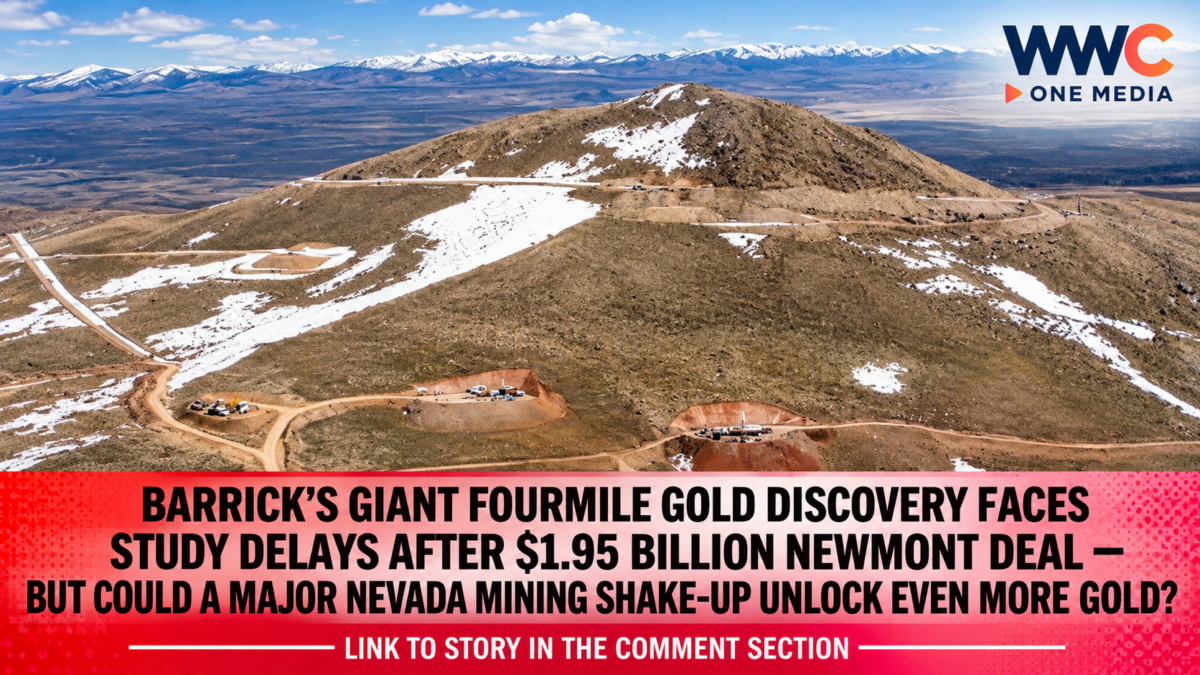
NEVADA, UNITED STATES — November 10, 2026 — One of the world’s most promising gold discoveries is facing fresh uncertainty as Barrick Mining Corporation reassesses how to develop its massive Fourmile deposit in Nevada, raising questions about the timetable for a critical mining study.
The Canadian mining giant is reviewing its development strategy after reaching a landmark agreement with rival Newmont Corporation that will bring Fourmile into their Nevada Gold Mines joint venture.
The deal could open new opportunities to share underground infrastructure, reduce duplicated development work and improve the economics of the gold deposit. However, it has also complicated the timeline for engineering and underground access.
According to Bloomberg’s November 9 report, Barrick is no longer confirming its previously discussed 2028 target for Fourmile’s pre-feasibility study.
For investors, the uncertainty comes at a pivotal moment: Barrick is pursuing a potential public listing of its North American gold assets while benefiting from stronger gold prices and improving quarterly earnings.
The central question is whether redesigning Fourmile now will unlock greater long-term value—or delay one of Barrick’s most important future growth projects.
Why Barrick Is Rethinking Its Fourmile Gold Project
Fourmile, located near the Goldrush mine in Nevada, is regarded by Barrick as a potential Tier One gold asset because of its high-grade mineralization and substantial exploration potential.
The deposit sits within one of North America’s most established gold-producing regions, where existing mining infrastructure could provide significant development advantages.
Previously, Fourmile was planned as a separately owned Barrick project.
That strategy changed after the company reached an August 10, 2026 agreement with Newmont to contribute Fourmile to their Nevada Gold Mines joint venture.
Barrick will contribute Fourmile, while Newmont will contribute its Mike and Fiberline properties.
Under the arrangement, Newmont will make a $1.95 billion cash payment to Barrick. The existing ownership interests in Nevada Gold Mines will remain unchanged at 61.5% for Barrick and 38.5% for Newmont.
The transaction also resolves outstanding disputes between the mining giants and secures Newmont’s consent for Barrick’s proposed North American initial public offering.
The contribution of the assets was expected to be completed during the fourth quarter of 2026.
Could Fourmile’s 2028 Study Deadline Slip?
The biggest immediate concern involves the project’s pre-feasibility study, a detailed assessment used to evaluate mining methods, technical requirements, potential costs and commercial viability.
Barrick had previously discussed completing the study in 2028.
However, during its November 9 earnings conference call, company executives declined to reaffirm that specific deadline.
Tim Cribb, chief operating officer of Barrick’s North American business, explained that bringing Fourmile into the Nevada Gold Mines complex had prompted the company to reconsider its engineering and access strategy.
Instead of depending exclusively on a separate underground entrance, Barrick is evaluating whether Fourmile could be accessed through infrastructure associated with the neighboring Goldrush mine.
That approach may improve coordination and create operating efficiencies.
But it also requires additional engineering work, changes to permitting plans and revisions to the project’s development schedule.
One affected component is the Bullion Hill decline, a planned underground entrance intended to provide access to Fourmile.
Barrick’s third-quarter disclosures indicate that early works were underway, with further activity expected during the fourth quarter, subject to permits.
Importantly, Barrick’s quarterly management report separately refers to advanced Fourmile studies expected to be completed in 2029.
These disclosures suggest that the project’s development milestones are being reassessed, but they do not establish a definitive new deadline for the pre-feasibility study.
Why the $1.95 Billion Newmont Agreement Matters
The agreement between Barrick and Newmont is about more than ownership of a promising gold deposit.
It represents an effort to integrate valuable mining properties within an already established operating complex.
Access through Goldrush could potentially allow Barrick to take advantage of shared resources, existing infrastructure and coordinated mine planning.
Those opportunities could reduce the need for certain standalone development investments, although the financial benefits have not yet been quantified publicly.
The arrangement also removes a major source of tension between the two mining companies.
Newmont’s consent is particularly important because Barrick is preparing to offer investors an ownership interest in a business containing some of its most valuable North American operations.
Barrick expects to file registration documents for the proposed IPO in November, targeting a listing in the fourth quarter of 2026 or early 2027.
The eventual valuation will depend partly on investors’ assessment of the assets’ existing production and future growth prospects.
Fourmile could play a significant role in that longer-term investment story.
Barrick’s Profit Rises as Gold Prices Support Earnings
Despite uncertainty surrounding Fourmile’s development schedule, Barrick’s latest financial results show stronger earnings supported by favorable gold prices.
For the third quarter ended September 30, 2026, the company reported:
- Revenue: $5.07 billion, up 22% year over year.
- Net earnings: $1.32 billion.
- Gold production: 816,000 ounces.
- Adjusted earnings per share: $0.82, up 41% year over year.
- Attributable adjusted EBITDA: $2.47 billion.
- Net cash position: Approximately $900 million.
Barrick also returned approximately $1.04 billion to shareholders through dividends and share repurchases during the quarter.
Reuters reported that the company’s average realized gold price rose to approximately $4,243 per ounce, helping offset lower year-over-year production.
Barrick reaffirmed its full-year 2026 gold production guidance of 2.90 million to 3.25 million ounces.
These financial results highlight the importance of gold prices in supporting mining-sector earnings, even as companies contend with higher operating expenses and increasingly complex development projects.
For additional market context, WWC ONE MEDIA’s latest gold market coverage examines the volatility surrounding bullion prices and the economic forces influencing investor demand.
Why a Giant Gold Discovery Is Not Automatically a Profitable Mine
Fourmile’s geological potential is substantial, but turning mineral discoveries into commercial production remains a lengthy and capital-intensive process.
Mining companies must establish the size, grade and recoverability of deposits before determining whether extraction can deliver acceptable financial returns.
Development also depends on underground access, ventilation systems, geological stability, water management, environmental approvals and processing capacity.
The revised Fourmile strategy could influence several of these factors.
Sharing infrastructure with Goldrush might lower some long-term costs, but new engineering requirements could affect near-term spending and construction schedules.
A longer development timetable may also increase exposure to inflation, equipment prices and labor costs.
This tension between geological promise and commercial reality is not unique to Nevada.
In the Philippines, disputes involving mineral exploration, environmental safeguards and community rights illustrate the broader challenges associated with advancing mining projects.
Related reading: WWC ONE MEDIA’s report on the proposed 1,410-hectare Bataan mining project.
Although the Nevada and Philippine projects involve very different circumstances, both demonstrate why development decisions must account for more than the value of minerals underground.
Could Strong Gold Prices Change Fourmile’s Economics?
Higher gold prices can make mineral deposits more attractive by increasing the potential revenue generated from future production.
However, the relationship is not automatic.
Barrick must still determine how much it will cost to construct access infrastructure, extract ore, process the material and operate the mine over its expected lifetime.
Investors will also consider future gold prices rather than relying only on current quotations.
International bullion markets have experienced significant volatility in 2026, with changes in geopolitical risk, monetary-policy expectations and currency movements influencing demand.
WWC ONE MEDIA previously examined how gold’s sharp retreat from record highs unsettled global investors.
The publication also covered gold’s recovery above $4,000 amid changing US financial-market conditions.
For Fourmile, sustained favorable gold prices could improve future project economics, but they cannot eliminate permitting, construction or geological risks.
What Investors Should Watch Next
Several developments could determine how quickly Barrick turns Fourmile’s exploration success into a viable mining operation.
The first is clarification of the pre-feasibility study timetable.
Investors will want to know whether management formally establishes a new completion target and whether the revised engineering work affects overall development costs.
The second is progress on the Bullion Hill decline and the proposed integration with Goldrush.
The third is completion of the asset-contribution agreement with Newmont.
The fourth is Barrick’s planned North American IPO, including the technical information and investment assumptions disclosed in its registration documents.
Finally, continued drilling will be essential in determining Fourmile’s long-term resource potential and supporting future mine-design decisions.
Barrick says exploration and resource-definition drilling remain priorities as the company advances technical studies covering metallurgy, geotechnical conditions and underground development.
The Bigger Picture: A Gold Giant at a Crossroads
Barrick’s decision to revisit its Fourmile development plans is not necessarily evidence that the deposit has become less attractive.
It could instead signal an attempt to develop the project more efficiently now that it can be integrated with the broader Nevada Gold Mines complex.
However, the uncertainty surrounding the pre-feasibility study timetable introduces a question investors cannot ignore.
Can Barrick translate the potential benefits of its Newmont agreement into a more efficient development plan without sacrificing years of progress?
With a $1.95 billion transaction, a potential North American IPO and one of the mining industry’s most closely watched gold discoveries all connected, the stakes extend far beyond a single engineering study.
Fourmile may hold the potential to become a major new source of gold production—but whether Barrick can unlock that value on a commercially attractive timetable remains the biggest unanswered question.