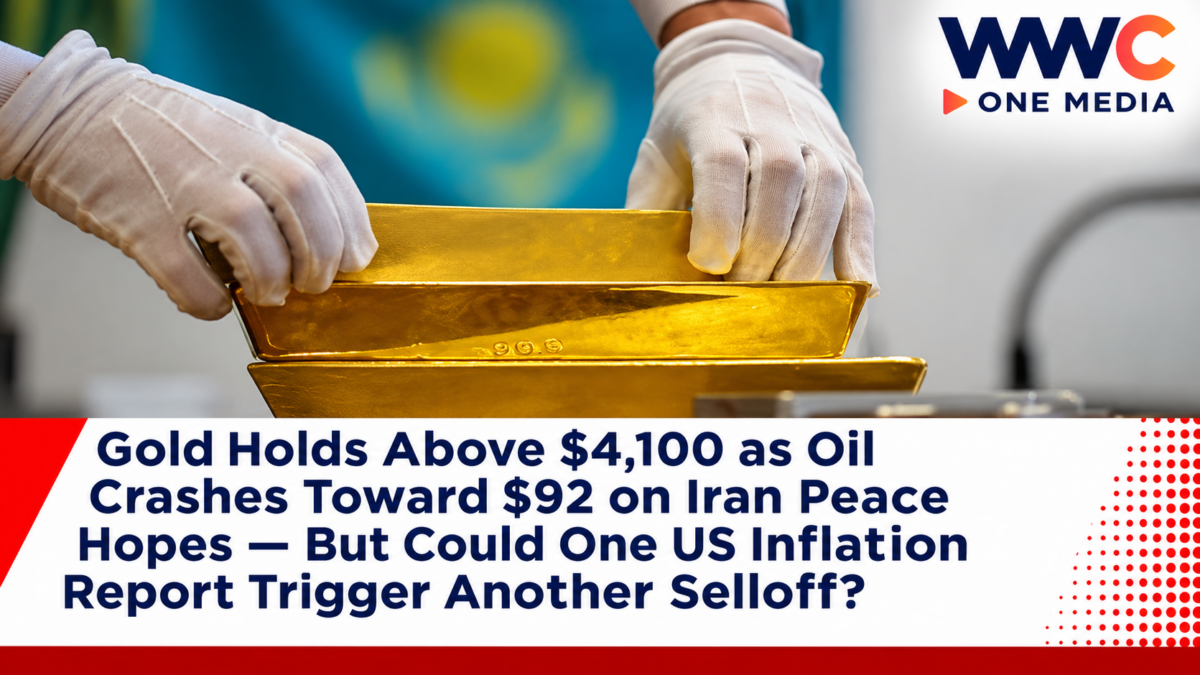
SINGAPORE / NEW YORK — November 10, 2026 — Gold prices held above the critical US$4,100-per-ounce threshold on Tuesday as falling oil prices, a weaker US dollar and growing hopes for a diplomatic breakthrough in the Middle East helped revive demand for the precious metal after months of extreme volatility.
Spot gold traded around $4,139 an ounce at 7:59 a.m. Singapore time, according to Bloomberg, following a 1.7% advance on Monday and a rally of approximately 5% during the previous week.
The recovery comes as Brent crude oil prices retreat toward $92 a barrel amid expectations that negotiations involving the United States and Iran could eventually ease disruptions to global energy supplies.
The decline in oil prices is particularly important because expensive energy has fueled inflation concerns and strengthened expectations that the US Federal Reserve will maintain restrictive monetary policy.
Lower oil prices could reduce some of those pressures, potentially improving the outlook for gold, which does not pay interest.
But the precious metal is approaching another major test.
With investors awaiting crucial US consumer inflation figures and markets pricing a high probability of another Federal Reserve rate increase in December, could gold’s rebound above $4,100 quickly turn into another painful selloff?
Gold Holds Near $4,140 After Powerful Market Recovery
Gold steadied during early Asian trading on Tuesday after a significant recovery in global precious-metals markets.
Bloomberg reported that bullion was little changed near $4,139 an ounce, following gains of approximately 1.7% on Monday.
The metal had also climbed around 5% during the preceding week, recovering from a prolonged decline that previously pushed prices below $4,000.
Reuters independently reported that spot gold rose to $4,107.01 an ounce during Monday trading, while US December gold futures settled 1% higher at $4,114.50.
The differences reflect separate observation times and instruments rather than conflicting reports.
Spot gold represents the market price for relatively immediate delivery, while futures contracts reflect trading in gold for specified future delivery dates.
The recovery has been supported by lower crude oil prices, softer Treasury yields and reduced strength in the US dollar.
However, gold remains substantially below its record high earlier in 2026.
Its return above $4,100 therefore represents an important short-term recovery rather than proof that the previous bull market has fully resumed.
Why Falling Oil Prices Are Suddenly Helping Gold
One of the most surprising features of the current precious-metals market is the relationship between gold and oil.
Traditionally, geopolitical conflicts can support gold prices because investors seek assets perceived as relatively defensive during uncertainty.
But the prolonged war involving Iran has created a more complicated environment.
Disruptions to oil shipments through the Strait of Hormuz have contributed to rising energy prices and higher inflation expectations.
Expensive petroleum increases transportation, manufacturing and other business costs.
Those costs can eventually reach consumers through higher prices.
When inflation remains elevated, central banks may respond by keeping interest rates high or raising them further.
That creates a challenge for gold investors.
Unlike government bonds or bank deposits, physical gold produces no regular interest income.
As returns on competing assets rise, the opportunity cost of holding bullion increases.
Consequently, falling oil prices can support gold by reducing expectations of future interest-rate increases.
The effect is not guaranteed, but it has become an important driver of market sentiment.
Brent Oil Retreats Toward $92 as Iran Peace Talks Advance
The immediate catalyst is renewed optimism surrounding negotiations between Washington and Tehran.
US President Donald Trump indicated that additional American strikes against Iran were highly unlikely as diplomatic efforts to end the conflict continued.
The remarks encouraged investors to reassess the likelihood of further disruptions to Middle Eastern energy supplies.
Brent crude retreated toward $92 a barrel, according to Bloomberg’s November 10 market coverage.
The decline represents a substantial change from the elevated levels recorded during the earlier stages of the energy crisis.
In early November, Brent traded above $100 as fears about maritime security and restricted shipping continued affecting the market.
WWC ONE MEDIA previously examined the sharp reversal in Oil Prices Crash Nearly 8% as Iran Peace Talks Send Brent to $104 — But Could One Failed Deal Trigger a $140-a-Barrel Shock?.
The earlier report documented how diplomatic optimism rapidly reduced the geopolitical premium embedded in oil prices.
However, the conflict has not been conclusively resolved.
Reuters reported that attacks on ships near the Strait of Hormuz continued to create supply concerns.
A deterioration in negotiations or another significant disruption could push energy prices higher again.
For gold, the resulting effect would depend on whether safe-haven demand outweighs renewed inflation and interest-rate fears.
Gold’s Comeback Follows a Brutal October Selloff
The recovery above $4,100 is particularly notable because bullion recently experienced one of its sharpest corrections in years.
Gold climbed above $5,500 per ounce earlier in 2026 before reversing as higher oil prices intensified inflation concerns.
By October 30, the precious metal had fallen to approximately $3,869.85 an ounce, according to Reuters.
From that level, a recovery to $4,139 represents a gain of nearly 7%.
But the metal remains approximately 25% below a $5,500 reference level.
The extreme price swings illustrate how sensitive gold has become to monetary-policy expectations, geopolitical events and global investor positioning.
WWC ONE MEDIA examined the earlier downturn in Gold Struggles Near $3,900 After Historic $5,500 Peak as Iran Peace Talks and US Midterms Shake Markets — But Could Another Selloff Be Coming?.
That coverage highlighted the unusual combination of rising geopolitical risks and falling gold prices.
The latest rebound demonstrates that the same forces can reverse quickly when energy prices, currency movements and market expectations change.
US Midterm Elections Add Momentum to the Rally
Political developments in Washington have also influenced precious-metals markets.
The Democratic Party’s victory in the November 3 US midterm elections prompted investors to reconsider the outlook for fiscal policy, technology regulation and relations with Iran.
Some market participants believe the new political balance could increase pressure for a diplomatic resolution to the Middle East conflict.
Others expect additional congressional scrutiny of major artificial intelligence investments.
Those expectations have contributed to changes in the dollar, Treasury yields and global risk sentiment.
Gold gained approximately 5% during the previous week as investors reacted to the elections and changing geopolitical expectations.
WWC ONE MEDIA previously documented the rebound in Gold Surges Back Above $4,000 as Democrats Sweep US Congress and Treasury Yields Fall — But Could One Jobs Report Trigger Another Precious Metals Crash?.
However, political expectations are not guarantees.
A change in congressional control does not automatically produce a peace agreement, lower inflation or a weaker dollar.
Gold’s reaction will continue depending on actual policy developments and economic data.
Weaker US Dollar Offers Another Source of Support
Currency movements are helping explain the recent gold rally.
Bloomberg reported that the Bloomberg Dollar Spot Index fell approximately 0.5% on Monday before stabilizing during Tuesday’s early Asian session.
Because gold is priced internationally in US dollars, a weaker dollar can make the metal more affordable for investors holding other currencies.
That can support demand.
The relationship is particularly important in major gold-consuming countries such as China and India.
However, gold and the dollar do not always move in opposite directions.
During periods of severe financial stress, investors may purchase both assets for defensive reasons.
Gold can also decline while the dollar weakens if other market forces—such as rising real interest rates or investor liquidation—become more important.
The latest movement therefore reflects several interacting factors rather than a single cause.
Federal Reserve Rate-Hike Bets Remain a Major Threat
Despite the improvement in gold prices, the Federal Reserve’s monetary-policy outlook remains challenging.
Reuters reported that traders were assigning approximately an 81% probability to another US interest-rate increase in December.
Those expectations strengthened after Friday’s US employment report indicated that hiring remained resilient.
The labor-market data reduced hopes that the Federal Reserve would quickly move toward easier monetary conditions.
Higher interest rates can put pressure on gold through two channels.
First, they increase the income available from interest-bearing investments.
Second, they may strengthen the US dollar, increasing the effective cost of bullion for some international buyers.
The next Federal Reserve decision has not yet been made.
Market-implied probabilities are estimates based on financial prices, not commitments by policymakers.
The outlook could shift significantly in response to upcoming inflation reports.
For gold, this creates a fragile environment.
Lower oil prices may ease inflation concerns, but strong employment and persistent underlying price pressures could still encourage monetary tightening.
November 10 US Inflation Data Could Decide Gold’s Next Direction
The immediate market focus is the upcoming US Consumer Price Index report.
Economists expect October consumer prices to have increased approximately 0.3% from the previous month, according to market forecasts.
Investors will pay particular attention to whether inflation is moderating after earlier increases linked partly to energy costs.
A lower-than-expected inflation reading could reduce pressure for future interest-rate increases.
That might support gold by weakening Treasury yields and the dollar.
But a hotter-than-expected report could have the opposite effect.
Stronger inflation could increase expectations of additional Federal Reserve tightening and make bullion less attractive relative to income-producing assets.
The Wall Street Journal reported that gold was edging lower in early Asian trading as investors prepared for the release.
That observation illustrates why bullion may fluctuate even when its broader recovery remains intact.
The October inflation figures had not been released at the time of Bloomberg’s early-morning report.
Consequently, the market reaction should not be presented as though the results were already known.
China Makes Its Largest Monthly Gold Purchase in Three Years
Beyond short-term trading, central-bank purchases remain an important source of gold demand.
Reuters reported that China’s central bank purchased approximately 25.8 metric tons of gold in October, its largest monthly addition in three years, according to World Gold Council data.
The purchase demonstrates continued official-sector interest in holding gold as part of international reserves.
Central banks may buy gold to diversify reserve portfolios and reduce reliance on particular currencies or financial assets.
Their investment horizons can differ substantially from those of short-term traders.
As a result, official-sector purchases can continue during periods when speculative investors are selling.
But central-bank buying does not guarantee that gold prices will increase.
The overall market remains influenced by interest rates, investment flows, physical demand and supply.
Reuters also reported that global central banks purchased approximately 321.2 metric tons during the third quarter, the strongest quarterly total since late 2024.
That demand provides an important longer-term consideration for investors evaluating the gold market.
Gold Jewelry Demand Remains Strong in Parts of Asia
Physical gold demand adds another dimension to the outlook.
China and India remain among the world’s largest markets for gold jewelry.
Despite high prices and substantial volatility, consumers in both countries have continued buying the metal.
Reuters reported that jewelry demand in China and India increased during the third quarter.
In Hong Kong, gold jewelry sales also recorded strong growth.
WWC ONE MEDIA examined the trend in Hong Kong Gold Jewelry Sales Soar 20.3% to HK$4.71 Billion as China’s Wealthy Seek a Safe Haven — But Could the Gold Rush Be Hiding a Bigger Economic Warning?.
However, higher jewelry sales do not necessarily translate into an equivalent increase in demand for investment bullion.
Jewelry purchases can reflect cultural traditions, seasonal demand, gift-giving or changing retail prices.
Likewise, an increase in the value of jewelry sales does not automatically mean that the physical quantity purchased rose by the same percentage.
For investors, the important distinction is between consumer spending, investment flows and official-sector purchases.
All three can influence gold prices, but they respond to different incentives.
Goldman Sachs’ Lower Forecast Highlights the Risks
The strength of gold’s recovery has not eliminated concerns among major financial institutions.
Reuters reported on November 6 that Goldman Sachs lowered its end-2026 gold price forecast from $4,650 to $4,150 per ounce.
The revision reflected expectations that the Federal Reserve would maintain a more restrictive policy stance than previously anticipated.
The revised target is close to the level at which bullion traded during Tuesday’s early session.
That does not mean gold cannot rise above $4,150.
It means the bank’s forecast has become more cautious.
Such targets are projections rather than guaranteed outcomes.
Gold may finish the year above or below those estimates depending on changes in inflation, interest rates and geopolitical developments.
The rapid shift in forecasts demonstrates how challenging it has become to assess the precious metal after this year’s extraordinary volatility.
What the Rally Means for Philippine Investors
Movements in international gold prices can also affect the Philippines.
Because gold is priced globally in dollars, the peso-dollar exchange rate plays an important role in determining its value in local currency.
A rise in international gold prices may increase peso-denominated valuations if exchange rates remain stable.
However, a stronger peso could offset part of the gain.
For Philippine gold producers, higher bullion prices can support revenue, but actual profitability also depends on production volumes, mining costs, taxes and hedging arrangements.
The decline in international oil prices may also benefit the broader Philippine economy.
The country relies heavily on imported petroleum and refined fuel products.
Sustained lower energy prices could help ease transportation and production costs.
But international crude prices do not translate immediately into identical changes at local gasoline stations.
Domestic fuel pricing also depends on refined-product benchmarks, exchange rates, taxes and other factors.
For Filipino investors considering gold, the latest rally reinforces the need to evaluate price volatility rather than assume the metal always provides protection against market losses.
Could Gold Reach $4,500 or $5,000 Again?
The recovery toward $4,140 has renewed discussion of whether gold can regain its earlier momentum.
A rise to $4,500 from $4,139 would require approximately 9% additional upside.
Reaching $5,000 would require a gain of nearly 21%.
Such moves are possible in a volatile commodity market, but they would require sustained support from investor demand and market conditions.
Potential positive catalysts include lower real interest rates, continued dollar weakness, strong central-bank purchases and renewed demand for defensive assets.
Potential obstacles include hotter inflation, further Federal Reserve tightening, renewed dollar strength and profit-taking.
The sharp decline from this year’s record highs demonstrates why ambitious price targets require caution.
An asset can have strong long-term demand while still suffering significant short-term losses.
What Happens Next for Gold?
The coming days could determine whether bullion consolidates above $4,100 or faces renewed selling.
The first major event is the US October inflation release on November 10.
A softer reading could improve expectations for future monetary policy.
The second is the US Producer Price Index report scheduled for November 13.
Producer prices can offer additional information about cost pressures affecting businesses.
The third is the direction of international oil prices.
Progress in US-Iran negotiations could support lower energy costs, while renewed escalation could increase inflation concerns.
The fourth is the Federal Reserve’s December policy meeting.
Investors will be monitoring whether policymakers raise interest rates and how they describe the outlook for 2027.
Finally, gold traders will continue assessing the strength of physical demand and central-bank purchases.
These forces may have different effects over different time horizons.
The Bigger Picture: Can Gold’s Comeback Survive the Next Inflation Shock?
Gold’s recovery above $4,100 demonstrates how quickly financial markets can change direction when geopolitical and monetary expectations shift.
The precious metal has benefited from lower oil prices, a softer dollar and hopes that the Middle East conflict may move toward a diplomatic resolution.
Central-bank purchases and physical demand also provide important support.
But the risks have not disappeared.
US inflation remains elevated.
Financial markets continue expecting another Federal Reserve interest-rate increase.
And the Iran conflict remains unresolved.
Gold’s recent trading history shows that its traditional safe-haven role can be overwhelmed by rising bond yields and liquidity pressures.
For the current recovery to become more durable, investors may need evidence that inflation is moderating without triggering renewed financial instability.
With gold holding near $4,140 and Brent crude retreating toward $92, the precious metal is enjoying a powerful rebound after months of losses. But as Wall Street prepares for another decisive US inflation report, the question is whether gold can build momentum toward $4,500—or whether one unexpected inflation shock could send prices tumbling back below $4,000.