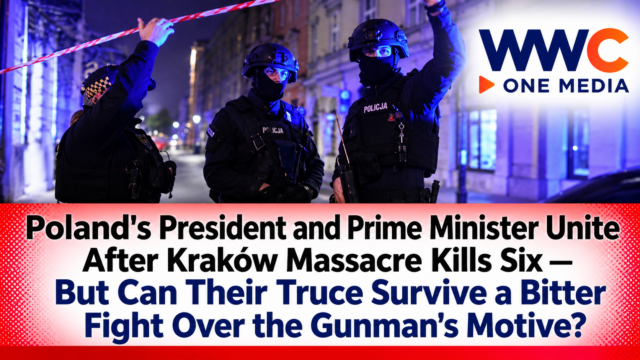
KRAKÓW, POLAND — November 10, 2026 — Poland’s two most powerful political rivals stood shoulder to shoulder on Monday night as tens of thousands of mourners gathered in Kraków to honor the victims of a deadly mass shooting that has shaken the nation and reignited a fierce debate over political extremism and public safety.
President Karol Nawrocki and Prime Minister Donald Tusk, whose bitter disagreements have dominated Polish politics, joined a silent candlelight procession on November 9, just two days after a gunman opened fire in Kraków’s historic Main Market Square.
Six people were killed, including four Polish nationals, a British man and an Austrian woman. Fifteen others were wounded, among them two police officers who confronted the attacker.
The suspected gunman, identified as 24-year-old Michał Oksiński, died in hospital on Monday after being wounded during a police confrontation.
Investigators also discovered the bodies of his parents and sister at the family residence in Ostrowiec Świętokrzyski, bringing the number of deaths under investigation to nine, excluding the suspect.
The tragedy has produced one of the most extraordinary political moments in Poland this year.
Nawrocki, a nationalist conservative aligned with the opposition, and Tusk, leader of a pro-European governing coalition, set aside their differences to walk and mourn together.
But the rare display of unity comes as their political camps dispute whether the attacker was motivated by far-right ideology.
Could the Kraków tragedy become a turning point for national reconciliation—or will the unresolved investigation deepen the political divisions already threatening Poland’s stability?
Poland’s President and Prime Minister Lead an Extraordinary Silent March
Monday’s March of Silence began at approximately 8 p.m. near the junction of Main Market Square and Sławkowska Street.
It was close to the location where the November 7 shooting began.
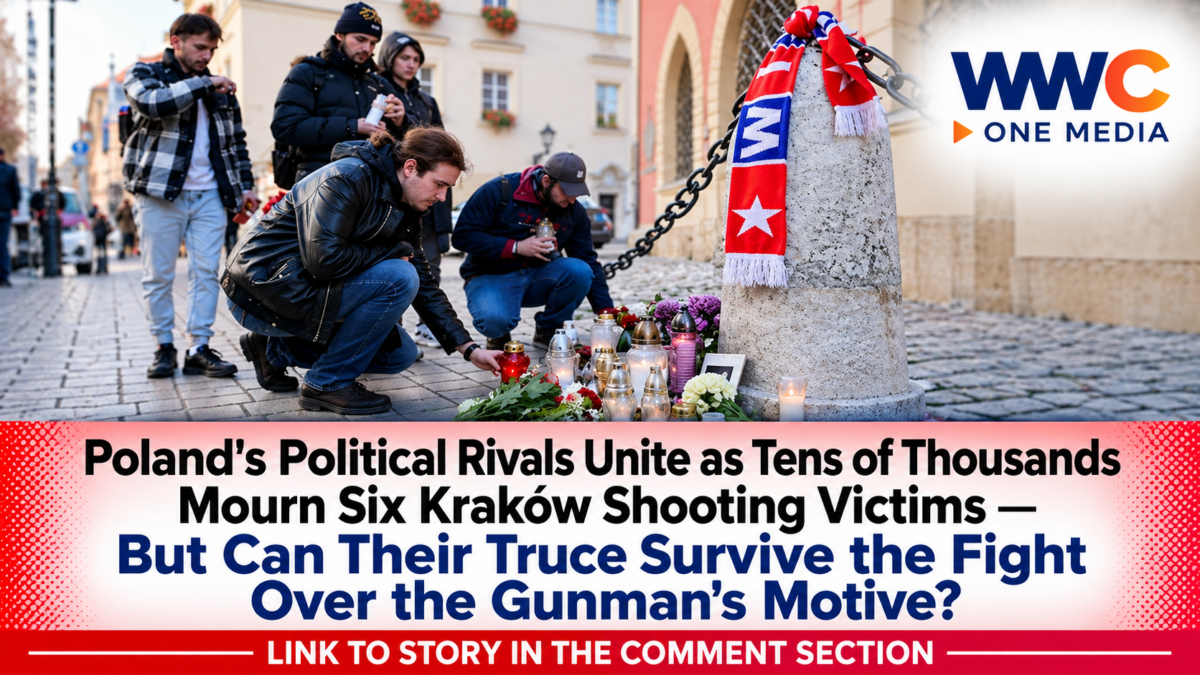
Mourners carried candles and flowers as they walked through Kraków’s historic center, stopping at memorials honoring the victims.
President Nawrocki and Prime Minister Tusk walked alongside Kraków Mayor Łukasz Gibała, who organized the commemoration.
Representatives of local government, the Catholic Church and other public institutions also attended.
The procession moved toward St. Mary’s Basilica before concluding near the Town Hall Tower.
Organizers deliberately avoided political speeches.
Instead, the ceremony emphasized remembrance, solidarity and support for families affected by the attack.
The leaders placed candles together and knelt at the memorial.
For many Poles, the image of the president and prime minister mourning side by side was remarkable.
Their relationship has been defined by disagreements over judicial appointments, constitutional authority and the country’s political direction.
Yet on Monday, they presented a unified response to a tragedy affecting people from Poland and several other European nations.
Why the March Matters in Poland’s Bitter Political Climate
The appearance was particularly significant because Poland is experiencing a deep constitutional confrontation.
Tusk’s governing coalition has attempted to reform judicial institutions it argues were compromised under the previous nationalist administration.
Nawrocki and the opposition Law and Justice party have challenged the legality of several proposed measures.
The conflict escalated in late October following disputed attempts to suspend senior officials of Poland’s Constitutional Tribunal.
The controversy even prompted Nawrocki to interrupt an overseas trip and return to Warsaw.
WWC ONE MEDIA previously examined the confrontation in Poland’s Constitutional Court Erupts Into Chaos as Top Judges Face Suspension and President Rushes Home — But Is a Bigger Political Crisis Coming?.
The judicial dispute remains unresolved.
That is why the Kraków memorial carried a political significance beyond the ceremony itself.
It demonstrated that the two leaders could cooperate in a moment of national grief, even as their disagreements over the country’s institutions continue.
But one evening of solidarity does not amount to a lasting political agreement.
What Happened During the November 7 Kraków Shooting?
The attack occurred on Saturday afternoon in Main Market Square, one of Kraków’s busiest public spaces.
According to Polish authorities, a 24-year-old man drove into the historic square and opened fire from his vehicle.
Residents and tourists rushed for cover as gunshots rang out near restaurants, shops and historic buildings.
Six people died in the attack.
The victims included four Polish citizens and two foreign nationals, one from Britain and another from Austria.
Fifteen people were wounded.
Among them were two police officers who confronted the armed suspect.
Police shot and detained the attacker after an exchange of gunfire.
The suspect was taken to hospital in critical condition.
The incident became one of Poland’s deadliest mass shootings in decades, shocking a country that has generally experienced relatively low levels of mass gun violence.
WWC ONE MEDIA documented the initial attack in Poland Mass Shooting Leaves 6 Dead in Kraków as Police Discover 3 More Bodies at Gunman’s Home — But Was an Even Deadlier Attack Being Planned?.
That earlier report examined the police response, victims and discovery of additional deaths connected to the investigation.
Suspected Gunman Dies in Hospital
Polish authorities confirmed that Oksiński died early on November 9.
He had undergone three operations after suffering injuries during the confrontation with police.
His death creates an additional challenge for investigators because they will no longer be able to question him directly about his actions and motivations.
Authorities must rely on forensic evidence, witness statements, recovered weapons, electronic devices and the reconstruction of events before the attack.
Police said the suspected attacker had no known previous criminal record.
Officials also confirmed that he and his father held firearms permits.
Investigators recovered multiple weapons and ammunition connected to the case.
However, possession of firearms and shooting-club membership do not independently establish the attacker’s motive.
Authorities are examining how the weapons were obtained and whether existing safeguards were adequate.
Three More Deaths Discovered at Suspect’s Family Home
The investigation took another disturbing turn when police searched the suspect’s family residence in Ostrowiec Świętokrzyski.
Officers discovered the bodies of his father, mother and sister.
Investigators believe the three may have been killed before the suspect traveled to Kraków.
However, the exact circumstances and timeline remain under investigation.
Those deaths are separate from the six people killed in the market-square attack.
The combined number of deaths being investigated is nine, excluding the suspected attacker.
The discovery raises questions about the events leading up to the shooting.
Authorities are examining whether the suspect acted alone and whether anyone else knew about or assisted his preparations.
No publicly established finding links the attack to a wider organization.
Police Officers Praised for Their Courage
Two officers injured while confronting the suspect have been praised for potentially preventing additional deaths.
The officers were identified as Artur Morański and Jakub Kulik.
Both suffered serious gunshot injuries and required intensive medical treatment.
By November 9, authorities said both had regained consciousness.
Morański’s condition had improved enough for doctors to remove assisted breathing support.
Polish officials reported that one of his first questions after regaining consciousness was whether Kulik had survived.
The account became a powerful symbol of the police response.
The officers’ condition remains an important concern for their families and colleagues.
President Nawrocki has also recognized their actions through a state honor.
Their recovery highlights the human consequences of the attack beyond the death toll.
Was the Gunman Motivated by Far-Right Extremism?
The possible motive has become one of the most politically sensitive elements of the investigation.
Interior Minister Marcin Kierwiński initially said the suspect appeared fascinated by far-right or ultranationalist ideologies.
Prime Minister Tusk described the shooting as an act of terrorism.
However, prosecutors later emphasized that investigators had not established a definitive ideological motive.
National Prosecutor’s Office spokesperson Przemysław Nowak cautioned against drawing premature conclusions.
Investigators reportedly found a Gadsden flag bearing the phrase “Don’t tread on me” in the suspect’s room.
But Nowak noted that the symbol carries different meanings and does not independently prove extremist motivation.
Officials are also examining emblems found on the suspect’s clothing and material recovered during searches.
The presence of political symbols does not, by itself, establish why someone committed violence.
Investigators must determine whether particular beliefs influenced the attack and whether any other individuals or organizations were involved.
For now, the motive remains unconfirmed.
Poland’s Opposition Rejects Early Political Claims
The government’s early comments about a possible far-right motive drew strong opposition criticism.
Law and Justice leader Jarosław Kaczyński accused government figures of attempting to connect the killings to nationalist political movements without sufficient evidence.
The controversy reflects the country’s tense political environment.
Government officials have argued that potential ideological influences deserve investigation.
Opposition figures have warned against using an unresolved criminal case to stigmatize political opponents.
Both concerns make careful public communication essential.
Authorities must pursue credible evidence of possible extremist motivation.
But political leaders should avoid presenting disputed information as established fact.
Government spokesperson Adam Szłapka subsequently urged restraint until investigators had obtained more complete information.
The disagreement has continued despite the symbolic unity of Monday’s memorial.
Poland Begins Reviewing Gun-Control Safeguards
The shooting has also triggered a review of Poland’s firearms-permit system.
Authorities recovered numerous weapons during searches involving the suspect.
AFP reported that investigators seized 11 firearms in connection with the case.
Poland’s Interior Ministry has indicated that medical-record and licensing procedures may be reassessed.
The review comes amid an increase in legally issued firearms permits.
According to police figures cited by AFP, more than 50,000 new permits were issued in 2025, bringing the total to approximately 411,000.
However, those figures do not establish that rising permit numbers caused the Kraków shooting.
Investigators must determine whether relevant safeguards were followed and whether earlier warning signs could reasonably have been detected.
Any policy changes will need to distinguish lawful gun ownership from specific risks associated with violence.
Authorities Monitor Threats of Copycat Violence
The tragedy has also prompted increased monitoring of threatening online activity.
Reuters reported that Poland’s Central Bureau for Combating Cybercrime detained six people over threatening or alarming posts made following the attack.
Officials said they were concerned about the possibility of copycat violence.
The online response to highly publicized attacks presents a difficult challenge.
Security authorities must identify credible threats without assuming every controversial statement reflects a genuine intention to commit violence.
WWC ONE MEDIA previously examined similar prevention challenges in Singapore’s Terror Threat Remains High — But the Biggest Warning May Be Hiding Online.
That report discussed online self-radicalization and preventive security measures.
The Singapore and Kraków cases are unrelated, and no connection should be inferred.
The comparison is relevant only to the broader challenge of identifying credible threats while protecting the public.
An Existing WWC ONE MEDIA Report Documents the Memorial
The Kraków march also received dedicated coverage from WWC ONE MEDIA.
In Thousands Join Silent March in Kraków After Mass Shooting Leaves Poland in Shock, the publication described the candlelight procession, the leaders’ participation, the wounded officers and the continuing investigation.
That reporting provides additional background on how Kraków residents responded to the attack.
The gathering was not simply an official political ceremony.
It represented a community attempting to reclaim a historic public space associated with daily life, tourism and cultural heritage.
The decision to hold a silent procession rather than a rally with speeches helped keep attention on the victims.
Could the Tragedy Change Poland’s Political Direction?
The timing of the shooting is especially sensitive.
Poland is approaching parliamentary elections expected in 2027.
Its major political parties remain divided over the judiciary, national institutions and the direction of government.
The tragedy may increase public pressure for cooperation on security and public safety.
However, it could also intensify political arguments about extremism and responsibility.
The way leaders respond in the coming weeks will be important.
A thorough investigation could help reduce speculation.
Transparent communication could restore confidence in public institutions.
And evidence-based reforms could address genuine security concerns without turning the tragedy into a partisan weapon.
But neither the election outcome nor the political consequences of the shooting can be predicted from the memorial alone.
What Happens Next?
Polish investigators will continue examining the circumstances surrounding the nine deaths.
Their work includes reconstructing the suspect’s movements, reviewing firearms records and determining whether he had any assistance.
Authorities must also establish what happened at the family residence before the Kraków shooting.
The motive remains a central unresolved question.
Meanwhile, Poland’s government is considering whether firearm-licensing requirements need changes.
Officials are also monitoring potential threats arising from online reactions to the attack.
For the victims’ families, the immediate priority remains mourning and receiving reliable information about what happened.
The November 9 march offered a moment of solidarity.
But the investigation will determine whether Poland receives a full explanation of the violence.
The Bigger Picture: A Rare Moment of Unity in a Divided Country
The Kraków tragedy has revealed two contrasting realities about Poland.
The first is the scale of public grief following an exceptionally violent attack.
Six people were killed in the city’s historic square.
Fifteen others were injured.
Three additional family members were found dead.
The suspected attacker later died in hospital.
The second is the unusual moment of political solidarity.
President Nawrocki and Prime Minister Tusk, despite months of bitter confrontation, stood together to honor the victims.
Their appearance showed that national mourning can temporarily bridge political divisions.
But the unresolved motive has already reopened disagreements between the country’s political camps.
The challenge now is to prevent those disagreements from overshadowing the investigation and the families affected.
As tens of thousands of Poles gather in remembrance and their rival leaders briefly set aside a bitter constitutional feud, the central question is whether the Kraków tragedy can encourage lasting national cooperation—or whether the fight over the gunman’s motive will deepen the divisions ahead of Poland’s 2027 elections.