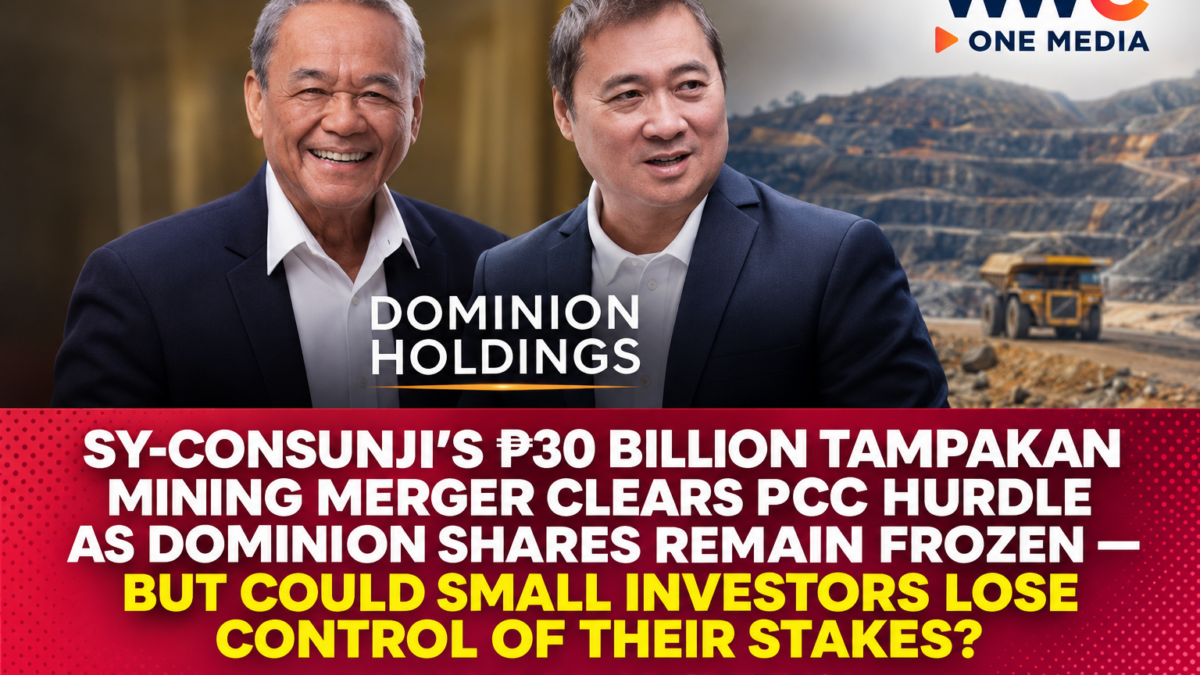
MANILA, PHILIPPINES — November 10, 2026 — Two of the Philippines’ most influential business families are moving closer to bringing one of the world’s largest undeveloped copper-gold deposits into a publicly listed company. But while the billionaires behind the deal are advancing their mining ambitions, smaller shareholders are still waiting for answers about what their investments will be worth after the merger.
Dominion Holdings Inc. (PSE: DHI), whose board includes prominent businessmen Henry “Big Boy” Sy Jr. and Isidro “Sid” Consunji, has cleared another regulatory hurdle in its plan to acquire controlling ownership of Sagittarius Mines Inc., the developer of the massive Tampakan copper-gold project in South Cotabato.
The company disclosed that it received a November 9 letter from the Philippine Competition Commission (PCC) confirming that the proposed merger is not covered by compulsory merger-notification requirements.
The development moves Dominion closer to completing its merger with Indophil Resources Philippines Inc. and Sonar Holdings Inc.
But the transaction is far from finished.
The Securities and Exchange Commission (SEC) must still approve the merger, Dominion’s shares remain suspended from trading, and the company has not disclosed the final exchange ratio or how much existing investors’ ownership could shrink.
With an authorized capital increase from ₱3.42 billion to ₱30 billion forming part of the transaction, the unanswered questions are becoming increasingly important.
The central issue is no longer simply whether Dominion can bring Tampakan into its portfolio. It is whether public shareholders will receive sufficient information and protection as the company’s ownership structure undergoes a potentially dramatic transformation.
PCC Gives Dominion a Regulatory Breakthrough — But the Merger Is Not Yet Approved
According to Dominion’s November 10 disclosure and reporting by Bilyonaryo, the company received a letter of non-coverage from compulsory notification dated November 9, 2026.
The letter concerns Dominion’s proposed merger with Indophil Resources Philippines Inc. and Sonar Holdings Inc.
The distinction matters.
A letter of non-coverage means the transaction does not require compulsory notification to the PCC under the applicable merger-notification framework.
It does not mean the commission has completed a full substantive review and determined that every aspect of the merger presents no competition concerns.
Nor does it automatically authorize the companies to complete the transaction.
Dominion still needs SEC approval and must satisfy applicable regulatory and disclosure requirements.
The company had previously targeted completion during the fourth quarter of 2026, but that timetable remains subject to the necessary approvals.
For investors, the PCC development is a positive procedural milestone, not confirmation that the merger has already closed.
How the Sy and Consunji Groups Plan to Bring Tampakan Into Dominion
The proposed merger involves three companies:
- Dominion Holdings Inc., the publicly listed company that will survive the transaction.
- Indophil Resources Philippines Inc., a holding company with interests in Sagittarius Mines.
- Sonar Holdings Inc., another holding company with interests in Sagittarius Mines.
Indophil and Sonar together hold 100% of the voting rights in Sagittarius Mines Inc. under the ownership arrangements described in Dominion’s disclosures.
Sagittarius holds the Financial and Technical Assistance Agreement covering the Tampakan copper-gold project.
Under the proposed transaction, Dominion will absorb Indophil and Sonar, including their assets, rights and liabilities.
In exchange, the shareholders of Indophil and Sonar will receive newly issued Dominion common shares.
Once the merger is completed, Dominion expects to hold 100% of the voting rights and controlling ownership of Sagittarius Mines.
That would transform Dominion from a holding company into a major listed investment vehicle focused on mining assets.
Importantly, 100% of the voting rights should not automatically be interpreted as 100% of the economic ownership of Sagittarius.
Earlier disclosures identified Indophil’s 40% stake and Sonar’s 31.6% stake, representing 71.6% combined economic ownership, alongside arrangements granting the companies all voting rights.
The distinction between voting control and economic ownership is important when evaluating Dominion’s eventual interest in Tampakan.
Who Are the Billionaires Behind the Deal?
Henry Sy Jr. is a prominent member of the family behind the SM Group, one of the Philippines’ largest conglomerates.
He serves as chairman of SM Prime Holdings and vice chairman of SM Investments Corporation.
Sy has indirect interests in Indophil and Sonar through family-linked corporate entities.
Isidro Consunji, meanwhile, is chairman and president of DMCI Holdings, a diversified conglomerate with interests in construction, property development, energy, cement and mining.
Consunji became Dominion’s chairman in March 2026.
His family is connected to DFC Holdings Inc., which owns a minority interest in Indophil.
The involvement of these business leaders has intensified market interest in Dominion’s transformation.
Both families have extensive experience in capital-intensive industries.
But their business backgrounds do not eliminate the financial, environmental and regulatory risks associated with developing a large mining project.
Their involvement also raises questions about related-party transactions, valuations and safeguards for smaller investors.
The broader importance of corporate governance was examined by WWC ONE MEDIA in its report on the DMCI Group’s seven Golden Arrow Awards and first-half earnings growth.
For Dominion, governance scrutiny will be especially important because of the merger’s potential effect on existing shareholders.
Why Tampakan Is Considered a Giant Mining Opportunity
The Tampakan copper-gold project in South Cotabato is one of the Philippines’ most significant undeveloped mineral deposits.
Historical estimates associated with the project indicate approximately:
- 15 million tonnes of contained copper
- 17.6 million ounces of contained gold
These figures highlight the deposit’s potential size, but they should not be interpreted as guaranteed commercial reserves or future production.
Actual recoverable quantities depend on updated geological studies, extraction methods, engineering assumptions, permitting and economic feasibility.
Copper is a critical industrial metal used in electrical wiring, transmission systems, industrial machinery and many renewable-energy technologies.
Gold is used in jewelry, investment products, electronics and other applications.
Demand for both metals has made large copper-gold deposits increasingly attractive to investors.
However, market prices are volatile.
As WWC ONE MEDIA reported in its coverage of copper’s sharp market fluctuations and changing industrial demand, even strategically important commodities can experience significant price swings.
For Tampakan, strong commodity prices could improve long-term economics, but they cannot guarantee that developing the project will be commercially attractive.
The mineral deposit has remained commercially undeveloped for decades.
A corporate merger does not mean mining operations are about to begin.
Dominion Plans to Expand Authorized Capital Nearly Ninefold
To accommodate the proposed merger, Dominion shareholders have approved a substantial expansion of the company’s authorized capital stock.
The capital structure would increase from ₱3.42 billion to ₱30 billion.
The authorized common shares would increase from 3.4 billion to 29.75 billion, while authorized preferred shares would increase from 200,000 to 2.5 million.
That represents an almost ninefold increase in authorized capital.
The purpose is to create room for the issuance of new shares under the merger and potentially future financing activities.
However, authorized capital is not the same as issued capital.
Increasing the maximum number of shares a company is legally permitted to issue does not automatically mean every authorized share will be issued.
The actual effect on ownership depends on the number of shares issued to Indophil and Sonar shareholders, together with any subsequent transactions.
That is precisely the information many investors are still waiting to see.
Small Shareholders Face a Major Question: How Much Will Their Stakes Be Diluted?
The most controversial issue surrounding Dominion’s merger is the potential dilution of existing shareholders.
Before the transaction, Dominion’s reported ownership structure included:
- Monte Sur Equity Holdings Inc. — approximately 70%.
- DFC Holdings Inc. — approximately 8.87%.
- Public shareholders — approximately 21.12%.
The company has not yet disclosed the final post-merger ownership percentages.
Its merger documentation identifies several of these figures as still to be determined.
That uncertainty creates a problem for public investors.
When a company issues new shares to investors who are contributing assets, existing shareholders generally own a smaller percentage of the enlarged company unless they also receive additional shares.
This is called ownership dilution.
For example, suppose a shareholder owns 1% of a company with 100 million outstanding shares.
If the company issues another 100 million shares to new investors and the original shareholder receives no additional shares, that person’s ownership falls to 0.5%.
The investor still owns the same number of shares, but a smaller percentage of the company.
This is only an illustration, not a forecast of Dominion’s actual post-merger structure.
The financial consequences depend on the value of the assets contributed and the fairness of the share-exchange ratio.
Dilution does not necessarily mean shareholders will lose money.
If the assets received are worth enough, a smaller percentage of a more valuable company could still benefit investors.
But shareholders need credible valuations and complete transaction details to assess that possibility.
Without the final share-exchange ratio and ownership table, they cannot accurately determine the dilution they may face.
Why the Share-Exchange Ratio Matters So Much
Dominion has indicated that the exchange ratio will be based on the book values of Dominion, Indophil and Sonar using audited interim financial statements as of August 31, 2026.
An independent fairness valuator is expected to assess the transaction.
That review matters because the exchange ratio determines how many Dominion shares the owners of Indophil and Sonar will receive.
If the ratio grants the incoming shareholders a very large portion of the enlarged company, existing investors could experience substantial percentage dilution.
Alternatively, if the value of the contributed mining interests justifies the share issuance, the merger could create long-term benefits for shareholders.
The difficulty is that investors cannot make an informed assessment without seeing the final numbers.
A fairness opinion may provide an independent assessment of whether the financial terms are fair under its stated assumptions.
However, the opinion does not guarantee that the mining project will become profitable or that Dominion’s market price will rise.
The quality of valuation assumptions is especially important for an undeveloped mining deposit.
Development timelines, construction costs, commodity prices, discount rates and regulatory risks can significantly affect estimated value.
Shareholders Approved the Merger — But Key Numbers Remain Unanswered
Dominion’s shareholders approved the merger during the company’s annual meeting on September 14, 2026.
They also approved the increase in authorized capital and a waiver relating to the rights or public-offer requirement for shares to be issued to Indophil and Sonar shareholders.
The waiver was supported by the required majority of minority shareholders, according to the company’s disclosures.
These approvals allow the transaction to advance through the regulatory process.
But approval does not mean every financial detail has been finalized or disclosed.
Investors still need to know the final exchange ratio, total share issuance and resulting ownership percentages.
These are not minor technical details.
They determine how voting influence and economic ownership will be distributed after the merger.
The company has said it will disclose the final ownership structure and public float when available.
Until then, the potential effect on each shareholder remains uncertain.
Dominion Trading Remains Suspended on the Philippine Stock Exchange
The uncertainty is intensified by the suspension of Dominion shares.
Following the board’s August 19 approval of the merger, the Philippine Stock Exchange halted trading on August 20 while awaiting additional information.
The exchange subsequently suspended the shares on August 26 after classifying the transaction as a backdoor listing.
A backdoor listing generally involves an existing listed company acquiring or combining with another business in a manner that materially changes its operations or ownership.
Such transactions are subject to additional disclosure and regulatory requirements because they can effectively introduce new businesses into the public market without following a conventional initial public offering.
Dominion’s proposed acquisition of a controlling interest in Sagittarius Mines represents a major change in its business direction.
The suspension has left shareholders unable to trade DHI shares on the exchange while the company addresses the relevant requirements.
The resumption date remains undisclosed as of November 10.
That uncertainty is particularly significant because Dominion shares had surged more than 800% over the 12 months preceding August 7, according to Bilyonaryo.
The earlier rally demonstrates strong investor interest, but it does not establish what the shares will be worth when trading resumes.
Market conditions, transaction disclosures and investor expectations could all influence the eventual price.
Could Dominion’s Public Float Fall Below PSE Requirements?
Another complication is the company’s minimum public ownership requirement.
The Philippine Stock Exchange requires listed companies to maintain applicable minimum levels of shares held by the public.
Dominion’s public shareholders currently account for approximately 21.12% of its pre-merger ownership structure, based on reported figures.
If a large number of new shares is issued to existing owners of Indophil and Sonar, the public’s percentage could fall.
That may create a need for additional share sales or other transactions to meet exchange requirements.
Dominion has indicated that shareholders are considering potential sell-downs and other arrangements to address public float.
However, the final strategy and amount of shares involved have not been confirmed.
This presents a second layer of uncertainty for existing investors.
Even after the merger is approved, Dominion may need to complete additional transactions before its shareholding structure satisfies the applicable listing requirements.
Investors will need to examine not just the final merger ratio, but also any proposed sale of shares following the transaction.
Tampakan’s Long History Shows Why Mining Development Is Never Simple
The Tampakan project has attracted interest for decades because of its enormous mineral potential.
But despite its scale, commercial development has repeatedly faced obstacles.
These include regulatory uncertainty, environmental issues, local policy restrictions and objections from communities affected by the proposed mine.
Large-scale mining projects can offer substantial economic benefits through employment, infrastructure investment, exports and government revenues.
However, they can also create significant environmental and social risks.
Potential concerns include land disturbance, water use, waste management, biodiversity loss and impacts on local livelihoods.
Tampakan’s future will depend not only on corporate restructuring but also on the ability of its developers to satisfy applicable regulatory, environmental and community requirements.
The issue reflects a broader debate over responsible mineral development in the Philippines.
As WWC ONE MEDIA examined in its analysis of the environmental and social costs of mining, the mining industry’s long-term value must be evaluated beyond production volumes and export revenues.
Rehabilitation obligations, community participation and measurable environmental performance are also critical.
For Tampakan, the merger may reorganize ownership, but it does not automatically resolve these longstanding issues.
Indigenous Communities and Environmental Safeguards Remain Important
Large mining developments in the Philippines must also contend with questions surrounding ancestral domains and Indigenous community rights.
Where applicable, laws governing free, prior and informed consent and other community protections must be observed.
The implications differ from project to project, and allegations involving one mining site should not be assumed to establish wrongdoing at another.
Nevertheless, recent controversies demonstrate the importance of transparent consultation.
In related coverage, WWC ONE MEDIA reported on a congressional investigation sought by Leila de Lima concerning a 1,410-hectare mining project in Bataan and questions raised by Ayta communities.
That case is separate from Tampakan.
Its relevance lies in the broader governance challenge confronting mining companies: securing necessary approvals while demonstrating respect for affected communities and environmental protections.
For a project as large as Tampakan, these considerations could materially influence development schedules, financing requirements and investor confidence.
Why the SEC Approval Is Still Critical
Although the PCC non-coverage letter represents progress, Dominion’s proposed merger cannot be treated as completed.
The SEC must still approve the merger under the applicable corporate requirements.
The parties must also finalize the share-exchange terms and satisfy other conditions.
Dominion’s disclosures indicate that the merger will become effective on the first calendar day of the month following the issuance and release of the SEC’s certificate of merger.
This means that even after approval is granted, the specific legal effective date depends on the timing established in the transaction documents.
Investors should therefore avoid assuming that the PCC letter alone has completed the acquisition of Sagittarius Mines.
A regulatory milestone is not the same as legal closing.
What Happens Next? Five Questions Investors Need Answered
Dominion’s next disclosures will be especially important because they could clarify the financial consequences of the proposed merger.
1. What is the final share-exchange ratio?
Investors need to know how many shares will be issued to Indophil and Sonar shareholders.
2. How much dilution will existing shareholders face?
The company must disclose the final ownership percentages and the effect on public shareholders.
3. When will the SEC approve the merger?
The PCC has issued its letter of non-coverage, but SEC approval remains necessary.
4. When will DHI trading resume?
The suspension prevents investors from buying or selling shares through normal exchange trading.
5. How will Tampakan be financed and developed?
The merger would bring control of the mining project into Dominion, but substantial technical, financial, environmental and regulatory work may still be necessary before commercial operations can begin.
Answers to these questions will help investors determine whether the transaction offers attractive long-term value or exposes them to risks they cannot yet measure.
The Bigger Picture: A Mining Giant in the Making, but Shareholders Need Answers
The Sy and Consunji groups are attempting one of the most consequential mining-related corporate restructurings in the Philippine stock market.
The proposed Dominion merger could place voting control of Sagittarius Mines and the massive Tampakan copper-gold project inside a publicly listed holding company.
The PCC’s November 9 non-coverage letter removes an important regulatory obstacle.
Shareholders have also approved the merger and a substantial increase in authorized capital.
Yet the transaction still contains major unresolved issues.
The final exchange ratio remains undisclosed.
The post-merger ownership structure has not been finalized.
Public shareholders do not yet know how much their ownership percentages could shrink.
And Dominion’s shares remain suspended, with no announced date for trading to resume.
For the billionaires behind the project, the merger could create a powerful vehicle for developing one of the country’s most valuable mineral assets.
For smaller investors, however, the immediate priority is greater transparency.
Tampakan’s copper and gold may be worth pursuing, but that does not automatically make every share-exchange arrangement fair to existing investors.
As the transaction moves toward its next regulatory milestone, the question facing Dominion is becoming unavoidable:
Will the Sy-Consunji merger unlock billions in long-term mining value for all shareholders—or could the eventual ownership structure reveal that the biggest gains are concentrated among the deal’s most powerful investors?