
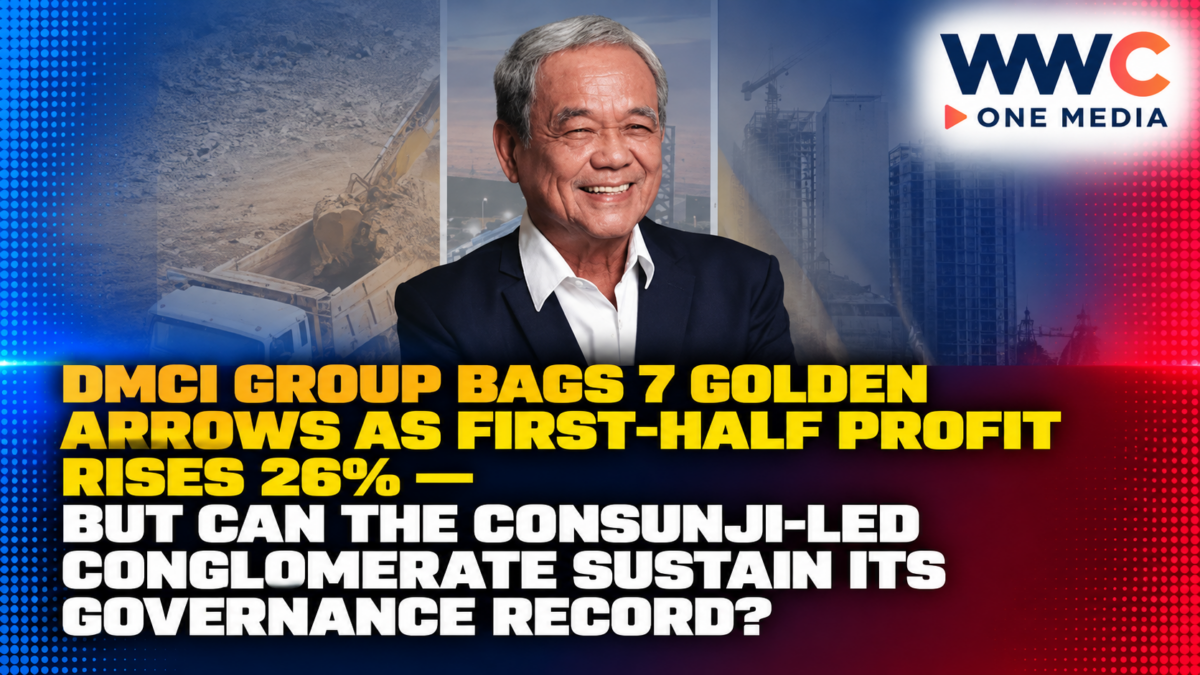
MANILA, PHILIPPINES — Three publicly listed companies belonging to the Consunji-led DMCI Group have secured corporate governance honors at the 2026 Golden Arrow Awards, underscoring the importance of transparency and accountability as the diversified conglomerate expands across mining, energy, construction, property and cement manufacturing.
DMCI Holdings Inc., Semirara Mining and Power Corporation (SMPC), and Concreat Holdings Philippines Inc. received a combined seven Golden Arrows at the ceremony held October 23 at the Shangri-La Hotel in Makati City.
The recognition comes as DMCI Holdings reported a 26% increase in first-half 2026 net income attributable to its shareholders, reaching approximately ₱11.4 billion.
But a closer examination of the awards reveals an important development.
While the group continues to receive governance recognition, parent company DMCI Holdings earned Two Golden Arrows this year, down from Three Golden Arrows in the previous assessment.
The company has not disclosed a specific explanation for the change.
As DMCI navigates growing investments, volatile commodity markets and the integration of its cement operations, the question becomes increasingly important:
Can the group turn governance recognition and stronger financial results into lasting shareholder value—or will its next phase of expansion test the strength of its corporate oversight?
THREE DMCI COMPANIES RECOGNIZED AT GOLDEN ARROW AWARDS
According to InsiderPH’s October 27 report and DMCI Holdings’ disclosure to the Philippine Stock Exchange, three group companies received honors under the 2025 ASEAN Corporate Governance Scorecard assessment.
DMCI Holdings received Two Golden Arrows.
Semirara Mining and Power Corporation received Three Golden Arrows.
Concreat Holdings Philippines received Two Golden Arrows, marking the cement manufacturer’s sixth overall corporate governance recognition.
The ceremony took place October 23, 2026.
The awards are conferred by the Institute of Corporate Directors in partnership with the Securities and Exchange Commission.
The assessments recognize governance practices rather than commercial performance alone.
That distinction matters because the awards are not proof that every business in the group achieved record profits, eliminated operational risks or outperformed competing companies.
WHY SEVEN GOLDEN ARROWS MATTER
The combined seven-arrow total highlights recognition across three separately listed corporations.
Each company has different business activities, shareholders, regulatory requirements and management responsibilities.
DMCI Holdings is the diversified parent conglomerate.
Semirara operates an integrated coal mining and power generation business.
Concreat manufactures cement used in construction and infrastructure.
Governance standards are particularly important because these industries involve large investments, operational hazards, environmental requirements and complex commercial relationships.
For shareholders, transparent disclosures and effective board oversight can help them assess how corporate leaders manage these responsibilities.
However, the three award ratings must be presented individually.
The group did not receive one seven-arrow award, and none of the three companies received the highest Five Golden Arrows distinction.
DMCI HOLDINGS DROPS FROM THREE ARROWS TO TWO
A comparison with the previous year’s recognition reveals a detail that should not be overlooked.
In October 2025, DMCI Holdings announced that it had earned Three Golden Arrows for the third consecutive year.
Its published disclosure identified an overall governance score of 97.85 out of 130 points under the revised assessment framework.
At the October 2026 ceremony, the parent company received Two Golden Arrows.
This represents a change in its award tier.
However, the publicly available announcement does not identify the exact score for the latest assessment or explain which evaluation factors contributed to the difference.
The change should not automatically be interpreted as evidence of a regulatory violation, financial misconduct or a governance scandal.
A responsible assessment requires the actual scorecard and information about the applicable methodology.
The decline nevertheless illustrates why corporate governance recognition should be examined over several years rather than treated as a permanent achievement.
SEMIRARA EARNS THREE GOLDEN ARROWS
Semirara Mining and Power Corporation received Three Golden Arrows at the latest awards.
The company operates in industries where corporate oversight is particularly important because of their environmental, operational and financial risks.
Its integrated operations include coal production and electricity generation.
Mining requires safety procedures, environmental management and responsible handling of rehabilitation obligations.
Power generation involves plant reliability, maintenance planning, regulatory compliance and long-term capital expenditure.
Semirara has received corporate governance recognition in previous assessment cycles.
Its latest award continues that record.
However, a governance distinction does not certify that every environmental obligation has been completed or that future power operations will be free from disruptions.
Those outcomes must be assessed using separate regulatory reports and operating disclosures.
CONCREAT GETS ITS SIXTH GOVERNANCE RECOGNITION
Concreat Holdings Philippines, formerly known as Cemex Holdings Philippines, received Two Golden Arrows.
According to DMCI’s regulatory disclosure, the distinction marks Concreat’s sixth overall recognition for corporate governance.
Concreat operates two cement manufacturing facilities with a combined rated annual production capacity of approximately 7.2 million metric tons.
Its cement products include the APO, Island and Rizal brands.
The company became part of the wider Consunji business portfolio following a transaction completed in December 2024 involving DMCI Holdings, Semirara and Dacon Corporation.
For Concreat, the governance recognition comes during a period of business integration and financial restructuring.
Its management must balance cost control, demand conditions, financing obligations and the operational requirements of cement manufacturing.
A sixth governance recognition provides a record of participation in the assessment process.
But it does not mean that the cement business has fully recovered financially.
WHO CONTROLS CONCREAT?
The Philippine Stock Exchange’s company information confirms that Concreat was previously known as Cemex Holdings Philippines.
The Consunji-related buyers completed their acquisition of shares in its former controlling parent in December 2024.
Through that transaction, the purchasing group obtained indirect control over approximately 89.86% of Concreat.
The listed cement business continues to operate through subsidiaries including APO Cement Corporation and Solid Cement Corporation.
This ownership structure is relevant to governance because major transactions and commercial relationships among group companies require appropriate disclosure and oversight.
Investors need to understand how ownership, financing and operating agreements affect the listed business.
HERBERT CONSUNJI EMPHASIZES TRUST AND ACCOUNTABILITY
DMCI Holdings executive vice president and chief finance officer Herbert Consunji welcomed the latest awards.
He emphasized that governance is essential to strengthening businesses, maintaining stakeholder confidence and supporting sustainable value creation.
The group’s official statement identifies transparency, accountability, integrity and responsible management as continuing priorities.
These principles are particularly relevant to a conglomerate operating in industries with significant long-term commitments.
But they must also be reflected in measurable outcomes.
For investors, the important questions include whether management adequately discloses material risks, evaluates major investments carefully and follows appropriate procedures in transactions involving related parties.
Strong corporate values are meaningful when they guide decisions—not merely when they appear in annual reports.
HOW THE ASEAN CORPORATE GOVERNANCE SCORECARD WORKS
The Golden Arrow Awards use the ASEAN Corporate Governance Scorecard, or ACGS, to evaluate publicly listed companies.
The framework covers shareholder rights, equitable treatment, disclosure practices, board responsibilities and other governance considerations.
The revised framework places additional emphasis on sustainability and resilience.
It aligns with updated international corporate governance principles developed through the G20 and the Organisation for Economic Co-operation and Development.
These criteria reflect the increasing expectation that corporate boards should prepare for financial, environmental and operational risks.
For a mining and infrastructure conglomerate, that means governance extends well beyond formal board meetings.
It also involves how leaders assess capital investments, environmental obligations, financial exposures and the interests of communities affected by operations.
DMCI’S FIRST-HALF PROFIT JUMPS 26%
The Golden Arrow recognition comes alongside stronger financial performance.
DMCI Holdings reported approximately ₱11.4 billion in first-half 2026 net income attributable to parent shareholders.
That was 26% higher than the approximately ₱9 billion reported in the first half of 2025.
In the second quarter alone, earnings increased 61% to approximately ₱6.5 billion.
Consolidated first-half revenue climbed about 10% to ₱67.5 billion.
The Philippine Star and Manila Bulletin independently reported these results in August.
The improvement reflects stronger contributions from several business segments, including nickel mining, construction, property development and a narrowing of losses in cement.
However, the earnings growth should not be attributed directly to the Golden Arrow Awards.
Financial performance and corporate governance ratings measure different aspects of a company.
NICKEL MINING BECOMES AN IMPORTANT EARNINGS DRIVER
DMCI Mining delivered strong results during the first half of 2026.
Its Long Point mine contributed a full quarter of operations, increasing the number of active nickel mines in the company’s portfolio.
This helped support higher production and shipment volumes.
DMCI’s second-quarter report described record nickel mining earnings.
The development highlights the group’s exposure to mineral-resource markets.
Nickel is used in stainless steel production and certain battery supply chains.
But mining revenue depends on production volumes, international commodity prices, costs and regulatory conditions.
A strong quarter does not guarantee that the same earnings level can be maintained indefinitely.
For investors, the sustainability of mining profits will depend on market demand, operating efficiency and responsible resource management.
SEMIRARA’S POWER BUSINESS OFFSETS WEAKER COAL RESULTS
Semirara’s integrated business also contributed to the group’s first-half earnings.
Power generation performance helped offset weaker conditions in coal operations.
DMCI’s disclosures show that Semirara contributed approximately ₱4.7 billion to the parent group’s first-half attributable earnings.
That represented a small decline compared with the previous year, despite stronger performance in selected operating areas.
The difference underscores why segment-level analysis matters.
An energy company may experience improving results in power generation while facing lower earnings from coal.
These operations respond to different market conditions and cost structures.
Investors must consider both when evaluating the group’s outlook.
CONCREAT’S LOSSES NARROW SIGNIFICANTLY
Another important development is the improvement in Concreat’s financial performance.
In the first half of 2026, Concreat’s attributable loss to the DMCI Group narrowed to approximately ₱207 million.
That compares with a loss of about ₱1.2 billion in the previous year’s first half.
In the second quarter, its contribution was close to break-even, with a small loss.
The improvement was supported by operating adjustments, stronger cement sales conditions and cost management.
However, a smaller loss is not the same as sustained profitability.
Concreat still faces challenges involving cement demand, competition, financing expenses and operating costs.
Its next financial reports will be important in determining whether the recovery can continue.
CEMENT AND CONSTRUCTION CREATE STRATEGIC OPPORTUNITIES
The integration of Concreat into the DMCI Group creates potential relationships between cement production and the conglomerate’s construction activities.
Cement is a fundamental input for residential developments, transport infrastructure, industrial facilities and other construction projects.
DMCI’s businesses may benefit from coordinated planning and logistics arrangements.
However, any commercial relationships among group companies must be managed according to applicable governance and disclosure requirements.
Investors should not assume that internal transactions automatically create savings or additional profit.
Benefits must be demonstrated through operating results and transparent financial reporting.
PROPERTY DEVELOPMENT REMAINS A MAJOR PART OF THE GROUP
DMCI Homes contributes to the conglomerate’s real estate operations.
Its business includes residential developments, particularly in urban areas.
The division reported stronger second-quarter results amid improved development progress and operating margins.
However, residential property markets are affected by financing rates, construction expenses, consumer demand and project delivery schedules.
Property developers also face responsibilities to buyers involving completion timelines, contract terms and construction quality.
Corporate governance matters in managing these obligations.
The latest awards do not directly measure the experience of individual property buyers or the quality of specific developments.
MAYNILAD ADDS ANOTHER GOVERNANCE DIMENSION
DMCI Holdings also has an investment in Maynilad Water Services.
The utility provides water and wastewater services in its concession area and operates within a regulated environment.
Following Maynilad’s public offering, DMCI’s effective ownership interest decreased, affecting the contribution from the investment to the conglomerate’s earnings.
Water utilities face responsibilities involving infrastructure investment, service reliability, environmental compliance and customer protection.
Although Maynilad was not one of the three companies named in the October 2026 Golden Arrow announcement, it remains relevant to understanding the group’s broader risk exposure.
A diversified conglomerate must exercise effective oversight across its investments, not only within the companies receiving awards.
FINANCIAL STRENGTH SUPPORTS FUTURE INVESTMENT
DMCI’s first-half 2026 interim reporting showed cash and cash equivalents of approximately ₱39.1 billion at the end of June.
Total debt stood at approximately ₱66.4 billion.
The group’s net debt-to-equity ratio improved to about 17.1% from 25.1% at the end of 2025.
These figures indicate that cash generation and financial management remained important priorities.
However, the group continues to face borrowing obligations and substantial investment requirements.
Earlier in 2026, DMCI announced a capital expenditure allocation of approximately ₱24.6 billion for its subsidiaries.
Planned expenditures are not the same as completed investment.
The actual deployment of funds and its effect on profitability depend on project progress and business conditions.
WHAT MULTIPLE NEWS SOURCES CONFIRM
InsiderPH’s October 27 report identifies the three Golden Arrow recipients and emphasizes the group’s governance commitments.
DMCI Holdings’ filing with the Philippine Stock Exchange confirms the award levels, event date and official statements.
StockBayan and Philippine Stock Market Today separately summarize the stock-exchange disclosure and confirm that the award announcement contains no new financial results.
For financial context, The Philippine Star and Manila Bulletin independently reported the company’s first-half earnings increase.
The Philippine Stock Exchange’s company profile confirms Concreat’s former name, ownership transition and cement manufacturing operations.
DMCI’s October 2025 award announcement also provides direct evidence that the parent company previously received Three Golden Arrows.
These sources establish both the latest recognition and the broader developments affecting the conglomerate.
However, the award coverage does not independently establish the reasons for DMCI Holdings’ lower rating or prove that governance recognition directly caused stronger earnings.
WHAT THE AWARDS MEAN FOR DMCI SHAREHOLDERS
Corporate governance recognition can be useful when evaluating a publicly traded company.
It provides information about how an organization performs against a recognized framework of board oversight, transparency and shareholder protections.
But it should be considered alongside financial results and operational risks.
DMCI Holdings has reported stronger earnings, but its businesses remain exposed to changing market conditions.
Coal and nickel prices can fluctuate.
Cement demand may weaken.
Property development can be affected by interest rates and consumer confidence.
Major infrastructure and energy operations require careful financial and environmental management.
For shareholders, these factors are just as important as an award rating.
THE BIGGER QUESTION: CAN DMCI TURN RECOGNITION INTO LASTING VALUE?
The DMCI Group’s latest Golden Arrow Awards recognize governance practices across three publicly listed businesses.
Semirara received Three Golden Arrows, while DMCI Holdings and Concreat each received Two.
The awards come as the parent conglomerate reports stronger profits and improving performance across several operations.
But the results also show that governance ratings can change.
DMCI Holdings’ movement from three arrows to two raises a reasonable question about how the company will perform in future assessments.
There is no verified evidence that the rating change resulted from misconduct, and no explanation should be invented.
The company will ultimately be evaluated on how well it manages business risks, communicates with shareholders and delivers sustainable financial performance.
For the Consunji-led conglomerate, the real test is whether governance principles continue translating into responsible decisions as its businesses grow more complex.
And with earnings recovering, cement operations improving and major investments ahead, one important question remains:
Will DMCI’s latest governance recognition and stronger profits help sustain its growth—or will changing markets, expansion risks and tougher oversight requirements become the biggest test of its next chapter?










