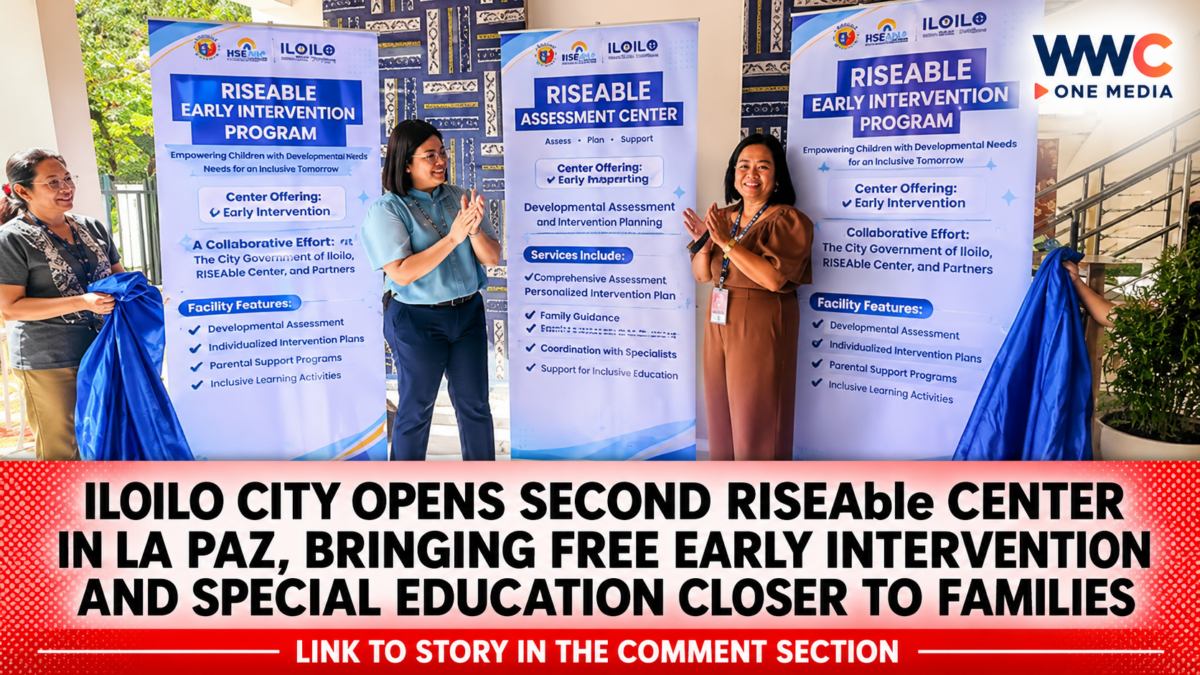
Families raising children with autism and other developmental conditions in Iloilo City now have another place to seek specialized support after the city government opened its second RISEAble Center in La Paz, expanding access to free early intervention, developmental assessment and special education services.
The new facility, located at the Delfin Jaranilla Learning Center in La Paz, is intended to serve families from La Paz, Jaro and Lapuz. It expands the program first established in Molo in October 2025, reducing the distance some parents must travel to access services for their children.
Mayor Raisa Treñas led the inauguration on November 9, 2026, emphasizing that children should receive appropriate support as early as possible to help them develop communication, social and daily living skills and become more independent.
The expansion is part of the city’s broader RISEAble Program: Kaya sang Kada Bata, which aims to make developmental support more accessible to children and their families.
Panay News separately reported that the city is proposing a ₱3.9-million allocation for the program in its 2027 budget to sustain and expand its services. SunStar Publishing Inc.+1
Second Center Expands Services to More Iloilo Families
The opening of the La Paz facility marks an important expansion of a program designed to address the needs of young children with neurodevelopmental conditions.
The original RISEAble Center in Barangay Taal, Molo, began operating in October 2025. The new La Paz location is expected to serve families from three additional districts, making it easier for parents to access intervention and educational support without having to travel as far.
Under the current arrangement, the Molo center serves families from Molo, Arevalo and Mandurriao, while the La Paz facility caters to La Paz, Jaro and Lapuz.
City officials are also exploring the possibility of establishing another center in Barangay Bo. Obrero through a partnership with Assumption.
Treñas has expressed her goal of eventually establishing RISEAble centers in every district so families can obtain services closer to home.
The expansion is particularly important for parents who face transportation expenses, limited access to specialists and the high cost of private developmental services. Panay News+1
Free Early Intervention for Children Aged Zero to Five
One of the program’s central components is the RISEAble Early Intervention Program, which serves children aged zero to five with neurodevelopmental disorders.
The initiative focuses on identifying developmental needs early and providing individualized support during a critical period of childhood development.
Services include specialized intervention sessions and Special Education (SPED) classes tailored to each child’s abilities and needs.
The program aims to strengthen essential skills, including:
- Communication and language development
- Social interaction and relationship-building
- Behavioral development and self-regulation
- Early academic and classroom readiness
- Independence and daily living skills
The city says these services are delivered by licensed SPED teachers, psychometricians and trained personnel.
Rather than applying the same learning approach to every child, the center provides individualized sessions based on developmental assessments and the needs identified for each learner.
The long-term objective is to help children develop the skills needed to participate more confidently in educational settings, including eventual integration into regular classrooms when appropriate. SunStar Publishing Inc.+1
Developmental Assessments Also Available for Free
Beyond intervention and SPED classes, the RISEAble initiative includes assessment services intended to help families better understand their children’s developmental needs.
The city has identified several services under its RISEAble Assessment Center, including:
- Developmental screening and assessment
- Draw-A-Person Test (DAP)
- Autism Diagnostic Observation Schedule (ADOS-2)
- Consultations and guidance for parents
These assessments can help qualified professionals evaluate developmental patterns and determine what additional support may be appropriate.
ADOS-2, for example, is a standardized assessment tool used by trained professionals as part of an evaluation for autism spectrum disorder. It is not a stand-alone substitute for a comprehensive clinical assessment.
Access to screening and assessment is important because parents may notice differences in communication, social interaction or behavior but may not know where to seek professional guidance.
Early evaluation can help families understand their child’s needs and identify suitable educational or developmental support.
The city has emphasized that the program is intended to make these services more accessible without requiring families to shoulder the full cost of private assessments. SunStar Publishing Inc.+1
Nearly Half of Molo Center Learners Endorsed to Regular Schools
The expansion comes as the city reports progress among children who enrolled at the original RISEAble Center in Molo.
According to the city government, nearly half of the center’s learners have already been endorsed to regular schools under the Department of Education’s Iloilo City Division.
The transition reflects the program’s objective of preparing children to participate in mainstream education when their developmental progress and individual needs allow.
The process is not necessarily an immediate or automatic transfer. Children may need continuing intervention, gradual classroom exposure and support from teachers and families.
An earlier report by Iloilo Metropolitan Times documented the progress of the first batch of 28 learners at the Molo center. Eight were identified for full integration into regular classrooms, while 20 were placed under partial integration, allowing them to continue intervention while gradually experiencing larger classroom environments.
These figures relate to the earlier reported batch and should not be confused with the city’s broader statement that nearly half of its learners have been endorsed to regular schools. SunStar Publishing Inc.+1
The Cost of Private Therapy Makes Free Services Especially Important
For many families, obtaining developmental support can be financially difficult.
When Iloilo City opened its first RISEAble center in October 2025, the Philippine News Agency reported that Mayor Treñas had learned of a family struggling to afford private therapy, which could cost approximately ₱25,000 to ₱30,000 per month.
That expense can place enormous pressure on households, particularly when children require continuing sessions and additional assessments.
The city-run program aims to reduce that burden by offering specialized learning and intervention services without charge.
Parents have also welcomed the expansion, according to Panay News, with families describing the program as valuable assistance for children who might otherwise struggle to obtain early intervention.
However, free access does not automatically mean every child can immediately receive a slot. The city has previously discussed accommodating learners in batches, and the number of available teachers and specialists will affect how many children can be served. Panay News+2
A Separate Program Supports Young Adults With Disabilities
RISEAble is not limited to young children.
The city has also highlighted the Breaking Barriers for Young Adults with Disabilities (BBY) Training and Development Center, located along M.H. del Pilar Street in Molo.
The facility serves individuals aged 15 to 45 and is intended to provide opportunities for development and skills training.
This component recognizes that support for people with disabilities should not end when they reach school age.
Young adults may also need assistance developing practical skills, improving independence and preparing for greater participation in community and economic life.
By combining early intervention for young children with training opportunities for older individuals, the city is positioning RISEAble as a broader support initiative rather than a single special education facility. SunStar Publishing Inc.+1
Iloilo’s Expansion Comes as the Philippines Strengthens Inclusive Education
The opening of the second RISEAble Center also comes amid wider efforts to improve educational access for learners with disabilities across the Philippines.
Republic Act No. 11650, or the Inclusive Education Act, provides a national framework for supporting learners with disabilities through inclusive education and the establishment of Inclusive Learning Resource Centers (ILRCs).
The law envisions access to educational and related support services, including psychological, medical and allied services, depending on learners’ individual needs.
In August 2026, WWC ONE MEDIA reported that Senate President Sherwin Gatchalian was urging the Department of Education to accelerate the hiring of specialists for inclusive education after the approval of 133 new plantilla positions.
The report highlighted the shortage of professionals needed to support learners with disabilities and the importance of ensuring that approved positions translate into actual services in schools and communities.
Read more: Gatchalian Presses DepEd to Speed Up Hiring of Specialists for Inclusive Education.
The national challenge is substantial. Establishing centers and approving positions are important steps, but families also need qualified personnel, consistent funding, accessible assessments and reliable referral systems.
Iloilo City’s expansion demonstrates how local governments can contribute to that wider effort by bringing services closer to communities. WWC One Media+1
More Support Is Needed Beyond the Classroom
Children with developmental conditions may need coordinated assistance from educators, health professionals, therapists and family members.
A special education center can provide an important foundation, but long-term progress often depends on continuity between home, school and other support services.
Parents need guidance on how to reinforce learning at home. Teachers need training and resources to accommodate different learning needs. Qualified professionals must also be available to assess children and recommend appropriate interventions.
WWC ONE MEDIA has previously reported on the importance of protecting children’s welfare through stronger local initiatives, including Iloilo’s Child-Safety Partnership With Meta, TikTok and Roblox.
Although online safety and developmental intervention address different concerns, both highlight the importance of building support systems around children rather than expecting families to manage every challenge alone.
The city has also been working on wider education initiatives, including efforts to improve school leadership and address learning gaps. Read more: Security Bank Trains 22 Public School Principals to Fight Learning Gaps and Absenteeism.
Proposed ₱3.9-Million Budget Could Help Sustain the Expansion
The city government’s proposed ₱3.9-million allocation for 2027 is another important development.
If approved and properly implemented, the funding could help sustain the program’s operations and support the expansion of early intervention services.
The proposal is particularly relevant as the city considers establishing additional centers in other districts.
However, the proposed allocation should not be treated as an already approved or released budget. Its implementation will depend on the city’s budget process and the final allocation approved for 2027.
The city will also need to ensure that funding supports the people and services that make the centers effective—not simply the facilities themselves.
That means maintaining qualified staff, providing appropriate learning materials, ensuring assessment capacity and establishing a clear system for admitting and supporting children.
The Bigger Challenge Is Making Early Intervention Accessible to Every Child
The opening of the La Paz RISEAble Center is a significant step for Iloilo City, particularly for families who have struggled to find affordable developmental services.
But the real measure of success will be how many children can access the program, how consistently they receive support and whether families see meaningful improvements in their children’s development and participation in education.
The city’s goal of establishing centers in every district is ambitious. Achieving it will require sustained funding, trained professionals and coordination with schools and healthcare providers.
For parents, the new facility offers something important: another accessible place where their children can be assessed, supported and encouraged to develop at their own pace.
For Iloilo City, it is a reminder that inclusive education is not simply about allowing children with disabilities to enter classrooms. It is about ensuring they receive the support, resources and opportunities they need to learn, participate and build more independent lives.