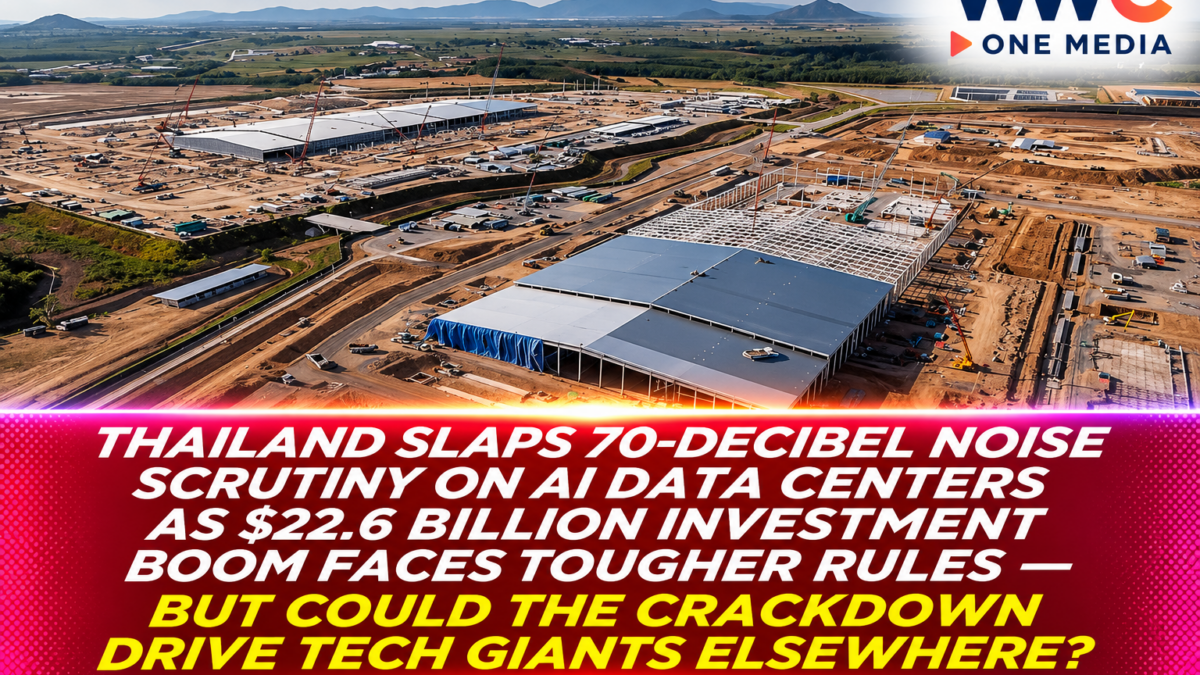
BANGKOK, THAILAND — November 10, 2026 — Thailand’s multibillion-dollar ambition to become Southeast Asia’s next artificial intelligence and data-center powerhouse is facing a major regulatory test as authorities intensify controls over noise, heat, water consumption and electricity demand.
The government is tightening oversight of large computing facilities following growing complaints about their environmental effects on surrounding communities.
The scrutiny includes Thailand’s existing 70-decibel environmental noise benchmark, Bangkok’s heat-impact inspection criteria and proposed nationwide requirements governing data-center construction and operation.
For global technology companies seeking to expand in Southeast Asia, the message is increasingly clear: Access to land, electricity and investment incentives will no longer be enough. Developers must also demonstrate that their facilities can operate without imposing unacceptable costs or environmental risks on nearby communities.
The regulatory push comes as Thailand attempts to attract billions of dollars in foreign technology investment.
As of February 2026, the country had 42 data centers representing approximately 3,400 megawatts of reported IT load and investment valued at about 750 billion baht, equivalent to roughly US$22.6 billion at the exchange rate used in October reporting.
But the expansion has triggered concerns over electricity consumption, backup fuel storage, noise, cooling systems and environmental oversight.
In September, the authorities paused construction activity involving 49 projects and held up another 117 projects awaiting approval while new standards were being prepared.
The latest measures could change the economics of building and operating data centers throughout Thailand.
The biggest question is whether stronger environmental regulations will create a more sustainable AI industry—or slow the massive investment wave that Thailand hopes will transform its economy.
Thailand’s 70-Decibel Standard Puts Data-Center Noise Under Scrutiny
One of the main concerns surrounding data-center development is noise pollution.
Large facilities rely on cooling equipment, ventilation systems, backup generators and other machinery that can create continuous noise.
Unlike conventional office buildings, data centers often operate around the clock.
Thailand’s existing environmental standards establish a general ambient noise limit of 70 decibels on a 24-hour average basis, expressed as dBA.
The framework also includes a maximum noise standard of 115 dBA and an annoyance-noise assessment based on increases above background levels.
These measures are particularly important for data centers located close to residential neighborhoods, hospitals and commercial establishments.
A facility that meets the general 70-decibel benchmark may still require further assessment if its operating noise creates excessive disturbance relative to its surroundings.
The important distinction is that the 70-decibel benchmark is not a newly invented standard introduced exclusively for data centers.
It originates from Thailand’s broader environmental noise regulations.
The current regulatory initiative is about strengthening oversight and establishing clearer industry-specific obligations.
Bangkok Adds Heat Monitoring to Data-Center Inspections
Thailand’s data-center scrutiny extends beyond sound.
Heat discharged from computing facilities has also become an important environmental concern.
Powerful servers generate substantial amounts of heat while processing and storing information.
Cooling systems remove that heat to maintain safe operating temperatures.
Depending on how the systems are designed, some heat may be released into the surrounding environment.
In September, the Bangkok Metropolitan Administration introduced a more stringent inspection checklist covering environmental and community impacts.
The checklist includes temperature and humidity monitoring at source locations and within a 500-meter radius of nearby communities.
Bangkok officials specified a maximum 2-degree-Celsius temperature differential over a 24-hour assessment period.
This is a city-level inspection criterion, not a confirmed universal national temperature limit for every Thai data center.
Authorities have also been checking cooling equipment, water use, wastewater discharge, air pollution and emergency safety systems.
The inspections reflect increasing awareness that data centers are industrial-scale infrastructure, even when they are housed in buildings originally classified as offices or warehouses.
166 Data-Center Projects Caught in Regulatory Review
The environmental crackdown follows an earlier government decision to pause data-center development while national operating standards were prepared.
In September, Thai officials reported 49 projects under construction and 117 awaiting approval that were affected by regulatory restrictions.
That represents 166 projects at different stages of development.
The government’s objective was to establish clearer requirements involving site suitability, environmental protection, utility infrastructure and building safety.
However, the pause should not be interpreted as a permanent cancellation of all 166 projects.
The authorities have repeatedly emphasized that Thailand remains open to data-center investment.
They want the industry to develop under more consistent rules.
On October 27, Reuters reported that Thailand’s data-center committee had advanced minimum requirements covering land use, fuel storage, water management and environmental practices.
The government was also developing a seven-tier classification framework based on electricity demand and related facility characteristics.
New applications were expected to resume in early 2027, subject to the necessary approvals and implementation of the regulations.
Existing facilities were expected to receive a transition period to comply with the new minimum requirements.
Why Thailand Is Worried About AI’s Electricity and Water Demand
Data centers are essential infrastructure for artificial intelligence, cloud services, internet platforms and digital business operations.
But they also require large quantities of electricity.
Advanced AI computing facilities contain powerful processors that need dependable electricity supplies and specialized cooling.
Large installations can require tens or hundreds of megawatts of capacity.
This can create pressure on electricity networks that must also serve households, factories and other businesses.
Cooling is another major consideration.
Some data centers use water-intensive cooling systems, making water availability and wastewater management important concerns.
Thailand is considering requirements for more efficient water use, including proposals involving the reuse of cooling-tower wastewater.
An October 25 report by The Nation indicated that regulators were preparing to review a proposal requiring facilities to treat and reuse at least 80% of certain cooling-tower wastewater.
That proposal was scheduled for consideration on November 27 and should not be described as an already implemented nationwide requirement.
The regulatory direction nevertheless signals a shift.
Thailand wants technology investors to account for the environmental and infrastructure resources required by their projects.
Thailand’s $22.6-Billion Data-Center Industry Faces a New Test
The financial stakes are substantial.
Thailand has attracted strong interest from international investors looking to expand computing capacity in Southeast Asia.
According to Reuters’ October 27 report, the country’s identified data-center investment had reached approximately 750 billion baht as of February.
The government also reported more than 100 prospective operators interested in the sector.
International technology companies, including Google and TikTok’s parent company ByteDance, have announced significant investments or investment plans connected with Thailand’s digital infrastructure.
Google announced a $1-billion investment in Thai data-center and cloud infrastructure in 2024.
These investments reflect the country’s advantages, including its geographic position, industrial infrastructure and proximity to rapidly growing Asian digital markets.
But regulatory delays could influence project development schedules.
If developers face additional engineering requirements, environmental assessments or infrastructure obligations, project costs could increase.
The commercial consequences will vary depending on each project’s location, design and stage of approval.
Stronger rules could also provide investors with greater regulatory certainty once implemented.
The issue is therefore not simply whether regulations will increase costs.
It is whether Thailand can establish standards that protect communities while allowing commercially viable facilities to proceed.
Thailand Wants to Compete With Singapore and Malaysia
Southeast Asia has become an increasingly attractive destination for data-center investment.
Singapore is already an established digital infrastructure hub, while Malaysia has attracted substantial interest in new computing facilities.
Thailand hopes to expand its share of that market.
Its strategic location and existing industrial base could support the development of cloud services, artificial intelligence infrastructure and digital businesses.
However, countries competing for data-center investment must offer more than tax incentives.
Developers also need reliable power supplies, adequate water resources, access to telecommunications networks and predictable permitting procedures.
Thailand’s regulatory reforms could ultimately become part of its competitive strategy if they provide investors with clear and stable operating requirements.
But uncertainty during the transition could discourage some developers from immediately committing additional capital.
The outcome will depend on how quickly the regulations are finalized and how consistently they are enforced.
AI Infrastructure Boom Creates a Global Energy Problem
Thailand’s challenges reflect a broader international trend.
Artificial intelligence is driving extraordinary investment in data centers, but electricity supply is becoming a major constraint.
Major technology companies are competing to secure land, power connections, cooling infrastructure and specialized equipment.
WWC ONE MEDIA previously reported that Nokia CEO Justin Hotard believes AI data-center development could accelerate substantially if companies had better access to electricity and memory chips.
Related WWC ONE MEDIA report: Nokia Says AI Data Centers Could Be Built Twice as Fast — But Power and Memory Are Becoming the Real Bottleneck
The issue is increasingly significant because developing additional computing capacity requires more than buying advanced processors.
Companies must also ensure that the surrounding infrastructure can support their facilities.
Power supply, transmission capacity, cooling and environmental compliance are becoming critical factors in determining which projects proceed.
The Global AI Investment Boom Could Reach $2.1 Trillion
The scale of worldwide data-center investment adds urgency to Thailand’s regulatory decisions.
According to Bank of America research previously covered by WWC ONE MEDIA, global data-center investment could reach approximately $2.1 trillion by 2028.
The forecast reflects expectations for continued expansion in AI infrastructure and cloud computing.
Related WWC ONE MEDIA report: Bank of America Predicts $2.1 Trillion AI Data Center Explosion by 2028 — But Could a Global Power Shortage Bring the Entire Boom Crashing Down?
The projection is an investment forecast rather than a confirmed future spending total.
Nevertheless, it demonstrates why governments are competing to attract large technology projects.
For Thailand, even a relatively modest share of global investment could support construction, energy infrastructure, engineering services and related business activity.
But data-center development can also create concentrated demands on local resources.
That is why the distribution of economic benefits and environmental costs has become an important policy concern.
The United States Is Facing Similar Data-Center Backlash
Thailand is not the only country confronting resistance to AI infrastructure expansion.
Across the United States, communities have raised concerns about electricity prices, water consumption, environmental effects and the siting of large computing facilities.
WWC ONE MEDIA recently reported that 46 of 47 decided local ballot measures involving data-center development favored restrictions in the November 2026 elections.
Related WWC ONE MEDIA report: America Rejects AI Data Centers in 46 of 47 Local Votes as Big Tech Faces a Massive Backlash — But Could the Trillion-Dollar AI Boom Be in Danger?
The US experience illustrates how communities are becoming more involved in decisions about large technology facilities.
While data centers can generate construction activity and investment, residents may question whether the benefits compensate for potential effects on local infrastructure and living conditions.
These concerns are especially significant when facilities are proposed near residential areas.
For Thailand, clearer zoning and environmental rules could help reduce conflict between developers and communities.
Bangkok Residents Have Already Raised Safety Concerns
Community complaints played an important role in bringing Thailand’s data-center regulatory gaps to public attention.
In September, Channel NewsAsia reported concerns involving facilities located close to homes, businesses and public services in Bangkok.
Some data centers had been classified under building categories that did not fully reflect their industrial-scale electricity requirements or backup fuel storage.
One facility visited by CNA was situated near a hospital and commercial establishments.
Residents expressed concern about the risks associated with large quantities of backup diesel fuel and the absence of clear information about nearby operations.
The Bangkok Metropolitan Administration responded by increasing inspections and reviewing permitting practices.
Authorities began examining building standards, electricity and water consumption, environmental impacts, fire safety and evacuation preparedness.
The objective was to identify problems before they developed into more serious incidents.
These concerns explain why Thailand’s new requirements extend beyond a single noise limit.
They form part of a wider effort to close regulatory gaps in a rapidly expanding industry.
Data Centers Could Reshape the Philippine Energy Industry Too
Thailand’s situation also offers lessons for the Philippines.
The Philippine government and private sector have been promoting digital infrastructure as part of efforts to attract technology investment and develop the country’s AI capabilities.
But large computing facilities require dependable electricity, advanced power distribution and sophisticated cooling systems.
WWC ONE MEDIA previously examined how Schneider Electric’s Philippine operations could benefit from increasing demand for AI-related power-management infrastructure.
Related WWC ONE MEDIA report: Schneider Electric Names Ginger So-Amprimo Acting Philippines President as AI and Power Demand Surge — But Can She Lead Its Next Energy Breakthrough?
The company’s activities illustrate the growing commercial importance of power distribution, automation and energy-management technologies.
For the Philippines, expanding data-center investment could create opportunities in telecommunications, construction, energy and technical services.
However, policymakers would also need to consider electricity availability, environmental safeguards, water infrastructure and effects on surrounding communities.
Thailand’s experience demonstrates why those issues are best addressed before development accelerates.
Could Stricter Regulations Slow Southeast Asia’s AI Race?
The most important commercial question is whether stricter rules will discourage foreign technology companies from expanding in Thailand.
There is no verified evidence that the newly discussed 70-decibel and heat-related measures have already caused major international investors to abandon the country.
However, more demanding regulations can affect project design, approval schedules and costs.
Developers may need to install additional acoustic barriers, select quieter cooling equipment, improve water recycling or change site layouts.
Some facilities may require larger distances from residential areas.
These measures could increase upfront investment but also reduce environmental and operational risks.
Regulatory clarity may ultimately be beneficial if developers know exactly what requirements must be satisfied.
The greatest uncertainty could arise if rules remain unclear or approval decisions become unpredictable.
Thailand must therefore balance environmental protection with a transparent and efficient permitting system.
What Happens Next?
Several regulatory milestones will determine the direction of Thailand’s data-center industry.
The government is expected to continue developing nationwide operating standards, including provisions on building safety, water efficiency, energy infrastructure and environmental impacts.
The Data Centre Board is scheduled to review additional draft requirements on November 27.
Officials have indicated that new applications could resume in early 2027 once the necessary regulatory arrangements are completed.
Existing facilities are expected to receive time to make required adjustments, although exact obligations will depend on the final approved rules.
Investors will be monitoring the implementation timetable, compliance costs and whether previously delayed projects are allowed to proceed.
Nearby communities will be looking for stronger assurances that large facilities will not create unacceptable noise, heat, pollution or safety risks.
The Bigger Picture: Thailand Wants the AI Billions, but Not at Any Cost
Thailand’s data-center crackdown represents a significant moment in Southeast Asia’s growing competition for artificial intelligence investment.
The government wants to transform the country into a major regional computing and digital infrastructure hub.
International technology companies see opportunities in its location, industrial capabilities and expanding digital economy.
But the rapid growth of data centers has exposed gaps in environmental oversight and public infrastructure planning.
Noise, heat, water consumption, fuel storage and electricity demand are no longer secondary issues.
They are becoming central to whether projects receive approval.
The 70-decibel noise benchmark and heat-related inspections illustrate how existing environmental standards are being applied alongside new regulatory proposals.
The next challenge is implementing an effective framework without unnecessarily discouraging investment.
Thailand is discovering that winning the global AI race requires more than attracting billions of dollars. It also requires building data centers that communities can safely live alongside.
And with billions already committed to the sector and more projects awaiting approval, one question could determine the country’s digital future:
Will Thailand’s stricter environmental standards create Southeast Asia’s most sustainable AI hub—or persuade major technology investors to build their next data centers somewhere else?