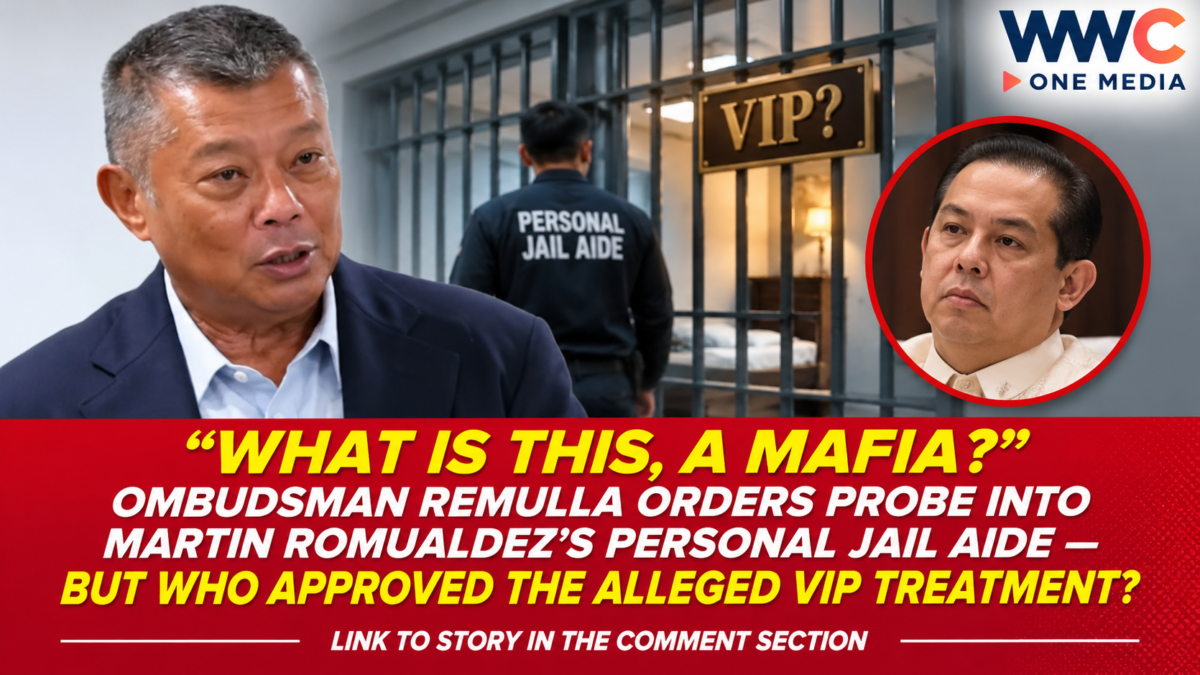
MANILA, PHILIPPINES — A growing controversy over the detention conditions of former House Speaker Martin Romualdez has erupted into a new investigation after Ombudsman Jesus Crispin “Boying” Remulla questioned why the politically influential lawmaker was allowed to have a personal assistant inside the New Quezon City Jail.
Speaking on his DZRH radio programme on Saturday, November 7, Remulla expressed disbelief that an outside aide had reportedly been permitted to stay with Romualdez while he remained in custody over a multibillion-peso plunder case.
The Ombudsman’s unusually sharp criticism placed the Bureau of Jail Management and Penology (BJMP) under renewed scrutiny.
The issue is no longer simply whether Romualdez remains inside his detention facility. Investigators are now examining whether someone authorized a privilege that ordinary detainees would not normally receive.
Remulla said his office would investigate the arrangement and claimed that investigators had already identified people allegedly involved in facilitating it.
He declined to name them publicly.
The BJMP has since confirmed that it is investigating the arrangement authorized by one of its jail wardens.
The bureau also promised to take appropriate action if violations are established.
But no final finding of misconduct has been announced.
The controversy comes just days before the Sandiganbayan is scheduled to question jail authorities about Romualdez’s detention records, surveillance footage and the people allowed to assist him inside the facility.
And as the investigation widens, one question threatens to become the central issue: Did officials approve a legitimate accommodation for a detainee’s needs, or did a powerful former politician receive preferential treatment unavailable to ordinary Filipinos?
Remulla Questions Why Romualdez Has a Personal Aide in Jail
The controversy intensified during Remulla’s November 7 radio programme.
The Ombudsman criticized the arrangement that allowed a personal assistant from outside the jail to attend to Romualdez.
He questioned why an individual in detention would require a privately arranged aide.
Remulla also publicly reprimanded the BJMP and said he wanted the matter investigated.
His concern was directed at the officials who permitted the arrangement and whether they had followed established custodial rules.
He claimed that his office had identified a group allegedly connected to the arrangement, but did not disclose its members.
That assertion has not yet been followed by public findings identifying individuals responsible for wrongdoing.
The distinction is important.
Remulla’s statements signal a serious investigation, but they do not independently establish the existence of a criminal organization or prove that jail personnel accepted improper benefits.
His reference to a “mafia” was a rhetorical challenge to the arrangement, not an official finding that organized crime was operating inside the facility.
Jail Warden Admits Authorizing Personal Staff for Romualdez
The dispute began with testimony from Jail Superintendent Maria Lourdes Pacion, who oversees the New Quezon City Jail Male Dormitory in Payatas.
During proceedings before the Sandiganbayan Third Division on November 5, Pacion acknowledged that Romualdez had been allowed a personal staff member to assist him.
She said the arrangement had been approved because the former Speaker needed continuous assistance and jail personnel could not provide a dedicated employee around the clock.
Pacion also cited concerns about his mental state.
According to reports from Philstar and News5, she described his condition as unstable based on her assessment.
Those statements explain why the warden says she authorized the arrangement.
But they do not establish that a qualified medical professional had independently determined such assistance was necessary.
Nor do they conclusively establish that the arrangement complied with BJMP policy.
Those are among the questions authorities must examine.
The warden’s explanation also introduces a broader concern about how jail facilities handle detainees with genuine medical or psychological needs.
Appropriate care may be necessary.
But any accommodation must be properly justified and consistent with applicable rules.
BJMP Confirms Investigation Into the Arrangement
Following the Ombudsman’s criticism, the BJMP issued a statement acknowledging the controversy.
The bureau said it was investigating an arrangement authorized by one of its wardens.
It also confirmed that a comprehensive report would be submitted to the Department of the Interior and Local Government within the required period.
The agency emphasized that it does not tolerate unauthorized privileges or preferential treatment for persons deprived of liberty.
It said appropriate action would follow if investigators establish policy violations.
This response is significant because it goes beyond simply denying all allegations of special treatment.
The BJMP is now examining whether the personal-aide arrangement was properly authorized.
But an investigation is not the same as a disciplinary ruling.
The responsible authorities still need to determine what permissions were given, who approved them and which regulations apply.
They must also establish whether the aide’s presence was supported by legitimate circumstances.
Two Remullas, Two Different Public Responses
The controversy has attracted particular attention because two senior officials with the surname Remulla have addressed Romualdez’s detention.
They hold different government positions.
Jesus Crispin “Boying” Remulla is the Ombudsman, responsible for investigating potential misconduct involving public officials.
Jonvic Remulla is the Secretary of the Interior and Local Government, whose department supervises the BJMP.
Their statements have focused on different allegations and developments.
On November 5, Interior Secretary Jonvic Remulla rejected claims that Romualdez had secretly left the detention facility.
He pointed to CCTV footage that he said showed no unauthorized departures.
The Ombudsman’s subsequent criticism concerned a different question: whether Romualdez was improperly allowed a personal aide inside the jail.
These positions should not be described as contradictory without explaining the distinction.
It is possible for a detainee to remain inside a facility while questions persist about privileges granted within it.
That is why authorities must separately examine custody records and internal accommodations.
Earlier Allegations That Romualdez Sneaked Out Were Retracted
The controversy initially focused on claims that Romualdez was secretly leaving the New Quezon City Jail.
Columnist Ramon Tulfo had alleged that the former Speaker could leave the facility without proper authorization.
His account suggested that CCTV cameras were disabled during supposed movements.
The allegations circulated widely on social media.
However, Tulfo subsequently admitted that his source had supplied incorrect information.
He acknowledged that he had failed to verify the account before publishing it.
The BJMP also reported that its initial CCTV review found no recorded interruption in security-camera operations and no unauthorized movement by Romualdez during the period examined.
As WWC ONE MEDIA reported in its earlier coverage of the disputed jail-exit claims, the Sandiganbayan nevertheless directed officials to provide more detailed custody records.
This is an important correction to the public narrative.
The allegation that Romualdez was secretly leaving jail has been retracted by its original publisher and was not supported by the BJMP’s initial findings.
The current controversy over his personal aide remains a separate question that authorities are investigating.
Sandiganbayan Demands Detailed CCTV and Custody Records
The Sandiganbayan Third Division has ordered jail officials to submit a detailed account of Romualdez’s whereabouts since his transfer to the facility on September 14.
The order requires an examination of CCTV recordings and related records.
These include surveillance-system operating logs, maintenance reports, access records and information concerning potential interruptions.
The court also wants records involving vehicles entering or leaving the jail.
It has requested information about ambulance movements, medical-related trips and personnel assigned to relevant shifts.
Importantly, the documentation also includes records identifying people permitted to assist Romualdez inside the facility.
That requirement makes the personal-aide controversy directly relevant to the court’s inquiry.
The court is not merely asking whether a person was physically present inside the jail.
It is examining how custodial arrangements were managed and documented.
Reliable records could help determine whether officials complied with the conditions imposed on Romualdez’s detention.
November 9 Hearing Could Reveal More About the Arrangement
The Sandiganbayan has scheduled another hearing for November 9 at 8:30 a.m.
Jail Superintendent Pacion and medical officer Dr. Henry Fabro are among those ordered to appear.
Relevant information-technology personnel are also expected to address questions concerning the detention facility’s surveillance systems.
The court may examine records that explain who was allowed access to Romualdez and under what authority.
The hearing could clarify whether the aide was formally registered, what duties the individual performed and why the arrangement was considered necessary.
It may also address the evidence supporting the warden’s statements about Romualdez’s health-related needs.
However, the court has not yet issued a final finding that the arrangement violated custodial rules.
The November 9 proceedings may provide additional evidence rather than an immediate final resolution.
Why Romualdez Is Being Held at Quezon City Jail
Romualdez has been detained in connection with a plunder case involving allegations of irregularities in government-funded flood-control and infrastructure projects.
The Office of the Ombudsman filed charges involving approximately ₱7.44 billion in alleged kickbacks and other financial benefits.
The allegations concern government projects implemented during the 2022–2025 period.
Romualdez was arrested on September 7 following the issuance of a warrant by the Sandiganbayan.
He initially received medical attention and was later transferred to regular detention.
As WWC ONE MEDIA reported when the Sandiganbayan ordered his arrest, the case represented a major development in the country’s investigation of alleged corruption involving public infrastructure spending.
But the charges remain allegations.
Romualdez has denied wrongdoing.
He is entitled to the presumption of innocence unless the prosecution establishes his guilt through the judicial process.
The jail-aide investigation is separate from determining whether he committed plunder.
The ₱7.44-Billion Plunder Case Remains Unresolved
The underlying corruption case involves allegations that Romualdez and other individuals benefited from transactions connected with government infrastructure projects.
Prosecutors have examined witness accounts, financial records and alleged payments associated with contractors.
As WWC ONE MEDIA reported in its coverage of testimony by a former Department of Public Works and Highways official, investigators have sought to establish whether the alleged financial arrangements can be supported through credible evidence.
Romualdez’s camp has disputed the allegations and challenged the credibility of certain accounts.
The case has also involved disagreements over witnesses who later changed or withdrew their previous statements.
Those disputes must be assessed by the court.
The fact that a defendant is detained while facing charges does not mean the criminal allegations have been proven.
Nor should any alleged violation of jail rules be treated as proof of involvement in the underlying flood-control controversy.
Each issue requires its own evidence.
Romualdez’s Health Has Already Been a Major Detention Issue
Questions about Romualdez’s health emerged soon after his arrest.
He was initially confined at Cardinal Santos Medical Center in San Juan.
His lawyers cited medical concerns while seeking appropriate arrangements during detention.
The Sandiganbayan subsequently ordered an independent assessment involving the Philippine General Hospital.
As WWC ONE MEDIA reported in its examination of the court’s decision to seek an independent medical evaluation, the issue was whether his condition justified continued hospital confinement.
That history is relevant because the warden has now cited Romualdez’s condition as a reason for permitting personal assistance.
However, the earlier medical proceedings do not automatically establish that a private aide was authorized under jail regulations.
A medical need and the legality of a particular custodial arrangement are distinct questions.
Authorities must establish whether necessary assistance could have been provided by qualified jail personnel or other approved means.
What Makes a Jail Accommodation Legitimate?
Detention facilities have responsibilities toward people in their custody.
Those responsibilities include security, access to appropriate medical care and compliance with lawful court orders.
A detainee with a genuine health condition may require special assistance.
However, an accommodation should be justified by evidence and handled under the applicable rules.
The issue is not whether all detainees have identical needs.
It is whether officials apply consistent standards without granting unjustified advantages based on wealth, political influence or personal connections.
For example, a medically necessary arrangement supported by appropriate authorization differs from a privilege granted simply because a detainee is powerful.
Investigators will need to establish which category applies in Romualdez’s case.
They must also consider whether any personnel knowingly violated regulations.
Those questions cannot be settled solely through public accusations.
Why the Case Has Become a Test of Equal Treatment
The controversy reflects wider public concern about how influential defendants are treated while in custody.
Ordinary detainees generally cannot assume that they will be allowed a personal assistant from outside a detention facility.
That makes the reported arrangement politically sensitive.
If officials authorized assistance for legitimate reasons, they should be able to explain the justification and the relevant rules.
If the arrangement violated regulations, accountability mechanisms should determine the appropriate consequences.
The principle is straightforward: status and political connections should not replace established custody requirements.
That principle also protects detainees with legitimate health needs.
Properly documented accommodations help distinguish necessary care from preferential treatment.
For the BJMP, this is an opportunity to demonstrate that its policies can withstand scrutiny even when a high-profile detainee is involved.
Could Jail Officials Face Administrative or Criminal Cases?
The BJMP has said personnel responsible for established violations may face appropriate action.
That could include disciplinary consequences under applicable rules.
However, the nature of any penalty would depend on the conduct established and the governing regulations.
Administrative wrongdoing is not automatically a criminal offense.
The Ombudsman’s involvement raises the possibility of examining whether public officials committed misconduct within its jurisdiction.
But no completed investigation has established a criminal conspiracy or identified an organized group guilty of facilitating unlawful privileges.
Remulla’s comments about knowing the individuals allegedly involved should therefore be reported as his claim, not as an independently verified finding.
Investigators must document the arrangement, identify decision-makers and evaluate the reasons given for authorizing it.
Any resulting case would require due process.
What Happens Next?
Several developments could clarify the controversy.
The first is the BJMP’s comprehensive report to the Department of the Interior and Local Government.
The second is the Ombudsman’s examination of the personnel allegedly involved in authorizing the arrangement.
The third is the November 9 Sandiganbayan hearing.
The fourth is the review of CCTV, access and custody records.
Together, those steps could establish whether Romualdez remained in the facility under the court’s orders and whether the assistance provided to him complied with jail policy.
The investigation may also clarify whether the warden’s explanation is supported by adequate documentation.
For now, the allegation of unauthorized special treatment remains under examination.
The public should not confuse a confirmed personal-aide arrangement with a completed finding of misconduct.
The Bottom Line: Romualdez’s Personal Aide Raises Questions the BJMP Must Answer
Ombudsman Jesus Crispin Remulla has criticized the Bureau of Jail Management and Penology for allowing former House Speaker Martin Romualdez to have a personal assistant while detained at the New Quezon City Jail.
The controversy intensified after Jail Superintendent Maria Lourdes Pacion acknowledged authorizing the arrangement.
She cited the former Speaker’s needs and the facility’s inability to provide a dedicated staff member around the clock.
The BJMP has confirmed an internal investigation and promised action if violations are established.
The Sandiganbayan has also demanded detailed custody and surveillance records.
Meanwhile, earlier allegations that Romualdez was secretly leaving jail have been retracted by the columnist who published them.
The BJMP’s initial review found no evidence supporting those claims.
Romualdez remains detained in connection with a disputed ₱7.44-billion plunder case.
His guilt or innocence in that case has not been determined.
The current controversy therefore concerns a separate question: whether the conditions of his detention complied with applicable custodial rules.
And as Ombudsman Remulla challenges the BJMP over an arrangement that gave one of the country’s most powerful former lawmakers access to a personal aide inside jail, one question now demands an answer: Was this a legitimate accommodation for a detainee’s needs—or will investigators uncover an unauthorized privilege that puts more government officials under scrutiny?