MANILA, PHILIPPINES — A growing movement of Filipino volunteers, technology specialists and civil society watchdogs is emerging as a formidable force in the battle for government budget transparency.
And according to lawyer JV Bautista, their work could be one of the most effective safeguards against questionable spending decisions in Congress.
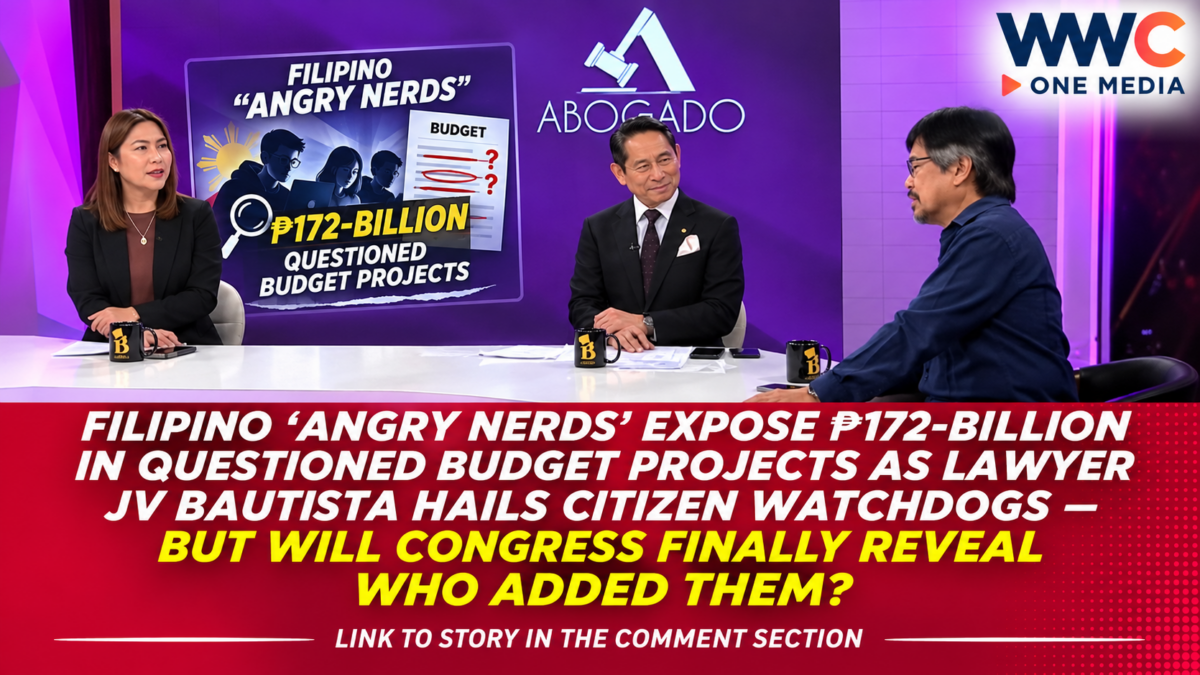
In an interview featured on Bilyonaryo News Channel’s Abogado programme, Bautista praised organizations such as the People’s Budget Coalition for scrutinizing proposed government appropriations and challenging lawmakers to explain controversial provisions.
He also welcomed the participation of volunteer experts popularly described as “angry nerds”—citizens using specialized knowledge, research and digital tools to examine public spending.
The remarks come as Congress deliberates on the proposed ₱7.2-trillion national budget for 2027.
At an October 26 Senate hearing, the People’s Budget Coalition identified more than ₱1 trillion in proposed allocations it considered vulnerable to political patronage or requiring closer examination.
Among the items it flagged were approximately 6,200 public works projects worth ₱172 billion that the coalition said had been added by the House without publicly available supporting documents.
Those figures are part of the watchdog’s preliminary risk assessment. They do not establish that all the projects are fictitious, corrupt or unlawful.
But they raise a fundamental question about how billions of pesos in taxpayer money enter the national spending plan.
If independent volunteers can identify potentially questionable allocations using publicly available documents, why aren’t the same discrepancies consistently resolved before lawmakers approve the budget?
JV Bautista Says Citizen Watchdogs Are Becoming a Powerful Check on Congress
Bautista argued that the growing involvement of citizens’ organizations is creating an important layer of accountability in the budget process.
He noted that presidential veto powers and court challenges remain important constitutional safeguards.
But those mechanisms have limitations.
A presidential veto can be overridden under constitutional conditions.
A court petition may take considerable time to resolve.
Public scrutiny, by contrast, can identify controversial provisions while legislators are still debating them.
Bautista said the interventions of citizens’ groups were making a meaningful difference in how lawmakers approached budget decisions.
He particularly praised the People’s Budget Coalition for its efforts to examine appropriations and call attention to questionable changes.
His remarks reflect an increasingly visible development in Philippine politics: independent analysts are no longer waiting until government spending controversies erupt before asking questions.
They are examining the proposed budget while amendments are still being considered.
That creates an opportunity to demand explanations before questionable allocations become part of the final appropriations law.
Why Bautista Calls Budget Experts ‘Angry Nerds’
The phrase “angry nerds” refers to citizen volunteers who use specialized skills to investigate government spending.
These may include programmers, accountants, researchers, policy analysts and other technically skilled individuals.
Their work can involve comparing spreadsheets, identifying changes between versions of government documents and examining whether projects have sufficient supporting information.
Bautista welcomed their involvement because budget legislation is technically demanding.
He observed that understanding a national budget requires considerable expertise and experience.
He also suggested that relatively few lawmakers possess a deep understanding of the entire budget process.
That makes independent research particularly valuable.
The national budget contains thousands of programs, projects and financial classifications.
Identifying changes across different versions can require substantial time and technical skill.
Digital tools can help analysts complete parts of that work more efficiently.
But the technology does not eliminate the need for professional judgment.
A flagged project still requires verification against official records and explanations from the responsible agencies.
Citizen Watchdogs Flag More Than ₱1 Trillion in Budget Risks
The People’s Budget Coalition’s concerns gained national attention during an October 26 Senate Committee on Finance hearing.
According to Philstar, the coalition identified more than ₱1 trillion in proposed spending that it considered vulnerable to political patronage or otherwise deserving of additional scrutiny.
Approximately ₱695 billion of that amount involved infrastructure.
Within the infrastructure category, the coalition flagged roughly 6,200 public works projects worth ₱172 billion.
Its concern was that the House had allegedly introduced these projects without publishing adequate supporting documentation.
The allegations were raised as part of a preliminary analysis.
This distinction matters because budget risk assessments are not the same as criminal investigations.
A project may lack publicly accessible documentation for reasons that still require clarification.
An incomplete record can indicate a transparency problem without conclusively establishing theft or fraud.
However, projects involving public money should be supported by clear descriptions, locations, costs and justifications.
When those details are unavailable, citizens have legitimate grounds to demand explanations.
Where Did the ₱172 Billion in Questioned Projects Come From?
The disputed ₱172-billion figure concerns public works projects that the coalition identified as additions or changes in the House budget version.
The coalition questioned the availability of supporting records.
Such records can help establish whether a project was requested by an implementing agency, whether its cost is justified and whether its proposed location and scope are accurately described.
The issue is especially significant for infrastructure spending.
Public works projects may involve roads, flood control facilities, bridges and other construction activities.
Their costs can vary widely depending on location, materials and technical requirements.
Without adequate documentation, it becomes more difficult for independent analysts to determine whether an allocation is reasonable.
The coalition’s findings therefore focus on traceability and verification.
The key question is not whether every added project is improper.
It is whether the government can show why each project belongs in the spending plan.
Why an Audit Trail Could Change Philippine Budget Politics
A complete audit trail would allow the public to follow changes to the budget throughout the legislative process.
The trail would begin with the National Expenditure Program, the executive branch’s proposed spending plan.
It would then identify amendments introduced in the House and Senate.
Finally, it would record the changes adopted during bicameral negotiations before the final General Appropriations Act is enacted.
As WWC ONE MEDIA previously reported in its coverage of demands for a complete budget audit trail, transparency advocates want the public to be able to identify additions, deletions and modifications across successive budget versions.
Such a system could make it easier to ask who proposed a particular project and why.
It could also help distinguish legitimate amendments from changes requiring further explanation.
But an audit trail alone cannot prove corruption.
Its value depends on the accuracy and completeness of the underlying records.
Senate Invites Civil Society to Examine the Budget
The Senate has taken steps to involve independent organizations more directly in the budget process.
On October 26, the Senate Committee on Finance conducted a consultation with civil society organizations.
The hearing gave watchdogs an opportunity to present findings and recommendations involving the proposed 2027 spending plan.
The session is recorded on the Senate’s Budget Transparency Portal.
As WWC ONE MEDIA reported before the hearing, the consultation represented an important opportunity for independent groups to raise concerns before the budget reaches its final stages.
Senate leaders have also expressed support for making budget records more accessible.
The initiative could allow more Filipinos to participate in discussions that previously depended heavily on lawmakers and government agencies.
However, public consultation is only one step.
Its ultimate value will depend on whether legitimate concerns lead to documentary clarification, corrections or changes in appropriations.
AI Helps Citizens Analyze Budget Changes Faster
Technology has become an increasingly important part of the transparency movement.
At the October 26 hearing, Senate President Sherwin Gatchalian praised civil society groups for using artificial intelligence and digital tools to analyze budget records.
According to the Philippine News Agency, he observed that tasks that traditionally required one or two weeks could, in some instances, be completed in a day.
Volunteer technology organization BetterGov.ph has worked with the People’s Budget Coalition to develop tools that compare government spending documents.
Their analysis allows users to examine differences between the executive’s original proposal and the House-approved spending bill.
A November 5 report by PhilstarTech confirmed that the Senate’s transparency portal had begun linking to BetterGov’s independent review.
That gives citizens an additional way to examine proposed projects, allocations and amendments.
But AI-generated findings must still be checked.
Automated comparisons can identify discrepancies.
They cannot independently determine whether a project is lawful, necessary or corrupt.
That requires official documentation, careful analysis and accountable decisions.
The House Faces Pressure to Disclose Its Budget Amendments
The growing influence of citizen watchdogs is also changing how lawmakers respond to public questions.
On November 5, Deputy Speaker Ronaldo Puno said members of the National Unity Party were willing to disclose amendments they introduced into the proposed 2027 budget.
The announcement followed a meeting with the People’s Budget Coalition.
According to GMA News, Puno said he had explained projects in his district and supported greater transparency.
The statement is significant because it recognizes the importance of explaining legislative amendments.
A lawmaker may have legitimate reasons for proposing additional infrastructure or community projects.
But those reasons should be documented and open to examination.
Disclosure can help distinguish projects with clear public purposes from items that require further scrutiny.
The challenge is ensuring consistent standards for all lawmakers rather than relying only on voluntary disclosures.
House Budget Hearings Become More Transparent
The House has also announced measures intended to improve visibility into budget amendments.
The chamber previously opened discussions on proposed changes to the 2027 General Appropriations Bill for public scrutiny.
As WWC ONE MEDIA reported in September, the Budget Amendments Review Subcommittee was expected to examine proposed changes and provide greater visibility into the legislative process.
The reform responded partly to concerns that citizen organizations lacked sufficient access to budget discussions.
For transparency advocates, opening hearings is important.
But access to meetings alone is not enough.
The public also needs to see the documents being discussed.
Those records should identify the amounts involved, the projects affected and the reasons for amendments.
Only then can citizens meaningfully evaluate the budget.
JV Ejercito Promises Civil Society Access to Bicameral Talks
The next major transparency test will occur when the House and Senate reconcile their different budget versions.
On November 2, Senate finance committee chairperson JV Ejercito said civil society organizations would be invited to observe the bicameral conference committee’s deliberations on the 2027 budget.
He also confirmed that the proceedings would be livestreamed.
GMA News reported that Ejercito wanted more independent observers to help identify last-minute insertions or inadequately reviewed projects.
The commitment is important because bicameral negotiations can produce significant changes before a budget becomes law.
However, the bicameral stage has not yet been completed.
The promise of public observation should therefore be distinguished from a confirmed assessment of how transparent the eventual negotiations will be.
The real test will be whether observers have sufficient access to understand and verify the decisions being made.
Government Spending Portal Offers Another Layer of Oversight
Budget transparency does not end when Congress passes an appropriations law.
Citizens also need information about how approved funds are released and spent.
President Ferdinand Marcos Jr. has institutionalized the government’s Centralized Open Monitoring Platform for Appropriations and Spending Statistics, or COMPASS.
The platform is designed to consolidate information about appropriations, allotments, obligations and disbursements.
As WWC ONE MEDIA reported in its September coverage of the platform, Executive Order No. 126 formalized COMPASS as a public-facing digital monitoring mechanism.
The system could help citizens examine spending across agencies and programs.
However, the availability of a platform does not guarantee that every record is complete or instantly updated.
Effective oversight also requires accurate data, regular publication and opportunities to challenge discrepancies.
The legislative budget trail and spending-monitoring tools serve complementary purposes.
One helps explain how appropriations were approved.
The other helps show what happens to funds afterward.
Why Budget Watchdogs Matter Beyond Allegations of Corruption
Public budget scrutiny is often associated with corruption investigations.
But its value extends beyond identifying possible misconduct.
A transparent budget can help citizens evaluate government priorities.
For example, communities may want to know why funding for a particular road was increased while a school or hospital project received less support.
Researchers may examine whether spending matches long-term development plans.
Local residents may verify whether a proposed project addresses an actual need.
Budget monitoring can also identify administrative errors before they create larger problems.
Poor documentation does not always indicate criminal intent.
But it can still weaken accountability and public trust.
Citizen watchdogs therefore perform an important role even when no illegal activity is ultimately established.
They help demand explanations for decisions involving taxpayer money.
Can Ordinary Filipinos Really Challenge a ₱7.2-Trillion Budget?
The national budget can appear too technical for ordinary citizens to examine.
It contains complex classifications, program codes, financial tables and supporting documents.
But recent developments show that organized public participation can make the process more accessible.
Volunteer analysts can compare data.
Journalists can investigate questionable items.
Local communities can assess whether proposed projects exist or address genuine needs.
Civil society organizations can present findings to lawmakers.
And government agencies can respond by producing records and correcting errors.
Each activity contributes to a broader accountability process.
No individual group can review every peso by itself.
But cooperation between independent experts, lawmakers and public institutions may improve the chances that important discrepancies are identified before money is spent.
What Happens Next for the 2027 National Budget?
The Senate is continuing its examination of the proposed national spending plan.
Further committee work and plenary deliberations will determine its proposed revisions.
The House and Senate will subsequently need to reconcile their respective versions.
Civil society groups are expected to remain involved in monitoring those changes.
The key questions will concern documentation, disclosure and the treatment of allocations flagged for possible risks.
Will lawmakers provide adequate explanations?
Will publicly identified discrepancies be corrected?
Will the bicameral conference process remain accessible to outside observers?
And will the final spending law include enough information for citizens to trace major changes?
Those questions cannot yet be answered conclusively.
The outcome will depend on the actions taken during the remaining legislative process.
The Bottom Line: Citizen Budget Watchdogs Are Changing the Accountability Debate
Lawyer JV Bautista has praised the growing influence of Filipino citizens’ organizations and volunteer experts in monitoring the national budget.
He says their participation has become an important check on questionable provisions.
His remarks come after the People’s Budget Coalition identified more than ₱1 trillion in spending risks during its preliminary review of the proposed 2027 budget.
The coalition also flagged approximately 6,200 public works projects worth ₱172 billion over concerns involving supporting documentation.
Those findings are not proof that all the projects are corrupt.
But they demonstrate why public access to spending records matters.
The Senate has opened consultations with civil society organizations and expanded access to independent budget analysis.
Some House lawmakers have also expressed support for disclosing their amendments.
The challenge is translating those commitments into lasting transparency.
And as Filipino volunteers use spreadsheets, artificial intelligence and public records to examine trillions of pesos in government spending, one question remains: Will Congress finally make every major budget amendment traceable—or will the country’s new generation of citizen watchdogs discover that the most important decisions are still being made beyond public view?