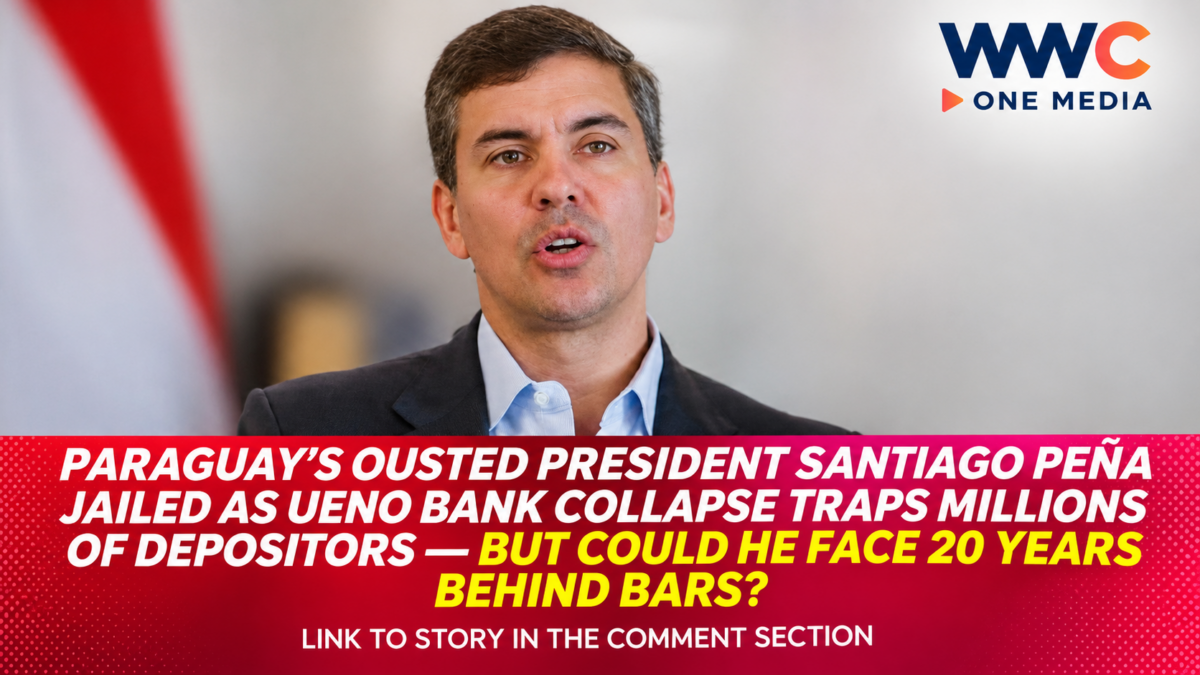
ASUNCIÓN, PARAGUAY — A banking collapse that left nearly three million customers struggling to access their money has triggered an extraordinary political crisis in Paraguay, where former President Santiago Peña has now been ordered into pretrial detention just one day after being removed from office.
On Saturday, November 7, Judge Humberto Otazú ordered Peña held at a military facility in the capital, Asunción, while prosecutors investigate allegations involving his relationship with collapsed digital lender Ueno Bank.
The 47-year-old former president faces criminal charges of breach of trust and administration for personal gain.
Prosecutors allege that Peña improperly used his presidential influence to benefit Ueno despite having previously held shares in the bank’s parent company.
He has denied wrongdoing and pleaded not guilty.
But the investigation comes amid a rapidly escalating financial emergency that has shaken public confidence, sparked demonstrations and placed hundreds of millions of dollars in government deposits under scrutiny.
The political consequences have already been devastating.
Peña was removed by Paraguay’s Senate on November 6, and his former vice president, Pedro Alliana, was sworn in to complete the presidential term through August 2028.
Now, the former head of state faces the possibility of a lengthy criminal trial.
And as regulators race to return money to depositors, the most urgent questions are no longer limited to why Ueno Bank collapsed.
They also concern whether government officials ignored financial warning signs—and whether political influence helped expose public money to extraordinary risks.
Judge Orders Santiago Peña Held at Military Facility
Judge Otazú issued the detention order following Peña’s appearance before prosecutors on November 7.
According to Reuters, the court determined that pretrial detention was necessary to ensure the former president remained in Paraguay while the criminal proceedings moved forward.
The order followed a period of house arrest after Peña’s removal from office.
His detention at a military facility reflects the seriousness of the charges and the exceptional circumstances surrounding the case.
However, pretrial detention is not a criminal conviction.
The court has not determined that Peña committed the offenses alleged by prosecutors.
The former president retains the right to challenge the evidence and defend himself through the judicial process.
His attorney, Ricardo Preda, told reporters that Peña would cooperate with investigators.
Preda also expressed confidence that the case would ultimately be dismissed.
That defense position is important because allegations contained in a criminal charge must still be proven through appropriate legal proceedings.
What Criminal Charges Does Peña Face?
The former president has been charged with breach of trust and administration for personal gain.
According to prosecutor Nancy Salomón, each charge carries a potential sentence of up to 10 years.
That creates theoretical exposure to substantial imprisonment if Peña is convicted.
However, it would be misleading to present a 20-year sentence as certain.
Any eventual punishment would depend on the charges proven, the applicable sentencing rules and the court’s judgment.
The investigation focuses on whether Peña improperly influenced decisions affecting Ueno Bank.
Prosecutors allege that government institutions maintained large deposits at the lender while Peña had financial ties to its ownership structure.
They are examining whether his conduct involved conflicts of interest or the improper use of public authority.
The central issue is whether prosecutors can demonstrate an unlawful connection between his official actions and financial benefits involving the bank.
Peña disputes that allegation.
Ueno Bank Collapse Triggers a National Financial Emergency
At the heart of the crisis is Ueno, a fast-growing digital lender that became one of Paraguay’s most prominent banking institutions.
The bank expanded rapidly through technology-driven financial services and attracted a large customer base.
According to Associated Press reporting, nearly three million customers were affected when regulators intervened in the institution.
The intervention followed concerns about the bank’s financial condition and solvency.
Customers experienced difficulties accessing money through their accounts.
The disruption affected households, businesses and pensioners who relied on the institution for everyday financial transactions.
Some reported being unable to withdraw savings or complete payments.
The situation quickly escalated into a national emergency.
Thousands of protesters gathered in Asunción demanding access to their money and accountability from officials.
But the collapse of one institution does not automatically mean Paraguay’s entire banking system has failed.
Regulators are attempting to contain the crisis and prevent wider financial instability.
Why Did the Government Keep Public Money at Ueno?
One of the most serious questions involves public-sector deposits.
According to AFP, Ueno held more than $800 million in government funds.
These deposits reportedly involved government agencies and state-owned entities.
Prosecutors allege that Peña used his influence to encourage or facilitate decisions keeping public money at the bank.
The concern is particularly significant because government funds are supposed to be managed under appropriate financial controls.
Authorities must establish whether the placement of those deposits complied with regulations and whether relevant officials properly assessed the bank’s risks.
However, the existence of large government deposits at a financial institution does not itself establish corruption.
Investigators must demonstrate that decisions were improperly influenced or violated applicable laws.
The amount held at Ueno also should not be described as money already proven stolen or permanently lost.
The eventual financial impact depends on deposit recovery, bank resolution and judicial proceedings.
Peña’s Former Shareholding Becomes Central to Investigation
Peña previously owned shares in Ueno’s holding company.
According to Reuters, he held that interest until March 2025.
The former president has denied wrongdoing and argued that the bank’s financial problems were matters for regulators.
His legal team has also challenged the suggestion that he personally controlled decisions about where government funds were deposited.
The prosecution, however, is examining whether his previous commercial relationships created conflicts of interest while he held public office.
That distinction is fundamental.
A former shareholding is not automatically proof of a crime.
But a financial relationship may warrant investigation when a public official is alleged to have used government influence to benefit a particular institution.
The court must determine whether any legal obligations were breached.
Paraguay’s Senate Removes Peña From Power
The criminal investigation followed an extraordinary political development.
On Friday, November 6, Paraguay’s Senate voted to remove Peña from office.
The decision followed impeachment proceedings amid growing anger over the banking crisis.
As WWC ONE MEDIA reported in its coverage of Peña’s removal and the Ueno collapse, all 44 senators present voted to remove the president.
Peña had previously offered to resign.
But lawmakers proceeded with impeachment instead.
The distinction was politically consequential because impeachment and ordinary resignation can have different implications under Paraguay’s constitutional arrangements.
The Senate’s action ended Peña’s presidency.
However, a constitutional impeachment judgment is distinct from a criminal conviction.
His alleged offenses involving Ueno must still be examined through the courts.
From Resignation Offer to Criminal Detention in Days
Peña’s political collapse unfolded with remarkable speed.
On November 5, he announced his intention to resign amid mounting pressure.
At the time, the crisis was already disrupting banking services and triggering demonstrations.
But lawmakers moved forward with proceedings to remove him.
The following day, he lost the presidency.
By November 7, he had appeared before prosecutors and received an order for pretrial detention.
As WWC ONE MEDIA reported before the impeachment vote was completed, Peña’s departure had become central to the country’s attempts to restore political and financial stability.
The latest detention order marks a new stage.
Peña is no longer defending his presidency.
He is defending himself against criminal allegations that could carry serious legal consequences.
Former Central Bank Chief Also Faces Charges
The scandal has also reached Paraguay’s central bank.
Former central bank chief Carlos Carvallo has been charged in connection with the investigation.
The charges reported by Reuters include breach of trust, administration for personal gain and producing false public documents.
Carvallo had previously led Ueno before becoming head of the central bank.
That career history has attracted scrutiny because financial regulators are responsible for supervising banks and identifying risks to depositors.
Prosecutors are examining whether decisions involving Ueno were influenced by improper relationships.
Subsequent reporting indicated that Carvallo was also ordered into pretrial detention.
However, his criminal responsibility has not been established.
Investigators must distinguish between potential weaknesses in financial supervision and conduct that meets the legal requirements of a criminal offense.
The case highlights the importance of credible, independent banking regulation.
Pedro Alliana Becomes Paraguay’s New President
Following Peña’s removal, Vice President Pedro Alliana was sworn in as Paraguay’s new president.
Alliana, a politician from the long-ruling Colorado Party, is expected to complete the presidential term ending in August 2028.
His immediate challenge is restoring public confidence.
The new government must respond to widespread anger among depositors, stabilize financial institutions and demonstrate that investigations will proceed appropriately.
Alliana has pledged not to abandon those affected by Ueno’s collapse.
But some protesters remain skeptical because he belongs to the same political party as Peña.
For the new administration, political continuity may help maintain government operations.
At the same time, restoring legitimacy will require visible progress on the banking crisis.
People affected by frozen accounts are likely to judge the government by how quickly and fairly their money is returned.
Nearly 1.2 Million Depositors Receive Payments
Amid the political turmoil, Paraguay’s financial regulators have begun returning money to affected customers.
According to Reuters, the central bank reported that approximately $160 million had been paid to nearly 1.2 million savers through the state deposit guarantee scheme by November 7.
The payments represent an important step toward limiting the human impact of Ueno’s failure.
But the recovery process remains incomplete.
Many customers are still waiting to regain access to money.
Others may have balances exceeding applicable deposit-insurance limits.
Associated Press reporting indicated that the insurance framework covers eligible deposits up to approximately $37,000.
The guarantee provides protection within its rules, but it does not establish that every individual will recover every dollar immediately.
The distinction between account access, insured deposits and final losses remains important.
For affected families, the immediate concern is whether they can pay bills, meet living expenses and continue operating businesses.
Could the Ueno Collapse Trigger Wider Banking Problems?
The failure of a large financial institution can create fear among customers of other banks.
People may begin withdrawing deposits or transferring accounts because they worry about the safety of their money.
That can put pressure on the financial system.
Regulators therefore have a responsibility to explain what happened and how they intend to contain the damage.
Ueno’s collapse is particularly sensitive because of its extensive customer base and reported government deposits.
However, no verified finding establishes that the entire Paraguayan banking sector is insolvent.
The authorities have continued working through the deposit guarantee and resolution process.
The outcome will depend on how effectively they protect depositors and address financial risks.
What the Crisis Reveals About Banking Oversight
Ueno’s collapse raises questions that extend beyond Paraguay.
Rapidly expanding banks can attract customers through convenient digital services and competitive financial products.
But rapid growth does not remove the need for capital adequacy, responsible lending and effective supervision.
Financial institutions must manage their exposure to risky borrowers and maintain sufficient resources to meet obligations.
Regulators must identify warning signs and act when necessary.
As WWC ONE MEDIA reported in its coverage of National Australia Bank’s rising credit impairments, even established financial institutions must regularly assess potential loan losses.
Australia’s NAB is not involved in Ueno’s collapse, and the financial circumstances are different.
But the comparison illustrates why transparent risk reporting and prudent supervision matter.
A bank can grow its business while facing increasing financial pressure beneath the surface.
Could the Philippines Learn From Paraguay’s Banking Crisis?
The crisis also offers lessons for countries across Southeast Asia.
As banking becomes increasingly digital, financial institutions need stronger systems to protect customer funds and monitor risk.
In the Philippines, commercial banks operate under capital, liquidity and supervisory requirements established by the Bangko Sentral ng Pilipinas.
These requirements are intended to help maintain financial stability.
As WWC ONE MEDIA reported in its coverage of EastWest Bank’s higher expected credit-loss provisions, lenders can experience significant earnings pressure when the risk of borrower defaults increases.
The EastWest report concerns a profitable Philippine bank recognizing credit risk, not the collapse of a financial institution.
There is no evidence that its circumstances are equivalent to Ueno’s.
The broader lesson is that credit quality, strong governance and transparent oversight are essential regardless of a bank’s size or location.
What Happens Next for Santiago Peña?
The criminal investigation will continue while Peña remains under the court’s pretrial detention order.
Prosecutors will seek to establish whether he committed the alleged offenses.
His defense will have the opportunity to challenge the evidence and the legal basis of the charges.
The court must determine whether the allegations are proven under Paraguayan law.
Potential developments include additional hearings, documentary evidence, witness testimony and challenges to procedural decisions.
No final conviction or sentence has been issued.
Meanwhile, the investigation involving former central bank chief Carvallo and other relevant officials will proceed separately under the applicable legal framework.
For Paraguay, the case is a major test of whether its justice system can examine allegations involving powerful political figures while respecting due process.
The Bigger Challenge: Recovering Money and Public Trust
The country’s political leadership has changed.
But the collapse of Ueno remains unresolved.
The immediate priorities are protecting eligible deposits, restoring banking services and establishing what caused the lender’s financial failure.
Authorities must also determine whether government money was managed appropriately.
If wrongdoing occurred, those responsible should be held accountable through lawful proceedings.
But investigations must rely on evidence rather than political pressure or public anger alone.
Alliana’s administration must demonstrate that financial stability and depositor protection are central priorities.
For ordinary Paraguayans, meaningful progress will be measured through access to savings, reliable banking services and confidence that future failures can be prevented.
The Bottom Line: A President Has Fallen, but Paraguay’s Banking Nightmare Is Far From Over
Former Paraguayan President Santiago Peña has been placed in pretrial detention following his removal from office.
The November 7 court order came after prosecutors charged him with breach of trust and administration for personal gain in connection with the collapse of Ueno Bank.
Prosecutors allege that Peña used presidential influence to benefit a lender with which he previously had financial ties.
Peña denies wrongdoing and has pleaded not guilty.
The bank’s collapse disrupted access to accounts for nearly three million customers and sparked public demonstrations.
Regulators say they have already distributed approximately $160 million to nearly 1.2 million savers.
But the broader banking crisis has not been fully resolved.
Former Vice President Pedro Alliana has assumed the presidency and must now oversee efforts to restore public confidence.
The next stage will be determined by criminal investigations, banking-sector recovery measures and the new government’s ability to protect depositors.
And as Santiago Peña moves from Paraguay’s presidential palace into pretrial detention while millions of customers struggle with the fallout from Ueno Bank’s collapse, one question now hangs over the country: Will the investigation expose criminal misuse of presidential power—or could the collapse reveal a much deeper failure of banking supervision that extends beyond one former president?