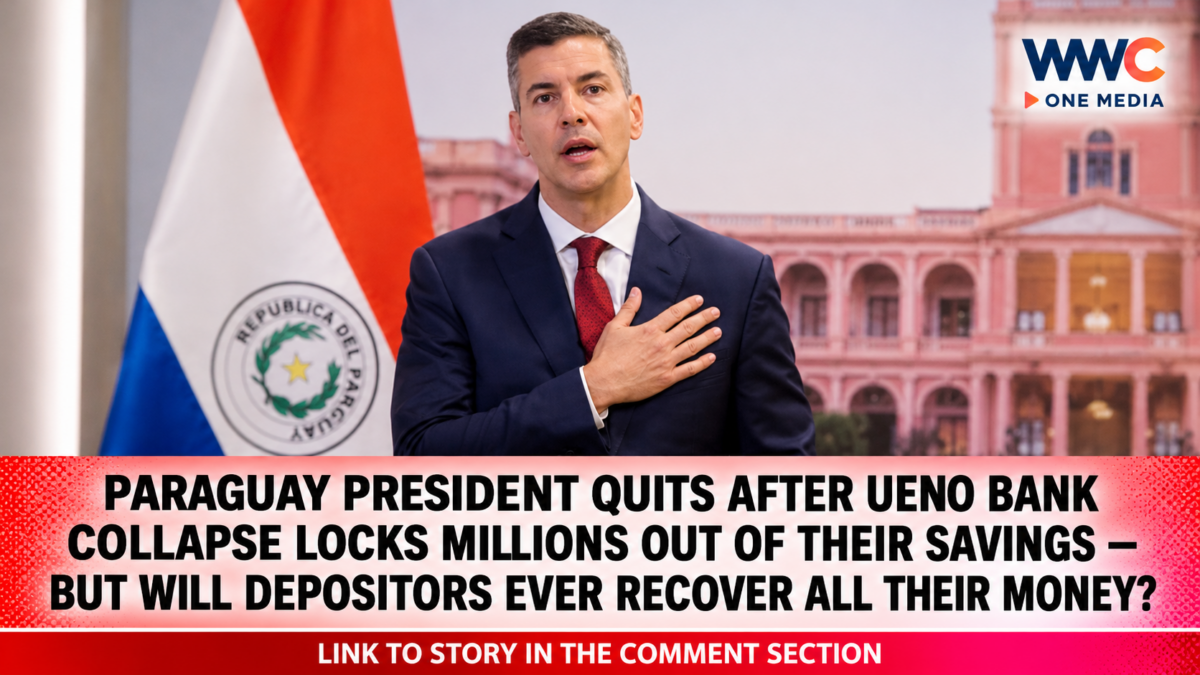
Paraguay has been plunged into one of its most serious political and financial crises in recent years after President Santiago Peña announced his resignation on November 5, following the collapse of Ueno Bank, a major digital lender whose business connections reached into his political circle.
The crisis has left approximately three million customers unable to access their accounts, placed hundreds of millions of dollars in public funds under scrutiny and triggered widespread protests in the capital, Asunción.
Peña stepped down as lawmakers prepared to advance impeachment proceedings against him. His resignation came after he lost support from members of his own conservative Colorado Party, turning a banking failure into a major test of the country’s political institutions and financial oversight.
The 47-year-old president said he was resigning to protect national stability, social peace and democratic institutions. However, he also indicated that he intended to defend himself during Senate proceedings and urged authorities to prioritise the return of money to affected depositors.
The controversy is particularly sensitive because Peña previously held business interests in Grupo Vázquez, the conglomerate associated with Ueno, until March 2025. He has denied wrongdoing and rejected allegations that he improperly influenced the bank’s operations.
The collapse has also rattled financial markets, weakened Paraguay’s currency and raised serious questions about how a lender serving such a large portion of the population accumulated public deposits despite concerns about its financial condition. Reuters+2
Ueno Bank Collapse Leaves Three Million Customers Locked Out
At the centre of the crisis is Ueno Bank, which expanded rapidly from a relatively small financial business into one of Paraguay’s most prominent digital lenders.
The institution reportedly served around three million customers in a country with approximately 6.5 million people. That represents a substantial share of the national population and roughly 60% of Paraguay’s adults.
Its popularity grew through digital banking services, promotional offers, an expanding physical presence and high-profile sponsorships, including its association with Paraguay’s national football team.
However, the bank’s rapid expansion was followed by growing concerns about its financial health.
Paraguay’s central bank intervened after determining that Ueno had breached minimum solvency requirements. Regulators placed the institution under a resolution process after examining its financial position and identifying problems involving loans and assets.
The intervention effectively shut down normal access to the bank’s services. Customers reported being unable to use their accounts, cards and transfers, leaving families, pensioners and businesses struggling to access their money.
The situation also triggered concerns across the wider banking sector as customers attempted to transfer their funds to other financial institutions. The resulting surge in account-opening activity contributed to temporary disruptions in other banking applications.
Importantly, Ueno’s intervention does not mean that Paraguay’s entire banking system has collapsed. The country’s banking association said other lenders remained operational and were working to accommodate customers moving their accounts. Los Angeles Times+2
Up to US$850 Million in Public Funds Exposed to the Crisis
The controversy extends far beyond ordinary customer deposits.
Ueno reportedly administered approximately US$800 million to US$850 million in public funds, including money connected to government institutions, state entities and pension-related organisations.
One particularly significant exposure involved Paraguay’s state pension and health fund, known as the IPS. Reports indicated that approximately US$380 million connected to the fund was invested in or held through Ueno.
That exposure has raised questions about why substantial public resources were placed with a rapidly expanding private financial institution and whether adequate safeguards were applied.
The issue is especially sensitive because pension funds represent money intended to support retirees and other beneficiaries.
Authorities have sought to reassure the public that monthly pension payments would continue, while the pension fund indicated that it would pursue legal measures to recover its exposure.
The distinction between public deposits, pension investments and ordinary customer savings is important. These funds do not necessarily face identical recovery arrangements, and the final amount recoverable will depend on the resolution process and the legal treatment of the bank’s remaining assets. Los Angeles Times+2
Why Paraguay’s President Became Entangled in the Banking Scandal
Peña’s previous business connections to the bank’s ownership group became a major political issue as the financial crisis intensified.
Before entering the presidency, he had links to Grupo Vázquez, the conglomerate associated with Ueno. He has said that he sold his stake in the group in March 2025 and maintained that he had no improper involvement in the bank’s operations.
However, opposition lawmakers questioned the relationship between the government, the lender and the country’s financial regulators.
Another controversial appointment involved Carlos Carvallo, who had previously led Financiera Ueno, the predecessor to Ueno Bank, before becoming president of Paraguay’s central bank under Peña.
That appointment attracted scrutiny because the central bank was responsible for supervising the financial institution.
Carvallo’s position became increasingly difficult as the regulator moved against Ueno. He subsequently resigned, adding another major departure to the unfolding crisis.
Opposition politicians accused Peña of conflicts of interest, misuse of pension funds and institutional efforts to shield the lender from scrutiny.
These are serious allegations, but they should not be treated as established criminal findings against the former president. Peña has denied wrongdoing and maintained that the matter should be addressed through the appropriate legal and regulatory processes. Los Angeles Times+2
The controversy also raises wider questions about financial transparency and the responsibilities of politically connected business figures.
WWC ONE MEDIA previously examined a separate Philippine investment scandal involving frozen accounts and allegations of financial misconduct in The Inventing of Mica Tan: How a Self-Made Angel Investor Sold the Philippine Elite a Glittering Private-Equity Dream.
Although the circumstances are different, both cases highlight the importance of transparency, independent financial oversight and protecting investors when institutions face serious financial distress.
Impeachment Pressure Mounts as Peña Loses Support From His Own Party
The political consequences escalated rapidly in the days before Peña announced his resignation.
On November 4, lawmakers submitted impeachment articles against the president, accusing him of responsibility for the crisis and questioning his handling of the bank’s connections to public institutions.
The pressure became more serious when members of his own Colorado Party began withdrawing their support.
Former president Horacio Cartes, a powerful figure within the ruling political movement and a former ally of Peña, also publicly backed impeachment.
Peña announced his resignation on November 5, shortly before the lower house advanced the impeachment motion.
The lower house subsequently approved the motion unanimously, sending the matter to the Senate.
However, the resignation did not automatically settle every constitutional and legal question. Reports from November 6 indicated that the Senate had failed to reach a quorum during proceedings concerning the political transition.
Vice President Pedro Alliana is constitutionally positioned to succeed Peña if the resignation is accepted, but the precise transition arrangements remained subject to the required congressional process.
Peña also indicated that he intended to exercise his right to defend himself in the Senate. The Guardian+2
Eight Ueno Executives Face Arrest Warrants as Investigation Expands
The investigation into Ueno’s collapse has also moved beyond political accusations.
Authorities issued arrest warrants for eight senior executives connected to the financial institution. The executives subsequently surrendered to authorities, according to Reuters.
The investigation concerns suspected irregularities involving the bank’s operations, financial position and lending activities.
Reports from the Associated Press also identified concerns about loans to companies connected to the bank’s owners, including lending that allegedly exceeded legal limits or lacked sufficient collateral.
Regulators reportedly discovered poorly documented loans and expenses that had been incorrectly counted as assets.
After adjustments to the bank’s accounts, its capital position fell below the legal requirements, leaving the institution unable to meet the minimum solvency standards.
A separate investigation reported by Brazil’s Folha de S.Paulo described allegations involving a simulated sale of a US$74.4 million loan portfolio to a company allegedly connected to the bank.
According to the report, the transaction may have been structured using funds originating from loans made by Ueno to companies associated with Grupo Vázquez.
These allegations form part of the wider investigation and have not all been established through final court judgments. Los Angeles Times+2
Will Ueno Customers Get Their Money Back?
For ordinary Paraguayans, the most urgent concern is not the political battle but whether they can recover their savings.
Paraguay’s central bank has indicated that eligible deposits are protected up to 228 million guaraníes, equivalent to approximately US$38,000 per depositor.
Preliminary estimates cited by regulators suggested that around 97% of Ueno depositors had balances within the guarantee limit.
Authorities have also outlined a process to transfer customer accounts and deposits to other financial institutions, while the remaining assets of Ueno are assessed.
However, customers with balances above the guaranteed amount face greater uncertainty.
Recovery of those funds will depend on the value of the bank’s remaining assets, the outcome of the resolution process and the treatment of creditors under applicable banking laws.
The distinction is crucial: a deposit guarantee can protect eligible balances, but it does not automatically guarantee that every customer will immediately recover every dollar held at the institution.
The crisis has also affected workers. Reports indicated that thousands of employees connected to Ueno and other Grupo Vázquez businesses faced uncertainty over their jobs and unpaid wages. Los Angeles Times+1
The situation echoes concerns raised in another WWC ONE MEDIA report, BANK ERROR, BANK’S LOSS? Supreme Court Says BDO Cannot Recover ₱76,000 After Its Own Mistake, which examined the responsibilities financial institutions carry when banking procedures fail.
Paraguay’s Currency and Investor Confidence Take a Hit
The political crisis has also affected Paraguay’s financial markets.
Following Peña’s resignation, the country’s sovereign bond prices declined while the guaraní weakened sharply against the US dollar.
Reuters reported that the currency briefly moved beyond 6,500 guaraníes per dollar before closing at approximately 6,490, representing a decline of nearly 5% on the day.
The reaction reflects concerns about political uncertainty, financial-sector supervision and the potential consequences of the Ueno crisis for public finances.
Paraguay had built a reputation as one of South America’s relatively stable destinations for investment. The sudden collapse of a major lender with connections to government figures has therefore created questions about the strength of its regulatory institutions.
The government and financial authorities now face the challenge of restoring confidence while ensuring that depositors are treated fairly and that any misconduct is investigated.
WWC ONE MEDIA has also reported on how government borrowing pressures can affect financial stability in PH Debt Hits Record ₱19.39 Trillion — But the Bigger Problem May Be What Comes Next.
While Paraguay’s banking crisis is different from the Philippines’ public-debt situation, both developments underline how financial confidence depends on credible institutions, transparent management and responsible use of public resources. AsiaOne+2
A Political Crisis That Could Reshape Paraguay’s Leadership
Peña’s resignation marks a dramatic turn for a president who took office in August 2023 and was expected to serve until 2028.
His departure leaves Paraguay facing two connected challenges: resolving the banking crisis and determining political accountability.
Vice President Pedro Alliana is next in line under the country’s constitutional arrangements, but the transition still depends on the formal congressional process.
Meanwhile, the investigation into Ueno must establish what caused the institution’s financial collapse, whether regulatory safeguards were ignored and whether any individuals should face criminal responsibility.
The outcome could have lasting consequences for Paraguay’s banking sector, political leadership and reputation among international investors.
The most immediate test, however, is whether millions of customers can regain access to their money without further disruption.
Peña’s departure may ease some political pressure, but it does not resolve the financial losses, unanswered questions or allegations surrounding Ueno Bank.
For Paraguay, the real test is only beginning: restoring public trust while ensuring that the people responsible for any proven wrongdoing are held accountable.