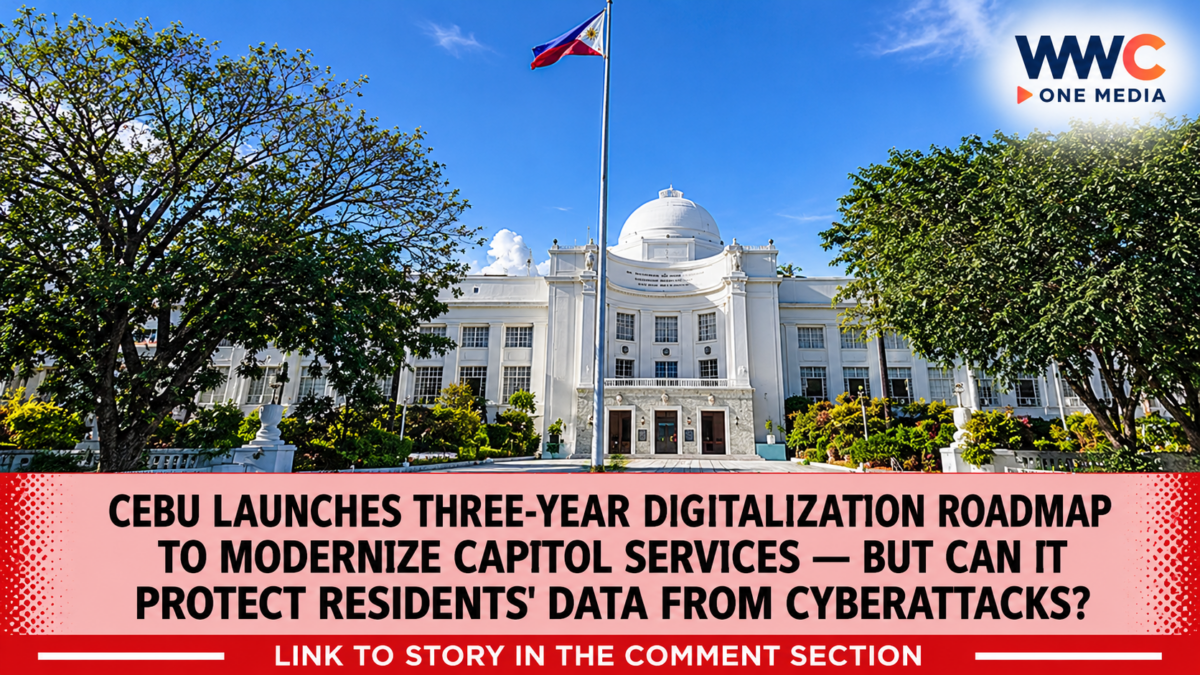
The Cebu Provincial Government is moving to modernize its operations through a three-year digitalization roadmap designed to make public services more efficient, connect government offices, improve disaster response and protect sensitive information from cyberattacks.
The Cebu Province Digitalization Roadmap 2025–2028 was presented by Paulo Uy, the provincial government’s digitalization lead, during a Cybersecurity Summit at the Capitol on October 30, 2026. The initiative follows an assessment of the provincial government’s existing technology systems and the gaps that could expose public services and government data to disruption.
The plan is not simply about putting more government transactions online. It also aims to strengthen the digital infrastructure behind provincial operations, including cybersecurity defenses, data protection, system integration and disaster-recovery capabilities.
If implemented successfully, the roadmap could change how residents interact with provincial offices, how hospitals and other agencies share information, and how local governments coordinate during emergencies. SunStar Publishing Inc.+1
What the Cebu Province Digitalization Roadmap Includes
The roadmap covers several technology upgrades intended to protect the Capitol’s computer networks and improve the reliability of its digital services.
Among the planned measures are:
- Stronger firewall protection to block unauthorized access.
- Intrusion detection and prevention systems to identify and respond to suspicious network activity.
- Improved endpoint security for computers and other devices used by government personnel.
- Stronger encryption and backup procedures to protect sensitive information.
- Tighter access controls to ensure employees can only access systems and data required for their duties.
- Network segmentation to prevent a security breach in one part of the system from spreading across the entire government network.
- Multi-site disaster recovery capabilities to help restore systems and operations if a major outage, cyberattack or other disruption occurs.
These upgrades are particularly important because provincial government systems may contain sensitive records and support essential services. A serious cyber incident could affect public transactions, healthcare operations, revenue collection and emergency coordination.
The roadmap is scheduled to run through 2028, with quarterly reviews intended to monitor implementation and progress. SunStar Publishing Inc.+1
Digital Integration Could Improve Healthcare, Revenue Collection and Public Transactions
Beyond cybersecurity, the roadmap aims to connect provincial government systems so that offices can exchange information more efficiently instead of relying on disconnected processes.
The expected benefits include improvements in:
Healthcare services. Better integration of provincial hospital systems could support more coordinated access to medical information and improve the handling of patient records. A unified system would need strict privacy controls because medical information is particularly sensitive.
Revenue collection and payments. Digital platforms could make it easier for residents and businesses to settle provincial dues, track transactions and reduce the need for repeated visits to government offices.
Public transactions. Connecting provincial offices could reduce paperwork, improve coordination and make services more accessible to communities outside Cebu City.
Disaster response. The province is also developing digital tools for hazard mapping, early-warning system connections, automated damage and needs assessments, and incident dashboards that municipalities can use to report emergencies.
These disaster-response tools could be especially valuable in a province exposed to typhoons, flooding, landslides and other hazards. A shared reporting system could help provincial authorities identify affected areas and coordinate assistance more quickly, although its effectiveness will depend on reliable information from municipalities and functioning communication networks. SunStar Publishing Inc.+1
Cybersecurity Will Depend on Employees, Not Just Technology
One of the strongest messages from the Cybersecurity Summit was that new equipment and software cannot guarantee the safety of government information by themselves.
Uy emphasized that employees must protect their login credentials, follow proper data-handling procedures and report suspicious messages, unusual system activity or possible security breaches immediately.
This is important because phishing messages, stolen passwords and careless handling of sensitive files can expose government systems even when advanced security tools are installed.
The roadmap’s focus on access controls and network segmentation is intended to limit the damage if an account or device is compromised. Multi-site backups and disaster-recovery arrangements are also designed to help restore operations if systems become unavailable.
For the public, the issue goes beyond protecting government computers. Residents expect their personal information, tax records, medical details and transaction histories to remain confidential when they use digital government services.
The province will therefore need clear rules on who can access information, how long records are retained, how incidents are reported and how affected individuals are protected. SunStar Publishing Inc.+1
Cebu’s Digitalization Drive Has Been Building for Several Years
The 2025–2028 roadmap is not the province’s first move toward digital government.
In December 2025, the Cebu Provincial Board approved on second reading a proposed ordinance establishing a province-wide digital services framework. The measure envisioned a coordinated approach to digital transformation, with the Provincial Information and Communications Technology Council serving as the policy and oversight body.
The proposed ordinance also called for a technical working committee to coordinate planning, pilot projects and reforms across provincial offices. It included employee training and quarterly progress reporting, with an initial proposed implementation allocation of ₱5 million.
That earlier legislative initiative is relevant because a digitalization roadmap needs more than technical upgrades. It also requires governance structures, funding, employee training and clear responsibility for implementation. The December report described the measure as having passed second reading; it should not be treated as proof that every provision had already become an enacted ordinance. SunStar Publishing Inc.
The province has also been developing online systems for infrastructure monitoring. Its Cebu Infrastructure Project Management and Monitoring System (CIPMMS) was designed to provide online tracking of project documents and public access to project status, helping identify where processing delays occur. Province of Cebu – Official Website
Cebu City Is Pursuing Its Own Digital Government Projects
The provincial roadmap should not be confused with the separate digitalization programme of Cebu City Government.
Cebu City has been developing its own online service portal and digital complaint-handling system. In February 2026, The Freeman reported that the City Council approved a ₱5.3-million modernization project for the city’s official web portal. The planned portal is intended to provide residents with access to government services, forms, schedules, announcements, transparency information and online payment facilities.
The city has also pursued a proposed ₱10.25-million upgrade of its Citizen Action Center, which is intended to consolidate complaints and service requests received through hotlines, social media, email and walk-in channels. The proposed platform would provide digital ticket numbers and allow residents to track the progress of their concerns. The Freeman+1
Cebu City has separately opened its 24/7 Government Services Hub at Cebu Exchange Tower in Lahug, allowing participating offices to serve residents outside conventional government working hours. BusinessMirror and The Freeman reported that the facility began operations in April 2026, initially offering services from several city offices and participating national agencies. Carmel Pedroza+1
WWC ONE MEDIA has also reported on the city’s efforts to expand access to government transactions through Cebu City’s 24/7 Government Hub and its National ID services.
The distinction matters: Cebu Province’s 2025–2028 roadmap concerns the provincial government’s systems and services, while the 24/7 hub and city portal are initiatives of the separate Cebu City Government.
National E-Governance Push Raises the Stakes for Local Governments
Cebu’s plans also fit into a broader national push to move government services online.
Republic Act No. 12254, or the E-Governance Act, institutionalizes the government’s transition to digital systems and calls for more integrated, accessible and citizen-centered electronic services.
The national government is also proposing significant investment in digital infrastructure. The Department of Budget and Management reported that the proposed 2027 national budget includes ₱53.1 billion in government-wide information and communications technology and digitalization spending. The proposal includes expanded public internet access, stronger broadband infrastructure and increased funding for e-government systems.
Separately, the Anti-Red Tape Authority has been pushing local government units to operationalize electronic Business One-Stop Shop systems for online business permit processing. The aim is to let businesses submit documents, pay fees and receive permits digitally rather than repeatedly visiting government offices. Supreme Court E-Library+2
For Cebu, these national initiatives create an opportunity to align provincial systems with broader government platforms and standards. They also raise expectations that online services should be reliable, secure and accessible—not simply digital versions of paperwork.
WWC ONE MEDIA previously examined Cebu’s technology ambitions in the proposed AI research center involving companies from Cebu, China and South Korea. That proposal remains separate from the provincial government’s digitalization roadmap, but both reflect the province’s growing focus on technology and innovation.
The Biggest Challenges Are Funding, Implementation and Public Trust
A three-year digitalization roadmap can promise faster transactions and stronger security, but its success will depend on how consistently the province delivers the projects.
Several questions will matter as implementation moves forward:
- Funding: What is the total cost of the roadmap, and how much will be allocated to each system upgrade?
- Implementation: Which provincial offices and hospitals will be connected first, and when will the systems become operational?
- Data privacy: How will the province protect medical records, taxpayer information and other sensitive personal data?
- Cybersecurity: How frequently will systems be tested, updated and audited for vulnerabilities?
- Public access: Will residents in remote municipalities have reliable internet access and sufficient support to use online services?
- Accountability: Will quarterly reviews disclose measurable progress, project delays and security incidents?
These are not minor details. If digital platforms are difficult to use, frequently unavailable or poorly protected, residents may continue relying on manual transactions. And if separate offices develop systems that cannot communicate with one another, digitalization could simply create another layer of bureaucracy.
The province’s commitment to quarterly reviews provides a mechanism for monitoring progress, but transparent reporting will be essential to show whether the roadmap is producing real improvements.
Cebu’s Digital Future Will Be Tested by Results, Not Announcements
The Cebu Provincial Government’s Digitalization Roadmap 2025–2028 sets out an ambitious programme to modernize public services, strengthen cybersecurity and improve coordination across provincial offices and municipalities.
Its most important potential benefits could be felt in everyday transactions: more convenient payments, better-connected healthcare services, quicker access to government information and improved emergency coordination.
But the roadmap also places a major responsibility on the provincial government to protect the information residents entrust to its systems.
With implementation scheduled through 2028 and quarterly reviews planned, the coming years will show whether Cebu can turn its digital transformation agenda into dependable services that residents can actually use.
The real test is not how many systems the province puts online, but whether those systems make government faster, safer and more accountable for every Cebuano.