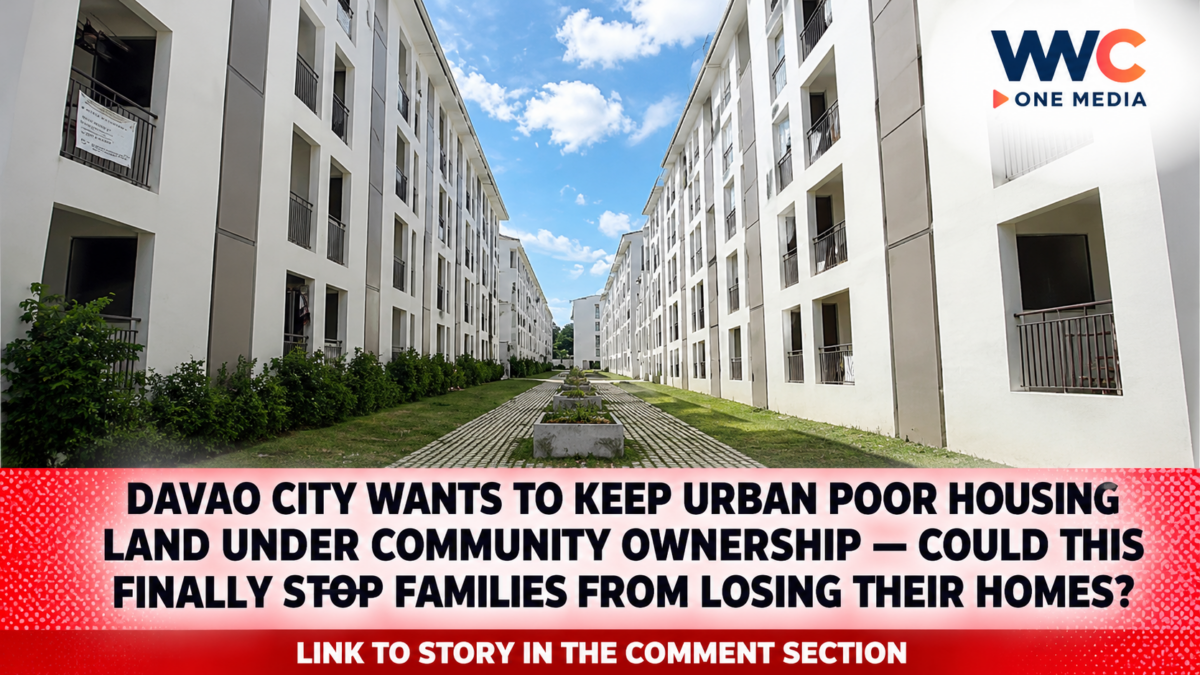
Davao City is considering a major shift in how socialized housing land is owned, with a proposed ordinance seeking to keep land acquired for low-income communities under permanent collective ownership instead of transferring individual land titles to beneficiary families.
The proposal, introduced by City Councilor Temujin “Tek” Ocampo, aims to protect urban poor households from distress sales, land speculation and displacement. Its central argument is that giving a family a title does not always guarantee lasting housing security when poverty, debt or financial emergencies can eventually force the sale of the property.
Ocampo presented the proposed Davao City Urban Poor Collective Land Tenure Ordinance through a privilege speech during the 21st City Council’s regular session on November 3, 2026.
The measure was referred on first reading to the Committee on Housing, Rural and Urban Development for further deliberation. It has not yet been passed into law.
The proposal comes as Davao City continues to explore housing solutions for informal settler families and other residents who struggle to secure affordable and stable homes. SunStar Publishing Inc.+2
Why Davao Wants to Move Beyond Individual Land Titles
Under conventional housing arrangements, qualified beneficiaries may eventually receive individual titles to the lots they occupy or acquire through a housing program.
But Ocampo argues that individual ownership can create another vulnerability for families living close to the poverty line.
When household income becomes insufficient to cover food, healthcare, education, debt or other emergencies, a titled property may become one of the few assets a family can sell.
That transaction may provide short-term financial relief, but it can also leave the household without secure housing. Families who sell their properties may eventually return to informal settlements, including riverbanks, flood-prone areas and hazard-exposed slopes.
Ocampo said the proposed system would protect land acquired for socialized housing from being sold off under financial pressure or becoming the subject of speculative transactions.
His proposal is therefore built around a different idea of homeownership: families would retain long-term rights to occupy and use their homes, while the land itself would remain collectively owned and protected for the community.
The objective is to make housing security more durable across generations rather than treating individual land titles as the only measure of success. SunStar Publishing Inc.+2
How the Proposed Collective Land Ownership System Would Work
The ordinance proposes two major mechanisms: a Collective Land Acquisition Program and the establishment of Community Land Trusts.
1. Collective Land Acquisition Program
The proposed Collective Land Acquisition Program (CLAP) would allow the city to acquire land intended for socialized housing and place it under a collective ownership arrangement.
Instead of dividing the land into individually transferable properties, the community would retain collective ownership through a master title and an appropriate legal structure.
2. Community Land Trusts
Community Land Trusts (CLTs) would serve as the mechanism for protecting land from speculative transactions and ensuring that it remains dedicated to community housing.
Under this arrangement, the land would remain collectively held rather than becoming an asset that individual beneficiaries could freely sell to private buyers.
3. Certificates of Occupancy and Usufruct Rights
Instead of receiving separate land titles, qualified families would receive long-term Certificates of Occupancy and Usufruct Rights (COUR).
These documents are intended to recognize their rights to occupy and use their homes over an extended period, potentially across generations, while keeping the underlying land under community ownership.
The distinction is important: beneficiaries would gain legally recognized housing-use rights, but they would not receive the same individual ownership and transfer rights associated with separate land titles.
Ocampo says this would help protect communities from displacement while preventing socialized housing land from becoming a target for speculation. SunStar Publishing Inc.+1
Proposed Housing Trust Fund Would Help Finance Land and Development
The proposed ordinance also calls for the creation of a Davao City Collective Socialized Housing Trust Fund.
The fund would support land acquisition and site development, helping the city establish housing communities without relying exclusively on individual beneficiaries to shoulder the initial financial burden.
Its proposed funding sources include:
- An initial seed allocation from the city.
- Development funds.
- Collections from idle land taxes.
The proposal also includes direct equity subsidies for vulnerable sectors, particularly senior citizens, persons with disabilities and single parents.
These subsidies could help qualified beneficiaries who face greater difficulty contributing financially to housing projects.
However, the ordinance still needs committee review and the full legislative process. The proposed funding sources should not be interpreted as money already allocated or available for immediate distribution. SunStar Publishing Inc.+1
Collective Land Ownership Already Exists in Philippine Housing Law
One important legal distinction deserves attention: collective land ownership is not entirely new to the Philippines.
The Urban Development and Housing Act of 1992, or Republic Act No. 7279, already provides a legal foundation for community-based land acquisition and ownership arrangements.
Its Community Mortgage Program provisions allow legally organized associations of underprivileged and homeless citizens to acquire and develop land under the concept of community ownership.
Section 33 also recognizes that beneficiary associations may collectively acquire and own land covered by the program, subject to applicable rules.
The Social Housing Finance Corporation (SHFC) implements the Community Mortgage Program to help organized communities secure tenure over the land they occupy or relocate to.
This means Davao’s proposed ordinance would not introduce the concept of collective land ownership for the first time. Its significance lies in establishing a city-level framework that could use collective acquisition, master titles, community land trusts and long-term occupancy rights as part of a broader local housing strategy. Lawphil+2
There is also a legal issue that must be examined carefully before implementation. RA 7279 contains provisions governing the use of leasehold and usufruct arrangements in socialized housing, including rules concerning their duration and the transition of beneficiaries toward greater independence. The proposed COUR system will therefore need to be reviewed against national housing laws and regulations to ensure that its long-term protections are legally enforceable.
Government’s 4PH Program Shows Another Route to Secure Housing
The proposal comes as the national government continues expanding its Pambansang Pabahay para sa Pilipino (4PH) program.
In Davao City, People’s Ville in Barangay Riverside, Calinan District, is an example of vertical socialized housing developed under the 4PH program through the Social Housing Finance Corporation.
The development aims to provide affordable and secure community housing for qualified residents.
Another initiative is the Expanded 4PH program, which has broadened the government’s housing approach through partnerships with developers and financing institutions.
In July 2026, the Philippine News Agency reported that the Department of Human Settlements and Urban Development had approved ₱870.6 million in land acquisition loans covering 47 Enhanced Community Mortgage Program projects. These projects were expected to benefit approximately 8,100 low-income and informal settler families nationwide.
The program demonstrates how collective community arrangements and government-backed financing can help organized communities acquire land and strengthen their security of tenure. Philippine News Agency+1
For additional context, WWC ONE MEDIA previously explained how the Expanded 4PH housing program works and who may qualify.
It also examined the government’s housing complaint resolution drive, which gives priority to faster action on homebuyer and homeowners’ association concerns.
Davao Homeowners’ Associations Win Recognition in Thailand
The discussion of collective housing also comes as two Davao homeowners’ associations receive international recognition for their community-led housing initiatives.
During the same City Council session, Ocampo filed a resolution recognizing the Kasilak Phase 1 Homeowners Association of Barangay 76-A Bucana and the Samahang Matute at Soliman (Samasol) Homeowners Association Inc. of Barangay Los Amigos, Tugbok District.
Both groups were recognized at the Collective Housing Best Practices Forum and Collective Housing Awards held in Bangkok, Thailand.
Kasilak placed second among the Philippine awardees, while Samasol placed third. The Association of People’s Organizations of Metro Manila (APOAMF) of Pasig City secured first place, according to the Homeless People’s Federation Philippines Inc.
The awards highlighted different strengths:
- Kasilak Phase 1 was recognized for grassroots empowerment of urban poor communities, participatory community management and secure land tenure.
- Samasol received recognition for climate-resilient housing design, environmentally friendly construction materials and community-led socialized housing development.
Thailand Deputy Prime Minister Yodchanan Wongsawat presented the awards.
The recognition demonstrates that community participation can play an important role in housing development, particularly when residents are involved in planning, management and long-term maintenance. SunStar Publishing Inc.+1
WWC ONE MEDIA has also reported on housing developers’ support for changes to land-transfer procedures, a separate policy issue that highlights how land administration can affect the delivery of residential projects.
Its coverage of Asialink’s expanding housing finance network also examines the financing challenges facing Filipino homebuyers.
BALAI Calinan Applicants Warned Against Unauthorized Housing Fees
Separately, the Davao City Housing Office (DCHO) reminded residents interested in the BALAI Calinan Housing Project to transact directly with the authorized office.
The project is a public rental transitory socialized housing development for underprivileged and homeless Dabawenyos in Barangay Talomo River, Calinan District.
The housing office stressed that it does not collect membership fees or application payments for the project.
The warning is important because unauthorized individuals may attempt to take advantage of residents hoping to secure housing assistance.
Applicants should verify requirements and application procedures directly with the DCHO rather than paying intermediaries who claim they can guarantee a slot or speed up an application.
The city previously announced that the BALAI Calinan development is expected to provide approximately 630 housing units. SunStar Publishing Inc.+1
What Happens Next to the Proposed Davao Ordinance?
The proposed Davao City Urban Poor Collective Land Tenure Ordinance has only completed its first legislative step.
It was referred to the Committee on Housing, Rural and Urban Development, where its provisions will need to undergo further examination.
Among the questions that lawmakers and housing stakeholders will need to address are:
- How will community land trusts be legally established and managed?
- Who will qualify for Certificates of Occupancy and Usufruct Rights?
- How long will occupancy rights last, and how will they be passed to heirs?
- What happens when a beneficiary violates housing or community rules?
- How will the proposed trust fund be financed and audited?
- What legal safeguards will prevent disputes over membership, occupancy and community management?
The city will also need to establish clear rules to protect residents from arbitrary removal while ensuring that community-owned land remains available for its intended beneficiaries.
The proposal’s long-term success will depend on whether these protections can be translated into workable legal and administrative arrangements.
Can Collective Land Ownership Stop the Urban Poor From Losing Their Homes?
Davao City’s proposal raises an important question about the purpose of socialized housing.
Is providing a family with an individual land title enough to guarantee long-term housing security, or should government also protect communities from the financial pressures that can force them to sell their homes?
Ocampo’s proposal favors a collective approach, arguing that land acquired for socialized housing should remain protected for the community and future generations.
If enacted and implemented effectively, the measure could provide another model for addressing displacement and land insecurity among low-income families.
But it will also require careful legal review, transparent funding, accountable community management and meaningful participation from the people who will be affected.
For now, Davao’s collective land tenure proposal remains under legislative consideration. The next challenge is turning its promise of permanent housing security into a system that is legally sound, financially sustainable and genuinely protective of the urban poor.