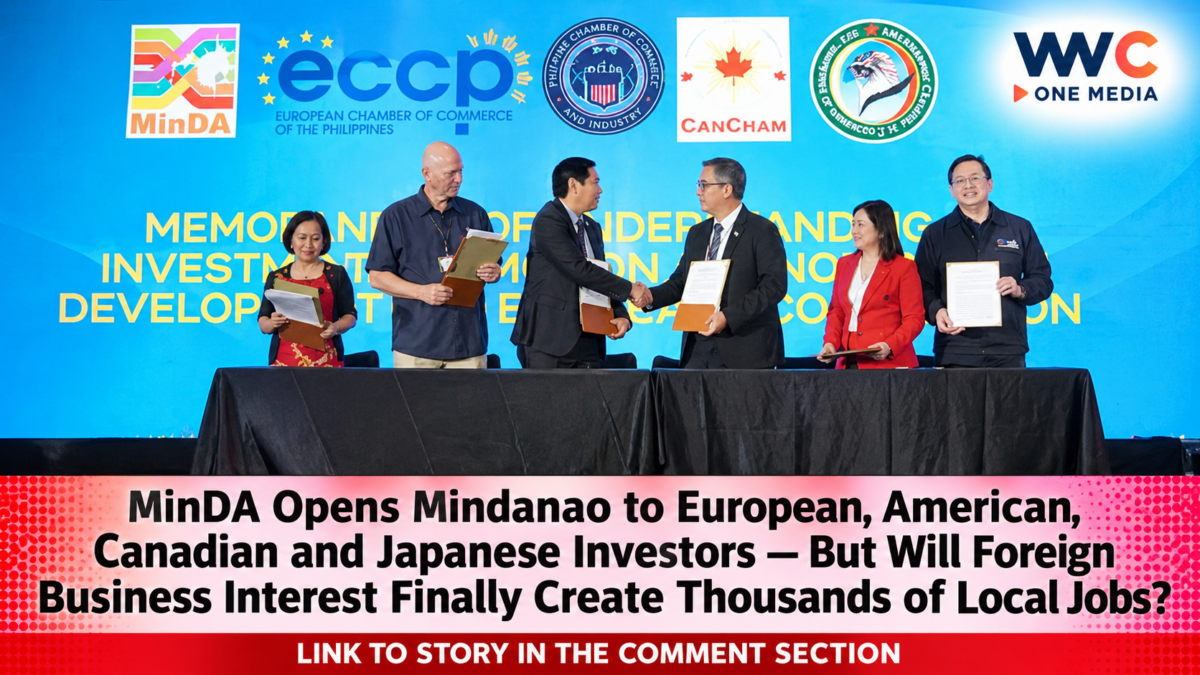
Mindanao is stepping up its campaign to attract international investors after the Mindanao Development Authority (MinDA) signed a strategic partnership with foreign business chambers aimed at connecting overseas companies with investment projects, local enterprises and emerging business opportunities across the island.
The agreement is designed to move beyond investment forums and networking events by creating a continuing system for investor referrals, business matching, trade connections and coordination between foreign business groups and Mindanao stakeholders.
The memorandum of understanding (MOU) follows the Mindanao Development Forum (MDF) 2026, held in Davao City on October 27 and 28. MinDA said the partnership would help turn discussions at the forum into practical business engagements that could support industrial development and employment.
MinDA Chairperson and Secretary Leo Tereso A. Magno described the agreement as a way to sustain cooperation among government, private businesses and international commercial networks.
The partnership is significant because Mindanao has been working to strengthen its position as an investment destination, particularly in agriculture, infrastructure, renewable energy, manufacturing, tourism and logistics. SunStar Publishing Inc.+2
Correction: The preceding partial text was unrelated to your requested story. The article below covers the MinDA–foreign chambers investment partnership.
MinDA, Foreign Chambers Sign Investment Partnership to Bring Global Investors to Mindanao — Will the Deal Finally Turn Business Opportunities Into Jobs?
Mindanao is strengthening its campaign to attract foreign investment after the Mindanao Development Authority (MinDA) signed a strategic partnership with European, American, Canadian and Japanese business chambers to connect international investors with priority projects, local enterprises and emerging industries across the island.
The agreement aims to move beyond business forums and networking events by establishing a continuing system for investor referrals, business matching, trade connections and coordination between international business networks and Mindanao stakeholders.
The memorandum of understanding (MOU) follows the Mindanao Development Forum (MDF) 2026, held in Davao City on October 27 and 28. MinDA said the partnership would help turn discussions at the forum into practical business engagements capable of supporting industrial development and creating employment opportunities.
MinDA Chairperson and Secretary Leo Tereso A. Magno said the agreement translates the forum’s discussions into sustained cooperation among government, private businesses and international commercial networks.
“The development forum is not just about shared ideas; it is about partnerships that we build and the actions that we commit to take together,” Magno said. SunStar Publishing Inc.+2
Four Foreign Business Groups Join Mindanao’s Investment Push
The agreement brings together business organizations representing European, American, Canadian and Japanese commercial interests.
The representatives present during the MOU signing included:
- Antonio Peralta, chairman of the European Chamber of Commerce of the Philippines (ECCP) – Southern Mindanao.
- Peter Cowles, president of the American Chamber of Commerce of the Philippines in Mindanao (AmCham Mindanao).
- Jocelyn Romero, third vice president of the Canadian Chamber of Commerce of the Philippines.
- Tesui Kitae, representative of the Japanese Chamber of Commerce of Mindanao.
Their participation gives MinDA access to established international business networks that can introduce Mindanao companies and projects to potential foreign partners.
The chambers are expected to promote investment opportunities through their respective networks, connect prospective investors with local businesses and provide market insights that could help improve Mindanao’s competitiveness.
For local enterprises, the value of the partnership could extend beyond attracting large corporations. It may also create opportunities to find foreign buyers, technology partners, financing connections and technical expertise. SunStar Publishing Inc.+2
New Coordination Mechanism Will Track Investment Leads
One of the most important features of the agreement is the creation of a MinDA–Mindanao Foreign Chambers Coordination Mechanism.
Rather than allowing cooperation to end after the investment forum, the mechanism is intended to maintain communication and monitor business opportunities generated through the partnership.
Its responsibilities include:
- Tracking investment leads and potential projects.
- Identifying priority activities and opportunities for collaboration.
- Facilitating introductions between investors, local enterprises and government agencies.
- Coordinating business-to-business and business-to-government engagements.
- Maintaining cooperation beyond the Mindanao Development Forum.
MinDA will facilitate investor referrals, provide relevant investment information, coordinate with project proponents and government partners, and follow up on business leads.
The foreign chambers, meanwhile, will use their international networks to promote Mindanao, identify prospective investors and share information about market conditions and business opportunities.
Both sides also plan to organize investment forums, business missions, project presentations, investor briefings and an Investment and Partnership Marketplace.
MinDA Executive Director Undersecretary Janet M. Lopoz emphasized that the partnership must produce tangible results rather than remain a formal agreement.
“Let us make sure that what we have agreed on, signed, and committed to here will really turn into actual projects on the ground,” Lopoz said. SunStar Publishing Inc.+2
Seven Priority Sectors Could Attract Foreign Capital
The partnership identifies several industries that MinDA and the foreign chambers want to promote to international investors.
These include:
- Agribusiness – Opportunities in agricultural production, food processing, supply chains and higher-value exports.
- Infrastructure – Projects that can improve transportation, connectivity and essential facilities.
- Renewable energy – Potential investments in clean power generation and related infrastructure.
- Manufacturing – Opportunities to expand industrial capacity and value-added production.
- Tourism – Development of destinations, hospitality businesses and tourism-related services.
- Logistics – Improvements in cargo movement, warehousing, distribution and regional trade.
- Economic zones – Investment opportunities in designated areas designed to support industrial and commercial activity.
These sectors reflect Mindanao’s existing economic strengths as well as areas where additional investment could improve productivity and competitiveness.
Agribusiness, in particular, is important because the region has established agricultural production and export industries. However, moving into higher-value processing, improving cold-chain facilities and strengthening access to international markets will require additional capital, technology and logistics support.
The involvement of foreign chambers could help local businesses explore those opportunities and establish connections with overseas partners. SunStar Publishing Inc.+2
Mindanao’s Investment Campaign Was Already Gaining Momentum
The new agreement is not MinDA’s first attempt to strengthen foreign investment promotion.
In June 2026, MinDA and the Board of Investments (BOI) signed a separate memorandum of agreement to improve investment promotion, investor facilitation and project readiness across Mindanao.
That partnership included plans to develop investment project profiles, prepare project presentations, conduct investment missions and forums, and improve coordination between the two agencies.
The BOI also identified opportunities in sectors such as mining and mineral processing, renewable energy and fisheries under the Strategic Investment Priority Plan.
The June agreement and the November partnership with foreign chambers serve different but complementary purposes: the BOI collaboration strengthens government investment facilitation, while the foreign-chambers arrangement aims to connect Mindanao opportunities with international business networks.
Together, they form part of a broader effort to make the region more attractive to local and overseas investors. Board of Investments+1
WWC ONE MEDIA has previously examined Japan’s growing interest in the region in its report, Japan Signals Deeper Partnership With Mindanao as Tourism, Investment and Peace Ties Expand.
The report highlighted potential cooperation in tourism, infrastructure, investment and peace-building, areas that could complement the broader investment promotion effort.
Davao and the Rest of Mindanao Could Benefit From Stronger Tourism and Trade Connections
Tourism and logistics are among the sectors identified in the MOU, and their development could create opportunities for businesses beyond major urban centers.
A stronger regional tourism network could encourage visitors to explore multiple destinations rather than concentrating travel in a few established locations.
MinDA and regional development stakeholders have also been exploring ways to connect destinations across the island. WWC ONE MEDIA previously reported on the Mindanao Tourism Circuit Framework discussions, an initiative intended to develop coordinated tourism routes and encourage investment in connected destinations.
For businesses, better tourism coordination could generate demand for accommodation, transportation, food services, tour operators and local products.
Logistics improvements could also help agricultural producers and manufacturers move goods more efficiently to domestic and international markets.
The challenge will be ensuring that investment opportunities reach smaller communities and local enterprises, rather than being concentrated only in established commercial centers.
MSMEs and Farmers Could Gain Access to International Markets
The partnership is also expected to benefit micro, small and medium enterprises (MSMEs), farmers’ organizations and local project proponents.
Many smaller businesses have products and services with commercial potential but lack the connections, financing, market information or technical support needed to expand internationally.
Foreign business chambers could help bridge some of those gaps by introducing local enterprises to overseas buyers, distributors, investors and technical partners.
For farmers’ organizations, better market connections could create opportunities to expand production, improve product quality and explore processing instead of relying exclusively on raw commodity sales.
However, access to international networks does not automatically guarantee contracts or export orders. Local businesses will still need to meet quality standards, maintain reliable supply, comply with export requirements and compete on price.
The partnership’s practical value will therefore depend on how effectively MinDA and the chambers connect interested investors with enterprises that are ready to participate.
BIMP-EAGA Could Give Mindanao a Wider Regional Advantage
Mindanao’s location also gives the investment campaign a regional dimension.
MinDA serves as the Philippine coordinating office for the Brunei Darussalam–Indonesia–Malaysia–Philippines East ASEAN Growth Area, commonly known as BIMP-EAGA.
The regional cooperation initiative seeks to strengthen economic connections among participating areas through trade, investment, transportation, tourism and other development activities.
For Mindanao, stronger links with neighboring Southeast Asian markets could create opportunities for agricultural exports, logistics services, tourism and cross-border business partnerships.
The foreign-chambers agreement could support this objective by giving local businesses additional connections to international commercial networks.
But regional competitiveness will depend on more than geography. Reliable transport links, efficient ports, predictable regulations, adequate infrastructure and a stable business environment will remain essential to attracting investors.
The Biggest Question: Will the MOU Deliver Actual Investments?
Despite the positive announcement, the agreement should not be mistaken for a confirmed investment package.
MinDA and the foreign chambers have established a framework for cooperation, but the announcement does not identify a specific amount of foreign capital committed, a list of approved projects or a guaranteed number of jobs to be created.
The next major test will be whether the coordination mechanism can generate qualified investor leads, connect businesses with suitable projects and help resolve obstacles that prevent investments from moving forward.
That distinction is important. An MOU can establish cooperation and open doors, but actual investments still require due diligence, financing, permits, commercial agreements and project implementation.
Mindanao also needs to address practical concerns that investors consider when evaluating projects, including infrastructure gaps, logistics costs, regulatory processes, access to skilled workers and the availability of reliable utilities.
The region’s ability to turn investment interest into completed projects will ultimately determine the economic impact of the partnership.
Mindanao’s Next Growth Chapter Depends on Turning Connections Into Jobs
The partnership between MinDA and foreign chambers marks another step in Mindanao’s effort to attract international business and strengthen its position as a regional investment destination.
The agreement creates a channel for European, American, Canadian and Japanese business networks to connect with local enterprises and priority development projects.
Its focus on agribusiness, infrastructure, renewable energy, manufacturing, tourism, logistics and economic zones reflects the range of opportunities available across the island.
For farmers, MSMEs and project proponents, the arrangement could provide access to investors, overseas markets and technical expertise that may otherwise be difficult to reach.
But the real measure of success will not be the number of meetings held or agreements signed.
It will be the projects that secure financing, the businesses that expand, the markets that open and the jobs that reach communities throughout Mindanao.
MinDA has made clear that it wants the partnership to produce results on the ground. The question now is whether international interest can translate into lasting investment and inclusive economic growth.