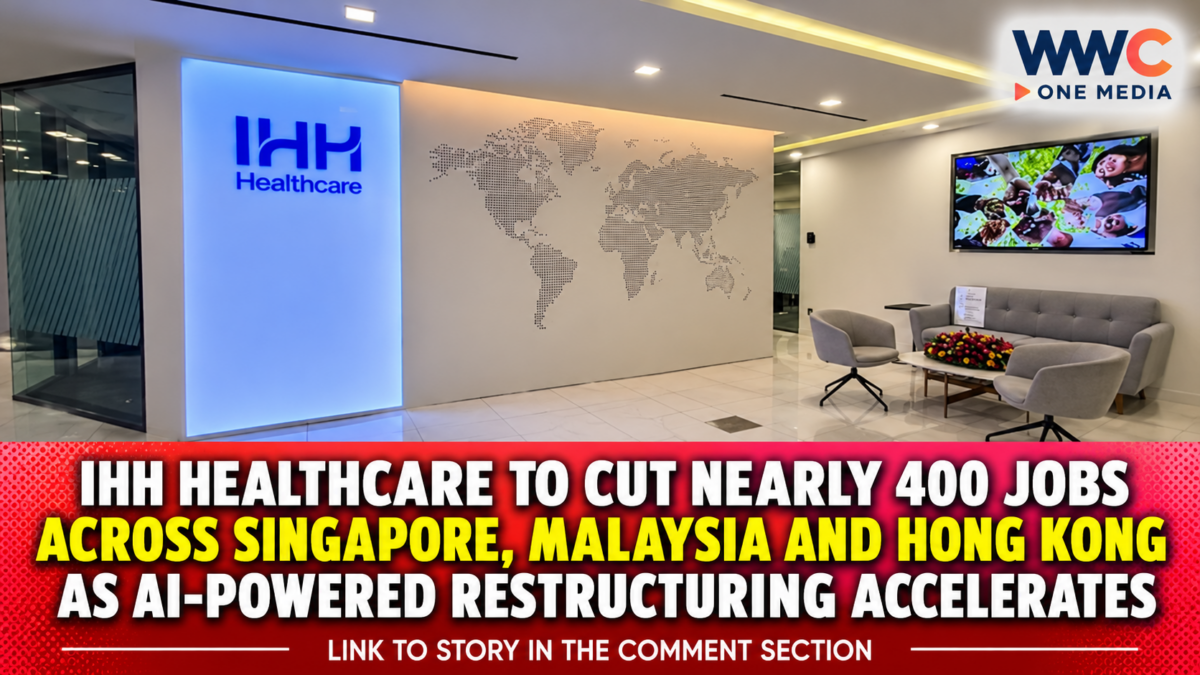
Nearly 400 employees of IHH Healthcare are expected to leave the company as one of Asia’s largest private healthcare groups consolidates its business support operations across Singapore, Malaysia and Hong Kong.
The restructuring, announced on November 4, 2026, is expected to affect approximately 380 employees, equivalent to around 0.5 percent of IHH’s global workforce of 76,000.
The company said the changes form part of a broader transformation strategy aimed at standardising administrative processes, improving operational efficiency and creating a more integrated business structure across its international hospital network.
IHH stressed that clinical services, healthcare professionals and teams directly serving patients will not be affected. However, the announcement has raised questions about the future of administrative and support jobs as healthcare companies increasingly adopt automation, artificial intelligence and centralised enterprise systems.
The affected employees are based in three important markets for the group: Singapore, Malaysia and Hong Kong. IHH has not disclosed the exact number of workers affected in each location. CNA+2
Why IHH Is Restructuring Its Workforce
IHH described the move as part of a transformation programme to make its operations more consistent, efficient and scalable.
The company wants to consolidate business support services across its network, harmonise administrative processes and redirect resources toward areas it believes will have the greatest impact on patients.
The restructuring also follows IHH’s June 2026 announcement of a collaboration with technology and consulting firm Infosys to develop an artificial intelligence-powered enterprise resource planning (ERP) system.
The system is intended to standardise and integrate business processes across the group’s markets, beginning with Singapore, Malaysia and Hong Kong.
An ERP platform can bring functions such as finance, procurement, human resources and other administrative operations into a more coordinated system. This can reduce duplicated processes and improve how information moves between departments.
However, IHH has not said that artificial intelligence alone is responsible for the job reductions. The company has presented the changes as part of a wider business consolidation and technology transformation. CNA+2
Not All 400 Employees Are Being Dismissed in the Same Way
Although the announcement is widely described as a workforce reduction of nearly 400 jobs, the company has not published a detailed breakdown of the employment arrangements.
An IHH spokesperson told media outlets that the departures involve a combination of separation arrangements, including voluntary separation offers and other employment separations based on established practices in each market.
Some employees will also move into redesigned positions rather than leave the company.
This distinction matters because the approximately 380 figure represents the estimated number of employees transitioning out of the organisation. It is not a confirmed count of employees who were all dismissed through compulsory retrenchment.
IHH has also not disclosed how many affected workers are based in Singapore, Malaysia or Hong Kong, nor has it provided a detailed list of the departments and positions involved. CNA+2
IHH Says Hospital Services and Patient-Facing Teams Will Not Be Affected
One of the biggest concerns following the announcement is whether the workforce changes could affect hospital operations or patient care.
IHH has specifically stated that clinical services, healthcare professionals and patient-facing teams are excluded from the restructuring.
The group operates approximately 190 healthcare facilities across 10 countries, including 89 hospitals. Its Singapore operations include:
- Gleneagles Hospital
- Mount Elizabeth Hospital
- Mount Elizabeth Novena Hospital
- Parkway East Hospital
The company said patients should continue receiving the same quality of care and that there would be no immediate changes to business operations or existing contractual arrangements for suppliers, partners and vendors.
Nevertheless, the full impact on administrative workflows will become clearer as the consolidation progresses. IHH has not provided a detailed explanation of how responsibilities will be redistributed among the remaining support employees. CNA+2
Singapore Union Steps In to Protect Affected Employees
In Singapore, the Singapore Manual & Mercantile Workers’ Union (SMMWU) is working with IHH to help ensure that affected employees receive fair treatment.
Union secretary-general Patrick Tay said the affected workers were informed on November 4, the same day IHH announced the restructuring.
The union represents employees at IHH subsidiaries Parkway Hospitals Singapore and Parkway Laboratory Services.
According to Tay, the union is working to ensure that affected members receive severance arrangements consistent with their collective agreement and the Tripartite Advisory on Managing Excess Manpower and Responsible Retrenchment.
Union representatives have also engaged affected employees and provided assistance with questions and concerns.
Support includes:
- Career guidance and job-search assistance
- Help with preparing CVs and applications
- Career transition and outplacement services
- Advice on upskilling and training
- Emotional support and guidance on starting a business
- Referrals to employment support networks
The union also plans to connect eligible Singaporean citizens and permanent residents with NTUC’s Employment and Employability Institute (e2i), which provides job matching, career coaching and skills-upgrading advice.
These measures are particularly important for employees whose experience may be closely tied to administrative systems and processes that are now being consolidated. The Business Times+2
IHH Promises Enhanced Severance and Career Transition Support
IHH said departing employees will receive support beyond the minimum requirements under local employment laws.
The announced assistance includes enhanced severance packages, immediate access to career transition and outplacement support, and a confidential channel for feedback and assistance.
The company also said it is committed to helping affected workers and their families throughout the transition.
However, the exact severance amounts and individual terms have not been publicly disclosed. Employment arrangements may also differ across Singapore, Malaysia and Hong Kong because each market has its own labour regulations and established employment practices.
For affected employees, the practical details of their separation agreements will be important, including notice periods, final salary payments, benefits, unused leave and eligibility for career assistance.
IHH’s Job Cuts Come as Singapore Retrenchments Reach a Four-Year High
The announcement comes at a time when Singapore’s labour market is showing signs of increased restructuring.
The Ministry of Manpower’s advance estimates released on October 30 showed that retrenchments rose to 4,800 in the third quarter of 2026, up from 4,620 in the previous quarter.
That was the highest quarterly total since the fourth quarter of 2020.
At the same time, total employment increased by 27,700 during the third quarter, showing that Singapore’s labour market is still creating jobs even as some companies reduce or reorganise their workforces.
The two developments can happen simultaneously: businesses may recruit in expanding areas while eliminating positions in departments or industries undergoing restructuring.
WWC ONE MEDIA previously examined Singapore’s rising job losses and the increase in unemployment among resident workers.
The trend also raises concerns about experienced employees who may find it difficult to return to work after losing long-held positions. Read WWC ONE MEDIA’s report on Singapore workers in their 50s struggling to find jobs after retrenchment. Reuters+3
Is AI Reshaping Healthcare Jobs Faster Than Workers Can Adapt?
IHH’s restructuring also highlights a growing question across the healthcare industry: how will technology change the jobs that keep hospitals and medical networks operating?
AI-powered systems and integrated business platforms can automate repetitive administrative tasks, improve financial reporting, streamline procurement and reduce duplicated work across different facilities.
But technology adoption does not automatically mean every affected position disappears. Some jobs may be redesigned, while others may require employees to learn new systems and take on different responsibilities.
Singapore’s government has also been encouraging workers to prepare for changes in job requirements.
WWC ONE MEDIA previously reported on Singapore’s launch of more than 200 AI courses and a new career centre to prepare workers for future jobs.
The wider debate is not simply whether AI will replace employees. It is whether employers can introduce new technology while giving existing workers realistic opportunities to retrain, move into redesigned roles or find comparable employment.
What Happens Next for IHH and Its Affected Employees?
IHH’s consolidation is expected to establish a more integrated operating structure as the company continues implementing its new ERP system.
For employees leaving the group, the immediate priorities will be securing fair separation arrangements and accessing the career support promised by the company.
For remaining employees, the transition may involve redesigned responsibilities and changes to how administrative functions are handled across the group’s markets.
For patients, IHH has pledged continuity in clinical services and patient-facing operations. The company has also said suppliers and business partners should not expect immediate changes to existing arrangements.
The full effects of the restructuring will depend on how the group implements its new operating model and whether the promised efficiency improvements can be achieved without disrupting essential support functions.
The bigger question is whether IHH can build a more efficient healthcare network while ensuring that the hundreds of employees affected by its transformation are not left behind.