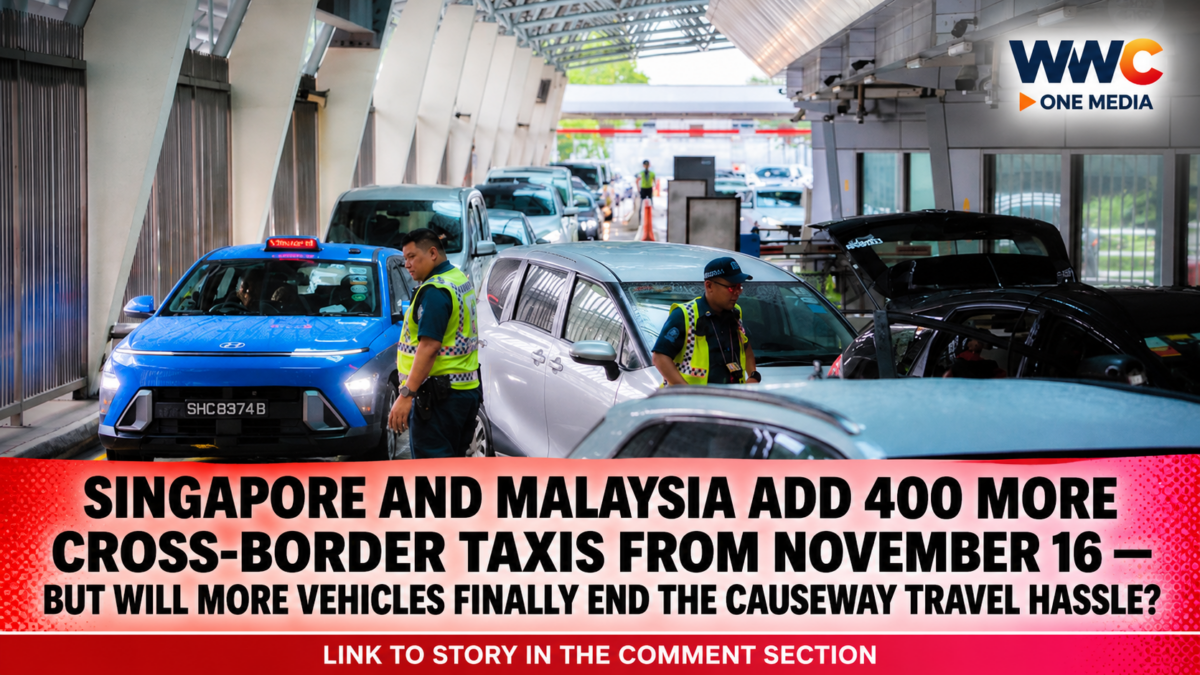
Travelling between Singapore and Johor Bahru could soon become easier as Singapore and Malaysia prepare to expand their licensed cross-border taxi services, increasing the quota from 300 to 500 vehicles per country starting November 16, 2026.
The expansion will raise the combined quota to as many as 1,000 licensed cross-border taxis, up from the current 600. Two additional ride-hailing operators — Singapore-based CDC Zig and Malaysia’s Kumpool — will also be allowed to operate under the enhanced Cross-Border Taxi Scheme, joining GrabCar.
The announcement was made on November 6 in a joint statement by the transport ministries of Singapore and Malaysia. The move is intended to give commuters more transport choices, improve cross-border point-to-point journeys and strengthen connectivity between the neighbouring countries.
For workers who regularly cross the Causeway, as well as families, tourists and business travellers, the changes could mean more opportunities to book a licensed ride instead of relying only on buses, private vehicles or traditional taxi arrangements. AsiaOne+2
Two New Operators Will Join GrabCar
The November 16 expansion will bring the number of licensed ride-hailing and e-hailing operators under the scheme to three:
- CDC Zig — Singapore-based operator.
- Kumpool — Malaysia-based operator.
- GrabCar — already licensed under the scheme.
The addition of CDC Zig and Kumpool is intended to give passengers more ways to arrange cross-border journeys through recognised platforms.
The expanded quota does not mean every additional vehicle will immediately be available for booking. The 500-vehicle limit on each side is the permitted supply under the scheme, while actual availability will depend on licensed operators and participating drivers.
The new operators will join a framework that regulates cross-border point-to-point transport rather than opening the border to unrestricted ride-hailing services. AsiaOne+1
What Changes for Passengers From November 16?
The increase builds on improvements introduced on May 4, 2026, when Singapore and Malaysia expanded the operating arrangements for licensed cross-border taxis.
Under the enhanced scheme, licensed taxis can drop passengers off at destinations across Singapore and within specified areas of Johor:
- Johor Bahru
- Iskandar Puteri
- Forest City
- Kulai
- Senai
This is a significant improvement over the earlier arrangement, which largely restricted cross-border taxi drop-offs to designated terminals.
Passengers can now arrange point-to-point journeys within the permitted operating areas, making the service more practical for people travelling to homes, hotels, workplaces and commercial destinations.
However, the rules are not identical for both countries. Singapore-registered taxis can drop passengers off within the specified Malaysian operating areas, while Malaysia-registered taxis can drop passengers off across Singapore. Ministry of Transport+1
Where Can Cross-Border Taxis Pick Up Passengers?
Although drop-off arrangements have become more flexible, foreign-registered taxis cannot freely collect passengers anywhere in the other country.
The restrictions are designed to prevent cross-border vehicles from competing unlawfully with local taxi and private-hire services.
Under the current arrangements:
Singapore-registered taxis entering Malaysia
- Can pick up passengers anywhere in Singapore.
- Can pick up passengers in Malaysia through designated locations and approved ride-hailing arrangements.
- Can continue to serve passengers at Larkin Sentral in Johor Bahru.
Malaysia-registered taxis entering Singapore
- Can pick up passengers anywhere in Malaysia.
- Can collect passengers in Singapore through designated pick-up points and approved ride-hailing arrangements.
- Can continue to serve passengers at Ban San Street Terminal.
The designated ride-hailing pick-up locations in Singapore include areas near VivoCity, Century Square and Joo Koon. In Malaysia, designated locations include Toppen Shopping Centre, Mid Valley Southkey Mall and Angsana Mall.
The restrictions mean that passengers should check the approved pick-up locations and booking arrangements before requesting a cross-border ride. Cross-Border Services+1
Why Singapore and Malaysia Are Increasing the Taxi Quota
The expansion reflects growing demand for convenient transport between the two countries.
The Singapore-Johor Bahru corridor serves workers, students, tourists, shoppers and business travellers. Many commuters regularly cross the border for employment and other daily activities, while weekend traffic increases as Singapore residents travel to Johor for shopping, dining and short holidays.
The existing quota was raised from 200 to 300 taxis per country in May 2026. The November 16 increase will bring it to 500 on each side.
The transport ministries said the earlier improvements had resulted in smoother and more comfortable journeys, with passengers benefiting from more flexible drop-offs and access to larger and premium vehicle options.
The latest expansion is intended to build on those improvements while maintaining safeguards for drivers and transport providers in both countries. AsiaOne+2
Larger Vehicles and Premium Taxi Options Are Part of the Expansion
The enhanced scheme is not limited to increasing the number of ordinary four-seater taxis.
The May 2026 arrangements introduced a wider selection of vehicles, including:
- Standard four-seater taxis
- Standard six-seater taxis
- Premium six-seater taxis
These options are intended to accommodate larger families, groups travelling together and business passengers who may need more space or a higher level of service.
The vehicle categories are particularly relevant for travellers carrying luggage or travelling with several companions, although the availability of each type will depend on the licensed operators.
The expansion should provide more capacity for these services, but passengers should still check vehicle types and fares through the relevant booking platforms before confirming a trip. Ministry of Transport+1
Strict Rules Remain to Prevent Illegal Cross-Border Taxi Services
Despite the increased quota, Singapore and Malaysia are not opening their markets to unrestricted cross-border ride-hailing.
Both governments have maintained rules to protect local drivers and ensure that only authorised vehicles operate across the border.
Licensed cross-border taxis must meet identification and regulatory requirements, including:
- Clearly identifiable taxi livery and signage.
- Prescribed vehicle registration plate prefixes.
- Required on-board equipment for enforcement.
- Valid licensing and permits for cross-border operations.
- Compliance with restrictions on domestic point-to-point trips.
The May 2026 framework also requires vehicles used under the enhanced arrangements to be no more than 10 years old, subject to transitional provisions for certain previously licensed taxis.
Taxis entering the other country must generally carry at least one passenger. There are specified exemptions for vacant entry: Malaysia-registered taxis entering Singapore on Fridays from noon to midnight, and Singapore-registered taxis entering Malaysia on Sundays during the same hours.
These requirements are intended to prevent a foreign taxi from entering the other country and operating as an ordinary local taxi without the appropriate authorisation. Ministry of Transport+1
Illegal Cross-Border Ride-Hailing Remains a Major Enforcement Concern
The stricter rules are significant because illegal cross-border transport services have been a recurring concern for authorities.
Singapore’s Land Transport Authority (LTA) has previously warned that unlicensed vehicles operating point-to-point services across the border may leave passengers without appropriate insurance protection.
In June 2026, LTA announced that Malaysia-registered taxis entering Singapore must hold the required Public Service Vehicle Licence and ASEAN Public Service Vehicle Permit to provide authorised cross-border services.
The authority also announced that the ASEAN Public Service Vehicle Permit fee for Malaysia-registered taxis entering Singapore would increase to S$15 per trip from January 1, 2027, replacing the previous S$2 monthly fee.
LTA has urged commuters to use licensed services because unauthorised vehicles may not have the required insurance coverage, potentially leaving passengers with limited protection if an accident occurs.
The expansion therefore comes with an important condition: more taxis must also mean stronger compliance and enforcement. Land Transport Authority+1
The Johor-Singapore Special Economic Zone Could Increase Demand for Cross-Border Transport
The taxi expansion also comes as Singapore and Malaysia deepen economic cooperation through the Johor-Singapore Special Economic Zone (JS-SEZ).
The zone is intended to strengthen investment, business activity and economic links between Johor and Singapore. More convenient transport between the two sides could help workers, investors and businesses move across the border more efficiently.
WWC ONE MEDIA previously reported that the JS-SEZ had attracted RM88.83 billion in approved investments between January 2025 and June 2026, with thousands of potential jobs associated with the projects.
Read the full report: Johor-Singapore Economic Zone Hits RM88.8 Billion in Investments — But the Real Test Is About to Begin.
More investment and employment opportunities could increase the need for dependable cross-border transport, particularly for people who live in one country and work or conduct business in the other.
RTS Link Will Offer Another Alternative to the Causeway
The taxi expansion is also taking place as both countries prepare for the Johor Bahru-Singapore Rapid Transit System (RTS) Link.
The rail project will connect Bukit Chagar in Johor Bahru with Woodlands North in Singapore. The train journey is expected to take approximately five minutes, with the system designed to carry up to 10,000 passengers per hour in each direction.
The RTS Link is expected to provide a major alternative to road travel through the Causeway, although taxis will remain useful for passengers who need direct journeys to destinations beyond the railway stations.
WWC ONE MEDIA has examined the project’s progress and the infrastructure challenges that could affect its ability to ease congestion: Johor’s RTS Link Is Almost Ready — But One Missing Piece Could Decide Whether It Really Eases Singapore Traffic.
The new rail service and expanded taxi scheme could eventually complement each other, giving commuters more choices depending on their destination, budget and travel needs. WWC One Media+1
Causeway Congestion Could Still Affect Cross-Border Taxi Journeys
More licensed taxis do not automatically mean shorter travel times.
The Singapore-Malaysia Causeway remains vulnerable to heavy traffic, especially during weekends, public holidays and school-holiday periods. Even a larger fleet can become caught in long queues when vehicle volumes rise or an incident disrupts traffic flow.
WWC ONE MEDIA has previously covered heavy traffic at Woodlands Checkpoint as queues stretched towards the Bukit Timah Expressway.
Another report examined the return of Causeway congestion as traffic from Malaysia backed up towards Singapore.
These incidents highlight a key limitation: the new taxi quota can increase transport availability, but it cannot by itself solve congestion at immigration checkpoints or on the roads approaching the border.
What Travellers Should Know Before Booking a Cross-Border Taxi
From November 16, travellers can expect a larger pool of licensed cross-border taxis and two additional ride-hailing operators under the scheme.
Before booking, passengers should remember:
- Use an authorised operator. Check that the service is licensed for cross-border journeys.
- Confirm the pick-up point. Foreign taxis cannot collect passengers freely throughout the other country.
- Check the drop-off area. The permitted operating boundaries differ depending on which country registered the taxi.
- Confirm the vehicle category and fare. Standard and premium vehicle options may have different prices.
- Allow extra travel time. Immigration queues and Causeway congestion can still affect journey times.
The expansion is expected to provide more flexibility, but passengers should not assume that every ordinary ride-hailing booking can cross the border.
More Taxis, More Operators — But Will Cross-Border Travel Finally Become Easier?
Singapore and Malaysia’s decision to raise the licensed cross-border taxi quota to 500 vehicles each marks another step toward improving transport connectivity between the two countries.
The addition of CDC Zig and Kumpool will broaden the available booking options, while the larger quota could help accommodate more commuters, families and business travellers.
The changes also fit into a wider effort to strengthen Singapore-Johor economic ties through the JS-SEZ and future transport infrastructure such as the RTS Link.
But the success of the expansion will depend on more than the number of taxis on the road. Operators must provide reliable services, authorities must enforce licensing rules fairly, and both countries must continue addressing congestion at their busiest border crossing.
For commuters, the most important test begins on November 16: whether the bigger fleet and additional booking platforms will translate into shorter waits, easier pick-ups and more dependable journeys.