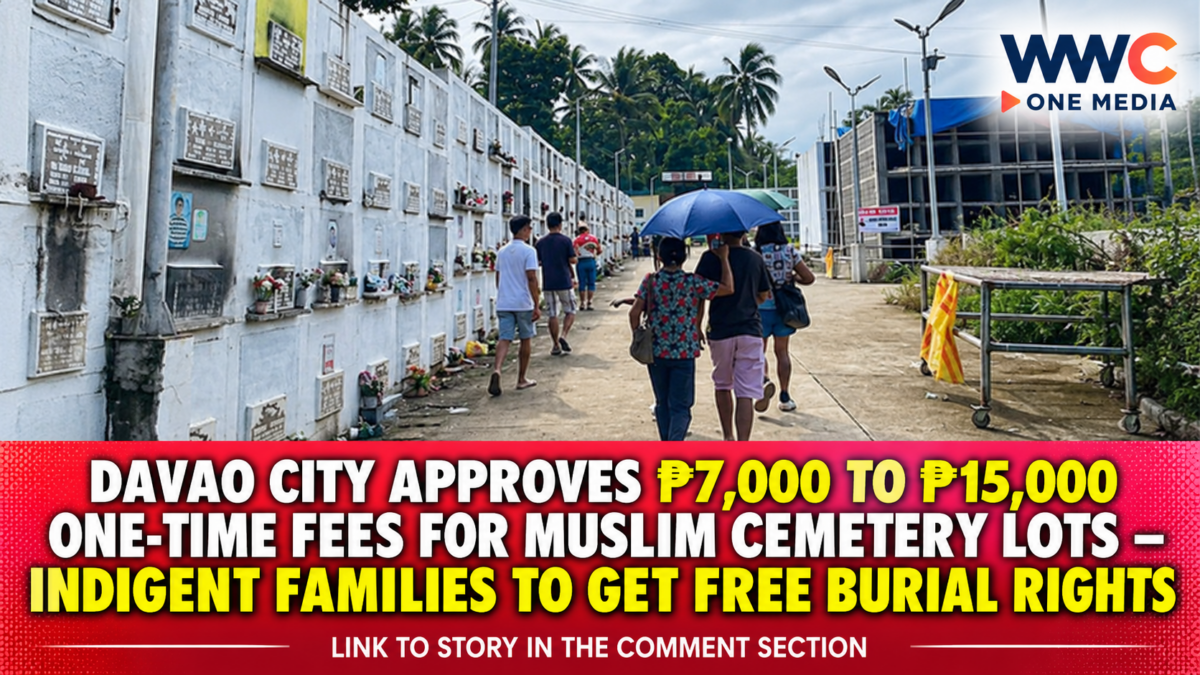
Muslim families in Davao City could soon have access to a more affordable and culturally appropriate public burial option after the City Council approved an ordinance on second reading establishing one-time fees for grave lots at the new Muslim cemetery inside Tagakpan Public Cemetery.
Under the proposed fee schedule, families would pay ₱7,000 for a children’s grave lot and ₱15,000 for a larger lot. Indigent families, meanwhile, would be exempt from paying upon certification by the City Social Welfare and Development Office (CSWDO).
The measure, sponsored by Councilor Ragde Niño Ibuyan Jr., was approved during the City Council’s regular session on November 3, 2026. It seeks to replace recurring cemetery charges with a single payment while respecting Islamic burial traditions, which do not allow the exhumation, transfer or reuse of remains.
The approval is an important step for Muslim communities seeking permanent burial spaces in the city. However, because the ordinance has only passed second reading, it should not yet be treated as a fully enacted or effective policy. SunStar Publishing Inc.+1
How Much Will Muslim Grave Lots Cost in Davao City?
The proposed rates are based on the lowest amounts within the fee range recommended by the City Economic Enterprises (CEE), according to the committee report.
The schedule covers two categories:
- ₱7,000 for children’s grave lots: The cemetery has 70 smaller lots intended for children.
- ₱15,000 for larger grave lots: There are 264 larger lots intended for adult burials.
This brings the planned capacity to 334 burial spaces.
Councilor Ibuyan said the rates were determined after a study and public hearing, with the goal of keeping the charges low enough to help families while providing funds for cemetery operations.
He also said the proposed prices are approximately 60 percent cheaper than those charged by private cemeteries identified during the city’s consultations. Private burial spaces reportedly cost more than ₱30,000 to ₱35,000.
The comparison is based on the private cemeteries surveyed by the city and should not be interpreted as a universal price for every private cemetery in Davao. SunStar Publishing Inc.+1
No Annual Renewal Fees and No Exhumation Under the Proposed System
One of the most significant differences between the new Muslim cemetery and Davao City’s regular public burial grounds is the proposed arrangement for permanent burial rights.
Regular public cemetery lots generally operate under six-year leases. Under the city’s existing revenue code, families may also face an annual renewal charge after the initial six-year period.
The new Muslim cemetery will follow a different arrangement.
Instead of issuing a temporary lease, the city will provide families with a contract granting the right of interment. The burial rights will be held in perpetuity, meaning there will be no annual renewal fee and no planned exhumation, transfer or reuse of the remains.
However, this does not mean families will own the land. The city government will retain ownership of the cemetery property, while families receive the contractual right to use the designated burial space.
The arrangement follows an opinion from the City Legal Office that a temporary lease would not be appropriate for Muslim burial practices, which require the graves to remain undisturbed.
This distinction is important because the policy is not simply about reducing cemetery charges. It is also an effort to provide public burial facilities that respect the religious and cultural requirements of Muslim residents. SunStar Publishing Inc.+1
Indigent Families Will Not Pay the Cemetery Fee
The City Council also amended the measure to exempt indigent families from paying for burial lots.
The exemption was raised by Councilor Diosdado Angelo Mahipus Jr. and incorporated into the ordinance during deliberations.
Under the approved amendment, families must secure certification from the CSWDO to qualify for free burial.
The council also approved a related resolution urging the CSWDO to study expanding its annual burial assistance program. The existing assistance is limited to indigent senior citizens, and the proposed review would consider extending support to other indigent residents.
This is particularly important for households that cannot afford private burial arrangements or even the proposed public cemetery charges.
The city has not yet announced a complete list of documentary requirements for the new exemption. Families should therefore coordinate with the CSWDO and the relevant cemetery office before making burial arrangements. SunStar Publishing Inc.+1
₱4.45 Million in Expected Fees Will Not Cover the Full Cemetery Project Cost
Although the new cemetery is designed to provide affordable burial spaces, the city still needs to fund its long-term operation and maintenance.
The proposed fees are expected to generate approximately ₱4.45 million, with proceeds intended to support cemetery operations and potentially help finance future Muslim burial facilities.
However, the project’s total cost reached approximately ₱7.33 million.
That means the expected collections would fall short of the original project cost by roughly ₱2.88 million.
Councilor Ibuyan said the rates were established in the spirit of public service rather than to recover the entire construction expense.
CEE Manager Macky Macalipes reported that construction began in May 2025 and was already 87 percent complete. The project includes a prayer building, pathways and a main entrance.
It was funded through the city’s 2022 Annual Development Plan Supplemental Budget 2.
The remaining challenge is ensuring that the cemetery has enough resources for personnel, maintenance, landscaping and the continuing needs of families using the facility. SunStar Publishing Inc.+1
Councilors Still Question Whether the Fees Are Affordable Enough
Despite the proposed rates being lower than those identified at private cemeteries, some councilors raised concerns about whether the charges could still be burdensome for families.
Councilor Danilo Dayanghirang asked the CEE to study whether the fees could be reduced further, emphasizing that government services should prioritize public welfare rather than operate primarily for profit.
Councilor Alberto Ungab offered another approach, suggesting that the CSWDO provide subsidies to poor families so that cemetery operations could still receive the necessary funding.
Meanwhile, Ibuyan said the committee plans to propose a 20 percent discount for deceased senior citizens and persons with disabilities in the following month.
That discount is still a proposed measure and should not be treated as an existing benefit under the ordinance approved on second reading.
The discussion highlights the challenge facing local governments: making burial services affordable while ensuring public cemeteries remain properly maintained and financially sustainable. SunStar Publishing Inc.+1
Ma-a Muslim Cemetery Will Also Be Expanded
Tagakpan is not the only Muslim burial facility included in the city’s longer-term plans.
Davao City’s existing Muslim public cemetery in Ma-a currently provides free burials. According to Ibuyan, the city plans to rehabilitate the facility and expand the section reserved for Muslim burials.
The rehabilitation is expected to be included in the city’s 2027 annual budget.
Plans also include improvements to drainage, roads and landscaping at the Ma-a, Panacan and Tibungco cemeteries.
The city is additionally looking for land in the Second District, which has a substantial Muslim population, for another Muslim cemetery.
These initiatives reflect the growing need to provide sufficient burial spaces while ensuring that cemetery facilities can accommodate the religious practices of different communities.
The City Government of Davao has also strengthened its cemetery management framework through the reconstitution of the Davao City Cemetery Management Board under Executive Order No. 4, series of 2026. The board is tasked with overseeing public cemetery management, modernization and rehabilitation planning. Mindanao Times+1
Why Davao City’s New Muslim Cemetery Policy Matters
The proposed one-time fee system addresses a concern that goes beyond the cost of burial.
For Muslim families, the ability to keep graves undisturbed is an important religious consideration. A temporary lease arrangement that could eventually require renewal or transfer of remains would not adequately address that requirement.
The new arrangement is therefore intended to balance three priorities:
- Religious and cultural respect: Burial rights will be granted in perpetuity, with no planned exhumation or transfer of remains.
- Financial accessibility: The proposed public rates are lower than the private cemetery prices cited by the city, while certified indigent families will receive free burial.
- Long-term cemetery management: The fees are intended to contribute to maintenance, staffing and the development of additional Muslim burial facilities.
For context, WWC ONE MEDIA has also reported on Davao police correcting a viral cemetery photograph ahead of Undas 2026, highlighting the public attention and operational demands surrounding the city’s cemeteries.
The broader issue of funeral affordability also extends beyond Davao. WWC ONE MEDIA previously examined government funeral assistance and why Filipino families should understand their available support.
Meanwhile, the city’s annual Undas preparations show how cemetery management affects public services, security and families across the country. Read WWC ONE MEDIA’s coverage of President Marcos’ Undas 2026 tribute to departed family members.
What Happens Before the New Fees Take Effect?
The biggest remaining question is when families can officially use the new fee arrangement.
The ordinance has passed second reading, but the latest reports do not establish that it has completed all legislative requirements or taken effect.
The city must still complete the applicable approval process before the new rates can be implemented. Families should wait for official announcements from the City Council and City Economic Enterprises before making payments under the proposed schedule.
The city must also clarify the procedures for securing burial-rights contracts and obtaining the indigent exemption.
For now, the proposed policy represents a major step toward providing Muslim residents with more permanent and affordable public burial options.
Davao City’s challenge will be ensuring that the new cemetery remains accessible, properly maintained and respectful of Islamic traditions—not only when it opens, but for generations of families who will depend on it.