ASUNCIÓN, PARAGUAY / MANILA, PHILIPPINES — November 7, 2026 | WWC ONE MEDIA | World Politics, Banking Crisis, Latin America and Global Financial Markets
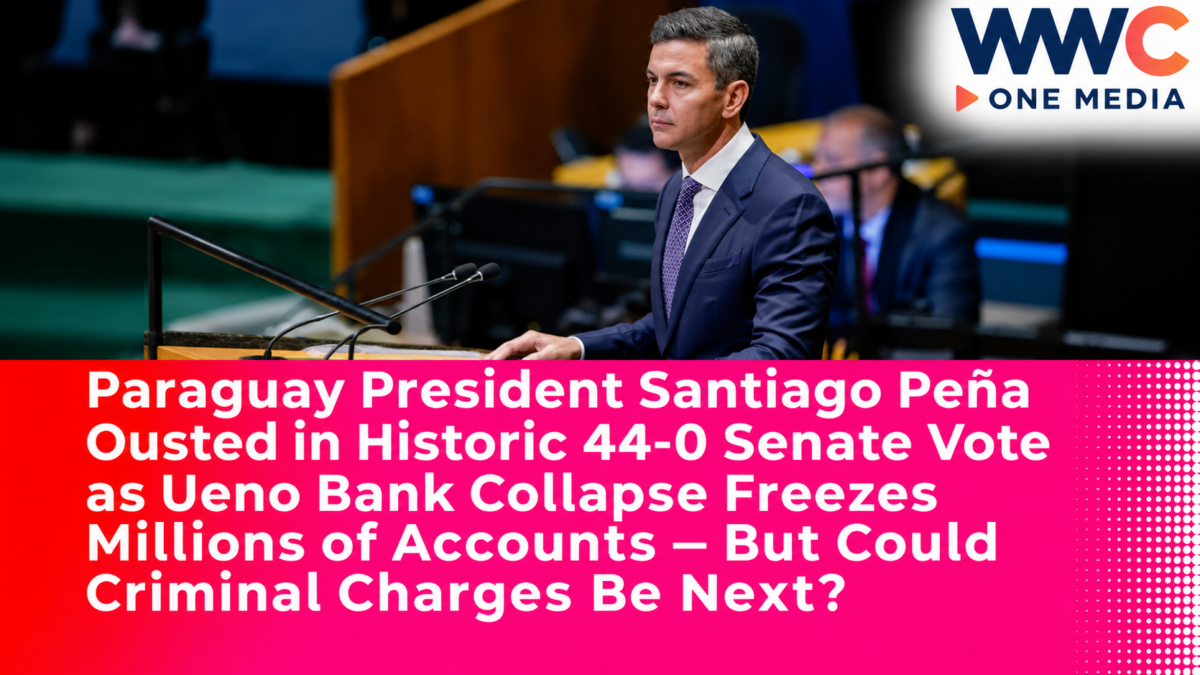
Paraguay has been plunged into one of its most dramatic political and financial crises in more than a decade after the country’s Senate unanimously removed President Santiago Peña from office amid allegations linking his administration to the collapse of one of its largest digital banks.
In a historic vote on Friday, November 6, all 44 senators present voted to remove Peña, ending his presidency and opening the possibility of further legal proceedings over the collapse of Ueno Bank.
The extraordinary development came just days after regulators intervened in the fast-growing financial institution, leaving millions of customers struggling to access their accounts and raising questions about approximately $850 million in public funds reportedly placed with the lender.
Vice President Pedro Alliana has since been sworn in as Paraguay’s new president and is expected to complete the presidential term ending in August 2028.
For Peña, the political consequences have been devastating.
The 47-year-old former president had offered to resign on November 5, arguing that his departure would help preserve stability.
But lawmakers continued with impeachment proceedings rather than simply accepting his resignation.
Their decision was particularly consequential because the different routes out of office could affect Peña’s claim to the lifelong senatorial status available to certain former Paraguayan presidents.
Now, investigators are examining allegations involving conflicts of interest, bank supervision and the placement of public money.
The collapse of Ueno Bank has therefore become much more than a financial scandal. It has toppled a president, shaken public confidence and raised a deeply uncomfortable question: how did a bank with millions of customers and politically connected investors reach the point of regulatory intervention?
Paraguay’s Senate Removes Santiago Peña in Unanimous Vote
The decisive vote took place on November 6 during an extraordinary session of Paraguay’s upper house.
According to the Senate’s official announcement, lawmakers found Peña responsible for poor performance of his presidential duties under the country’s constitutional impeachment procedures.
All 44 senators who attended voted in favor of his removal.
One senator was absent.
The vote followed impeachment proceedings initiated by the Chamber of Deputies the previous day.
The lower house had approved the impeachment case unanimously, establishing overwhelming legislative support for action against the president.
The Senate subsequently considered the accusations and proceeded to a final vote.
Peña was removed from office under the constitutional procedure for impeachment.
The decision represents one of the most significant political upheavals in Paraguay since former President Fernando Lugo was removed in 2012.
But parliamentary removal should not be confused with a criminal conviction.
The Senate’s decision concerned presidential responsibility and the constitutional grounds for removal.
The separate question of whether Peña committed criminal offenses belongs to Paraguay’s judicial system.
Ueno Bank Collapse Triggers Nationwide Financial Emergency
At the center of the scandal is Ueno Bank, a digital lender that expanded rapidly into one of Paraguay’s most prominent financial institutions.
The bank, launched in its modern digital form in 2021, developed a customer base of approximately three million people.
That is an extraordinary scale in a country with a relatively small population.
Ueno’s rapid growth helped make it an important provider of payments, savings accounts and digital financial services.
But the expansion came to a sudden halt in early November.
Paraguay’s Central Bank intervened in the lender after identifying failures to meet minimum solvency requirements.
The move restricted customers’ access to accounts and disrupted payment services.
For ordinary depositors, the consequences were immediate.
People reported being unable to withdraw cash, use bank cards or complete digital transactions.
The crisis also affected pensioners and people dependent on the institution for everyday payments.
What began as a regulatory intervention quickly became a national emergency.
Nearly Three Million Customers Affected by Bank Disruptions
Ueno’s reported customer base of approximately three million made the intervention especially disruptive.
The institution had become deeply integrated into Paraguay’s digital payment system.
When banking services stopped functioning normally, the consequences extended beyond customers trying to withdraw savings.
Businesses experienced problems receiving payments.
Families faced uncertainty about access to money.
People relying on digital transactions suddenly had to seek alternatives.
The disruption demonstrates how a fast-growing digital bank can become systemically important to everyday economic activity even when regulators consider its financial problems institution-specific.
However, there is an important distinction between a frozen account and a permanently lost deposit.
The inability to access money during a bank-resolution process does not mean every affected depositor has suffered a complete financial loss.
Recovery depends on the deposit-insurance framework, transfers of accounts, remaining bank assets and decisions by financial regulators.
By November 7, the Associated Press reported that some smaller depositors had begun receiving funds.
The central bank said deposit insurance covered approximately 97% of customers.
That does not mean 97% of all deposit amounts have necessarily been repaid.
Nor does it establish that every customer has already regained normal access.
Why $850 Million in Public Funds Is Under Scrutiny
One of the most politically sensitive issues concerns public money held at Ueno Bank.
Reuters reported that the lender managed approximately $850 million in public funds.
These reportedly included funds associated with state institutions.
Lawmakers and investigators are examining whether the placement and management of public money complied with applicable legal requirements.
The controversy also involves allegations concerning public pension deposits and possible breaches of regulatory limits.
Those questions are especially serious because public institutions have responsibilities to safeguard money held on behalf of taxpayers, pensioners and other beneficiaries.
But the reported $850-million exposure should not be described as a confirmed $850-million loss.
It represents the approximate amount of public funds reportedly associated with the lender.
The eventual financial consequences will depend on asset recovery, legal proceedings and how the bank’s obligations are resolved.
Investigators must establish whether public money was improperly directed to Ueno and whether any legal violations occurred.
Peña’s Business Connections Become Central to the Scandal
Peña’s relationship with the bank’s ownership group became a central focus of impeachment proceedings.
Before the current scandal, he had held an equity interest in Grupo Vázquez, the business group controlling Ueno Bank.
Peña says he sold that stake in March 2025.
He also maintains that he did not hold a direct ownership interest in the bank itself.
Nevertheless, lawmakers questioned whether his earlier commercial connections created conflicts of interest once he became president.
The allegations extended to the relationship between Ueno and government institutions responsible for financial supervision.
In particular, lawmakers questioned decisions involving the placement of public funds and the effectiveness of the central bank’s oversight.
Peña has denied wrongdoing.
His previous ownership interest is a documented matter, but it does not by itself establish criminal responsibility for Ueno’s collapse.
The investigation must determine whether any official decision was improperly influenced by private interests.
Central Bank Leadership Faces Its Own Crisis
The scandal also damaged Paraguay’s central bank leadership.
Carlos Carvallo, who had previously held a senior position at Ueno’s predecessor business, was appointed to lead the central bank under Peña.
That background became controversial once regulators intervened in Ueno.
The central bank was responsible for supervising the same financial institution with which Carvallo had previously been associated.
Critics questioned whether the relationship created conflicts of interest or weakened oversight.
Carvallo subsequently resigned.
The Associated Press reported that he was also facing legal action connected with the investigation.
His situation reflects a broader issue involving the relationship between financial institutions and the officials responsible for supervising them.
Employees moving between private banks and regulatory agencies are not automatically engaging in misconduct.
But such appointments can create risks if conflicts are not appropriately disclosed and managed.
The Ueno investigation will need to establish whether regulatory obligations were breached and whether any failures contributed to the bank’s deterioration.
Prosecutors Open Criminal Investigations
Paraguay’s public prosecutors have moved to investigate the circumstances surrounding the bank’s collapse.
Reuters reported that investigators opened cases examining Ueno’s operations, the management of public funds and the conduct of public officials.
By November 7, the Associated Press reported that 27 Ueno executives had been charged, while investigators had seized assets associated with the bank’s founder.
Peña was also placed under house arrest pending an appearance before prosecutors, according to the AP.
The charges and investigative measures demonstrate the seriousness of the case.
But they should not be treated as final judicial findings.
Peña has denied allegations involving breach of trust, influence peddling and the use of public office for personal benefit.
The accused executives and officials retain the right to defend themselves through the legal process.
The eventual outcome will depend on evidence, legal proceedings and decisions by the courts.
Why Lawmakers Refused to Simply Accept Peña’s Resignation
One of the most unusual aspects of the crisis involved the political struggle over how Peña would leave office.
On November 5, the president offered his resignation.
Under Paraguay’s constitutional arrangements, certain former presidents may acquire a lifetime, nonvoting seat in the Senate after leaving office.
That position carries legal protections relevant to potential prosecution.
However, removal through impeachment has different constitutional consequences.
Bloomberg reported that lawmakers proceeded with impeachment partly to prevent Peña from obtaining the status he might otherwise have claimed following resignation.
This made the impeachment vote more consequential than a routine change of government.
Peña’s allies had argued for accepting the resignation.
Other lawmakers insisted that the constitutional impeachment process should continue.
The Senate ultimately voted to remove him.
The decision has strengthened the possibility of further criminal proceedings, although the courts will determine the legal consequences.
Pedro Alliana Takes Over Paraguay’s Presidency
Following Peña’s removal, Vice President Pedro Alliana was sworn in as Paraguay’s new president.
Alliana is expected to serve the remainder of the term through August 2028.
The transition provides constitutional continuity during an exceptionally difficult period.
But the incoming president faces enormous challenges.
He must stabilize the political situation, reassure depositors and support efforts to restore confidence in the financial system.
Alliana also faces questions arising from the wider investigation.
The Associated Press reported that he remained under investigation, although he survived a separate impeachment effort.
This complicates the government’s attempts to convince the public that the crisis will be resolved quickly.
The new administration’s credibility may depend on its ability to demonstrate transparent investigations, effective regulatory action and progress in returning depositors’ funds.
Horacio Cartes’ Role Reveals Deep Political Divisions
The scandal also exposed divisions within Paraguay’s powerful Colorado Party.
Peña had been closely associated with former President Horacio Cartes, a major figure within the political movement.
But as the banking crisis escalated, Cartes supported Peña’s removal.
The reversal illustrated how quickly the president’s political support had deteriorated.
The Colorado Party has dominated much of Paraguay’s recent political history.
Internal divisions within the party can therefore have major consequences for government stability.
The bank scandal brought those divisions into the open.
The allegations against Peña also became entangled with wider questions about political influence, financial institutions and the relationship between government officials and private businesses.
However, political rivalries do not resolve the underlying criminal allegations.
Those require independent investigation and judicial review.
Paraguay Faces Its Biggest Presidential Crisis Since 2012
Peña’s removal recalls another dramatic moment in Paraguay’s political history.
In June 2012, Congress removed President Fernando Lugo following a deadly confrontation involving police officers and landless farmers.
The impeachment generated intense controversy and international scrutiny.
Now, more than a decade later, another president has been removed through congressional proceedings.
This time, the trigger was not a rural security confrontation but the collapse of a politically connected financial institution.
The events demonstrate the significant power held by Paraguay’s legislature under its constitutional system.
They also highlight the importance of clear legal procedures when an elected president faces removal.
The Senate’s unanimous vote established decisive political support for impeachment.
But the wider consequences will depend on how the financial crisis and criminal investigations are handled.
Can Paraguay Protect Depositors and Prevent a Banking Panic?
For millions of Ueno customers, the immediate priority is access to their money.
The central bank has insisted that the problems at Ueno should not be interpreted as evidence that Paraguay’s entire banking system is insolvent.
Regulators have been working to transfer accounts, protect eligible deposits and restore financial services.
The Associated Press reported that deposit insurance covers approximately 97% of Ueno’s customers.
That is an important reassurance.
But restoring confidence requires more than announcing insurance coverage.
Customers need clear information about eligibility, repayment procedures and when they can regain access.
Public institutions also need assurances about the treatment of their deposited funds.
And regulators must demonstrate that other financial institutions are being supervised appropriately.
A failure to communicate these details clearly could encourage uncertainty beyond the affected bank.
WWC ONE MEDIA Previously Covered Peña’s Resignation
The removal follows developments reported by WWC ONE MEDIA on November 6.
In Paraguay President Quits After Ueno Bank Collapse Locks Millions Out of Their Savings — But Will Depositors Ever Recover All Their Money?, the news desk examined Peña’s announcement that he intended to resign, the public protests and the first stages of impeachment proceedings.
That report reflected the situation before the Senate completed its final vote.
The November 6 impeachment therefore represents a significant new development.
Peña is no longer simply a president offering to resign.
He has now been formally removed from office by the Senate.
The political transition has also advanced, with Alliana sworn in as president.
Why Bank Supervision Matters Beyond Paraguay
The Ueno crisis raises questions familiar to financial regulators around the world.
Banks must maintain sufficient capital to absorb unexpected losses.
They must control lending risks and manage their exposure to borrowers connected to shareholders or executives.
Regulators also need to ensure that financial institutions comply with legal requirements.
A rapidly expanding bank can attract substantial deposits while its underlying financial risks become increasingly complicated.
WWC ONE MEDIA examined a different example of banking-sector pressure in Australia’s NAB Profit Crashes 13.4% to A$6.14 Billion as Bad Loans Surge 86% — But Could a Deepening Housing Slump Trigger a Bigger Banking Crisis?.
The Australian bank’s situation is fundamentally different from Ueno’s collapse.
The report concerns earnings and credit-loss provisions rather than a regulatory takeover.
Nevertheless, both stories illustrate why capital adequacy, loan quality and strong financial supervision are important.
A Lesson for Southeast Asian Banks
The Ueno scandal also offers a broader lesson for financial institutions in Southeast Asia.
Banks face pressure to grow lending, expand digital services and attract new customers.
But rapid expansion must be supported by adequate capital and effective risk controls.
WWC ONE MEDIA recently reported on profitability and credit-risk pressures in EastWest Bank Profit Plunges 24% Despite ₱43.4-Billion Revenue Surge — But Could ₱15.9 Billion in Loan-Loss Provisions Signal Bigger Trouble?.
That article examined how rising provisions for expected loan losses can affect earnings even when revenue increases.
EastWest’s reported capital ratios remained above applicable regulatory requirements.
There is no evidence linking EastWest to Ueno or suggesting that the Philippine institution faces the same crisis.
The relevance is the importance of transparent financial reporting and prudent lending practices.
Regulators and investors must distinguish between ordinary fluctuations in bank earnings and serious solvency failures.
Financial Trust Can Disappear Quickly
Another lesson concerns public confidence.
Banking depends heavily on customers believing that their money is safe and accessible.
That trust can be damaged when information about a financial institution becomes uncertain.
Digital banking adds convenience, but it can also make service interruptions immediately visible to large numbers of users.
WWC ONE MEDIA examined related consumer-security concerns in RCBC Fights Back Against ₱121.8-Billion Philippine Scam Crisis With Free Anti-Fraud App — But Can It Stop Criminals Before They Steal Your Money?.
The Philippine report concerns financial fraud and digital security rather than bank insolvency.
Still, both stories demonstrate that maintaining trust requires strong safeguards and effective responses when customers encounter financial risks.
For Ueno, rebuilding trust will depend on protecting depositors and explaining how the institution’s problems developed.
Could the Scandal Damage Paraguay’s International Reputation?
Paraguay has sought to build a reputation as a relatively stable South American economy.
The sudden collapse of a major financial institution, followed by the removal of a president, could challenge that image.
International investors generally evaluate political stability, the strength of financial institutions and the predictability of government policy.
Concerns about regulatory oversight can affect investment decisions even when a banking crisis is contained.
But it would be premature to conclude that Paraguay’s entire economy is headed for collapse.
The central bank has characterized Ueno’s failure as an isolated problem.
The country retains functioning political institutions and a constitutional mechanism for presidential succession.
The decisive test will be whether regulators can stabilize the financial sector and whether the new administration can restore confidence.
What Happens Next for Peña, Ueno and Paraguay?
Several developments will determine the direction of the crisis.
Prosecutors will continue investigating allegations involving Peña, bank executives and public officials.
Financial authorities must oversee the resolution of Ueno’s obligations and the treatment of affected customers.
The new administration will need to provide clear public information about financial stability and depositor protection.
Lawmakers may also consider whether the scandal exposes weaknesses in banking supervision or the management of public funds.
For Peña, the immediate challenge is defending himself against serious allegations.
For Alliana, the challenge is governing a country facing public anger and financial uncertainty.
For ordinary Paraguayans, the most urgent issue remains whether they can regain access to their money.
The Bigger Question: Can Paraguay Recover From a Banking Scandal That Toppled Its President?
Paraguay has experienced an extraordinary sequence of events.
A rapidly expanding digital bank collapsed.
Millions of customers faced disruptions to their accounts.
Questions emerged about public funds, regulatory supervision and political connections.
The president offered to resign.
Lawmakers instead moved forward with impeachment.
And on November 6, Santiago Peña was removed from office in a unanimous 44-0 Senate vote.
The decision represents a dramatic political turning point, but it does not resolve the banking crisis.
Peña faces criminal investigations, while the judicial process must determine whether misconduct occurred.
Meanwhile, Pedro Alliana must lead a government seeking to restore stability and public trust.
The financial authorities must also demonstrate that depositors are protected and that the problems at Ueno do not spread across the wider banking system.
As Paraguay removes President Santiago Peña over a banking scandal that disrupted millions of accounts and placed approximately $850 million in public funds under scrutiny, one question could define the country’s future: Will criminal investigations, depositor protection and a new government restore confidence—or could the Ueno Bank collapse expose an even deeper network of political influence and financial misconduct?