WASHINGTON, D.C. / MANILA, PHILIPPINES — November 7, 2026 | WWC ONE MEDIA | US Politics, Department of Justice, National Security and Government Accountability
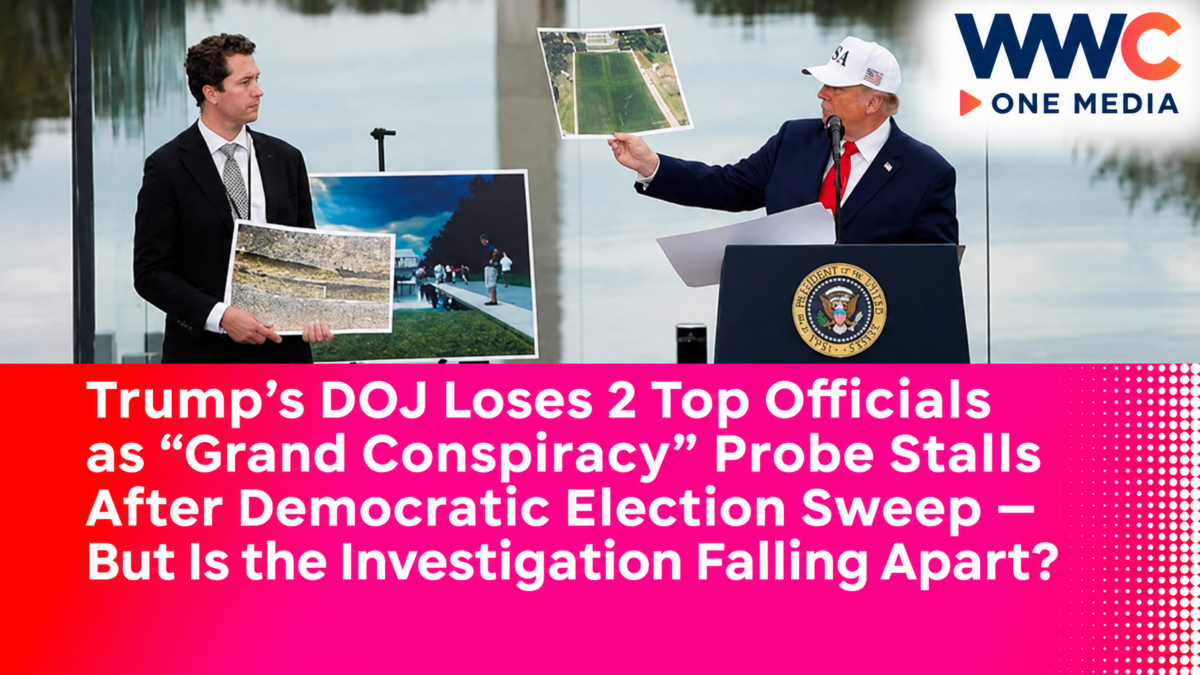
President Donald Trump’s Justice Department is facing a new leadership crisis after two senior officials resigned on the same day, deepening uncertainty over a politically sensitive investigation into allegations that former government officials conspired against the president.
Jason Reding Quiñones, the US attorney overseeing the so-called “grand conspiracy” investigation in South Florida, and John Eisenberg, the head of the Justice Department’s National Security Division, both stepped down on Friday, November 6.
Their departures came just three days after Democrats secured control of both chambers of Congress in the November 3 midterm elections.
The resignations followed the departure of Harmeet Dhillon, the assistant attorney general who led the department’s Civil Rights Division, announced on Thursday, November 5.
According to reporting by Bloomberg, Reuters, the Associated Press, CBS News and ABC News, the exits come amid significant internal tensions and growing questions about the progress of the administration’s most politically controversial investigations.
The departures are particularly consequential because Quiñones had been overseeing a sweeping inquiry into whether former intelligence and law-enforcement officials improperly investigated Trump during earlier presidential campaigns and administrations.
The investigation has faced repeated staffing changes, delayed grand jury proceedings and questions about the strength of the available evidence.
Despite considerable investigative activity, it has not produced criminal charges establishing the alleged overarching conspiracy.
For the Trump administration, the resignations create another challenge at an already difficult political moment.
For the Justice Department, they raise questions about leadership continuity, prosecutorial independence and the future of sensitive national security investigations.
As three senior officials leave within two days of each other, the central question is whether the Justice Department is experiencing a routine post-election reshuffle—or a deeper breakdown in the politically charged cases that have defined Trump’s second presidency.
Two Top Justice Department Officials Resign on November 6
Attorney General Todd Blanche announced the resignations of Jason Reding Quiñones and John Eisenberg on Friday.
Quiñones served as US attorney for the Southern District of Florida, a powerful federal prosecutorial district based in Miami.
Eisenberg headed the Justice Department’s National Security Division, which oversees some of the country’s most sensitive cases involving espionage, terrorism, cybercrime and foreign interference.
Both officials held senior positions during a period when the Trump administration placed significant emphasis on revisiting investigations involving the president and strengthening enforcement of its national security priorities.
Blanche praised Quiñones for his work combating violent crime, drug trafficking, sex trafficking and international criminal organizations.
He also recognized Eisenberg’s contributions to addressing threats to American security.
Neither public announcement established a definitive reason for the resignations.
Reuters reported that it was unclear why the officials stepped down.
The departures came during a wave of personnel changes after the elections, but the timing alone does not prove that the election results caused the resignations.
That distinction is important because senior officials may leave government service for many professional, personal or political reasons.
Jason Reding Quiñones Was Leading Trump’s “Grand Conspiracy” Investigation
Quiñones occupied one of the most politically sensitive positions in the Justice Department.
His office had been assigned to investigate allegations that intelligence and law-enforcement officials participated in a coordinated effort to undermine Trump.
The inquiry examined activities connected with investigations of Russian interference in the 2016 presidential election, contacts involving Trump’s campaign and Russia, and earlier investigations into Trump’s handling of classified government documents.
Trump and some of his allies have long argued that those investigations were politically motivated.
The Justice Department’s broader inquiry sought to determine whether certain officials had engaged in a criminal conspiracy that violated Trump’s rights.
However, allegations that an investigation was politically motivated are not equivalent to proof of criminal misconduct.
Prosecutors would need admissible evidence establishing the elements of any offense before securing convictions.
The investigation has not produced an indictment establishing the alleged overarching conspiracy.
According to CBS News, Quiñones’ resignation follows months of internal disagreements over the direction and management of the case.
Why the “Grand Conspiracy” Probe Has Struggled
The investigation has experienced significant turnover.
Joseph diGenova, a former federal prosecutor who had been brought in to help lead the inquiry, resigned in September without filing criminal charges.
Other attorneys assigned to the case have also departed or returned to their original offices.
CBS News reported that a career prosecutor was previously sidelined after expressing concerns about the strength of the evidence.
Investigators also postponed planned grand jury appearances involving several witnesses.
These developments have prompted questions about the inquiry’s future.
But delays and staff departures do not, by themselves, prove that a criminal investigation lacks merit.
Complex federal cases can require extensive document review, witness testimony and legal analysis.
At the same time, prosecutors must assess whether the available evidence supports charges that can survive judicial scrutiny.
The Justice Department must also consider legal defenses, the credibility of witnesses and applicable statutes of limitations.
A grand jury investigation is an investigative process, not a finding of guilt.
Until prosecutors file charges supported by evidence, the allegations remain unproven.
Former CIA Director John Brennan Became a Key Focus
One important aspect of the inquiry concerns former CIA Director John Brennan.
Investigators have examined questions involving Brennan’s statements to Congress and his role in intelligence assessments concerning Russian interference in the 2016 election.
The underlying issue involves disagreements over how US intelligence agencies assessed Russia’s activities and communicated their conclusions.
Trump’s allies have argued that officials exaggerated or misrepresented aspects of the intelligence findings.
Former intelligence officials and critics of the investigation have challenged those accusations.
CBS News reported that the Justice Department was examining whether Brennan misled Congress about the CIA’s involvement in preparing an intelligence assessment.
But the existence of an investigation does not establish that Brennan committed perjury or participated in a criminal conspiracy.
Those would require separate evidentiary findings and, where applicable, criminal proceedings.
As of the November 6 reporting, the broader alleged conspiracy had not resulted in established criminal charges.
John Eisenberg’s Departure Creates a Separate National Security Vacancy
The resignation of John Eisenberg raises a different set of concerns.
Eisenberg was sworn in as assistant attorney general for the National Security Division in June 2025.
He previously served as a senior legal adviser during Trump’s first administration.
The division he led handles national security matters that extend well beyond political investigations.
Its responsibilities include counterterrorism, counterespionage, export-control enforcement, cyber threats and certain cases involving classified information.
Such investigations often require cooperation among federal prosecutors, intelligence agencies and law-enforcement officials.
The division’s leadership therefore plays an important role in setting priorities and coordinating complex cases.
Eisenberg’s departure creates uncertainty about who will assume permanent leadership of the division.
However, the resignation does not mean the division has ceased functioning.
Career prosecutors and other department officials continue performing their responsibilities under the applicable supervisory structure.
No verified reporting establishes that national security prosecutions were automatically canceled because Eisenberg resigned.
The John Bolton Case Was Among Eisenberg’s High-Profile Matters
One prominent prosecution during Eisenberg’s tenure involved former national security adviser John Bolton.
Bolton faced charges concerning the handling of classified information.
The Associated Press reported that Bolton pleaded guilty in 2026 and was awaiting sentencing.
His case was among the National Security Division’s most politically prominent matters.
But the Bolton prosecution should not be confused with the separate investigation into the alleged conspiracy against Trump.
They involve different allegations and legal questions.
The fact that Eisenberg supervised national security matters does not establish that every case under the division was connected.
It also does not prove that his resignation resulted from disagreements about Bolton’s prosecution.
Some reporting has described tensions within the department, but the official reason for Eisenberg’s departure remains unconfirmed.
Harmeet Dhillon’s Exit Adds to the Leadership Shake-Up
The departure of Harmeet Dhillon on November 5 made the resignations particularly striking.
Dhillon had led the Justice Department’s Civil Rights Division.
Her tenure involved significant changes to enforcement priorities, staffing and the division’s approach to civil rights issues.
She also became a prominent figure in the department’s election-related activities.
Her resignation was announced one day before Quiñones and Eisenberg stepped down.
The sequence meant that three major Justice Department leadership changes were announced within approximately 48 hours.
The departures raise concerns about continuity across several important policy areas.
But they should not automatically be interpreted as evidence of one coordinated resignation campaign.
The officials held different positions and had different professional circumstances.
The available reporting does not establish a common private agreement among them to leave.
The Resignations Follow Trump’s Midterm Election Defeat
The political timing has attracted widespread attention.
On November 3, Democrats won control of the US House of Representatives and Senate.
The outcome marked a major shift in the balance of political power in Washington.
Although Republicans continue holding the existing congressional leadership positions until the transition, Democrats are preparing to exercise greater oversight once the new Congress convenes in January 2027.
That could lead to investigations into Justice Department decisions, federal law-enforcement priorities and the conduct of senior officials.
WWC ONE MEDIA previously covered the election’s consequences in Democrats Seize Control of US Congress in Historic Midterm Upset as Trump Accepts Defeat — Two Years of Political Showdown Loom.
The political shift matters because congressional committees can request information, conduct hearings and investigate allegations of executive-branch misconduct.
However, the timing does not establish that each resigning official acted because of a fear of congressional investigations.
That remains an interpretation rather than a confirmed explanation.
Democrats Prepare Closer Scrutiny of the Justice Department
Democratic lawmakers have already identified government accountability as a major priority.
Potential investigations could examine whether law-enforcement decisions were made according to established legal standards or influenced by political considerations.
Lawmakers may seek information about prosecutors’ appointments, changes in investigative teams and decisions involving politically sensitive cases.
WWC ONE MEDIA examined the anticipated oversight campaign in Democrats Prepare Five-Front Congressional Offensive Against Trump After Historic Midterm Sweep — But Could Subpoenas, Iran War Probes and Crypto Investigations Shake the White House?.
That report described how incoming congressional leaders may scrutinize decisions across multiple federal agencies.
The Justice Department’s latest departures could attract attention in that environment.
But congressional oversight and criminal prosecution serve different purposes.
A committee may investigate management decisions and demand testimony without establishing that anyone committed a crime.
Likewise, a personnel dispute does not automatically demonstrate misconduct.
Any conclusions must depend on documents, testimony and applicable law.
Justice Department Independence Becomes a Central Question
The controversy highlights a longstanding concern about the relationship between politics and federal prosecution.
The Justice Department is part of the executive branch, and senior officials are appointed through political processes.
Administrations may legitimately establish law-enforcement priorities within the law.
But individual criminal cases are expected to be evaluated according to evidence and legal standards.
That distinction is particularly important when investigations involve a president’s political opponents.
Critics argue that such cases can create an appearance of retaliation if the administration publicly demands charges before prosecutors complete their review.
Supporters of the inquiries argue that suspected wrongdoing by former government officials should be investigated regardless of their political affiliations.
Both considerations can be addressed through impartial procedures.
The decisive question is whether prosecutors can establish the necessary facts and apply the same legal standards to all subjects of investigation.
The lack of charges in the overarching conspiracy inquiry remains a significant fact, but it does not determine whether future evidence will emerge.
Election Monitoring Disputes Add to DOJ Scrutiny
The resignations also follow controversy over the Justice Department’s activities during the midterm elections.
The administration expanded federal election monitoring, prompting legal questions about the role of federal personnel at polling places.
A federal judge questioned the government’s representations about what its monitors would actually do.
WWC ONE MEDIA covered the dispute in US Judge Warns DOJ of ‘Hell to Pay’ Over Election Monitors as 1,000 Federal Staff Prepare for Midterms — But Could the Deployment Intimidate Voters?.
That controversy is distinct from the grand conspiracy investigation.
However, both involve questions about federal law-enforcement authority and public confidence in how the department operates.
A court’s concern about election monitoring does not establish that the conspiracy inquiry was improper.
Each issue requires examination on its own facts.
The California Voting Case Illustrates the Department’s Legal Challenges
Another high-profile dispute involved California’s voter records.
Before the November 3 elections, the Justice Department sought an emergency court order relating to more than 20,000 voter registrations whose citizenship status the government had questioned.
The US Supreme Court declined to grant the requested emergency relief.
WWC ONE MEDIA examined the dispute in Trump Loses Supreme Court Fight Over 20,000 California Voters Hours Before Midterms — But Could the Ballot Battle Return After Election Day?.
The ruling did not determine that every registration was valid or that the government’s concerns had been conclusively disproven.
Its immediate effect was to reject the requested last-minute intervention.
The episode provides additional context for the department’s challenging political and legal environment.
But it should not be presented as a direct cause of the November 6 resignations.
No such connection has been established.
What Happens to the Grand Conspiracy Investigation Now?
The departure of Quiñones raises immediate questions about who will oversee the investigation going forward.
Federal investigations can continue after senior prosecutors resign.
Responsibility may pass to an acting US attorney, another supervisory official or a newly appointed team.
Whether that happens in this case will depend on Justice Department decisions.
Investigators could continue reviewing evidence, pursue additional grand jury proceedings or narrow the inquiry.
They might also eventually close parts of the investigation if the evidence does not support charges.
These are possible procedural outcomes, not confirmed decisions.
CBS News reported that the case had already experienced internal disputes over its direction.
The previous departure of diGenova and delays involving grand jury witnesses add to the uncertainty.
But the investigation should not be described as officially terminated unless the Justice Department confirms that decision.
What Happens to the National Security Division?
Eisenberg’s resignation creates another leadership vacancy.
The Justice Department must maintain the National Security Division’s ability to handle sensitive investigations involving foreign threats, espionage and classified information.
Leadership transitions can affect management priorities, staffing and coordination with other agencies.
But national security operations rely on teams of prosecutors, investigators and professional staff.
The resignation of an assistant attorney general does not automatically erase pending cases or stop every investigation.
The department may appoint temporary leadership while considering a permanent replacement.
Any Senate-confirmed appointment would also be affected by the changing political composition of Congress.
Further announcements will be needed to establish the succession arrangements and whether the division’s priorities will change.
The Biggest Political Question Is What Democrats Investigate in 2027
The resignations may become part of a larger political confrontation.
Democrats are preparing to investigate allegations of political influence across the administration.
The Justice Department is a likely area of interest because of its role in handling sensitive investigations and prosecutions.
Potential hearings could examine communications between department leaders, staffing decisions and the legal basis for disputed investigative activities.
But whether Congress actually launches a specific investigation into the November 6 departures remains to be seen.
An incoming committee majority has the ability to pursue oversight, but formal decisions about hearings and subpoenas have not yet been established in this case.
The department may also respond to congressional inquiries by providing records, challenging requests or asserting applicable legal protections.
Those disputes could become legally and politically complicated.
Why the Story Matters Beyond Washington
The leadership turmoil is relevant to countries that maintain security, law-enforcement and diplomatic relationships with the United States.
The National Security Division handles matters involving international terrorism, cybercrime, espionage and foreign interference.
Changes in leadership could influence priorities and institutional coordination.
However, there is no verified evidence that Eisenberg’s resignation has caused a specific disruption to US-Philippines security cooperation or international criminal investigations involving the Philippines.
The broader significance lies in the stability and credibility of American federal institutions.
International partners depend on consistent legal processes and reliable cooperation.
The Justice Department’s ability to maintain those functions during leadership transitions will be closely watched.
The Bigger Question: Is Trump’s Justice Department Entering a Leadership Crisis?
The November 6 resignations came at a politically difficult moment for the Trump administration.
Jason Reding Quiñones had overseen an investigation into an alleged conspiracy involving officials who investigated Trump.
That inquiry has faced internal disputes, staff departures and delayed grand jury proceedings without producing charges establishing its central allegation.
John Eisenberg led the National Security Division, which oversees cases involving some of the country’s most sensitive security interests.
Their departures followed Harmeet Dhillon’s resignation from the Civil Rights Division.
Together, the changes have created uncertainty across several major Justice Department functions.
Yet the available evidence does not establish that the resignations were coordinated, that the alleged conspiracy occurred or that the department has officially terminated the investigation.
Attorney General Todd Blanche has praised the officials’ service, while independent reporting indicates that management concerns had complicated some of the department’s politically sensitive work.
The key questions now concern who will replace the departing officials, whether existing investigations continue and how the department handles increased scrutiny from the incoming Democratic Congress.
As two senior Justice Department officials resign on the same day and Trump’s politically charged “grand conspiracy” investigation faces another leadership setback, one question could shape Washington’s next confrontation: Will new prosecutors revive the investigation with stronger evidence—or could the departures expose a deeper crisis of confidence inside the agency responsible for enforcing America’s laws?