SAN FRANCISCO / NEW YORK / MANILA — November 7, 2026 | WWC ONE MEDIA | Artificial Intelligence, Global Technology, Venture Capital and Financial Markets
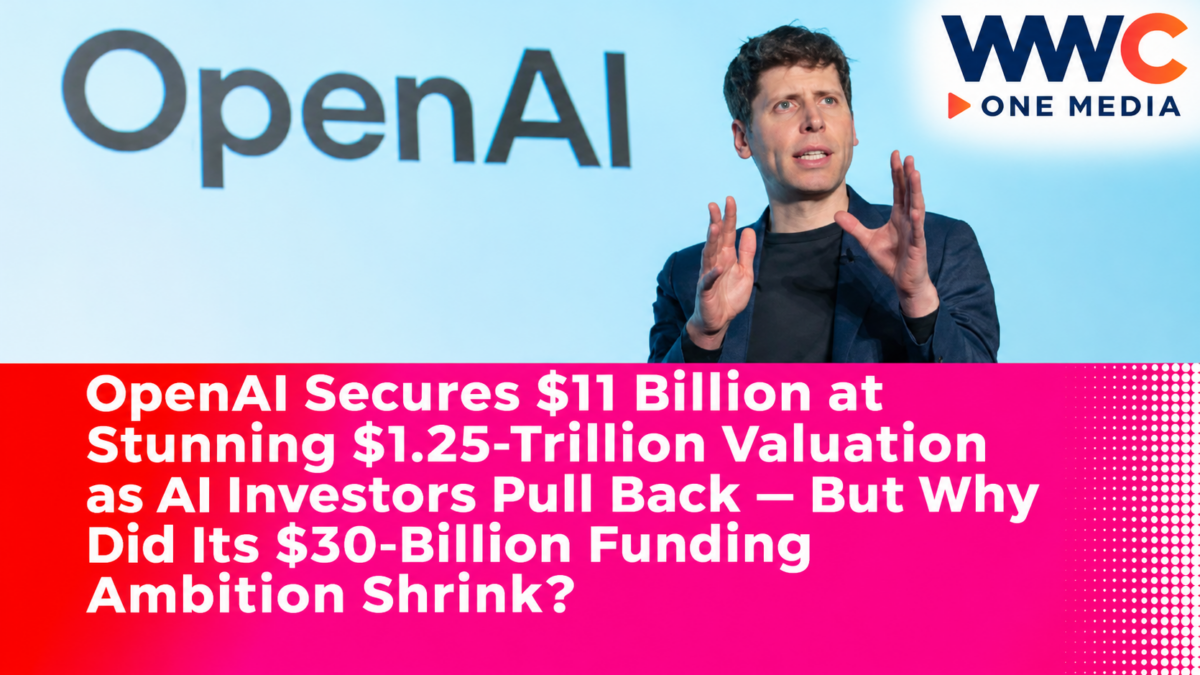
OpenAI has reportedly secured approximately $11 billion in fresh financing at a $1.25-trillion valuation, cementing its position among the world’s most valuable privately held technology companies even as a punishing selloff forces Wall Street to reconsider the enormous financial commitments behind the artificial intelligence boom.
The new funding, reported by Bloomberg on Friday, November 6, represents the first completed portion of a larger financing round that could eventually reach $20 billion.
According to people familiar with the transaction, the initial funds had already been transferred to the ChatGPT developer.
Reuters independently confirmed the $11-billion financing through a source familiar with the deal.
But behind the eye-catching valuation is a more complicated story.
OpenAI had previously sought to raise approximately $30 billion or more. Its ambitions were subsequently reduced as investors became more cautious about expensive AI companies, mounting infrastructure commitments and a sharp decline in technology stocks.
The revised target of up to $20 billion means the company has so far secured approximately 55% of the amount it is now seeking.
The financing also comes as rival Anthropic prepares for a possible initial public offering, intensifying the competition for capital in an industry where technological ambition increasingly requires unprecedented financial resources.
For OpenAI, the reported $11-billion cash injection demonstrates that major investors remain willing to support leading AI developers.
But the reduced fundraising target sends a different message.
Even the biggest names in artificial intelligence are no longer guaranteed to receive every dollar they seek at their preferred valuations.
As OpenAI secures another multibillion-dollar investment while Wall Street questions the economics of AI, one question is becoming impossible to ignore: Is the company’s $1.25-trillion valuation evidence of unstoppable growth—or a warning that expectations may be racing ahead of profitability?
OpenAI Completes First $11 Billion of New Funding Round
Bloomberg reported on November 6 that OpenAI had closed approximately $11 billion in financing.
The publication attributed the information to people familiar with the fundraising discussions, who requested anonymity because the details were not public.
The funds were reportedly wired to the company by Friday.
The financing is part of a broader round expected to reach as much as $20 billion in total if additional investments are completed.
That distinction is essential.
OpenAI did not announce that the entire $20-billion round had closed.
The confirmed reporting concerns the initial $11-billion portion.
The remaining financing was expected to be completed in the following weeks, but its eventual size and timing remained uncertain.
The Wall Street Journal reported that the company had secured less than half of its earlier $30-billion target, reflecting a decline in investor enthusiasm compared with previous fundraising efforts.
TechCrunch separately confirmed that the initial financing had been reported and that the larger round remained unfinished.
OpenAI declined to comment on the reports.
The latest development is therefore based on credible financial reporting rather than an official public announcement detailing final transaction terms.
Why OpenAI’s $1.25-Trillion Valuation Is So Significant
A $1.25-trillion valuation places OpenAI in exceptionally rare territory for a privately held company.
For comparison, a trillion-dollar valuation has historically been associated with the world’s largest publicly traded technology businesses.
OpenAI’s valuation reflects investors’ expectations about the commercial potential of artificial intelligence, including software subscriptions, enterprise services, developer tools and future AI applications.
However, a private fundraising valuation is different from a public stock-market capitalization.
The $1.25-trillion figure reflects pricing associated with a private financing transaction.
It does not mean OpenAI has $1.25 trillion in cash.
It also does not mean investors have collectively transferred that amount to the company.
Nor does it guarantee that OpenAI would receive the same valuation in an initial public offering.
Private investment terms may differ from the terms available to public shareholders.
The value investors ultimately assign to the business will depend on its financial performance, growth prospects, market conditions and the rights associated with particular securities.
Nevertheless, the valuation demonstrates the enormous expectations surrounding OpenAI’s technology and business model.
OpenAI Scales Back Its Earlier $30-Billion Funding Ambition
One of the most revealing aspects of the transaction is the reduction in OpenAI’s fundraising target.
Earlier reporting indicated that the company wanted to raise $30 billion or more.
By late October, its target had been reduced to approximately $20 billion.
Reuters, citing the Financial Times, reported that the company had lowered its fundraising ambitions by around $10 billion as the technology-stock selloff intensified.
Its desired valuation had also been reduced from an earlier reported $1.4 trillion to $1.25 trillion.
Reuters subsequently reported that some investors had described an earlier valuation ambition of approximately $1.5 trillion.
These figures reflect different reported stages of discussions, and the exact sequence should not be overstated.
What is clear is that the latest round involves a lower target than initially anticipated.
That development matters because raising capital has become central to the AI industry’s expansion.
The leading developers require substantial funding to acquire computing capacity, train new models and compete for customers.
A reduction in fundraising expectations can therefore influence how investors assess the industry’s financial outlook.
SoftBank and MGX Among Investors Backing OpenAI
Reuters reported that SoftBank and MGX participated in the financing.
SoftBank has become a major investor in artificial intelligence and advanced technology.
Its strategy involves financing businesses that it believes could benefit from long-term changes in computing, automation and digital services.
MGX is an Abu Dhabi-based investment company focused on artificial intelligence and advanced technology.
The involvement of international investors illustrates how the AI financing boom extends beyond Silicon Valley.
Capital from the United States, Japan and the Middle East is increasingly connected to the development of major AI companies.
Earlier Financial Times reporting also identified venture capital firms including Founders Fund, Coatue, Sequoia Capital and Andreessen Horowitz as expected participants.
However, expected participation should not be presented as proof that every firm completed an investment in the initial $11-billion tranche.
Final individual allocations were not fully disclosed in the reporting reviewed.
A $122-Billion March Financing Shows the Scale of OpenAI’s Capital Needs
The November financing follows another enormous reported investment round earlier in the year.
Bloomberg reported that OpenAI raised $122 billion in March 2026 at an approximately $852-billion valuation.
The latest valuation of $1.25 trillion is substantially higher.
It represents an increase of roughly 47% compared with the earlier reported figure.
But the increase in valuation should not be interpreted as an equivalent rise in revenue, earnings or cash flow.
Valuations reflect investor expectations and transaction terms.
They are not direct measurements of operating profitability.
The comparison nevertheless demonstrates why OpenAI remains a central focus of global investors.
The company has attracted enormous amounts of capital while competing in an industry where development expenses and computing requirements continue to expand.
The challenge is whether those investments eventually produce sufficient financial returns.
Wall Street’s AI Selloff Changes the Fundraising Environment
The new financing comes during a period of extraordinary volatility in technology markets.
On November 5, the Nasdaq Composite fell approximately 5.5% as investors sold shares of major AI-related companies.
Nvidia and Advanced Micro Devices suffered substantial declines, while pressure spread to data-center businesses and other infrastructure providers.
The selloff intensified concerns about the cost of building artificial intelligence systems.
For private companies seeking investment, weaker public-market sentiment can create difficult conditions.
Investors may demand lower valuations, more favorable terms or stronger evidence of revenue growth.
Even companies with substantial technological advantages can face greater scrutiny.
The reduced OpenAI funding target suggests that the company is not entirely insulated from those pressures.
At the same time, the initial $11-billion financing demonstrates that investor appetite has not disappeared.
The market is becoming more selective rather than uniformly rejecting artificial intelligence.
The Trillion-Dollar AI Financing Network Is Under Scrutiny
A major concern involves the growing financial relationships among technology companies.
AI developers obtain funding from investors who may also be suppliers, computing providers or commercial partners.
That structure can help companies finance expensive infrastructure.
But it also creates financial interdependence.
For example, an AI company may raise capital and then use part of that financing to purchase cloud computing services from another technology company.
The computing provider may then borrow or invest additional money to expand its facilities.
Such arrangements can support growth, but they may also amplify risks if anticipated customer demand fails to materialize.
WWC ONE MEDIA previously investigated this issue in AI Giants Are Funding Each Other in a Trillion-Dollar Money Loop — But Global Financial Watchdogs Warn the Boom Could Unravel.
The report examined the interconnected financial relationships involving OpenAI, Nvidia, Microsoft, Oracle and other AI businesses.
Circular financing is not automatically improper.
But investors and regulators are increasingly concerned about what could happen if a major participant reduces spending or struggles to meet its commitments.
OpenAI’s latest funding round therefore matters to companies far beyond the developer itself.
Oracle’s Data-Center Financing Shows the Risks Behind AI Expansion
OpenAI’s computing requirements have also created major commercial opportunities for infrastructure providers.
Oracle is among the businesses investing heavily in the data centers required to support advanced AI workloads.
But financing those facilities can be expensive.
WWC ONE MEDIA examined a related development in Oracle’s $18 Billion AI Data Center Debt Comes Under Pressure — And New Mexico’s Permitting Fight Is Getting Bigger.
That report explored pressure on financing connected to a major Oracle-leased data-center development in New Mexico.
It also examined permitting disputes and local opposition.
The broader challenge is that AI infrastructure requires capital long before all the expected revenue has been earned.
Companies must purchase chips, secure electrical connections, construct buildings and maintain specialized computing systems.
If projects are delayed, financial costs can continue accumulating.
OpenAI’s new financing may strengthen its ability to pursue computing and business expansion.
But the additional capital does not eliminate the financial risks facing every company in its infrastructure network.
Goldman Sachs Sees Opportunity Despite Growing Investor Anxiety
Major investment banks continue seeing opportunities in AI-related financing and corporate transactions.
Goldman Sachs Chief Executive Officer David Solomon recently described demand for AI dealmaking as strong despite volatility in technology shares.
WWC ONE MEDIA covered his comments in Goldman Sachs CEO Sees Explosive Demand for AI Megadeals Despite Tech Stock Selloff — But Could a Trillion-Dollar Financing Boom Turn Into Wall Street’s Next Crisis?.
The report highlighted the tension between enormous financing opportunities and growing investor concerns.
Banks can earn fees from fundraising, mergers, debt issuance and other transactions.
But companies receiving financing must ultimately generate returns sufficient to justify the cost of capital.
OpenAI’s latest round illustrates both sides of that equation.
Investors continue committing billions of dollars.
Yet even a leading AI company has reportedly reduced its fundraising target in response to changing market conditions.
Anthropic’s IPO Plans Add Pressure to OpenAI’s Strategy
OpenAI is also facing increasing competition for investor capital from rival Anthropic.
Anthropic develops AI models and enterprise services that compete in parts of the same market.
According to Reuters and TechCrunch, investors have become more cautious about the valuation Anthropic might command in a public offering.
Some investors reportedly discussed a valuation of around $1.5 trillion, below earlier expectations approaching $2 trillion.
TechCrunch separately reported that some potential buyers were considering even lower valuations.
These are investor expectations rather than an established IPO price.
A final valuation would depend on market conditions, demand and the terms of an actual offering.
The competition matters because both companies require significant capital to expand computing capacity and develop increasingly sophisticated models.
If investors become less willing to support exceptionally high valuations, AI developers may need to adapt their financing plans.
OpenAI’s decision to delay its own public listing adds another layer of uncertainty.
Why OpenAI’s IPO Delay Matters
OpenAI has discussed a possible initial public offering but has not completed one.
Bloomberg reported that the company delayed its IPO plans while pursuing another large private fundraising round.
A public listing could eventually provide access to a broader investor base.
It could also create opportunities for existing shareholders to sell securities.
But becoming publicly traded introduces additional disclosure, governance and market expectations.
Public investors would scrutinize revenue, expenses, cash flow and long-term profitability.
AI companies would also be valued continuously in public markets, potentially exposing them to substantial volatility.
For OpenAI, remaining private while securing major funding could provide more flexibility.
However, that approach also depends on the continued willingness of private investors to supply capital.
The latest $11-billion tranche demonstrates that significant financing is still available, even if investor enthusiasm has become more restrained.
Political Resistance to Data Centers Adds Another Complication
The AI financing environment is not being shaped solely by stock prices.
Political opposition to data centers has become another major concern.
Large computing facilities need electricity, land, cooling systems and supporting infrastructure.
In some communities, residents have objected to proposed developments because of their possible effects on electricity costs, water supplies and local environments.
The November 3 US midterm elections increased expectations that government officials could place tighter conditions on new projects.
Those concerns may affect how investors evaluate future computing capacity.
A company planning to train increasingly sophisticated AI systems must secure reliable infrastructure.
If construction becomes slower or more expensive, business plans may need to change.
But political proposals do not automatically mean all data-center projects will be canceled.
Their effects will depend on specific laws, permits and regulatory decisions.
Asian Chipmakers Could Feel the Effects of Slower AI Spending
The industry’s financial outlook also matters to Asian technology companies.
Semiconductor manufacturers supply the processors and memory used by AI data centers.
Large AI developers and their cloud providers are important sources of demand.
If infrastructure spending slows, suppliers could face weaker future orders.
But the impact will vary depending on existing contracts, technological leadership and other sources of demand.
WWC ONE MEDIA previously examined these concerns in Asian Chip Stocks Plunge as Amazon’s AI Spending Sparks Funding Fears — But Could the $2.1-Trillion Data Center Boom Be at Risk?.
The report explored why investors were becoming more cautious about the financial sustainability of AI infrastructure investment.
OpenAI’s fundraising is relevant to this wider supply chain because financing helps support future computing demand.
But obtaining investment does not guarantee that every planned data center will be built or that every chip supplier will experience continued earnings growth.
What the $11-Billion Funding Means for the Philippines
OpenAI’s financing also has implications for businesses and technology users in the Philippines.
Filipino companies increasingly encounter AI through business software, customer-service systems, programming tools and digital operations.
Major investments in AI development may support improvements in the availability and capabilities of those services.
The Philippines could also benefit indirectly from demand for data-center infrastructure, information technology services and related business activities.
However, the November 6 financing announcement does not establish that OpenAI has committed a specific portion of the $11 billion to Philippine investments.
Nor does it confirm new local offices, jobs or data centers.
Any direct Philippine economic benefits would require separate announcements or independently verifiable business developments.
The more immediate significance is global: investors are continuing to finance advanced AI development despite growing doubts about the industry’s valuations.
Is OpenAI’s $1.25-Trillion Valuation Sustainable?
The central debate is whether OpenAI can eventually produce financial performance that supports such a large valuation.
Supporters of the company may argue that artificial intelligence represents a transformational market with substantial long-term opportunities.
AI systems could become increasingly important to enterprise software, research, productivity and digital services.
Under that scenario, early investments in technology and infrastructure could generate significant future revenue.
Skeptics focus on the cost.
Developing advanced AI models requires expensive computing resources.
Competition may pressure companies to lower prices.
Infrastructure spending can consume substantial amounts of capital.
And technological progress does not automatically guarantee that one company will capture all the resulting economic value.
The reported reduction in OpenAI’s funding target suggests investors are weighing those risks more carefully.
But it does not prove the company’s valuation is unsustainable.
That determination will depend on future earnings, financing conditions and commercial performance.
What Happens Next for OpenAI?
The next major milestone is the completion of the remaining fundraising.
Bloomberg reported that the broader round could total approximately $20 billion.
With about $11 billion reportedly received, that would leave roughly $9 billion still to be secured if the final target remains unchanged.
Additional investments could come from institutional investors, wealthy individuals or other sources.
However, those future commitments are not guaranteed.
Investors will also watch whether OpenAI provides more information about its financial performance and public-listing plans.
Competition with Anthropic will remain important.
So will developments involving chip supply, cloud computing, electricity and data-center construction.
The company’s ability to convert new capital into sustainable growth will help shape investor confidence.
The Bigger Question: Is OpenAI Still Leading the AI Boom—or Facing Its Biggest Financial Test?
OpenAI’s latest reported financing is a major milestone.
The ChatGPT developer has secured approximately $11 billion at a $1.25-trillion valuation, according to Bloomberg and Reuters.
The investment demonstrates that major financial backers continue seeing enormous potential in advanced artificial intelligence.
But the details also reveal a shift.
The company originally sought a much larger funding round.
Its reported fundraising target has now fallen to approximately $20 billion.
Meanwhile, public technology markets have suffered steep losses, investors are questioning AI infrastructure costs, and rivals are competing for the same pool of global capital.
These developments do not mean the AI boom has ended.
They do suggest that investors are becoming more demanding about how companies justify their valuations and use new funding.
For OpenAI, the next challenge is not simply raising another multibillion-dollar investment.
It is demonstrating that the business opportunities created by artificial intelligence can eventually support the extraordinary capital required to develop the technology.
As OpenAI secures an $11-billion funding tranche at a staggering $1.25-trillion valuation while scaling back its earlier $30-billion ambitions, one question could determine the future of the global AI race: Will the new cash strengthen the company’s path toward a historic public offering—or could Wall Street’s growing doubts force even the biggest AI companies to rethink their trillion-dollar expectations?