WASHINGTON / NEW YORK / MANILA — November 7, 2026 | WWC ONE MEDIA | Artificial Intelligence, US Economy, Technology and Global Employment
Artificial intelligence was supposed to threaten millions of jobs. But America’s latest employment figures reveal a surprising development: the AI revolution is also generating demand for workers, and that demand is moving beyond the construction of massive data centers.
US employers added 165,000 jobs in October 2026, beating economists’ expectations, while unemployment declined to 4.1%, according to the latest employment report.
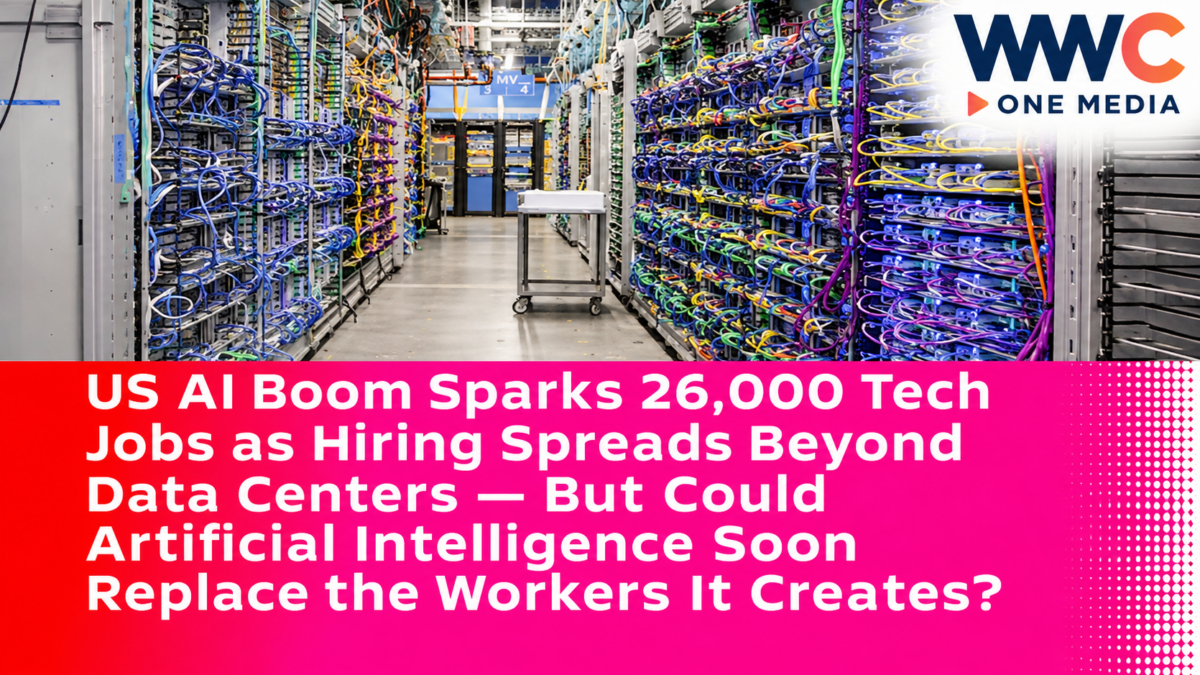
At the same time, approximately 26,000 additional workers entered information technology occupations across the US economy, according to an analysis released November 6 by technology industry association CompTIA.
The numbers suggest that America’s artificial intelligence boom is entering another important phase.
Instead of concentrating exclusively on the physical infrastructure needed to power increasingly sophisticated AI models, businesses are also recruiting people capable of deploying, securing, integrating and managing AI technology in their everyday operations.
That transition could reshape the American labor market for years.
But it also raises an uncomfortable question.
Will artificial intelligence ultimately create more employment opportunities than it eliminates, or is the current hiring expansion merely the beginning of a much larger workforce disruption?
America’s Labor Market Delivers an Unexpected 165,000 Jobs
The latest employment report challenged concerns that the US economy was heading toward a prolonged hiring slowdown.
According to figures released November 6 by the US Bureau of Labor Statistics:
- Nonfarm payroll employment increased by 165,000 in October.
- The unemployment rate declined from 4.2% to 4.1%.
- Revisions added a combined 84,000 jobs to previously reported August and September figures.
- Professional and business services accounted for approximately 70,000 additional jobs.
- Transportation and warehousing, healthcare and manufacturing also recorded employment gains.
The results provided evidence that American businesses continued expanding despite persistent inflation, elevated borrowing costs and uncertainty surrounding the country’s artificial intelligence investment boom.
Reuters and the Financial Times reported that the stronger-than-expected employment figures also increased expectations of another Federal Reserve interest-rate increase in December.
However, the headline figures do not mean every worker is benefiting equally.
Some Americans continue to experience lengthy unemployment spells, while entry-level applicants face intense competition.
And the relationship between artificial intelligence and employment is becoming increasingly complicated.
AI Hiring Moves From Data Centers Into Everyday Business Operations
For much of the recent AI investment boom, employment gains have been associated with building the infrastructure required to operate powerful computing systems.
Technology companies have invested heavily in data centers, specialized processors, electricity infrastructure, networking equipment and sophisticated cooling systems.
Those projects support demand for electricians, engineers, manufacturing employees, construction workers and suppliers of industrial equipment.
Bloomberg previously reported that employment growth among manufacturers and other goods producers had outpaced services-sector hiring over a six-month period through August, potentially reflecting the economic impact of AI infrastructure investment.
But the employment story is now expanding beyond physical construction.
A November 6 Bloomberg report examined whether AI-related job gains are spreading from infrastructure development into the implementation of artificial intelligence inside businesses.
That transition represents an important development.
Companies adopting AI require more than computers and software subscriptions.
They need professionals who can connect intelligent systems to existing databases, redesign business processes, protect sensitive information, train employees and monitor automated decisions.
This creates demand for workers with expertise in software engineering, cybersecurity, cloud infrastructure, systems architecture, data management and AI governance.
In other words, the next stage of AI investment is not just about building the machines. It is increasingly about making those machines useful.
CompTIA Reports 26,000 Additional IT Jobs and 366,322 AI-Skills Postings
CompTIA’s latest employment analysis offers some of the clearest evidence that demand for technology expertise is expanding across the American economy.
The organization reported that technology industry employment increased by approximately 7,200 jobs in October.
Across the broader economy, employment in IT occupations rose by approximately 26,000.
These are separate measurements: the first tracks employment in the technology industry, while the second tracks technology occupations across industries.
The unemployment rate among IT workers declined to 2.8%, below the national rate of 4.1%.
Meanwhile, employers posted 290,892 new IT job advertisements during October.
The number of active IT job postings reached 629,876, representing an 18.5% increase from a year earlier.
But perhaps the most revealing statistic involves artificial intelligence skills.
CompTIA counted 366,322 active job postings associated with AI skills, an increase of 6.2% from September.
Demand for specialized AI positions also increased by 9.8%.
Software developers and engineers remained particularly sought after, with 51,944 new job postings during October.
The figures reflect a broader transformation in employer requirements.
AI expertise is no longer confined to research laboratories or companies developing advanced language models.
Businesses across healthcare, manufacturing, financial services, professional services and other industries increasingly want employees capable of working with AI-powered systems.
Importantly, job advertisements are not equivalent to completed hires, and the AI-skills figure should not be interpreted as 366,322 newly created jobs.
Nevertheless, the data indicates substantial demand for workers capable of applying artificial intelligence in commercial environments.
Wall Street Is Already Recruiting Workers to Manage AI Agents
The shift toward AI implementation is particularly visible in financial services.
Banks are investing in systems that can analyze documents, assist with compliance reviews, process financial information and coordinate complex workflows.
That transformation is driving demand for specialists who can design, integrate and supervise increasingly autonomous AI applications.
As WWC ONE MEDIA previously reported in its investigation into Wall Street’s AI hiring surge, financial institutions have been searching for employees skilled in agent orchestration.
Agent orchestration involves coordinating multiple AI systems to complete interconnected tasks.
For example, one system might analyze financial data, another review regulatory requirements and a third prepare a report for human approval.
Rather than eliminating every employee involved in those processes, organizations may initially require additional specialists to develop and supervise the technology.
But the long-term employment consequences remain uncertain.
Once AI systems become reliable and easier to operate, employers could reassess how many human workers are needed to complete the same assignments.
That is the central contradiction emerging in the AI labor market.
The technology can create jobs during implementation while potentially reducing the need for some positions after deployment.
The Warning Sign: Entry-Level Workers Could Face the Greatest Pressure
Not everyone is benefiting from the AI employment boom.
Research published in September 2026 by economists Bharat Chandar of Stanford University and Bouke Klein Teeselink of King’s College London found that companies adopting AI experienced different employment patterns across seniority levels.
Across the study’s five-year observation period, senior employment at AI-adopting firms increased by 6.7%, while junior employment declined by 3%.
The research examined companies across 41 countries.
These findings suggest that AI adoption may favor experienced professionals while reducing demand for some junior positions.
That distinction matters because early-career employees traditionally learn through routine assignments, administrative responsibilities and supervised analytical tasks.
Many of those activities can now be assisted or partially automated by generative AI.
The concern extends beyond Malaysia.
If businesses increasingly expect new employees to demonstrate practical AI skills and professional experience before hiring them, graduates may struggle to obtain the entry-level opportunities needed to develop those capabilities.
That could create a long-term talent problem even while demand for experienced AI specialists increases.
Some Companies Are Already Restructuring Their Workforces
The expansion in AI-related recruitment is occurring alongside significant workforce reorganizations.
Some companies are redesigning jobs, consolidating administrative operations and introducing automated systems intended to improve efficiency.
The healthcare group described the changes as part of a broader organizational transformation involving standardized processes and integrated operations.
It did not identify artificial intelligence as the sole cause of the restructuring.
Nevertheless, the development illustrates how businesses are reconsidering staffing structures while investing in technology and operational modernization.
Similarly, WWC ONE MEDIA examined Canva’s sweeping workforce reorganization affecting approximately 22% of employees.
The changes involved a combination of role eliminations, redesigned responsibilities and relocation requirements.
These cases demonstrate why rising AI-related hiring cannot automatically be interpreted as proof that technology will increase employment across every occupation.
Different industries, companies and workers may experience very different outcomes.
AI Boom Faces Another Threat: Resistance to Data Centers
The employment debate is unfolding against a volatile investment backdrop.
Technology stocks suffered a sharp selloff in early November as investors questioned the sustainability of enormous AI capital expenditures.
According to Associated Press reporting on November 5, the Nasdaq Composite fell 5.5% during a major market decline driven partly by concerns about AI-related investment and data-center development.
Public resistance to new facilities has become another significant challenge.
Communities are increasingly questioning the electricity, water, land and infrastructure requirements associated with large computing centers.
WWC ONE MEDIA recently covered growing US political resistance to AI data-center expansion.
Restrictions and permitting delays could affect construction schedules and the associated demand for infrastructure workers.
However, the implications for AI implementation jobs may be different.
Even if some new data-center projects are delayed, businesses with access to existing computing resources may continue investing in software integration, cybersecurity, employee training and workflow automation.
That possibility makes the distinction between AI infrastructure spending and AI adoption increasingly important for investors and policymakers.
It also means a slowdown in data-center construction would not necessarily produce an identical slowdown in every AI-related occupation.
What the AI Jobs Boom Means for the Philippines
Although the latest employment figures concern the United States, their implications extend to the Philippines and other economies with large technology and outsourced-services industries.
The Philippines has substantial exposure to global demand for business process outsourcing, customer support, information technology services and back-office operations.
As American businesses introduce more sophisticated AI tools, the skills required by outsourcing providers may change.
Traditional tasks involving repetitive data entry, document processing and routine customer inquiries could become increasingly automated.
At the same time, opportunities may expand in AI integration, cybersecurity, cloud operations, data management, compliance monitoring and human oversight of automated systems.
Philippine firms capable of providing higher-value technology services could benefit from that transition.
However, those opportunities are not guaranteed.
Workers and companies will need to adapt their skills and business models to compete for emerging work.
The challenge for policymakers, universities and employers is therefore not simply to encourage AI adoption.
It is to ensure that employees can acquire the expertise needed to participate in the industries being transformed.
Could AI Produce a Jobs Boom Before a Wave of Automation?
The latest employment data offers evidence that artificial intelligence is supporting demand for certain kinds of labor.
The United States added 165,000 jobs in October, IT occupations recorded employment gains, and employers continued advertising hundreds of thousands of positions requiring technology expertise.
But these figures do not establish that AI was responsible for all the reported job gains.
Nor do they prove that AI will produce a permanent net increase in employment.
Three competing forces are shaping the labor market.
First, the construction and expansion of AI infrastructure can generate employment across manufacturing, engineering, utilities and construction.
Second, businesses implementing AI require specialists capable of integrating, securing, governing and improving intelligent systems.
Third, as AI systems become more capable, automation may reduce the amount of human labor required for some existing tasks.
Which force ultimately dominates remains uncertain.
For now, companies are recruiting people to help turn artificial intelligence into an operational reality.
But the next phase could determine whether today’s implementation specialists become the foundation of an expanded workforce—or whether increasingly sophisticated AI systems eventually reduce demand for the very workers helping deploy them.
America’s AI revolution is creating new opportunities today. The unanswered question is how many of those opportunities will survive once the technology reaches its full potential.