WASHINGTON, D.C. / MANILA, PHILIPPINES — November 7, 2026 | WWC ONE MEDIA | US Politics, Climate, Disaster Response and Government Accountability
The Trump administration is facing fresh questions about disaster-relief transparency after the Federal Emergency Management Agency stopped publishing a key daily record showing which states and tribal governments were still waiting for federal disaster declarations.
The change, which took effect on October 30, 2026, removes a long-standing information source used by journalists, researchers and disaster-policy watchdogs to monitor how quickly emergency assistance requests move through the federal government.
The missing information had become politically sensitive.
Earlier reporting by POLITICO identified substantial differences in approval rates between disaster requests submitted by Republican-led and Democratic-led states, raising questions about whether politics might be influencing decisions intended to respond to natural disasters.
FEMA has defended the revision as an effort to keep its operational briefings focused on emergency incidents and active federal disaster operations.
But critics argue that the decision reduces public visibility into requests that have yet to be approved or rejected.
The timing has intensified scrutiny, coming shortly after a report that the Trump administration accelerated disaster aid for Florida ahead of the November 3 midterm elections.
As FEMA removes the public list that helped outsiders monitor pending disaster requests, the central question is whether the change represents a routine reporting adjustment—or a troubling setback for transparency in a system where timely assistance can determine how quickly communities recover.
FEMA Removes Pending Disaster Requests From Its Daily Briefing
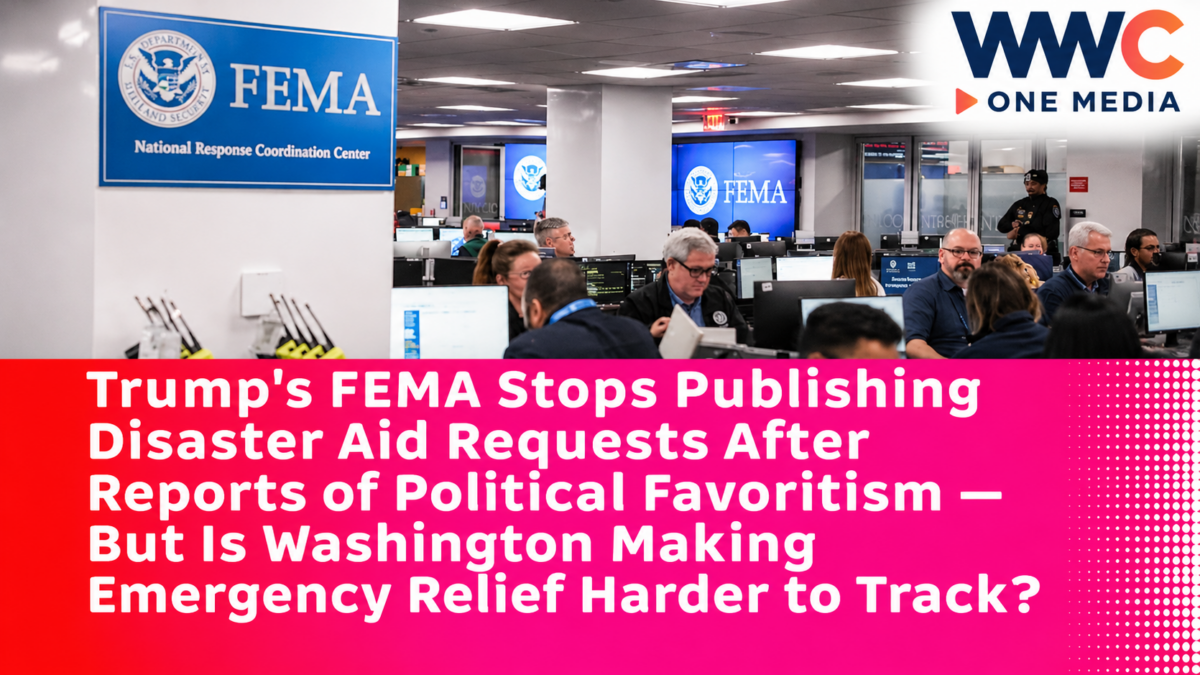
At the center of the controversy is FEMA’s Daily Operations Briefing, a regular report produced by the agency’s National Watch Center.
The document provides emergency-management officials with updates about significant incidents, potential threats and disaster-response activities.
Until late October, it also included a section tracking requests for federal disaster declarations.
That section identified state, territorial and tribal requests that were still being processed.
It provided information about when requests were submitted and the types of assistance being sought.
Beginning with the October 30 briefing, the pending-request table disappeared.
Subsequent reports continued without that section.
The change means members of the public can no longer rely on that daily briefing to identify newly submitted disaster requests or determine how long some requests have remained undecided.
The disappearance was independently documented by the Revolving Door Project, a government-accountability organization that tracks federal disaster decisions.
An unofficial archive operated by DisasterData.IO also confirms that the table stopped appearing after October 29.
Why the Missing Information Matters
A federal disaster declaration is a critical step in making certain forms of federal assistance available after severe storms, floods, wildfires and other emergencies.
Governors and authorized tribal officials may request federal declarations when the scale of a disaster exceeds available local and state resources.
Depending on the declaration and designated areas, federal support can include emergency operations, assistance to eligible households, infrastructure-repair funding and hazard-mitigation programs.
But a request does not automatically result in approval.
Federal officials evaluate damage, available resources and other relevant considerations before a recommendation reaches the president.
A public list of pending requests allows outside observers to see which jurisdictions are awaiting decisions.
It can help researchers calculate waiting periods and compare treatment across different disasters.
Without consistent publication, monitoring the process becomes more difficult.
Final approvals and denials may still appear in federal databases, but those records do not necessarily reveal every request while it is awaiting a decision.
That difference matters most during the period when affected communities are trying to determine what federal assistance may become available.
What FEMA Says About the Change
FEMA has described its decision as part of an effort to improve the focus of its daily operational reports.
In a response published by the Revolving Door Project, the agency said the revised briefings were designed to emphasize current incidents and the support provided for federally declared disaster operations.
FEMA also stated that its briefings evolve to meet the needs of emergency-management partners.
From an operational perspective, government agencies may periodically change how they organize reports to make information more useful to staff responding to emergencies.
But the explanation leaves an important question unanswered.
If pending-declaration information no longer belongs in the daily operational briefing, where will the government provide an equally accessible and regularly updated public record?
The agency’s response did not establish that a replacement dataset would provide comparable information.
There is also no verified evidence in the reviewed sources that FEMA committed to restoring the removed table.
POLITICO’s Analysis Raised Questions About Political Favoritism
The controversy follows reporting that examined whether disaster-aid decisions differed depending on the political affiliation of state leaders.
A March 2026 POLITICO analysis, drawing on available federal information, reported approval rates of approximately 89% for requests from Republican-led states and 23% for requests from Democratic-led states in the cases it examined.
The difference attracted scrutiny because federal disaster relief is intended to respond to demonstrated needs rather than electoral considerations.
However, a difference in approval rates does not, by itself, establish that every denial was politically motivated.
Requests can vary in severity, damage assessments, eligibility and state capacity to respond.
A rigorous assessment would need to consider those factors alongside political affiliation.
The Trump administration has rejected accusations that its disaster decisions are driven by partisan favoritism.
The reporting nevertheless raised legitimate questions about the need for accessible information that allows independent scrutiny.
Removing the pending-request table makes future comparisons more difficult because some of the relevant information may no longer be available on the same timetable.
Florida’s Disaster Aid Approval Adds to the Controversy
The timing of the removal became especially sensitive following reporting about federal assistance for Florida.
POLITICO reported that the administration moved quickly on Florida disaster aid shortly before the midterm elections.
The outlet compared that decision with other jurisdictions still waiting for federal action.
The episode generated questions about whether some disaster requests were receiving faster attention than others.
But the available evidence does not establish that Florida’s approval was unlawful or that election considerations were the documented reason for the decision.
Disaster declarations depend on circumstances that can vary substantially between events.
The appropriate question is whether decisions can be reviewed against consistent, transparent criteria.
That requires sufficient information about the requests submitted, the dates of decisions and the assistance approved or denied.
A public record of pending requests was one tool that helped make such comparisons possible.
Watchdogs Warn That a Critical Tracking Tool Has Disappeared
The Revolving Door Project has been maintaining a tracker documenting federal disaster-declaration requests and decisions.
Its records show delays, denials and partial approvals across different jurisdictions.
The organization said its most recent comprehensive update before the reporting change was October 29.
It also disclosed that the removal of pending requests prevented it from continuing the same daily monitoring process.
According to the watchdog’s October 29 figures, its tracker identified 14 weather-related requests awaiting decisions, including three appeals.
Those figures represent the organization’s assessment at that date.
They should not be presented as a verified current count for November 7 because the loss of the daily table makes subsequent updates harder to confirm.
The group has criticized the administration’s handling of disaster declarations and suggested that changes to public reporting could make unequal treatment more difficult to identify.
That is the watchdog’s position, not an independently proven explanation of FEMA’s motives.
Still, the practical consequence is clear: one regularly available source used to follow pending requests has disappeared.
Independent Archives Show How Disaster Tracking Has Changed
DisasterData.IO maintains an archive of FEMA’s operational briefings.
Its unofficial declaration tracker previously extracted pending-request information from the agency’s daily reports.
The archived documents allow researchers to examine historical request activity.
But preserving older records cannot fully replace an ongoing government publication.
The tracker now relies partly on announcements issued by governors, territorial officials and other government sources to identify new requests.
That approach can help fill some gaps.
However, public announcements may not provide complete, standardized information.
Some governments may issue detailed statements, while others provide little information until a decision is made.
Tribal requests can be particularly difficult to monitor if they are not widely publicized.
Consequently, independent organizations may now have a less complete picture of pending disaster requests.
The archive remains useful, but it is not an official FEMA service and should not be mistaken for a government-managed reporting system.
A Texas Disaster-Aid Denial Shows the Human Stakes
The importance of federal disaster decisions is illustrated by a separate case in Texas.
On October 21, The Texas Tribune reported that FEMA had denied a request for assistance to individuals affected by severe July flooding.
The storms damaged homes in and around Uvalde and Kerr County.
Governor Greg Abbott’s office said it was reviewing the denial and considering an appeal.
The situation demonstrated that disaster-aid disagreements are not limited to states led by one political party.
Texas is governed by Republicans, yet the state also faced a denial of requested federal assistance.
FEMA stated that it evaluates disaster requests using factors including insurance coverage, damage, unemployment and the financial capacity of state and local governments.
For affected households, such decisions can influence access to help with temporary housing, repairs and essential needs.
This is why knowing which requests remain undecided is important.
Delays and denials can have practical consequences regardless of the political affiliation of state leaders.
FEMA Has Been Under Pressure From Funding and Staffing Changes
The data controversy is unfolding amid a broader debate over FEMA’s future.
President Trump has advocated transferring more disaster-response responsibility to state and local authorities.
The administration has also pursued changes involving federal staffing, spending and emergency-management programs.
Earlier in 2026, a prolonged Department of Homeland Security funding dispute complicated FEMA operations.
Bloomberg reported in April that the agency had begun prioritizing lifesaving activities as disaster-relief funding came under pressure.
Other reporting documented delays involving grant approvals and recovery payments.
In April, Homeland Security Secretary Markwayne Mullin rescinded a restrictive approval requirement that had applied to certain expenditures exceeding $100,000.
The Associated Press reported that the earlier requirement had contributed to delays in federal emergency spending.
These developments are separate from the October 30 removal of pending-declaration data.
Together, however, they provide context for why lawmakers, emergency managers and outside researchers are closely scrutinizing FEMA’s operational changes.
Congress Has Already Called for More Disaster-Aid Transparency
The reporting change also contrasts with a separate federal initiative intended to make parts of FEMA’s funding process more transparent.
Legislation signed in April 2026 required the agency to develop an interactive public dashboard covering requests for reimbursement under the Public Assistance program.
That program helps eligible governments and organizations recover certain costs associated with federally declared disasters.
The dashboard requirement focuses on the progress of reimbursement requests for public-assistance projects.
That is not identical to the pending presidential disaster-declaration information removed from FEMA’s daily briefing.
The distinction matters because different stages of disaster assistance are documented through different systems.
A dashboard showing reimbursements after a declaration does not necessarily reveal which jurisdictions are still seeking the initial declaration.
Both categories of information can be important for oversight.
Congressional efforts to improve reporting therefore do not automatically resolve the transparency gap created by the missing pending-request table.
Could Disaster Relief Become a Bigger Congressional Issue?
The November 3 US midterm elections have changed the political environment in Washington.
Democrats gained control of Congress, increasing their ability to question administration decisions, request documents and conduct oversight hearings when the new congressional term begins.
FEMA’s reporting practices could become a subject of that scrutiny.
Lawmakers may ask why the agency removed the pending-request table and whether equivalent information will remain publicly available.
They could also examine approval and denial patterns across states and tribal governments.
However, no specific future congressional investigation into the October 30 reporting change should be described as confirmed without a formal announcement.
The potential for oversight is not the same as an investigation already underway.
The immediate question remains whether FEMA will restore a comparable public source of information voluntarily.
Disaster Transparency Is Also an Issue for the Philippines
Although the FEMA controversy concerns the United States, the underlying governance question is relevant to disaster-prone countries such as the Philippines.
The Philippines experiences frequent tropical cyclones, flooding, landslides and other natural hazards.
Government agencies must assess damage, distribute emergency supplies and allocate funding for recovery.
Reliable information about requests, approvals, release dates and completed projects can help the public evaluate whether communities are receiving appropriate support.
WWC ONE MEDIA recently examined the scale of disaster-recovery requirements in Cebu Needs ₱11.17 Billion to Recover From Typhoon Tino One Year Later — But Why Are Key Bridges Still Unfinished?.
That report detailed infrastructure, housing and public-service needs that remain important after floodwaters recede.
The American and Philippine disaster-assistance systems operate under different laws and institutions.
But both face a similar challenge: ensuring that funding decisions and recovery progress can be tracked by the communities affected.
Why Recovery Data Must Remain Accessible After a Disaster
Disaster recovery frequently continues long after a storm disappears from news headlines.
Roads and bridges may need rebuilding.
Families may require temporary shelter or permanent housing.
Schools, hospitals and water systems can remain damaged for months or years.
Public accountability depends partly on knowing which needs have been identified, which funding requests have been submitted and what assistance has been approved.
WWC ONE MEDIA highlighted this challenge in Cebu City Still Not Flood-Ready One Year After Typhoon Tino — Warning Sensors and Evacuation Centre Remain Unfinished.
The story examined the difference between proposed disaster-preparedness improvements and facilities that are actually operational.
That same distinction applies to financial assistance.
An announced program does not mean every eligible applicant has received support.
A submitted request does not mean it has been approved.
And an approval does not necessarily mean every payment has already been distributed.
Transparent reporting helps preserve those distinctions.
Early Preparation and Public Information Can Save Lives
Good disaster governance requires more than distributing assistance after a catastrophe.
Communities also need early warnings, evacuation procedures, trained responders and reliable information before emergencies occur.
WWC ONE MEDIA explored this issue in The Storm Hasn’t Arrived Yet—But LGUs Are Being Told to Act Now Before It’s Too Late.
The report emphasized the need for local governments to conduct risk assessments and prepare communities before severe weather strikes.
FEMA’s operational briefings primarily serve emergency-management purposes, while their public availability also provides a resource for researchers.
The debate over removing declaration information therefore raises two separate considerations.
One is whether the agency’s revised format serves operational teams more effectively.
The other is whether the government continues giving the public enough information to examine decisions about federal assistance.
Those goals do not necessarily conflict.
FEMA could streamline internal briefings while publishing equivalent declaration data through another accessible system.
The Economic Cost of Disasters Makes Accountability Essential
Extreme weather can create severe financial consequences for households, companies and governments.
In September, Philippine authorities reported approximately ₱12.4 billion in damage from successive weather disturbances.
WWC ONE MEDIA examined those losses in Storm Damage in the Philippines Hits ₱12.4 Billion — But the Biggest Cost May Come After the Floodwaters Disappear.
The report highlighted infrastructure and agricultural damage alongside the longer-term burden of recovery.
Disaster financing involves difficult decisions about priorities and available resources.
That makes accurate records especially valuable.
A transparent system can help identify projects awaiting assistance, funding gaps and delays in implementation.
It can also allow independent researchers to compare outcomes across communities.
The specific reporting system will differ from country to country, but the accountability principle remains relevant.
What Should FEMA Do Next?
The controversy could be addressed through a clear public explanation of the reporting change.
FEMA could identify whether the pending-request table will return or whether another system will provide equivalent information.
Any replacement would ideally include submission dates, the requesting jurisdiction, the category of assistance requested and the status of the federal decision.
Consistent updates would allow researchers to calculate waiting periods and identify unresolved cases.
Historical records should also remain available to support comparisons over time.
A properly maintained public dataset would not require officials to approve every request.
It would simply make the decision-making process easier to observe.
That transparency could benefit the administration as well as its critics.
Clear records allow the public to distinguish legitimate differences between disaster requests from unexplained delays or inconsistencies.
The Bigger Question: Why Remove the Data Now?
FEMA’s decision to stop publishing pending disaster-declaration requests has created a significant transparency dispute.
The agency says it is refining the focus of its operational briefings.
Critics argue that the removed information was essential for monitoring how federal disaster assistance was handled.
The dispute comes after reports identifying partisan differences in approval rates and renewed questions about the timing of assistance for Florida.
Those findings do not conclusively establish improper political motives behind every disaster decision.
They do, however, strengthen the case for maintaining a consistent public record that can be independently examined.
For families recovering from floods, storms and wildfires, the issue is not primarily political.
It is whether governments can explain the status of requests and account for decisions that affect recovery.
A disaster declaration can unlock substantial support.
A denial or prolonged delay can force communities to search for other resources.
And without complete public information, comparing those outcomes becomes harder.
As FEMA stops publishing a daily record of pending disaster-aid requests just as its decisions face growing scrutiny, one question could define the next stage of the controversy: Will the administration restore a transparent way to track federal emergency assistance—or could the disappearance of key public data make it increasingly difficult to determine why some disaster-hit communities receive help while others remain waiting?