NEW YORK / AUSTIN, TEXAS / MANILA, PHILIPPINES — November 7, 2026 | WWC ONE MEDIA | Global Business, SpaceX, Tesla, Artificial Intelligence and US Politics
A major leadership change is raising fresh questions about the future of Elon Musk’s technology empire after a longtime Google executive resigned from the board of SpaceX just one day after the United States’ closely watched midterm elections.
Donald Harrison, Google’s president of global partnerships and corporate development, has stepped down as a director of Space Exploration Technologies Corp., ending an 11-year board tenure that began when Google made a major investment in Musk’s rocket company in 2015.
The resignation took effect on November 4, 2026, one day after US voters delivered major congressional victories to the Democratic Party.
SpaceX disclosed the departure in a regulatory filing released on Friday, November 6.
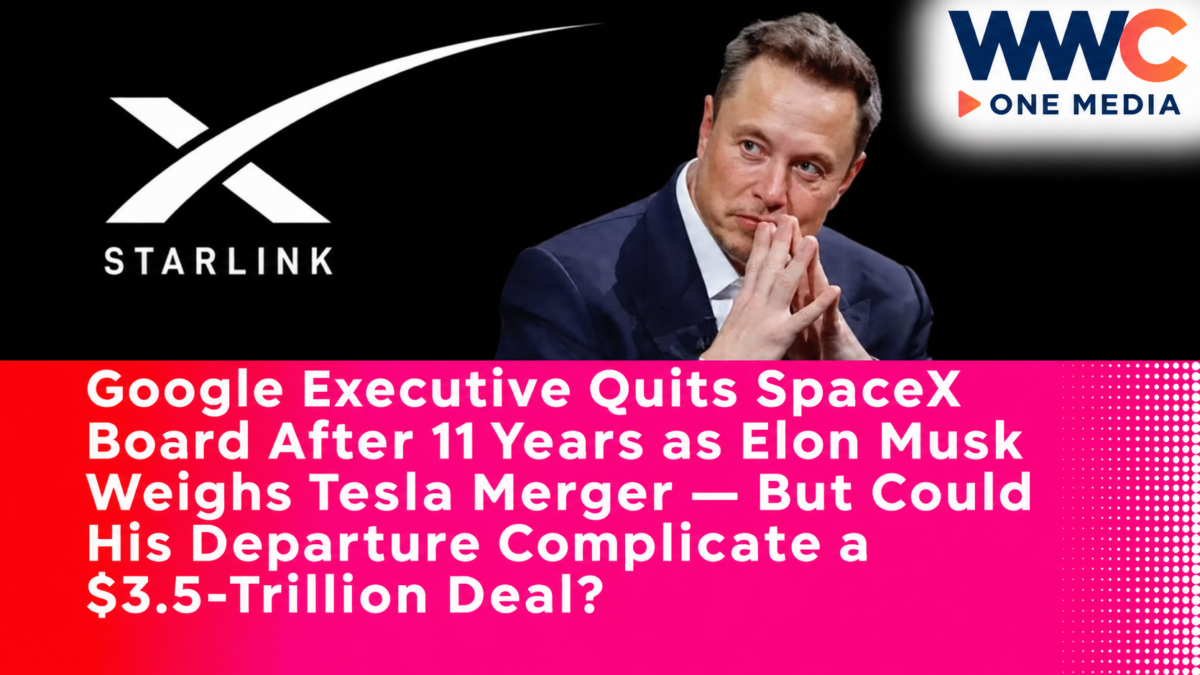
The timing is particularly sensitive because Musk is pursuing discussions about a potential merger between SpaceX and electric-vehicle manufacturer Tesla.
The two companies have become increasingly connected through artificial intelligence, computing infrastructure and advanced engineering.
A combination has been discussed as a possible multitrillion-dollar transaction, although neither company has announced a final merger agreement.
According to Bloomberg’s November 6 report, SpaceX Director Resigns From Board One Day After US Election, Harrison’s departure leaves a group of independent SpaceX directors considering Musk’s proposed corporate combination.
But the company emphasized an important point in its official disclosure.
Harrison’s resignation was not the result of a disagreement with SpaceX over its operations, policies or practices.
Google also expressed continued support for SpaceX and the companies’ longstanding commercial relationship.
The resignation therefore does not establish that Alphabet is abandoning SpaceX or that Harrison opposed the proposed merger.
Nevertheless, the departure removes a prominent representative of one of SpaceX’s largest investors at a time when major governance decisions could reshape Musk’s business empire.
As SpaceX considers an increasingly ambitious future alongside Tesla, the central question is whether Harrison’s exit will be a routine board transition—or a consequential change in the independent oversight surrounding a possible multitrillion-dollar merger.
SpaceX Confirms Donald Harrison’s November 4 Resignation
The most authoritative account of Harrison’s departure comes from SpaceX’s filing with the US Securities and Exchange Commission.
The company reported that Harrison, a Class B director, informed SpaceX on November 4 of his intention to resign from the board.
His resignation became effective immediately.
The filing was submitted on November 6 and signed by SpaceX Chief Financial Officer Bret Johnsen.
The disclosure identified no dispute between Harrison and management concerning the company’s policies, operations or business practices.
SpaceX also thanked Harrison for his years of service.
Reuters independently confirmed the filing, describing the resignation as the departure of a Google executive who had served on SpaceX’s board for more than a decade.
The Wall Street Journal and CNBC also reported the change.
The distinction between the resignation date and the disclosure date is essential.
Harrison left the board on November 4. SpaceX publicly disclosed the event on November 6.
Any account suggesting he resigned on November 6 would confuse the announcement with the effective departure date.
Who Is Donald Harrison, and Why Does His Exit Matter?
Harrison is a senior executive at Google, where he serves as president of global partnerships and corporate development.
He has been associated with the technology company since 2005.
His responsibilities involve major commercial relationships, corporate development and strategic business initiatives.
Harrison joined SpaceX’s board in 2015, the year Google made a substantial investment in Musk’s company.
The investment connected two businesses with overlapping interests in satellite communications, advanced technology and global connectivity.
During his board tenure, SpaceX underwent extraordinary changes.
The company expanded its reusable rocket operations, developed Starlink’s satellite internet business and became a major participant in commercial spaceflight.
It also moved into artificial intelligence and computing infrastructure.
Harrison’s board position gave Google’s corporate-development leadership a direct role in the governance of one of the world’s most influential aerospace businesses.
His departure therefore matters beyond the resignation of a single director.
It changes the composition of a board that may face important decisions involving corporate structure, financing and shareholder interests.
But a board resignation does not automatically indicate a breakdown in relations between the company and the investor associated with the departing director.
Alphabet Remains a Major SpaceX Shareholder
Despite Harrison’s departure, Google’s parent company, Alphabet, continues to hold a substantial investment in SpaceX.
Reuters reported that Alphabet was SpaceX’s largest single institutional shareholder, according to LSEG data.
Google also disclosed an increase in its reported SpaceX position to approximately 555 million shares from around 551.2 million previously.
That change is notable because it contradicts any simplistic interpretation that Harrison’s resignation represents an immediate disposal of Alphabet’s SpaceX holdings.
CNBC estimated Alphabet’s stake at approximately $74 billion at the November 6 market close.
The Wall Street Journal separately reported that the value of Google’s investment had reached approximately $75.2 billion at the end of the third quarter.
These figures refer to different measurement dates and market conditions.
They should not be treated as identical valuations.
The broader point is that Alphabet retains substantial financial exposure to SpaceX.
The resignation changes board representation, but it does not establish that Alphabet has withdrawn its investment.
Google Says Its SpaceX Partnership Will Continue
Google responded to the resignation by emphasizing that its relationship with SpaceX remains intact.
The company said it continues supporting SpaceX’s mission and expects to maintain the longstanding partnership.
That reassurance is important because the relationship is no longer limited to the historical equity investment.
According to CNBC, Google has become a significant commercial customer of SpaceX’s artificial intelligence division.
The companies also cooperate on advanced technology projects.
One reported agreement provides for payments of up to $920 million monthly for computing capacity associated with SpaceX data centers near Memphis, Tennessee.
That amount represents the reported potential contractual scale and should not automatically be described as a guaranteed amount paid every month.
The companies have also worked together on space-related computing technology.
These connections suggest that the commercial relationship could remain strategically important regardless of Harrison’s board membership.
However, continuing cooperation does not mean future contracts, investments or technology projects are guaranteed.
Those developments will depend on commercial negotiations and business performance.
Elon Musk’s Proposed Tesla–SpaceX Merger Adds to the Stakes
The resignation comes as Musk explores combining two of his most important companies.
Tesla is best known for electric vehicles, battery systems and energy products.
Its operations increasingly involve autonomous driving, robotics and artificial intelligence.
SpaceX began as a rocket launch company but has expanded into satellite communications and AI infrastructure.
The businesses now share several technological priorities.
Both depend on advanced engineering, high-performance computing and large-scale manufacturing.
A merger could potentially bring their operations under one corporate structure.
However, the transaction would involve major governance challenges because Musk holds influential positions and ownership interests in both companies.
Independent directors would need to assess whether any proposed combination is fair to shareholders.
WWC ONE MEDIA previously examined the potential deal in Wall Street Predicts $3.5-Trillion Tesla–SpaceX Merger as Elon Musk Sees Major AI Benefits — But One Shareholder Vote Could Derail Everything.
The report explored possible strategic benefits alongside the legal and shareholder-approval challenges.
The approximately $3.5-trillion figure is an analyst-discussed scenario, not a confirmed acquisition price.
Neither Tesla nor SpaceX has announced an approved merger valued at that amount.
Harrison Was Part of the Group Reviewing the Possible Merger
Bloomberg and The Information reported that Harrison was among the independent SpaceX directors considering a possible merger with Tesla.
The Information said his departure leaves five independent directors on the SpaceX board.
Independent oversight is particularly significant in a transaction involving companies controlled or heavily influenced by the same executive.
A merger between related businesses can create conflicts over valuations, voting rights and the allocation of financial benefits.
Directors have responsibilities to evaluate whether a proposed transaction serves the interests of the company and its shareholders.
In some situations, special committees can help address conflicts by reviewing transaction terms independently from executives with interests on both sides.
Harrison’s departure reduces the number of people participating in that oversight process.
But the available public filing does not establish that he opposed the merger.
It also does not establish that his resignation was requested by Musk.
No confirmed replacement or revised merger-review timetable was disclosed in the filing.
Those details would require future company announcements.
Could Losing an Independent Director Complicate the Merger?
The significance of a board departure depends partly on the expertise and responsibilities of the director leaving.
Harrison brought years of experience in technology partnerships and corporate development.
He also represented a long-standing relationship with a major institutional investor.
His absence could alter the experience and perspectives available during board discussions.
For a transaction as complicated as a proposed Tesla–SpaceX merger, directors may need to assess financial forecasts, valuation assumptions, shareholder rights and possible conflicts of interest.
A smaller independent group could face a greater workload.
But it would be premature to claim that Harrison’s resignation has delayed or derailed negotiations.
The available evidence does not establish that the merger committee has stopped functioning.
Nor has either company publicly confirmed that a final agreement was imminent before Harrison resigned.
The departure is a governance development worth monitoring, not proof that a transaction has failed.
The US Midterm Elections Add a Political Dimension
Harrison’s resignation became effective one day after the November 3 US midterm elections.
The results significantly changed the political environment surrounding President Donald Trump and major American technology companies.
Democrats gained control of Congress, creating the possibility of stronger oversight of corporate relationships with Washington.
Elon Musk had spent substantial sums supporting Republican candidates and political organizations.
His political activity made him a prominent figure in the election campaign.
WWC ONE MEDIA examined those developments in Elon Musk’s $474-Million Election Gamble Backfires as Democrats Crush Republican Hopes and Crypto, AI Giants Lose Millions — But Is Big Tech’s Political Power Finally Breaking?.
The report discussed the potential consequences for Musk’s businesses as congressional power shifts.
SpaceX works with government agencies and operates in industries shaped by federal policy.
Changes in political oversight could influence future hearings, spending debates and regulatory priorities.
But the election results do not establish why Harrison resigned.
The two events occurred close together, and no verified evidence demonstrates a causal connection.
SpaceX and Tesla Shares Face Market Volatility
The resignation comes during a volatile period for technology markets.
SpaceX and Tesla shares experienced selling pressure following the midterm results as investors reassessed political risks and valuations.
However, SpaceX subsequently rebounded during Friday’s trading session.
Market coverage showed the company’s shares rising more than 8% on November 6.
This demonstrates why investors should distinguish a corporate announcement from the many other developments influencing a stock price.
A share-price decline occurring around the time of a director’s resignation does not prove the resignation caused the decline.
Likewise, a subsequent rally does not mean every governance concern has disappeared.
Investors are evaluating SpaceX’s AI business, capital requirements, political exposure and potential merger with Tesla simultaneously.
The market reaction to any single event is therefore difficult to isolate.
SpaceX’s AI Business Is Becoming Increasingly Important
SpaceX’s business has expanded significantly beyond traditional aerospace operations.
The company now reports major revenue from artificial intelligence and computing infrastructure.
In October, SpaceX disclosed third-quarter revenue of approximately $14.6 billion and net income of around $4.4 billion.
Its AI-related operations contributed substantially to that performance.
WWC ONE MEDIA previously examined the expansion in SpaceX Shares Surge After $14.6-Billion Earnings Breakthrough — But Musk’s $40-Billion AI Spending Plan Raises a Bigger Question.
The report detailed how AI computing has become an increasingly important source of growth alongside Starlink and rocket launch services.
It also examined the enormous capital spending required to expand computing infrastructure.
Those developments give SpaceX additional strategic overlap with Tesla.
But they also create new questions for shareholders.
An enlarged technology conglomerate would need to manage substantial investments across industries with different risks and financial requirements.
Board oversight becomes especially important when management is considering such a major restructuring.
Why Alphabet’s Investment Makes This a Major Governance Story
Alphabet’s investment in SpaceX has grown dramatically since 2015.
The reported value of the stake now runs into tens of billions of dollars.
That gives the relationship considerable financial importance for both companies.
For Alphabet, the investment provides exposure to aerospace, satellite communications and AI computing.
For SpaceX, Google’s involvement offers a connection to one of the world’s largest technology businesses.
But the relationship also involves overlapping roles.
Alphabet is a shareholder, while Google is a commercial partner and customer.
Those connections can create opportunities for cooperation.
They can also require careful governance to ensure transactions are evaluated appropriately.
Harrison’s resignation makes the future structure of that relationship worth watching.
The companies have indicated that cooperation will continue, but no new board-representation arrangement has been confirmed.
The Tesla–SpaceX Merger Remains a Proposal, Not a Completed Deal
Investors should be particularly cautious about treating discussions as a finalized corporate transaction.
A merger would require agreement on multiple issues.
Those could include the relative value of each business, the ownership distribution among shareholders, voting rights and the future governance structure.
The companies would also need to comply with applicable legal requirements.
Shareholder approval could become a major obstacle depending on the final structure.
Musk has acknowledged that his personal interests in both businesses create conflicts that require independent evaluation.
The reported merger discussions therefore remain subject to significant uncertainty.
A possible combination may have strategic logic without becoming an approved transaction.
Likewise, Harrison’s resignation may affect the composition of the review process without determining its outcome.
Until the companies announce formal terms, any estimated combined valuation remains hypothetical.
SpaceX’s Broader Business Still Depends on Rockets and Satellites
Despite the growing attention on AI and a possible merger, SpaceX remains a major player in launch services and satellite communications.
Its Falcon rockets support commercial, government and other missions.
Starlink provides satellite broadband services in markets around the world.
SpaceX also continues developing Starship, its next-generation launch vehicle.
The company’s expanding operations create demand for specialized manufacturing, components and engineering services.
WWC ONE MEDIA previously examined the wider supply chain in SpaceX Supplier Applied Aerospace Trades Far Below IPO Price as Space and Defense Demand Accelerate.
The report discussed how suppliers can benefit from the expansion of rocket production while facing risks related to customer concentration and project execution.
These businesses provide another reason corporate governance matters.
SpaceX must balance enormous capital commitments across launch systems, satellite services and AI infrastructure.
Major ownership or structural changes could influence how management allocates resources among those operations.
But no evidence currently establishes that Harrison’s resignation has disrupted launch schedules or satellite services.
What Does the Board Change Mean for the Philippines?
SpaceX’s activities have relevance for the Philippines through satellite connectivity, international technology supply chains and global investment markets.
Starlink provides connectivity options in areas where traditional telecommunications infrastructure may be limited.
A possible merger involving Tesla and SpaceX could eventually change how the companies organize technology and capital investment.
However, there is no confirmed direct effect of Harrison’s resignation on Philippine Starlink services, local pricing or regulatory approvals.
The board change does not establish that the company will halt services or cancel projects in the Philippines.
For local businesses and investors, the more relevant questions involve SpaceX’s long-term stability, corporate governance and its ability to fund expansion.
Any specific Philippine business impact would require separate disclosure or evidence.
What Happens Next for SpaceX?
Several developments will determine how significant Harrison’s resignation becomes.
The first is whether SpaceX appoints a replacement director.
The second is how the remaining independent directors approach the proposed Tesla merger.
The third is whether the companies announce formal merger terms or decide not to proceed.
The fourth is how Alphabet manages its investment and commercial relationship with SpaceX.
The fifth is whether changes in Washington affect regulatory oversight, government contracts or major infrastructure projects involving Musk’s companies.
None of these outcomes should be assumed.
What is confirmed is that Harrison has left the board, SpaceX reported no disagreement behind the resignation, and Google has expressed continued support for the relationship.
The wider corporate and political consequences remain uncertain.
The Bigger Question: Is Musk’s Technology Empire Entering a New Governance Era?
Donald Harrison’s departure marks the end of an important chapter in SpaceX’s relationship with Google.
He joined the board in 2015, when Alphabet made a major investment in the company.
Over the following 11 years, SpaceX developed from a private aerospace innovator into a publicly traded business with major operations in rockets, satellite communications and artificial intelligence.
Now Harrison is leaving as Musk considers combining SpaceX with Tesla.
The timing, one day after the US midterm elections, has attracted attention.
But the confirmed company filing offers no evidence that politics caused the resignation.
SpaceX has said the departure did not arise from disagreements, while Google continues supporting its partnership.
The genuine unresolved issue concerns corporate governance.
An important independent director has left while a possible transaction involving two Musk-led businesses remains under consideration.
Investors will want to know how the remaining board members evaluate potential conflicts, protect shareholder interests and manage the enormous financial stakes.
As Google’s longtime representative exits SpaceX’s board just as Elon Musk explores a potential $3.5-trillion Tesla–SpaceX combination, one question could determine the next chapter of his business empire: Will the departure be a routine transition before a historic merger—or could the loss of an experienced independent director make an already complicated corporate deal even harder to complete?