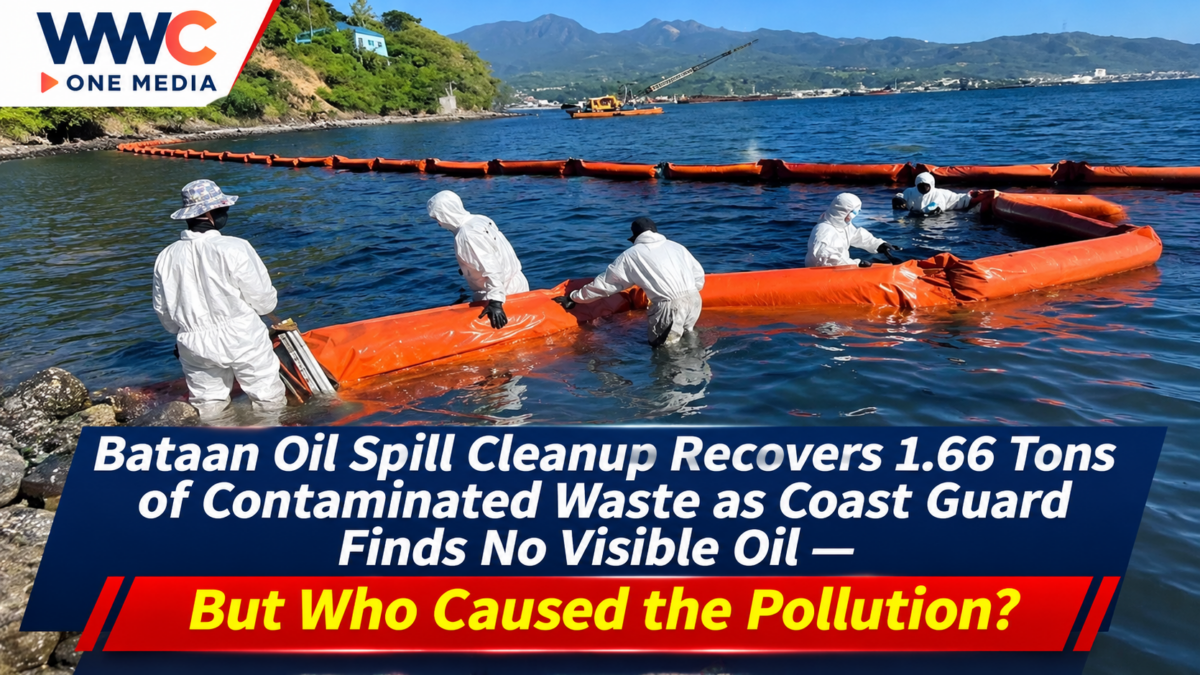
MARIVELES, BATAAN — The Philippine Coast Guard (PCG) has recovered more than 1.6 metric tons of oil-contaminated waste from the waters and shoreline of Mariveles, Bataan, allowing authorities to scale back emergency cleanup operations.
But one crucial question remains unanswered: Where did the oil come from, and who should be held responsible?
In an update reported on Sunday, November 8, the PCG confirmed that responders had collected 1,660 kilograms of oil-contaminated materials, packed into 83 sacks, following the discovery of an oil spill near Sitio Naswe in Barangay Ipag.
The contamination was initially reported on November 5 and affected approximately 500 square meters of coastal waters.
Authorities estimated that around 25 liters of used oil were involved.
After several days of containment and recovery, a joint inspection by the Coast Guard and the Mariveles Municipal Disaster Risk Reduction and Management Office found no visible oil sheen on the water’s surface.
The development prompted the PCG to shift from active oil spill response to monitoring operations.
However, the cleanup’s progress does not mean every question about the incident has been settled.
The oil’s precise origin remains under investigation, and the collected waste still requires proper treatment and disposal.
The Department of Environment and Natural Resources (DENR) has also ordered environmental assessment and coordination with local authorities.
For coastal communities, the biggest concern is whether the pollution has been fully controlled—or whether lingering contamination could still threaten marine life and livelihoods.
Philippine Coast Guard Recovers 1,660 Kilograms of Contaminated Waste
The Coast Guard reported that the volume of recovered material had reached 1,660 kilograms as of 5 p.m. on Saturday, November 7.
The waste was packed into 83 sacks and transported to a local transfer station in Mariveles for temporary storage.
The materials are awaiting transfer to an accredited oily waste collector and an authorized treatment, storage and disposal facility.
That process is important because oil-contaminated waste cannot simply be dumped with ordinary garbage.
Improper handling could create another source of pollution.
For example, contaminated debris may release oil into soil, drainage systems or waterways if storage areas are not properly managed.
Authorities must therefore ensure that the material is collected, transported and treated according to environmental regulations.
The latest recovery represents significant progress in the emergency operation.
But the amount recovered should be understood correctly.
The 1,660 kilograms refers to oil-contaminated materials, including debris and spent cleanup equipment—not 1,660 kilograms of pure spilled oil.
The original estimate involved approximately 25 liters of used oil.
The larger weight reflects the contaminated materials gathered during cleanup.
How the Bataan Oil Spill Was Discovered
The incident began on Thursday, November 5.
At approximately 9:30 a.m., the Philippine Coast Guard received a report of a suspected oil spill near Sitio Naswe, Barangay Ipag.
Responders discovered contamination across an estimated 500-square-meter section of coastal waters.
Initial findings suggested that the oily substance might have originated from washing activities.
However, the Coast Guard emphasized that its precise source remained subject to verification.
The possibility of washing-related contamination raises questions about how used oil or oily wastewater entered the marine environment.
Such contamination can potentially originate from various activities involving machinery, vessels or industrial operations.
But investigators have not identified a confirmed responsible individual, company or vessel.
It would therefore be premature to attribute the spill to a specific business or maritime operator.
For now, the verified finding is that used oil was detected in coastal waters and that authorities are investigating how it entered the area.
Seven Oil Booms and 2,200 Absorbent Pads Deployed
The Coast Guard responded by deploying equipment designed to prevent further spreading of the contamination.
The initial operation involved seven absorbent booms and approximately 2,200 absorbent pads.
Oil booms are floating barriers used to contain or limit the movement of oil on the water’s surface.
Absorbent pads help recover oily substances from affected areas.
The PCG coordinated with provincial and municipal disaster response personnel.
Representatives from the Mariveles Municipal Agriculture Office and Barangay Ipag also participated in the response.
By approximately 3:30 p.m. on November 5, workers had installed containment booms along the affected shoreline.
The barriers helped concentrate contamination and support recovery efforts.
The operation demonstrates the importance of acting quickly when oil is detected.
A relatively small quantity can spread across a much larger surface area, depending on currents, wind and environmental conditions.
Rapid containment can reduce the chances that pollution reaches additional coastal locations.
Cleanup Teams Initially Collected 800 Kilograms
The first major recovery milestone came on November 5.
By 6:30 p.m., responders had collected approximately 800 kilograms of contaminated debris and used absorbent materials.
The waste was placed inside 40 sacks.
Those figures were reported by GMA News, Philstar and the Philippine News Agency on November 6.
Cleanup efforts continued afterward.
By November 7, the total amount of recovered material had increased to 1,660 kilograms in 83 sacks.
That means the reported cumulative recovered-waste weight more than doubled from the initial figure.
The two numbers should not be added together.
The 1,660-kilogram total is the later cumulative update, not a separate amount recovered in addition to the first 800 kilograms.
The distinction is important because oil spill reporting often contains successive estimates as response operations progress.
No Visible Oil Sheen Found During Joint Inspection
A significant development occurred during the Coast Guard’s follow-up inspection on November 7.
At approximately 2 p.m., the PCG and Mariveles Municipal Disaster Risk Reduction and Management Office examined waters surrounding the affected area.
The team reported no visible oil sheen.
An oil sheen is a thin layer of petroleum product that can appear on the water’s surface.
The absence of a visible sheen suggests that the surface contamination had been substantially reduced or was no longer observable during the inspection.
That finding helped justify the Coast Guard’s decision to transition from active recovery to monitoring.
However, visual inspection has limitations.
Some contamination may persist in sediments, on shorelines or in areas not readily observable from the surface.
Environmental authorities may need additional assessments to determine whether any residual pollution remains.
No visible oil sheen is encouraging news, but it should not be treated as a laboratory-certified declaration that the entire area is pollution-free.
Coast Guard Shifts From Emergency Cleanup to Monitoring
The latest announcement marks a change in the government’s response.
During the active phase, teams concentrated on containing the oil, collecting contaminated debris and preventing further spread.
Monitoring operations focus on observing the area after the most immediate visible contamination has been addressed.
This can help authorities identify possible new oil traces or changes in coastal conditions.
It also provides an opportunity to determine whether further intervention is needed.
The Coast Guard’s decision indicates that the emergency response has progressed sufficiently to reduce active cleanup activity.
But it does not establish that the investigation has ended.
The agency must still address outstanding questions about the source of the contamination.
Environmental authorities also need to ensure that the recovered oily waste is transferred to an appropriate disposal facility.
DENR Orders Environmental Assessment and Accountability
The Department of Environment and Natural Resources responded to the incident on November 6.
Environment Secretary Juan Miguel Cuna directed the department’s regional offices and environmental management teams to coordinate with the Coast Guard and local government authorities.
The DENR called for rapid assessment of the affected coastal area.
It also emphasized the importance of preventing additional environmental damage.
The agency said responsible parties must comply with applicable environmental laws.
Its involvement is significant because the Coast Guard’s maritime response and the DENR’s environmental oversight serve different purposes.
The Coast Guard can conduct containment and recovery operations.
The DENR can examine environmental compliance and potential violations within its jurisdiction.
Both functions may be necessary to establish what happened.
However, authorities have not publicly announced a completed finding identifying the party responsible for the November 5 spill.
Accountability must be based on the investigation’s findings.
Why Proper Disposal of Oily Waste Matters
Recovering contaminated debris is only one stage of the response.
The next challenge involves safely handling the materials after collection.
Used oil and certain oil-contaminated wastes are subject to Philippine environmental regulations, including applicable rules under Republic Act No. 6969.
The law provides a framework for managing toxic substances and hazardous and nuclear wastes.
Depending on the waste’s classification, responsible parties may need to use authorized transporters and accredited treatment or disposal facilities.
Proper waste management helps prevent collected contamination from returning to the environment.
The PCG has said the recovered sacks will be transferred to an accredited oily waste collector and treatment, storage and disposal facility.
That planned transfer should be followed through.
Temporary storage should not become an indefinite solution.
How Oil Pollution Can Affect Fish and Marine Life
Oil contamination can threaten marine ecosystems even when the volume released is relatively small.
Petroleum products may affect fish, shellfish, seabirds and other organisms.
The degree of impact depends on the type of oil, concentration, exposure duration and sensitivity of the surrounding habitat.
Oil can coat surfaces and interfere with normal biological processes.
Some petroleum compounds can also be harmful if organisms absorb them.
Coastal habitats such as mangroves, seagrass beds and wetlands may be particularly sensitive.
These environments provide shelter, feeding areas and breeding grounds for marine species.
As WWC ONE MEDIA reported in its coverage of six dugongs and five green sea turtles spotted off Sultan Kudarat, healthy coastal habitats are essential to the survival of vulnerable marine wildlife.
The Sultan Kudarat sightings are unrelated to the Bataan spill.
But they illustrate why protecting Philippine coastal ecosystems matters.
Authorities have not confirmed that dugongs or sea turtles were harmed by the latest Mariveles incident.
Could Bataan Fisherfolk Face Livelihood Risks?
Coastal pollution can also affect fishing communities.
Fisherfolk depend on healthy marine environments and consumer confidence in seafood safety.
An oil spill may disrupt fishing activity if authorities restrict access to affected waters.
Contamination can also raise concerns about catches from nearby areas.
However, the November 8 report does not establish a confirmed fishing ban, significant fish kill or documented livelihood losses resulting from this incident.
Those potential effects should not be presented as accomplished facts.
Local authorities and fisheries officials would need to assess the conditions before issuing specific recommendations.
As WWC ONE MEDIA reported in its coverage of fisherfolk seeking permanent protection for the Verde Island Passage, coastal communities have long raised concerns about pollution and industrial activity threatening important fishing grounds.
The Verde Island Passage and Mariveles are separate areas.
Nevertheless, the underlying issue is similar: preventing marine pollution helps protect both ecosystems and livelihoods.
Bataan Has Experienced a Much Larger Oil Spill Before
The latest Mariveles incident has revived memories of the much larger Bataan oil spill in July 2024.
That disaster involved the motor tanker MT Terra Nova, which sank off Limay while carrying approximately 1.4 million liters of industrial fuel oil.
The accident triggered a major maritime pollution response involving multiple government agencies.
The scale was far greater than the November 2026 incident.
According to GMA’s November 7 oil-spill explainer, responders eventually recovered more than one million liters of oily waste during the 2024 cleanup.
The November 2026 spill involves an initial report of approximately 25 liters of used oil affecting around 500 square meters.
There is no verified evidence linking the current spill to the MT Terra Nova incident.
The two events must not be confused.
But the earlier disaster provides important context for why rapid response and marine pollution prevention remain priorities in Bataan.
Environmental Cleanup Does Not End When Waste Is Collected
One lesson from coastal cleanup operations is that removing visible pollution is not always the end of the problem.
Environmental agencies must also consider where the waste originated and how future releases can be prevented.
As WWC ONE MEDIA reported when more than 35 tons of rubbish were collected from Central Visayas shorelines, cleanup operations can reveal broader weaknesses in waste handling and pollution prevention.
That report concerned solid coastal waste rather than an oil spill.
But the principle remains relevant.
Collecting material from the environment addresses an immediate problem.
Identifying pollution sources and improving waste-management practices can help prevent recurrence.
For Mariveles, the investigation into the origin of the used oil remains an important unresolved task.
Without identifying the cause, authorities may have difficulty determining which preventive measures would be most effective.
Another Oil Leak in Asia Shows Why Monitoring Matters
The need for environmental monitoring is not limited to maritime incidents.
In Thailand, an oil leak at a Bangkok data centre raised concerns about contaminated wastewater and sediment.
As WWC ONE MEDIA reported in its September coverage of the Bangkok incident, environmental authorities examined whether oily waste could spread beyond the affected facility.
The circumstances differ from those in Bataan.
The Bangkok incident involved a land-based industrial facility, while Mariveles concerns coastal waters.
But both incidents demonstrate why containment, waste treatment and monitoring are distinct parts of environmental management.
A successful cleanup needs more than removing visible contamination.
It also requires appropriate handling of contaminated materials and attention to the possibility of further releases.
What Residents Should Know About Oil Spill Exposure
Oil spills can create health risks when people come into direct contact with contaminated substances.
The Department of Health has warned that exposure may cause skin and eye irritation and other symptoms, depending on the substance and circumstances.
GMA News highlighted these concerns in its November 7 explainer on oil pollution.
Residents should avoid unnecessarily touching oily debris or entering visibly contaminated waters.
Anyone exposed to oil should remove contaminated clothing and wash affected skin appropriately.
People experiencing significant symptoms should seek medical attention.
However, there is no confirmed report in the latest GMA article of injuries or illnesses linked to the Mariveles spill.
The presence of an oil spill does not automatically mean an entire community has suffered toxic exposure.
Residents should follow official local advisories rather than rely on speculation.
What Happens Next in Mariveles?
The immediate focus has shifted to monitoring and waste management.
The Coast Guard and local disaster authorities will need to continue observing the affected area for signs of residual or renewed contamination.
The 83 sacks of recovered waste must also be transferred to an accredited facility for treatment and disposal.
Environmental officials may determine whether further assessment is necessary.
Meanwhile, investigators must establish how the oil entered the coastal waters.
The initial reference to washing activities remains a preliminary finding.
No final public determination identifying the responsible party has been confirmed.
If investigators identify a violation of environmental law, the responsible authorities can evaluate the appropriate enforcement action.
But no penalties or criminal charges should be assumed before the relevant facts are established.
The Bottom Line: Bataan’s Visible Oil Spill Has Been Controlled, but Questions Remain
The Philippine Coast Guard has recovered 1,660 kilograms of oil-contaminated waste from coastal waters and shoreline areas in Mariveles, Bataan.
The recovered materials were packed into 83 sacks for temporary storage.
The original incident involved approximately 25 liters of used oil affecting an estimated 500 square meters near Sitio Naswe, Barangay Ipag.
After a joint inspection found no visible oil sheen, authorities shifted from active cleanup to monitoring.
The DENR has ordered environmental assessment and coordination with government responders.
The recovery represents meaningful progress.
But proper disposal of contaminated waste and identification of the pollution source remain important.
The government has not established that every environmental risk has disappeared.
Nor has it publicly identified the party responsible for releasing the oil.
And as Bataan’s latest oil spill disappears from the water’s surface following the recovery of 1.66 tons of contaminated materials, one question remains: Will investigators discover who allowed the oil to reach Mariveles’ coastal waters—or could another pollution incident occur before the government closes the gaps that caused this one?