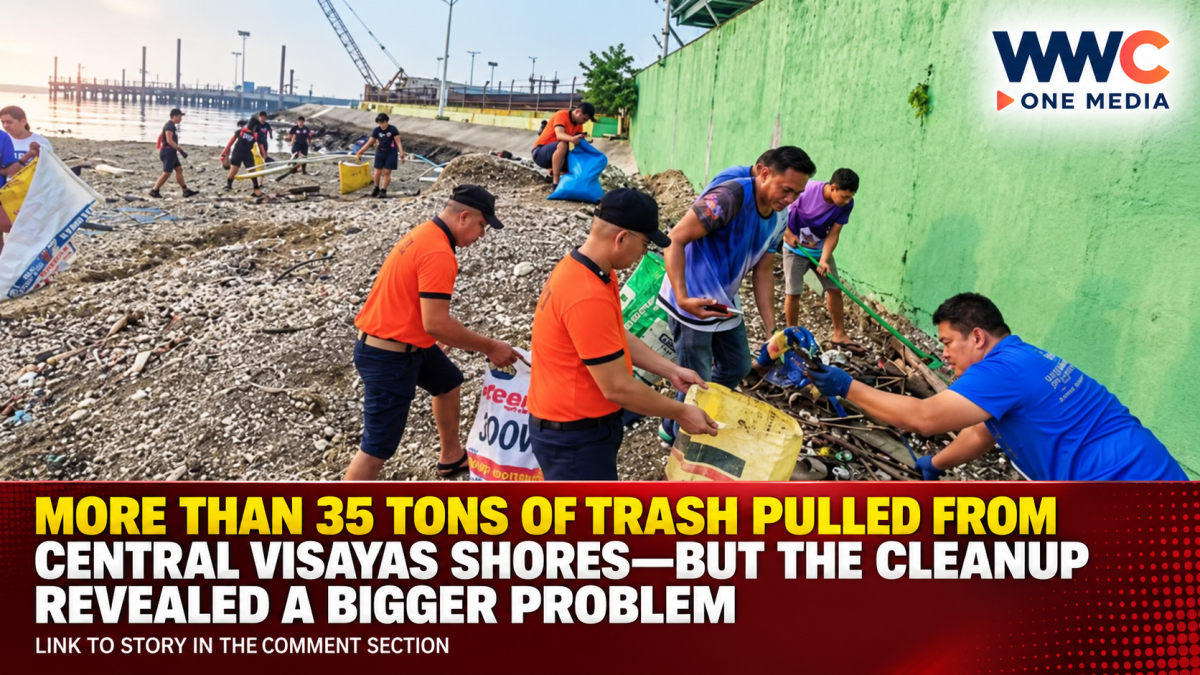
TAGBILARAN CITY, Bohol — More than 35 tons of trash were hauled from coastal areas across Central Visayas during the region’s 41st International Coastal Cleanup on Saturday, September 19, underscoring the continuing scale of marine waste threatening the region’s shorelines and waters.
Initial figures from the Department of Environment and Natural Resources–Central Visayas (DENR-7) showed that 35,781.4 kilograms of garbage had been collected as of 4 p.m. from 47 cleanup sites covering about 81.24 kilometers of coastline.
The operation mobilized 11,155 volunteers and 374 partner organizations, including local governments, national agencies, schools, businesses and community groups.
But environmental officials emphasized that the significance of the cleanup goes beyond the amount of garbage removed.
The trash problem doesn’t end at the shoreline
The 2026 International Coastal Cleanup carried the theme “Clean Seas for Resilient Communities,” with the DENR stressing that communities must address waste before it reaches rivers, waterways and the ocean.
Ahead of the nationwide activity, the DENR said the objective was not simply to collect the largest possible volume of trash, but to encourage better waste management practices at homes, schools, workplaces and communities. The agency organized simultaneous cleanup activities in 17 regions across the Philippines.
The Philippine government has also institutionalized the International Coastal Cleanup through Presidential Proclamation No. 470, which designates the third Saturday of September each year as International Coastal Cleanup Day.
Lapu-Lapu divers uncover waste beneath the water
The cleanup effort was particularly visible in Lapu-Lapu City, where volunteer divers entered the waters along the Hilutungan Channel to retrieve and document submerged marine debris.
The city’s “Scubasurero 2026: Diving for Clean Seas, Building Resilient Communities” brought together volunteer divers, environmental organizations, government agencies and private-sector partners.
According to The Freeman, the activity was designed not only to remove underwater waste but also to document the types of debris discovered. Lapu-Lapu City deployed volunteers across 15 designated coastal areas involving mainland and island communities.
City officials also pointed to waste segregation, collection, recycling, resource recovery and proper disposal as necessary parts of coastal protection.
Central Visayas has seen another massive cleanup haul
The latest figures also highlight how persistent the region’s marine-waste problem has been.
During the 2025 International Coastal Cleanup, Central Visayas volunteers collected 41,228 kilograms of trash, according to the Environmental Management Bureau Region 7. More than 9,000 volunteers participated in cleanup activities involving coastlines, rivers, estuaries and urban waterways.
That means the issue is not limited to isolated beaches. Waste can move through drainage systems, rivers and other waterways before ultimately reaching coastal ecosystems.
Why the cleanup matters
Marine debris can threaten marine animals, damage coastal habitats and affect communities whose livelihoods depend on fisheries and tourism. The DENR has therefore framed the annual cleanup as part of a broader effort to reduce the amount of waste entering waterways in the first place.
In Tagbilaran City, for example, collected materials were turned over to the city’s solid-waste management office for proper collection and disposal following the September 19 cleanup.
The cleanup data itself is also important. International Coastal Cleanup activities involve documenting the types and quantities of waste collected, generating information that can help identify patterns in marine debris and inform future waste-management strategies.
A warning hidden in 35 tons of garbage
The 35,781.4 kilograms collected in Central Visayas represents more than a headline-grabbing number. It also provides a snapshot of how much waste communities can encounter along their waterways and shorelines during a single coordinated cleanup.
For environmental officials, the bigger goal is therefore to reach a point where communities have less garbage to collect in the first place.
As Central Visayas continues its coastal protection efforts, the challenge now shifts from removing waste to preventing it from reaching the sea.