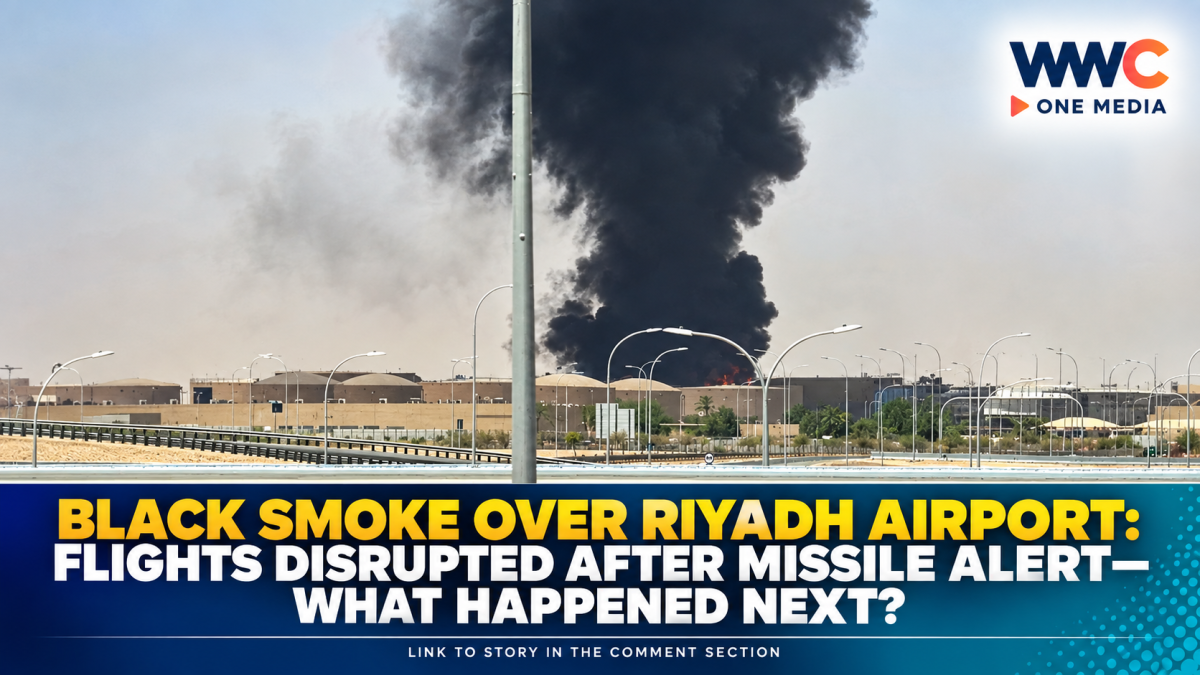
RIYADH — A huge plume of black smoke and flames rose near Saudi Arabia’s King Khalid International Airport on Saturday, September 19, after an overnight air-raid warning in Riyadh and reports of explosions sent the capital into heightened alert.
The incident disrupted air traffic at the kingdom’s main aviation hub, with FlightRadar24 reporting major operational problems, including flight cancellations and delays. Later tracking data indicated that airport operations were continuing, although disruptions remained.
The fire was reported at a fuel-storage area near the airport. An AFP journalist at the scene saw firefighters tackling flames involving a fuel tank bearing the logo of Saudi oil giant Aramco. Reuters photographs and video also showed a large column of smoke rising near airport facilities.
Saudi Arabia confirms missile aimed at Riyadh
The incident came hours after Saudi authorities issued an emergency warning to residents of Riyadh and the nearby Al-Kharj governorate, telling people to take precautions against a potential aerial threat.
Saudi Arabia’s official Saudi Press Agency reported that coalition spokesman Maj. Gen. Turki Al-Malki said Saudi air defenses had intercepted and destroyed a ballistic missile launched toward Riyadh by Yemen’s Houthi movement.
The Associated Press likewise reported that Saudi authorities confirmed the attempted strike, while saying there were no reported casualties or damage from the intercepted missile itself.
The Saudi-led coalition also said attacks aimed at civilian infrastructure in other locations, including Yanbu, Taif, Baysh and Farasan, had been thwarted.
Houthis claim attacks on Riyadh
Yemen’s Houthi movement subsequently said it had launched missile and drone operations against what it described as “sensitive” sites in Riyadh.
The group also claimed attacks against facilities belonging to Saudi Aramco in Yanbu, an important industrial and energy center on Saudi Arabia’s Red Sea coast. The claims were reported by Reuters and other international outlets, but the Houthis did not provide independent evidence establishing the extent of damage at the claimed targets.
That leaves an important unanswered question surrounding the Riyadh airport fire: whether the blaze was directly caused by the attempted Houthi attack has not been independently established in the available reporting.
What is confirmed is that the fire occurred in the same broader period as the missile alert, explosions reported by residents and the Houthi claim of attacks on Riyadh.
Flights hit by disruption
The airport disruption added another immediate consequence to the security incident.
FlightRadar24 initially placed King Khalid International Airport at its highest disruption level, reporting significant delays and cancellations. Subsequent tracking data showed the disruption index had fallen substantially as airport operations continued.
The situation underscores how quickly security incidents around major aviation and energy infrastructure can affect civilian travel, even when an incoming missile is intercepted before reaching its intended destination.
A wider escalation in Yemen
The Riyadh incident comes as fighting between the Saudi-backed Yemeni government and the Houthis has intensified.
The Houthis have expanded their military activity along Yemen’s Red Sea coast, while Saudi Arabia has carried out strikes against Houthi-controlled areas. The renewed fighting has also raised concerns about the security of the Bab al-Mandab Strait, one of the world’s important maritime chokepoints.
The United Nations has warned that the renewed fighting has displaced more than 112,000 people, while thousands more have crossed the Red Sea toward Djibouti.
The escalation is particularly significant for global energy markets because Saudi Arabia is one of the world’s largest oil exporters and the Red Sea provides an alternative maritime route for energy shipments.
Reuters reported that Saudi oil exports through the Bab al-Mandab Strait have fallen since July, although some loaded tankers have continued to use the route.
Regional tensions raise the stakes
The latest incident also comes against the backdrop of a much wider regional conflict involving Iran, the United States and Israel.
The Houthi movement is aligned with Iran, although Tehran’s government has publicly called for an end to the Saudi-Yemeni conflict. The Houthis, meanwhile, have continued their military campaign and have cited Saudi strikes in Yemen as justification for their attacks.
The UN Security Council has condemned continued Houthi attacks affecting Saudi civilian and energy infrastructure and called for an end to the group’s military escalation.
For Riyadh, Saturday’s events represented a significant security test: an air-raid warning, an intercepted ballistic missile, explosions reported by residents and a major fire near the capital’s principal airport all unfolded within hours.
While Saudi air defenses said they intercepted the missile aimed at Riyadh, the cause of the airport-area fire and the full extent of any damage remain key questions.
And with the Houthis claiming further attacks and fighting continuing along Yemen’s Red Sea coast, the next test may not be limited to the skies over Riyadh—it could extend to the region’s airports, energy infrastructure and vital shipping routes.