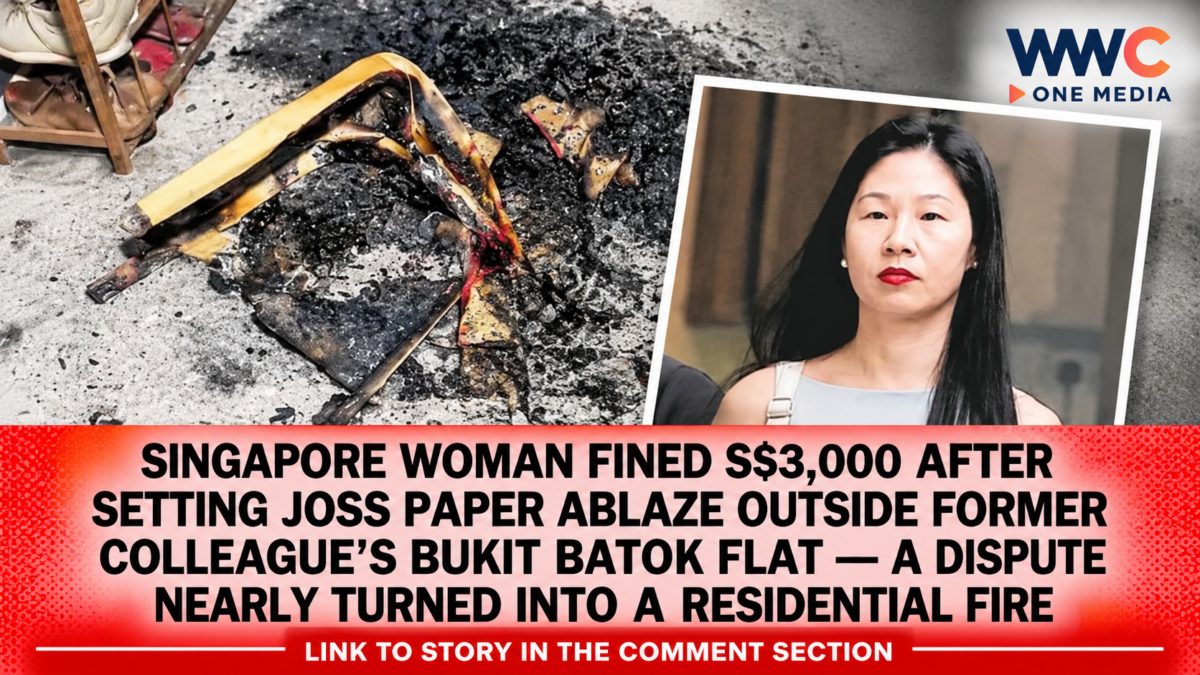
SINGAPORE — A woman who wanted to get the attention of a former colleague ended up setting fire to joss paper outside the colleague’s Bukit Batok flat, creating a potentially dangerous situation for residents in the housing block.
The 34-year-old woman, identified in Chinese-language reports by the transliterated name Tong Huan Ling, was fined S$3,000 after admitting to an offence involving the creation of a fire risk.
The incident happened on January 29, 2026, when she visited her former colleague’s home at around 9.30pm. After receiving no response despite waiting outside for approximately an hour, she decided to light a box containing joss paper near the flat’s entrance.
Her actions escalated when she kicked over a wooden chair, causing it to fall onto the burning box and allowing the flames to spread.
Although neighbours managed to extinguish the fire before it developed into a more serious incident, the damage and circumstances raised concerns about the dangers of deliberately lighting combustible materials in a residential corridor.
The case, reported in Singapore on November 3, is a reminder that an act intended to attract someone’s attention can have consequences far beyond the original disagreement.
A Visit to a Former Colleague’s Home Took an Unexpected Turn
According to court details reported by local media, the woman and the complainant’s wife had previously worked together.
At the time of the incident, the woman was unemployed. She travelled to the former colleague’s residence in the Bukit Batok Street 21 area on the evening of January 29, apparently hoping to meet her.
However, the former colleague was overseas at the time. Only her husband and daughter were at home.
The woman knocked on the door but received no response. Instead of leaving, she remained outside the flat for approximately one hour.
During that period, she reportedly noticed that the lights inside the home had been switched on. Believing that her former colleague was deliberately avoiding her, she tried knocking and ringing the doorbell again.
Still, nobody answered.
What happened next turned an ordinary visit into a potentially serious fire incident.
She Borrowed a Stranger’s Lighter and Set Fire to Joss Paper
After becoming frustrated, the woman reportedly decided to do something to get the attention of the person she had come to see.
She obtained a cardboard box containing joss paper from the ground floor of the housing block and brought it to the area outside the flat.
The box was placed near the shoe rack beside the unit’s metal gate.
She then approached a passer-by and borrowed a lighter.
At around 11pm, she used it to set the joss paper inside the box on fire.
The act was not simply an attempt to burn the paper and leave. Reports said she also recorded the burning materials and sent the footage to her former colleague.
She subsequently knocked on the door again.
But when nobody came out, her frustration continued to escalate.
Kicking Over a Wooden Chair Allowed the Flames to Spread
The situation became more dangerous when the woman kicked a wooden chair positioned outside the flat.
The chair toppled onto the burning cardboard box, contributing to the spread of the flames.
This increased the potential danger because the fire was burning directly outside an occupied residential unit, close to other combustible materials and the flat’s entrance.
The former colleague’s husband eventually looked through the door’s peephole and noticed flames and smoke outside.
He immediately contacted the authorities.
The fire could have developed into a much more serious incident had it reached the flat’s entrance or nearby materials. Fortunately, two neighbours who noticed the burning smell had already taken action to put out the flames by the time police officers arrived.
Neighbours Helped Extinguish the Fire Before It Escalated
Police officers reached the location at approximately 11.11pm.
By then, the two neighbours had managed to extinguish the fire.
The woman was reportedly sitting on a chair near the unit when officers questioned her.
She admitted that she had started the fire and explained that she wanted to attract her former colleague’s attention.
Although the incident did not result in reported physical injuries, it left visible damage outside the flat.
Court documents included photographs showing a blackened floor area, ash around the metal gate and a wooden chair badly damaged by the flames.
The chair was valued at approximately S$25.
The relatively low value of the damaged item, however, did not reflect the potential seriousness of the incident. A fire in a residential corridor can threaten occupants, neighbouring units and people who may have limited time or ability to evacuate.
The woman was arrested on January 30, the day after the incident. She was subsequently charged and remained in custody until she posted bail on February 10.
Why the Court Treated the Incident Seriously
The prosecution highlighted that the incident happened in a residential area, where a fire could have endangered other people.
Although the direct property damage was limited to a wooden chair worth S$25, the potential consequences were considerably more serious.
The flames could have spread to the flat’s wooden door, shoe rack or other nearby combustible materials. If the fire had grown, residents could have been exposed to smoke, flames and the risk of being trapped inside their homes.
The prosecution therefore emphasised that the case should not be assessed solely by looking at the monetary value of the damaged property.
The central concern was the danger created by deliberately lighting combustible material outside an occupied home.
The prosecution reportedly proposed a fine ranging from S$3,000 to S$4,000.
The court ultimately imposed a S$3,000 fine after considering the circumstances of the case and the mitigating factors presented.
Woman Apologised and Offered Compensation After the Incident
The woman reportedly attempted to make amends after the incident.
She offered to compensate the affected household and also tried to send an apology letter.
However, the former colleague’s husband rejected the offers.
Her lawyer told the court that she had made repeated attempts to apologise and provide compensation but had been unsuccessful.
The defence also highlighted that she had no previous criminal record and had pleaded guilty at an early stage.
These factors were presented as reasons for the court to consider a more lenient sentence.
The judge nevertheless criticised the seriousness of her actions, noting that it was fortunate the fire had not spread further and caused a much greater disaster.
In arriving at the sentence, the court considered her guilty plea, the attempted compensation and the time she had previously spent in remand.
She was ultimately fined S$3,000.
Mental Health Treatment Was Also Raised During Sentencing
Another factor brought up by the defence was the woman’s mental health.
Her lawyer said she had previously sought help from a psychiatrist and had been diagnosed with adjustment disorder.
She was reportedly receiving treatment.
The defence presented this information as part of its plea for leniency, alongside her lack of previous convictions, early guilty plea and attempts to apologise.
However, the reported diagnosis should not be treated as an explanation that automatically removes responsibility for the offence. The court considered the information in the context of sentencing, while also taking into account the danger created by the fire.
The case illustrates why personal difficulties and disputes should be addressed through appropriate channels rather than actions that could place other people at risk.
Singapore’s Dangerous-Fire Laws: Why Even a Small Fire Can Have Serious Consequences
Singapore’s Penal Code includes an offence covering conduct that causes or substantially contributes to the risk of a dangerous fire.
Section 285 addresses situations in which a person rashly or negligently uses fire, or something likely to cause fire, in circumstances that create a qualifying risk.
Depending on the circumstances and the consequences, the law provides for fines and imprisonment. The statutory penalties can be significantly more severe when a fire endangers human life, causes injury or results in death.
The Ministry of Home Affairs has previously explained that the offence was introduced to deter behaviour involving improperly discarded or handled burning materials, including cigarette butts and other items capable of starting fires.
The broader principle is straightforward: a person does not have to cause a large blaze before fire-related conduct becomes a serious public-safety concern.
In residential buildings, even a small fire can spread to nearby combustible materials, produce dangerous smoke and interfere with evacuation routes.
The Bukit Batok incident demonstrates how quickly a situation can become hazardous when burning materials are placed near a home’s entrance.
Why Burning Joss Paper Requires Proper Safety Precautions
Burning joss paper is a traditional practice observed by many people, particularly during religious ceremonies and occasions when families honour deceased relatives.
However, the practice must be carried out safely.
The Singapore Civil Defence Force has advised the public to burn incense paper, joss sticks and candles in appropriate receptacles, such as designated burners or metal containers.
These should be placed on stable surfaces and kept away from combustible objects, including cardboard, paper, plastic and furniture.
People should also ensure that burning materials and embers are completely extinguished before leaving the area.
The precautions are especially important in densely populated housing estates, where smoke and flames can affect people beyond the immediate location.
The Bukit Batok case was not simply an example of an accidental fire during a religious practice. According to the reported court facts, the woman deliberately lit the joss paper to attract someone’s attention. Nevertheless, the incident highlights the risks associated with leaving burning materials near residential property.
A Disagreement That Could Have Put Other Residents at Risk
One of the most striking aspects of the case is how the incident began.
The woman went to a former colleague’s home, received no answer and apparently interpreted the silence as deliberate avoidance.
Instead of leaving or attempting to contact the person through another channel, she chose to set fire to joss paper outside the unit.
Her subsequent decision to kick over a wooden chair made the situation even more dangerous.
The former colleague was not even at home when the incident occurred. Her husband and daughter were inside, while neighbours in the same block were potentially exposed to the consequences of a spreading fire.
The incident serves as a reminder that personal disagreements should never be turned into actions that endanger an entire residential community.
A lack of response at someone’s door does not give anyone the right to damage property, threaten occupants or create a fire hazard.
The Bottom Line
A 34-year-old woman has been fined S$3,000 after setting joss paper ablaze outside a former colleague’s Bukit Batok flat in an incident that could have developed into a serious residential fire.
The incident began when she waited outside the home for approximately an hour without receiving an answer. Believing that her former colleague was avoiding her, she borrowed a lighter, ignited a box of joss paper and later kicked over a wooden chair, causing it to fall onto the burning materials.
The former colleague’s husband discovered the flames and alerted the authorities. Two neighbours helped extinguish the fire before it spread further.
Although the damage was limited, the court considered the potential danger to residents and imposed a S$3,000 fine after taking into account the woman’s guilty plea and other mitigating circumstances.
The case sends a clear message about the seriousness of creating fire risks in residential areas. A moment of frustration can quickly become a threat to people who have nothing to do with a personal dispute.
Do you think the S$3,000 fine is an appropriate punishment for creating a fire hazard outside an occupied home, or should cases involving residential fire risks carry harsher penalties even when nobody is injured?