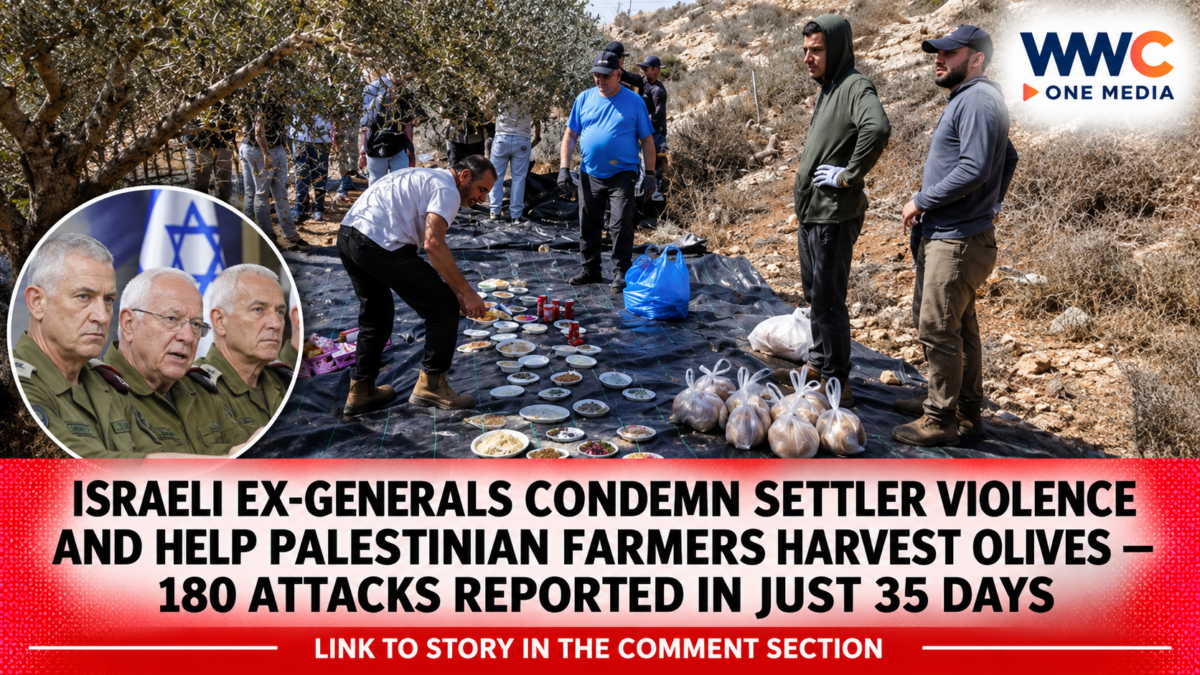
QUSRA, WEST BANK — A group of approximately 30 former senior Israeli military officials, including six generals, has joined Palestinian farmers in harvesting olives in the occupied West Bank, taking a public stand against rising violence by militant Israeli settlers.
The group participated in the harvest near the Palestinian village of Qusra on November 3, offering practical assistance and a visible show of solidarity at a time when Palestinian farmers say attacks and intimidation are making it increasingly difficult to reach their agricultural land.
The initiative was organised by former Israeli Major General Eyal Ben-Reuven, who said he began bringing former military officials together several months ago in response to escalating settler violence.
His comments were particularly striking because the participants were not foreign observers or outside campaigners. They were former members of Israel’s own military establishment, including officers who had held senior positions.
One former officer compared attacks on Palestinian women and children to historical pogroms against Jewish communities. Another described the occupation as a central problem within Israeli society that must be addressed through cooperation with Palestinians.
The intervention also comes amid mounting concern over the safety of Palestinian olive harvesters. Israeli rights group Yesh Din reported 180 physical attacks against Palestinian olive harvesters during the first 35 days of the season.
The latest development has placed renewed attention on the violence, the responsibilities of Israeli security forces and the growing divisions within Israeli society over the future of the West Bank.
Former Israeli Generals Join Palestinian Farmers in Qusra
The group of former military officials travelled to agricultural land near Qusra, where they helped Palestinian landowners collect olives.
The timing was significant. The annual olive harvest is an important agricultural activity for Palestinian communities, providing income for farming families and maintaining their connection to land that has often been affected by restrictions, conflict and violence.
For farmers in areas exposed to settler attacks, reaching olive groves can become a difficult and sometimes dangerous task.
Nimr Nazzal, a Palestinian landowner whose property was being harvested, said that without the presence of the former Israeli military officials, he would have struggled to access his olive trees because of attacks by settlers.
Their participation was intended to provide both practical help and a measure of protection through their presence.
Ben-Reuven said he began organising the group several months earlier as concerns about violence increased. Around 30 former senior military personnel, including six generals, eventually became involved.
The initiative illustrates how some former members of Israel’s security establishment are using their experience and public standing to challenge violence against Palestinian civilians.
Former Major General Compares Attacks to Historical Pogroms
Among the strongest comments came from Eyal Ben-Reuven, who described his reaction to reports of settlers attacking Palestinian women and children.
He said the scenes reminded him of stories told by his parents about the persecution suffered by Jewish people.
His comparison to pogroms was intended to underline the seriousness of attacks against civilians and the contradiction he sees between Jewish historical experiences of persecution and violence directed at Palestinians.
The remarks are particularly notable because they came from a former senior military officer rather than an outside political commentator.
Ben-Reuven’s involvement also suggests that opposition to settler violence is not limited to Palestinian activists or international organisations. Some former Israeli military personnel are publicly challenging the conduct of extremist settlers and calling for greater attention to the treatment of Palestinian communities.
However, the participation of former officers should not be confused with an official change in Israeli military policy. They were acting in a personal and voluntary capacity, and their views do not necessarily represent the position of the current military leadership.
Former Colonel Says Occupation Must Be Addressed
Former Colonel Doron Meinert also criticised the broader situation in the West Bank.
Meinert said that the occupation was a central problem for Israeli society and argued that it could not simply be ignored.
He called for the issue to be addressed together with Palestinians.
His comments reflect a wider debate within Israel over the future of the occupied territory, the expansion of settlements and the consequences of prolonged military control over Palestinian communities.
Meinert has devoted much of his time to volunteering in the West Bank in support of Palestinians.
He also alleged that some Israeli soldiers share the ideological positions of militant settlers, including beliefs that Palestinians should be expelled or treated as second-class residents.
These comments represent Meinert’s assessment and should not be interpreted as proof that all Israeli soldiers hold such views.
The Israeli military has said it represents the full spectrum of Israeli society and has maintained that its role is to provide security and maintain order in the West Bank.
Former Military Officials Also Warn About Israel’s International Reputation
The former officers said their involvement was motivated not only by concern for Palestinian farmers but also by the wider consequences of settler violence for Israel.
Former Brigadier General Jonatan Yoni said the attacks were creating strategic and diplomatic problems for Israel, particularly in its relationships with Western countries and the United States.
The criticism comes as Israel faces continued international scrutiny over its policies in the occupied West Bank.
The former officers also expressed opposition to Israeli annexation of the territory.
Annexation would involve extending Israeli sovereignty over all or part of the West Bank, a move that Palestinians and many international governments oppose because it could further undermine prospects for an independent Palestinian state.
The group believes that violence against Palestinian civilians and the continued conflict over land are damaging Israel’s standing internationally.
Their participation in the olive harvest therefore carried two messages: support for farmers facing difficulties reaching their land and opposition to policies and actions they believe are harming both Palestinians and Israel.
Palestinian Landowner Says Settler Attacks Make Harvesting Difficult
For Palestinian farmers, the issue is not only political. It directly affects their ability to work and earn a living.
Nimr Nazzal said that without the former military officials accompanying them, he would not have been able to access his olive trees because of settler attacks.
He also accused the Israeli military of protecting settlers involved in violence.
His allegation reflects a complaint frequently raised by Palestinian residents and rights organisations: that Israeli forces sometimes fail to intervene quickly enough when settlers attack Palestinian communities, or that their interventions can favour the settlers.
The Israeli military rejects claims that it supports attacks and says it condemns violence while working to maintain security in the territory.
The differing accounts highlight the continuing dispute over how Israeli forces respond when violence occurs between settlers and Palestinians.
For farmers, however, the immediate concern is whether they can reach their land, harvest their crops and return home safely.
The presence of the former officers offered a form of civilian accompaniment at a time when some farmers say they cannot safely work alone.
Rights Group Reports 180 Physical Attacks on Olive Harvesters
The scale of the reported violence has become a major concern during this year’s olive harvest.
Israeli rights group Yesh Din recorded 180 physical attacks against Palestinian olive harvesters during the first 35 days of the season.
The organisation also reported that Israeli military personnel were present in more than 23 per cent of the settler-violence cases it documented.
These figures are based on incidents recorded by the organisation and should be understood within the limits of its monitoring and reporting methodology. They do not necessarily represent every incident across the West Bank.
Nevertheless, the figures point to the security difficulties faced by farmers during a period when access to agricultural land is especially important.
The presence of military personnel in a reported incident does not, by itself, establish that soldiers participated in or supported an attack. It does, however, raise questions about what happened during those encounters, whether intervention occurred and whether authorities adequately protected the people involved.
Palestinians have said that when they contact the military for assistance, officers sometimes arrive late or support settlers involved in the violence.
The military denies these allegations.
Why the Olive Harvest Has Become a Flashpoint
Olive cultivation is deeply connected to Palestinian family life, agricultural income and land ownership.
Many families depend on olive trees for the production of olives and olive oil, while the annual harvest brings relatives and neighbours together to work on land that may have been cultivated for generations.
The harvest season also creates a period when farmers must regularly travel to groves located near settlements, roads and outposts.
In parts of the West Bank, these locations have become flashpoints for confrontations.
When farmers are prevented from reaching their trees or face attacks while harvesting, the consequences can extend beyond a single day’s work. Crops may be lost, income can be reduced and families may struggle to maintain their agricultural livelihoods.
For Palestinians, access to olive groves is also connected to concerns about land control and the possibility of losing access to property over time.
The presence of Israeli volunteers and former military personnel during the harvest has therefore become an important form of accompaniment for some communities.
The former generals’ participation is particularly significant because it brings attention from people who once served within the Israeli military establishment.
The Israeli Military Rejects Claims That It Supports Settler Violence
The allegations about military conduct remain contested.
Palestinian residents and activists have accused Israeli forces of responding inadequately to attacks or intervening in ways that benefit settlers.
Former Colonel Meinert also alleged that some soldiers share the ideological views of militant settlers.
The Israeli military, however, says it condemns violence and operates to maintain security in the West Bank.
It has also previously described itself as an institution representing different views within Israeli society.
It is important to distinguish between the documented presence of military personnel during some incidents, allegations of inadequate protection and claims that soldiers actively support attackers. These are related but different issues, and each requires evidence of its own.
The debate is likely to continue as rights organisations, Palestinian communities, Israeli officials and international observers examine how authorities respond to violence.
West Bank Settlements Remain a Major International Dispute
The incident also takes place against the backdrop of the longstanding dispute over Israeli settlements in the West Bank.
The territory is home to approximately 500,000 Israeli settlers and at least three million Palestinians, according to the figures cited in the reporting.
Most countries and United Nations bodies consider Israeli settlements in occupied territory illegal under international law.
Israel rejects that position and describes the West Bank as disputed territory rather than occupied territory.
The disagreement is central to the wider Israeli-Palestinian conflict.
Palestinians seek the West Bank as part of a future independent state, alongside East Jerusalem and Gaza. Settlement expansion and violence against Palestinian communities are among the issues that have complicated efforts to reach a political agreement.
The former military officials’ criticism of annexation reflects concern that extending Israeli sovereignty over the territory could further deepen the conflict.
Their comments also show that opposition to annexation and settler violence exists among some Israelis who previously served in senior military roles.
What the Former Generals’ Intervention Could Mean
The former officers’ participation does not resolve the wider conflict, nor does it guarantee that Palestinian farmers will be protected after the volunteers leave.
But it brings attention to a specific and recurring problem: the difficulty some Palestinian communities face in accessing their agricultural land during the olive harvest.
Their involvement also challenges the idea that the issue is simply a disagreement between Palestinians and Israelis as two unified groups.
There are divisions within Israeli society over settlement policy, military conduct and the treatment of Palestinians. The former generals’ actions demonstrate that some former members of the military establishment are willing to publicly criticise violence by Israeli settlers.
At the same time, the effectiveness of such initiatives will depend on whether they can help farmers access their land safely beyond isolated visits and whether authorities take meaningful steps to prevent attacks.
The central question remains how Palestinian communities can be protected while the wider political dispute over the West Bank remains unresolved.
The Bottom Line
Approximately 30 former Israeli military officials, including six generals, joined Palestinian farmers in harvesting olives near Qusra in the occupied West Bank on November 3.
Organised by former Major General Eyal Ben-Reuven, the initiative was a public response to rising settler violence and the difficulties Palestinian farmers face when trying to reach their agricultural land.
Former officers condemned attacks against civilians, criticised the broader occupation and warned that settler violence was damaging Israel’s international reputation.
The concerns come as Israeli rights group Yesh Din reports 180 physical attacks against Palestinian olive harvesters during the first 35 days of the season. Palestinians have accused Israeli forces of failing to protect them in some incidents, while the military denies supporting settler violence and says it works to maintain security.
The former officers’ participation is a notable example of internal Israeli criticism, but it does not represent an official military policy change or resolve the broader dispute over settlements and Palestinian land rights.
For the farmers involved, the immediate priority remains being able to reach their olive trees and complete the harvest without facing violence.
Will the involvement of former Israeli military leaders encourage stronger action against settler violence, or will Palestinian farmers continue to face the same risks when the next harvest season arrives?