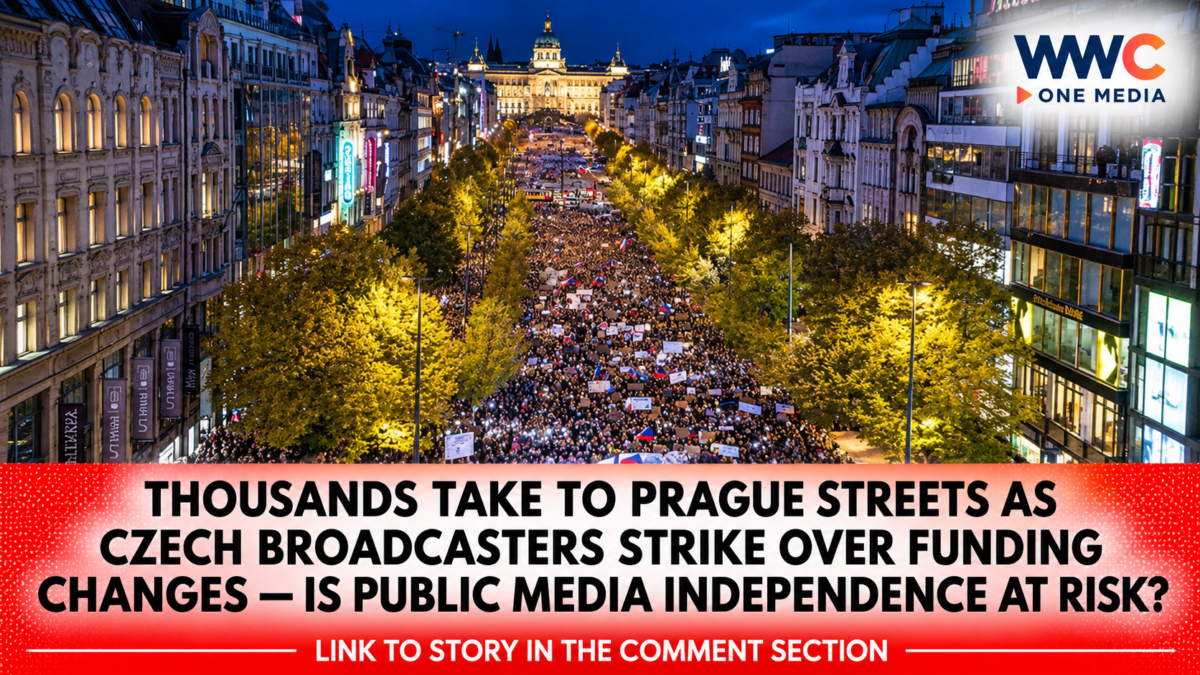
PRAGUE, Czech Republic — Thousands of people took to the streets of Prague and other Czech cities on November 3 as employees of the country’s public television and radio broadcasters staged a one-day strike against a proposed government funding overhaul that has triggered growing concerns about press freedom and editorial independence.
The demonstrations brought together students, artists, journalists, university representatives, labour unions and other supporters who fear that moving public broadcasting funds directly into the state budget could expose news organisations to greater political pressure.
At the centre of the dispute is a proposal by Prime Minister Andrej Babiš’s government to abolish the existing monthly household broadcasting fee of 205 Czech crowns, approximately US$9.43, and replace it with direct state-budget financing.
Critics say the proposed arrangement would also reduce the broadcasters’ available funding by approximately 15%, potentially forcing staff reductions, fewer programmes and cuts to regional and investigative journalism.
The government rejects accusations that it intends to control public media. Babiš says the reform is designed to reduce the financial burden on households and improve the broadcasters’ financial arrangements.
But the November 3 strike has turned the disagreement into a major public debate about who should finance public broadcasting, how its independence should be protected and whether government-controlled budget allocations could influence journalism.
With the legislation still moving through parliament, the confrontation is far from over.
Thousands Rally in Prague as Broadcasters Stage One-Day Strike
The protests took place on Tuesday, November 3, with thousands of demonstrators gathering in Prague and other Czech cities.
Public television and radio employees marched from the Czech Television headquarters towards Wenceslas Square, where they were joined by students and other supporters.
The demonstration was part of a wider mobilisation against the government’s proposed changes to the public broadcasting financing system.
Participants called on lawmakers to withdraw the legislation and demanded a transparent debate involving broadcasters, journalists and the public.
Students also joined the demonstrations, expressing concern about the future of independent journalism and the public’s access to reliable information.
One protester, 23-year-old student Alena Jechova, told Reuters that she wanted the media to remain free.
The demonstrations were not limited to media employees. Support also came from labour unions, university leaders, churches, artists, athletes and international journalism organisations.
The scale of participation reflected growing concern that the proposed funding changes could affect more than the broadcasters’ operating budgets.
For critics, the issue concerns the relationship between government institutions and the organisations responsible for reporting on those institutions.
What Happened Inside Czech Television and Czech Radio During the Strike?
The industrial action affected normal broadcasting operations, giving viewers and listeners an unusual look at what reduced public-service programming could mean.
Czech Television’s 24-hour news channel displayed a darkened newsroom, while presenters dressed in black delivered reports using scripts.
Instead of its usual programming, the broadcaster relied on shorter news bulletins and archived material.
The restrictions were intended to demonstrate the potential consequences of financial pressure on public broadcasting.
The Associated Press also reported that Czech Radio replaced some regular programming with music, recorded material, brief explanations and a minute of silence.
The strike affected different parts of the broadcasters’ operations, including news and current-affairs programming.
However, the action was limited to one day. It should not be confused with a permanent shutdown of Czech Television or Czech Radio.
The broadcasters’ employees were using industrial action to communicate their concerns about the proposed legislation and the future of their institutions.
The 205-Crown Broadcasting Fee at the Centre of the Dispute
The most significant proposed change involves the way Czech public broadcasters receive their money.
Under the existing system, households and businesses contribute through broadcasting fees that help finance Czech Television and Czech Radio.
The government wants to abolish the monthly household fee of 205 crowns, equivalent to approximately US$9.43, and replace the existing arrangement with direct funding from the state budget.
The proposed change is part of Babiš’s coalition government’s effort to restructure public broadcasting finances.
For households currently paying the fee, the government argues that removing the charge would reduce their financial obligations.
Babiš has repeatedly defended the proposal as a way to fulfil a promise to ease the public’s financial burden.
However, critics argue that the source of funding matters because it determines how independent public broadcasters can remain from political decision-makers.
Under the current arrangement, broadcasting fees create a funding relationship between the public and the broadcasters. Under the proposed system, the institutions would depend more directly on allocations determined through the national budget.
That change has raised concerns about whether future governments could use funding decisions to reward or punish broadcasters.
Proposed 15% Funding Reduction Raises Alarm
Beyond replacing the broadcasting fee, the legislation is expected to reduce the broadcasters’ available funding by approximately 15%, according to estimates cited by media organisations and international journalism groups.
The proposed reduction could have significant consequences for both institutions.
Reuters reported that the proposed changes would bring Czech Television’s nominal budget down to a level last seen in 2008 and Czech Radio’s to a level comparable to 2005.
Critics say the reduction could force broadcasters to reconsider their staffing levels, programming schedules and regional coverage.
Potential consequences include:
- Staff reductions: Both broadcasters could face pressure to reduce employment costs.
- Fewer original programmes: Some television and radio productions could be cancelled or scaled back.
- Reduced regional reporting: Local journalism and coverage outside major cities could become more difficult to maintain.
- Pressure on investigative journalism: Expensive and time-consuming reporting projects could face tighter budgets.
- Limited digital development: Investment in online services and new formats could be affected.
These are projected risks rather than confirmed outcomes. The proposed cuts have not yet been implemented, and the final funding arrangements could change during parliamentary consideration.
Nevertheless, the estimated reduction has become one of the strongest arguments used by opponents of the reform.
Prime Minister Andrej Babiš Rejects Claims of Political Takeover
Babiš has rejected accusations that his government wants to take control of Czech public television and radio.
The prime minister says the reform is intended to ease the financial burden on households and improve how public broadcasters manage their resources.
He has argued that the government does not intend to interfere with editorial decisions or nationalise the broadcasters.
Babiš also indicated that changes could still be made to the bill during further parliamentary debate.
His position is that changing the funding mechanism does not automatically mean changing the broadcasters’ editorial independence.
The government maintains that public broadcasters should operate efficiently while continuing to fulfil their responsibilities to the public.
However, critics argue that legal assurances about editorial independence are not enough if the institutions become financially dependent on annual government budget decisions.
The dispute therefore centres on whether the proposed safeguards would be strong enough to prevent political pressure.
Why Journalists Fear the Funding Change Could Affect Editorial Independence
Public broadcasters play a different role from privately owned television and radio networks.
Their responsibility is to provide information and programming that serve the public interest, including news, educational content, cultural programmes and regional reporting.
They are expected to cover government decisions, parliamentary debates and public controversies without simply representing the interests of the administration in power.
Critics of the Czech proposal argue that direct state-budget financing could create opportunities for political influence.
If future funding depends heavily on decisions made by politicians, broadcasters may face pressure when negotiating budgets or defending their operating costs.
Journalists fear that financial uncertainty could affect editorial decisions even without direct censorship.
A broadcaster facing the possibility of future budget cuts may become more cautious about investigations involving influential political figures or government policies.
This is a risk raised by journalists and media organisations, not proof that the Czech government has already interfered with editorial content.
The distinction is important because the legislation has not yet been fully adopted.
Nevertheless, the debate highlights why funding stability is considered an essential part of public-service media independence.
Opposition Parties Compare the Proposal With Hungary and Slovakia
The Czech funding controversy has also attracted comparisons with media reforms in neighbouring European countries.
Opposition parties have compared the proposed changes with developments in Hungary under former prime minister Viktor Orbán.
Critics argue that weakening public broadcasters financially can be one way of reducing their ability to operate independently.
They have also pointed to Slovakia, where changes to the country’s public broadcasting system have raised concerns among journalists and international media organisations.
These comparisons are political arguments made by critics. They do not establish that the Czech government will necessarily follow the same path.
However, the experiences of neighbouring countries have become part of the debate because they illustrate how changes to public broadcasting structures can affect media independence.
The Czech government’s position remains that the proposed funding reform is about financial efficiency and household costs, not political control.
A Controversial Overnight Parliamentary Vote Intensified the Backlash
The November 3 strike followed an earlier parliamentary confrontation that helped fuel public anger.
On October 23, the governing coalition unexpectedly brought forward the legislation in the Chamber of Deputies.
The bill passed its first reading at approximately 4:36 a.m. on October 24 following an overnight parliamentary session.
Opposition lawmakers criticised the speed of the proceedings, arguing that the government had restricted meaningful debate on a major change to the public broadcasting system.
The early-morning vote also became a symbol of the controversy.
During demonstrations in Prague on October 25, protesters chanted slogans including references to 4:36, highlighting their frustration with the way the legislation had been advanced.
The bill was sent for further parliamentary consideration, meaning the first-reading vote did not make the proposed changes law.
The parliamentary process remains important because lawmakers still have opportunities to examine, amend or challenge the proposed provisions.
International Media Organisations Warn About the Consequences
The controversy has drawn attention from international organisations representing journalists and media institutions.
The European Federation of Journalists, International Federation of Journalists, Reporters Without Borders and other organisations have expressed concern about the proposed funding model.
Their central argument is that public-service media require adequate, sustainable and predictable financing to protect editorial and functional independence.
A joint statement reported by the International Federation of Journalists on November 2 said the proposed changes could make both Czech broadcasters more directly dependent on the state budget while reducing their funding by approximately 15%.
The organisations warned that budget decisions could become a source of political pressure if adequate safeguards were not established.
They have called on Czech authorities to reconsider provisions that could weaken the broadcasters’ financial independence.
The European Broadcasting Union has also raised concerns about the direction of the proposed reforms, arguing that any funding changes should involve transparency, broad consultation and compliance with European media-freedom standards.
These organisations are not claiming that every state-funded public broadcaster is automatically politically controlled. Their concern is whether the Czech proposal provides enough protection against potential interference.
European Commission Is Assessing the Czech Government’s Response
The dispute has also attracted attention from the European Commission.
On November 3, the Commission confirmed that it had received a response from Czech authorities concerning the proposed public broadcasting funding reform.
Commission spokesperson Markus Lammert said the response was being assessed and that Brussels was following developments closely.
However, the Commission had not announced a finding that the proposed reform violated European Union law.
It had also not announced that infringement proceedings had been opened.
This distinction matters because the legislation remains under consideration and the EU review is not a final legal judgment.
European media-freedom standards require public-service broadcasters to have adequate, sustainable and predictable funding, with transparent arrangements that protect their independence.
The Commission’s assessment could therefore become an important part of the wider debate over whether the proposed Czech system meets those standards.
Why Public Broadcasting Matters Beyond Czech Television and Radio
The dispute in the Czech Republic reflects a broader international debate about how governments should finance public media without compromising editorial independence.
Public broadcasters can provide services that commercial media organisations may not always prioritise, including extensive regional reporting, educational programmes, cultural coverage and emergency information.
They can also serve as important sources of news during elections, national emergencies and major public controversies.
However, public broadcasters need reliable financing to maintain these services.
The challenge is to create a system that ensures public accountability without allowing politicians to use funding decisions as a means of influencing editorial coverage.
WWC One Media has previously examined concerns about government proposals that could affect freedom of expression and the work of journalists in the Philippines.
In September 2026, media and legal experts in Cebu warned that vague provisions in a proposed Anti-False Information Bill could create risks for press freedom and legitimate expression.
Read more: Experts Warn Anti-False Information Bill Could Threaten Press Freedom and Free Speech.
Another WWC One Media report examined renewed calls by the National Union of Journalists of the Philippines and human rights lawyers to decriminalise libel, with advocates warning that criminal penalties could discourage public-interest reporting.
Read more: NUJP, CenterLaw Renew Push to Decriminalize Libel, Warn of Chilling Effect on Press Freedom.
Although the Czech and Philippine legal systems are different, both debates raise questions about how governments can regulate or finance media without undermining journalists’ ability to report independently.
Europe Is Seeing Wider Public Frustration With Political Decisions
The Prague demonstrations also come amid a wider period of public protest across Europe.
In recent weeks, young people and other demonstrators have taken to the streets in several European countries over concerns involving living costs, public services, employment and political accountability.
WWC One Media previously reported on youth-led demonstrations across France, Italy, Belgium, Portugal, Spain and Albania, where protesters raised different national concerns but shared frustrations about economic opportunities and political representation.
Read more: Europe’s Young Generation Is Fighting Back—But Will Its Anger Force Leaders to Listen?.
The protests in the Czech Republic have a distinct focus: the future of public broadcasting and the independence of journalism.
Another WWC One Media report covered demonstrations and civil unrest in France, where public frustration over living costs and public services contributed to widespread protests.
These events are not part of one coordinated European movement. Their causes and demands differ. However, they illustrate how public dissatisfaction can develop into large demonstrations when citizens believe important institutions or public services are at risk.
What Happens Next? The Bill Still Faces Further Parliamentary Debate
Despite the strike and demonstrations, the proposed funding reform has not been finally approved.
The bill passed its first reading in the Chamber of Deputies in October and remains subject to further parliamentary consideration.
Lawmakers could still debate its provisions, consider amendments and examine concerns raised by broadcasters and media organisations.
The government has indicated that changes could be made during the legislative process.
A further rally has also been announced for November 15 at Letná Park in Prague, shortly before the anniversary of the 1989 Velvet Revolution.
The planned demonstration could provide another opportunity for citizens, journalists and civic organisations to express their views on the future of public broadcasting.
For Czech Television and Czech Radio employees, the coming weeks could determine whether the government revises its proposal or continues with the planned funding overhaul.
For the public, the outcome could shape the future of two of the country’s most important news institutions.
The Bottom Line
Thousands of people have protested across the Czech Republic as public television and radio employees challenge a government proposal that would replace the existing broadcasting fee with direct state-budget funding.
The proposed change would abolish the 205-crown monthly household fee and is estimated to reduce the broadcasters’ available funding by approximately 15%.
The government of Prime Minister Andrej Babiš says the reform will reduce household costs and improve financial efficiency. It denies that the proposal is intended to bring public media under political control.
Journalists, opposition parties and international media organisations, however, warn that the new funding arrangement could expose broadcasters to political pressure and weaken their ability to operate independently.
The November 3 strike brought those concerns into the streets, with thousands of supporters joining employees in Prague and other cities while television and radio programming was restricted.
The European Commission is assessing the Czech government’s response, but it has not announced a finding that the proposal violates EU law.
Most importantly, the bill has not yet become law. Further parliamentary debate and possible amendments could still change its final form.
The dispute is no longer simply about whether households should pay a broadcasting fee. It is about how a country can finance public journalism while ensuring that the organisations reporting on those in power remain independent of political influence.
Will the Czech government revise its funding proposal after the nationwide protests, or could the battle over public broadcasting become one of Europe’s biggest media-freedom disputes of 2026?