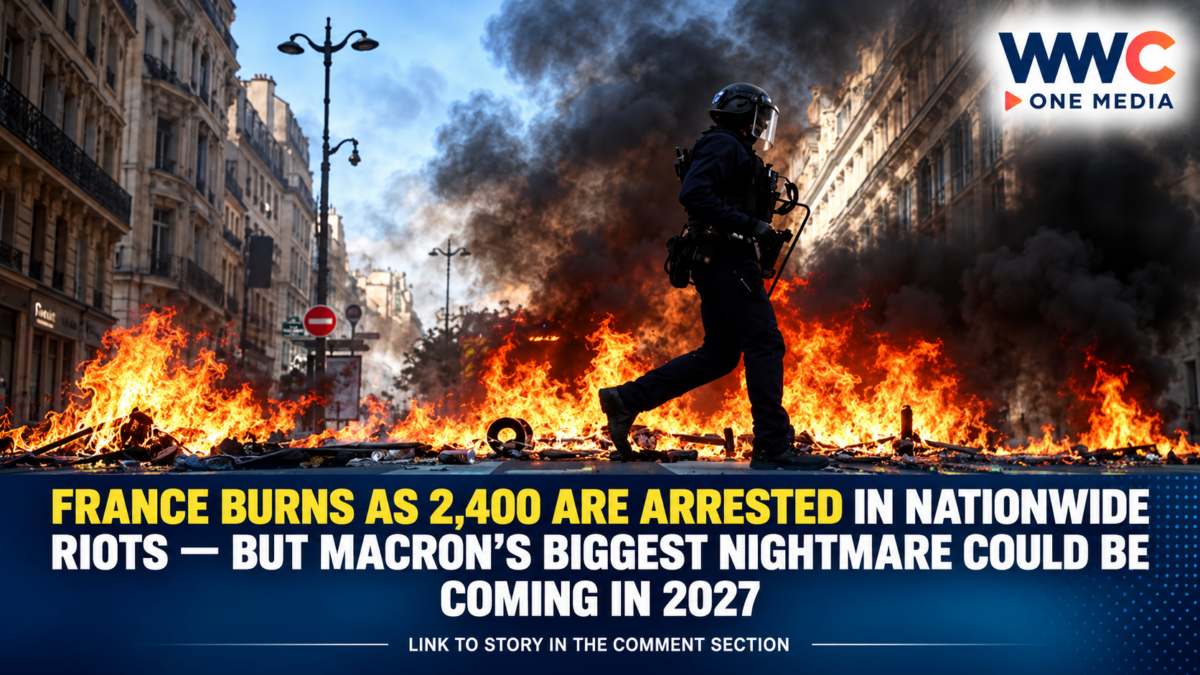
PARIS, France — France is confronting one of its worst waves of civil unrest in years after protests over soaring living costs, worsening public services and frustrations with President Emmanuel Macron escalated into widespread rioting, looting and violent clashes with police.
More than 2,400 people were arrested during the weekend unrest, according to reporting by Reuters and the Associated Press, while nearly 1,000 police officers were injured and businesses across the country suffered extensive damage.
What began as demonstrations over education, wages and economic hardship has developed into a nationwide political crisis, raising questions about Macron’s ability to maintain public order and restore confidence in his government just months before France’s 2027 presidential election.
The upheaval has exposed deeper tensions inside one of Europe’s largest economies — and a growing divide between citizens who believe they pay too much in taxes and a government struggling to finance the public services they expect.
Paris Streets Turn Into Scenes of Chaos
Paris, a global symbol of culture, tourism and European prosperity, witnessed scenes of destruction as demonstrators clashed with security forces and groups of rioters vandalized storefronts, erected barricades and looted businesses.
Police in riot gear patrolled damaged streets following the October 17–18 violence, while shopkeepers and residents began cleaning up shattered glass, burned debris and damaged property.
According to Reuters, more than 2,400 people were detained nationwide as the unrest spread beyond Paris to cities including Marseille and Lyon.
The violence also reached Limoges, where a major fire severely damaged the city’s town hall, becoming one of the most striking symbols of the disorder.
Authorities have blamed radical activists and criminal groups for exploiting demonstrations that initially centered on legitimate social and economic grievances.
However, the unrest cannot be explained by vandalism alone.
It reflects growing public dissatisfaction with wages, living standards, education funding and the government’s handling of mounting economic pressure.
Why Are French Citizens Protesting?
France’s latest unrest has several overlapping causes.
Students and education workers have protested deteriorating school conditions, staffing shortages and concerns about access to quality education.
Their demonstrations gradually intersected with broader discontent over fuel costs, inflation, household expenses and government spending priorities.
Trade unions, workers, retirees and supporters of the Yellow Vest movement have also participated in protests, creating a diverse coalition of groups with different demands.
The original Yellow Vest demonstrations, which began in 2018 over fuel taxes, became a national movement against economic inequality and Macron’s leadership.
Nearly eight years later, many of the underlying frustrations remain unresolved.
A Bloomberg Opinion commentary published by Channel News Asia on October 20 highlighted estimates suggesting that French households, on average, believe they need approximately €500 more each month to cover their expenses comfortably.
The commentary also cited figures showing that median wages have struggled to keep pace with cumulative inflation since 2017.
For many households, the problem is not simply the price of fuel or groceries. It is the growing perception that working harder no longer guarantees financial security.
France Spends Heavily — So Why Are People Still Angry?
One of the most striking contradictions in the French crisis is the scale of government spending.
France has an extensive welfare state, with significant public funding directed toward pensions, healthcare, education and social protection.
Yet public frustration remains widespread.
Bloomberg Opinion columnist Lionel Laurent argues that the problem is partly how public spending is distributed, rather than simply how much the government spends.
His analysis points to the growing weight of pension commitments compared with funding for education, public services and opportunities for younger workers.
The commentary cited estimates indicating that pension expenditure has increased dramatically as a share of France’s economy over the past five decades.
At the same time, the government faces rising borrowing costs, high public debt and limited room to introduce expensive relief measures.
This creates a difficult political equation: citizens are demanding better services and stronger purchasing power, while policymakers face increasing pressure to control spending.
The result is a widening conflict over who should bear the cost of France’s economic challenges.
Macron Faces Growing Pressure as Government Admits Failures
President Emmanuel Macron has condemned the violence while acknowledging the grievances underlying the demonstrations.
His government has faced criticism over its inability to anticipate the scale of the disorder and prevent peaceful protests from deteriorating into widespread unrest.
Interior Minister Laurent Nuñez offered to resign amid scrutiny of the police response, but Macron declined to accept his departure.
The administration has instead moved toward stronger security measures, including increased police deployments, restrictions on gatherings and localized curfews.
In Paris, authorities imposed an overnight curfew in the Place de la République and Les Halles areas, alongside wider restrictions on evening gatherings.
The measures are intended to prevent further violence, but they also illustrate the difficult balance between protecting public safety and preserving the right to peaceful protest.
For Macron, who cannot seek a third consecutive presidential term in 2027, the crisis threatens to dominate the remaining months of his presidency.
Could the Unrest Reshape France’s 2027 Presidential Election?
The political consequences could be significant.
The unrest has provided ammunition to opposition figures who argue that the government has lost control of public safety and failed to protect living standards.
Marine Le Pen and the far-right National Rally have sought to capitalize on concerns over crime, insecurity and economic dissatisfaction.
On the left, Jean-Luc Mélenchon and his political allies continue to challenge the government’s economic agenda and treatment of protesters.
Other political figures, including centre-left leader Raphaël Glucksmann, are positioning themselves as alternatives in an increasingly fragmented political landscape.
However, no party has demonstrated that it possesses an easy solution to France’s combination of high public debt, rising social demands and political polarization.
The presidential election in 2027 could become a referendum not only on Macron’s legacy but also on the future direction of France’s economic and social model.
Is Paris Still Safe for Tourists?
The violence has also raised concerns about safety in Paris, one of the world’s most visited cities.
While unrest has damaged businesses and disrupted activity in parts of the capital, the violence does not mean every Paris neighborhood is experiencing the same conditions.
The greatest immediate risks are concentrated around active demonstrations, police operations and areas where public gatherings have been restricted.
Travelers should check official advisories, local transport updates and police announcements before visiting affected locations.
The larger concern is whether repeated disruptions could damage France’s international reputation and discourage tourism, investment and business activity if instability continues.
France’s Crisis Reflects a Wider European Problem
France is not alone in experiencing public anger over the cost of living.
Demonstrations in countries including Italy, Spain and Portugal have highlighted concerns about housing affordability, inflation, wages and government spending.
Although the causes and intensity of protests differ by country, the broader pattern illustrates a growing political challenge across Europe.
Governments are under pressure to protect living standards while facing fiscal constraints, slower growth and economic uncertainty.
For France, the immediate priority is restoring public order.
The longer-term challenge is rebuilding trust between citizens and political institutions.
The bigger question is whether France’s leaders can address the economic frustrations driving the unrest before the country enters an even more divisive presidential campaign.
As damaged streets are repaired and businesses reopen, the underlying grievances remain.
And unless those grievances are addressed, France could face further demonstrations long after the latest barricades have disappeared.