
BANGKOK, Thailand — An oil leak at a data centre in Bangkok’s Rama 9 area has triggered environmental concerns and intensified scrutiny over the rapid growth of energy-intensive facilities in urban communities.
Authorities found oil-contaminated wastewater and sediment inside and outside the DAMAC Digital Thailand BKK 01 data centre after residents and nearby businesses complained of a strong oil-like smell.
The discovery raised fears that contaminated wastewater could enter the public drainage system and eventually reach nearby waterways.
Thailand’s Pollution Control Department and local authorities have since moved to contain the contamination, ordering the treatment and removal of affected wastewater and sediment while continuing environmental monitoring.
Residents Raise Alarm Over Oil-Like Smell
The investigation began after residents in the Rama 9 area reported a persistent smell resembling oil near the facility.
Some complaints also described irritation and discomfort associated with the odour, prompting authorities to inspect the data centre and surrounding drainage system.
Officials found oil residue and an oily smell in the facility’s wastewater system, as well as contamination in a public drain outside the premises.
Samples were collected for laboratory testing, while the operator was ordered to address the drainage problem and introduce measures to prevent further contamination.
The incident quickly became more than a local environmental complaint.
It also raised broader questions about how rapidly expanding data centres are regulated when they are built close to residential and commercial areas.
Emergency Work Begins to Contain the Contamination
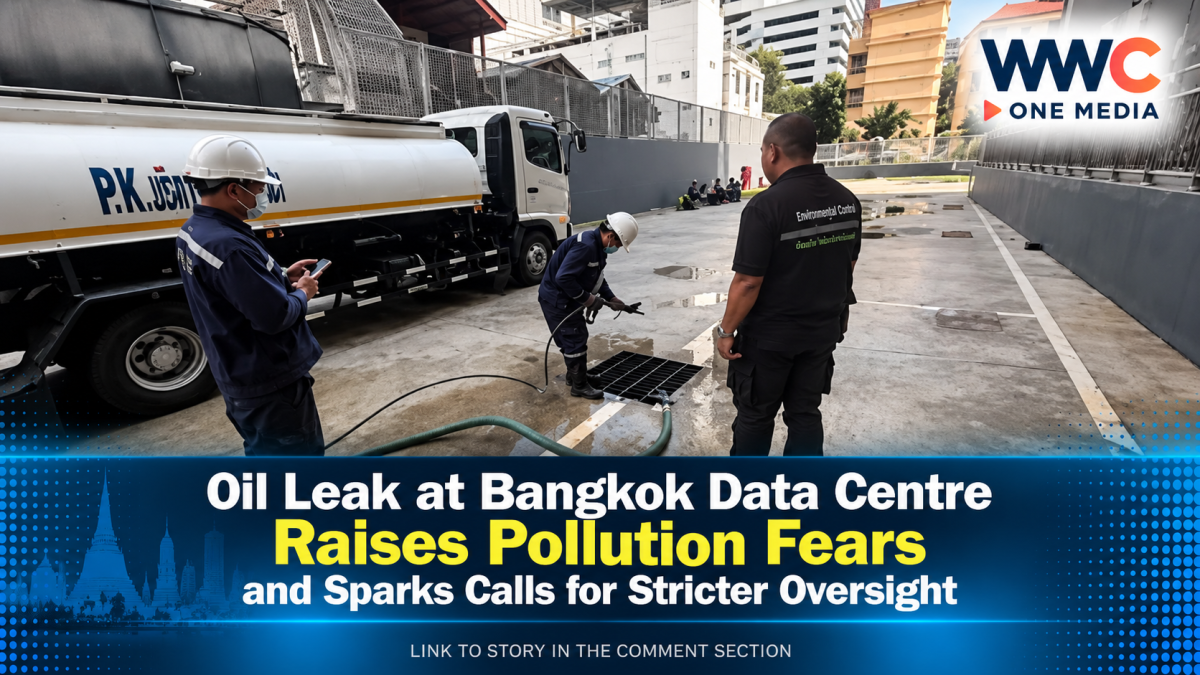
Authorities and contractors have begun removing contaminated wastewater and sediment from the site.
Sandbags were installed to isolate affected areas and prevent contaminated water from spreading through the drainage network.
Officials said oil-removal measures were being used before wastewater was pumped into trucks and transported for proper treatment and disposal.
Similar containment work was carried out outside the data centre to prevent contaminated material from entering the wider drainage system.
Authorities said wastewater produced during the clean-up process would be collected and treated rather than released into the environment.
Environmental officials are expected to conduct further tests after the clean-up to determine whether contamination remains.
Fears Grow Over Nearby Waterways
One of the main concerns is the possibility that oil-contaminated water could spread beyond the facility.
Thailand’s Pollution Control Department has been monitoring the connection between the data centre’s drainage system and public drains to prevent contamination from reaching nearby waterways.
The risk has made containment a priority.
Oil and fuel contamination can affect water quality and create environmental problems if allowed to enter drainage systems, canals or other bodies of water.
Officials have therefore focused on removing contaminated sediment and wastewater before it can spread further.
More Than 200,000 Litres of Diesel Under Scrutiny
The investigation has also drawn attention to the large amount of diesel reportedly stored at the facility for backup generators.
Energy authorities found that the site had stored more than 200,000 litres of diesel, according to recent reports.
The Department of Energy Business said the fuel storage had not received the required authorization and ordered the diesel removed from the site.
The reported fuel volume has raised concerns about the safety requirements applied to large data centres, particularly those located in densely populated urban areas.
Data centres depend on uninterrupted electricity to keep servers and digital services operating, making backup generators and fuel reserves a critical part of their infrastructure.
However, the Bangkok incident has highlighted the environmental and safety risks that can arise when large volumes of fuel are stored close to communities.
Data Centre Was Reportedly Undergoing Testing
Reports indicate the facility was not yet fully operational and was undergoing testing when the contamination issue emerged.
Initial inspections linked the problem to fuel-related activity involving backup systems, although authorities have continued investigating the exact circumstances and environmental impact.
The incident comes as Thailand experiences rapid growth in data-centre investment, driven by expanding demand for cloud computing and artificial intelligence infrastructure.
But the speed of that growth is also creating new regulatory challenges.
Authorities must now consider not only the economic benefits of attracting major technology investment, but also the impact on communities, electricity supplies, water resources, land use and public safety.
Thailand Tightens Scrutiny of Data Centres
The Rama 9 incident has emerged at a time when Thai authorities are already reviewing how data centres are regulated.
Recent reports said Bangkok and other authorities have paused or subjected planned data-centre projects to additional scrutiny while developing tighter rules covering fuel storage, safety, water and electricity consumption and land use.
The issue has become increasingly urgent because some data centres were previously classified under categories that did not necessarily trigger the same level of environmental and safety oversight applied to industrial facilities.
Officials are now examining whether existing regulations are sufficient for facilities that may store large amounts of diesel and consume enormous quantities of electricity and water.
A Warning for Thailand’s AI and Data Centre Boom
Thailand has positioned itself as an increasingly important destination for data-centre investment.
The expansion could bring jobs, infrastructure development and new opportunities linked to artificial intelligence and digital services.
But the oil contamination incident is a reminder that digital infrastructure also has a physical footprint.
Behind every cloud service and AI system are buildings filled with servers, cooling equipment, power systems and emergency generators.
Those facilities require land.
They require electricity.
They may require large amounts of water.
And, in some cases, they store significant quantities of fuel.
For communities living nearby, the question is becoming increasingly important:
Are regulations keeping pace with the technology boom?
Clean-Up Continues as Authorities Monitor the Site
For now, officials are focused on ensuring that contaminated wastewater and sediment are safely removed and that the drainage system is properly cleaned.
Further environmental tests are expected to examine the site and nearby drainage areas after the clean-up is completed.
Authorities will also continue monitoring the facility to determine whether additional corrective action is needed.
The outcome of the investigation could have implications beyond one data centre.
As Thailand pushes to become a major regional hub for cloud computing and artificial intelligence, the Rama 9 incident may become an important test of whether the country’s environmental and safety regulations can keep pace with the industry’s rapid expansion.
The data-centre boom is powering Thailand’s digital future. But after oil contamination triggered alarm in one Bangkok community, authorities are facing a growing challenge: ensuring that the race to build the infrastructure of tomorrow does not create environmental risks for the people living next door.
WWC ONE MEDIA J.M.D




Leave a Reply