
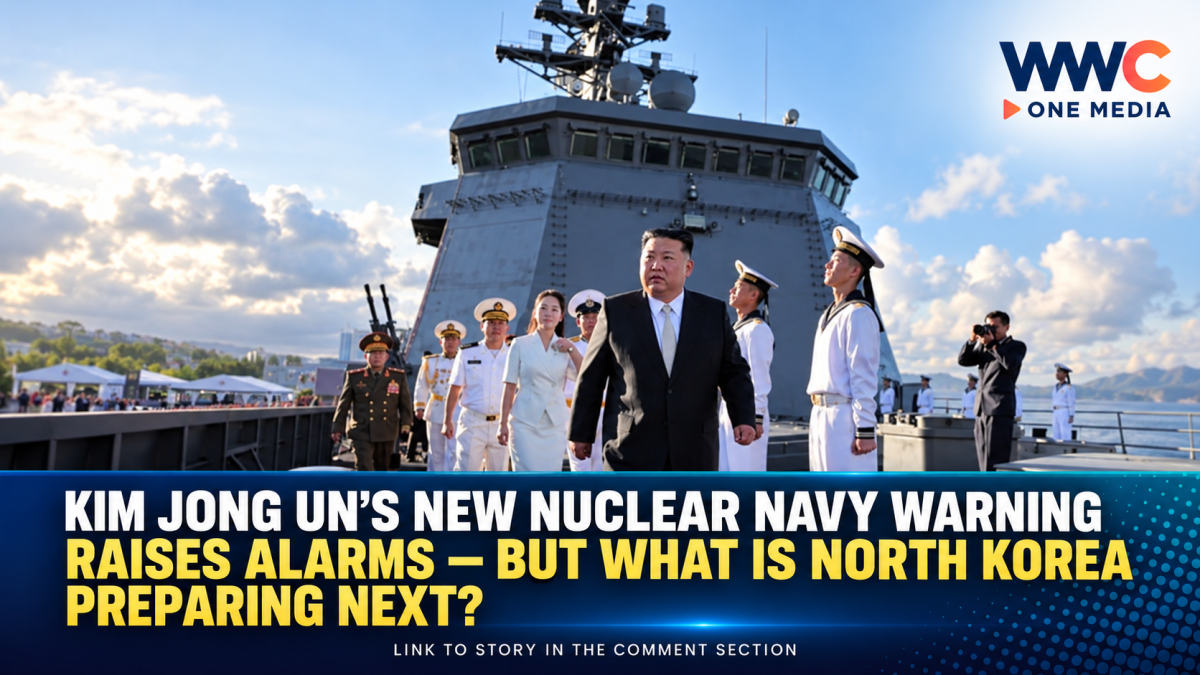
SEOUL — North Korean leader Kim Jong Un has vowed to transform his country’s navy into a nuclear-armed force, escalating tensions on the Korean Peninsula as the United States, South Korea and Japan launch fresh trilateral military drills.
Kim made the remarks while commissioning the Kang Kon, a new 5,000-ton-class destroyer that North Korea says will play a role in strengthening the country’s nuclear deterrence and maritime combat capabilities.
The development marks one of Pyongyang’s strongest recent signals that its expanding nuclear strategy is no longer focused solely on land-based missiles.
According to North Korean state media, Kim attended the commissioning ceremony in the eastern port city of Wonsan on Sunday, accompanied by his daughter, Kim Ju Ae. The event was reported on September 7, 2026.
Kim Pushes for a Nuclear-Armed Navy
Kim said North Korea must develop a naval force capable of operating nuclear combat systems effectively in real warfare, according to state media reports.
The statement suggests Pyongyang is seeking to expand its nuclear deterrent beyond its existing ballistic missile and submarine programs and into its growing surface fleet.
Reuters reported that Kim said the newly commissioned destroyer would become part of North Korea’s broader state nuclear response system, designed to provide powerful retaliatory capabilities against perceived enemies.
Military analysts believe the Kang Kon and similar warships could eventually be equipped with advanced cruise missiles capable of carrying nuclear warheads, although the full operational capabilities of the vessel remain unclear.
That distinction is important: North Korea’s declaration that it intends to build a nuclear-armed navy does not independently confirm that every new warship is already carrying operational nuclear weapons.
The Kang Kon: North Korea’s Second Major New Destroyer
The Kang Kon is North Korea’s second known 5,000-ton-class destroyer to enter service, following the Choe Hyon-class vessel unveiled earlier.
The warship’s commissioning also carries additional symbolism.
The Kang Kon was involved in an embarrassing accident during its initial launch in May 2025, when it partially capsized. Its eventual commissioning now allows Kim’s government to present the vessel as evidence of North Korea’s continued military modernization despite technical setbacks.
Associated Press reported that the destroyers are among the most sophisticated surface warships in North Korea’s fleet and could potentially carry both conventional and nuclear-capable weapons. The report also said analysts have raised questions about possible Russian assistance in North Korea’s naval modernization, though the extent of any such support remains difficult to independently verify.
US, South Korea and Japan Begin Freedom Edge Drills
Kim’s announcement came as the United States, South Korea and Japan began the latest Freedom Edge military exercise.
The trilateral drills were established in 2023 and are designed to improve coordination among the three allies against North Korea’s growing missile, nuclear and other military threats. The exercises have become a major source of tension with Pyongyang, which routinely condemns joint US-allied military drills as rehearsals for invasion.
Washington, Seoul and Tokyo reject that characterization and describe their exercises as defensive.
The timing of Kim’s announcement appears designed to reinforce North Korea’s message that it will continue expanding its military capabilities in response to what it sees as growing pressure from the US-led alliance network.
A Bigger Naval Build-Up Could Be Coming
Perhaps the most significant part of Kim’s latest announcement is what could come next.
Reuters reported that Kim indicated North Korea plans to continue developing new classes of warships and expand naval infrastructure, including bases along its east coast. He also hinted at another significant naval development within the coming months.
AP similarly reported that Kim has signaled continued expansion of North Korea’s naval capabilities, including ambitions tied to more advanced warships and potentially a nuclear-powered submarine program.
If those plans materialize, North Korea’s military strategy could undergo a significant shift.
For decades, Pyongyang’s most visible strategic threat has come from its ballistic missile arsenal. A stronger blue-water navy equipped with long-range missiles could give North Korea additional launch platforms and make its military capabilities more difficult for regional adversaries to track.
Kim’s Nuclear Strategy Is Moving Beyond Missiles
North Korea already possesses a wide range of ballistic and cruise missile systems, and Kim has repeatedly called for the development of more sophisticated military platforms.
The latest destroyer commissioning suggests Pyongyang wants to integrate those weapons into a broader multi-domain nuclear deterrence strategy involving:
- Land-based ballistic missiles
- Cruise missile systems
- Submarine-based weapons
- Advanced surface warships
- Potential nuclear-powered submarines
- Expanded naval bases and maritime infrastructure
The challenge for outside governments is determining how quickly North Korea can turn those ambitions into fully operational capabilities.
North Korean state media claims about new weapons systems are difficult to independently verify, and analysts continue to debate the reliability, survivability and nuclear integration of some of the country’s newest platforms.
Why Kim’s Daughter’s Appearance Matters
Kim Ju Ae’s presence at the ceremony also drew attention.
She has increasingly appeared alongside Kim Jong Un at major military and strategic events, fueling continued speculation among outside analysts about her possible future role in North Korea’s leadership.
Reuters reported that her prominent appearance at the destroyer commissioning added to speculation surrounding succession, although North Korea has not publicly identified an official successor to Kim Jong Un.
The combination of a major new warship, nuclear rhetoric and Kim Ju Ae’s appearance made the ceremony about more than naval modernization.
It was also a powerful display of political continuity.
Diplomatic Tensions Continue
The latest military developments come amid renewed uncertainty over possible diplomacy between Washington and Pyongyang.
North Korea recently rejected efforts aimed at reducing tensions surrounding joint military exercises. AP reported in August that Pyongyang responded to a scaled-back US-South Korean drill with a barrage of short-range ballistic missile launches, highlighting the deep distrust that continues to surround diplomatic efforts.
Meanwhile, Reuters reported that US President Donald Trump said in August that he planned to meet Kim Jong Un later in 2026, although there has been no confirmed agreement from North Korea on a new summit.
That leaves the region facing two competing trends: talk of possible diplomacy on one side, and accelerating military modernization on the other.
What Happens Next?
Kim Jong Un’s latest declaration does not necessarily mean North Korea suddenly has a fully operational fleet of nuclear-armed warships.
But it does send a clear strategic message.
North Korea is trying to make its nuclear deterrent more mobile, more diverse and potentially harder to neutralize.
The commissioning of the Kang Kon gives Pyongyang another major surface combatant. Its pledge to build a nuclear-armed navy suggests that even larger ambitions may be ahead.
And with US, South Korean and Japanese forces strengthening their military cooperation at the same time, the waters around the Korean Peninsula could become an increasingly important front in one of Asia’s most dangerous geopolitical rivalries.
The biggest question now is not simply what weapons the Kang Kon already carries — but what North Korea plans to put to sea next.
WWC ONE MEDIA J.M.S




Leave a Reply