BORONGAN CITY, EASTERN SAMAR — Thirteen years after Super Typhoon Yolanda devastated communities across Eastern Visayas, the Catholic Church in Eastern Samar is sounding a new environmental alarm: Protect the forests, defend the mangroves and reject destructive mining before another disaster exposes vulnerable communities to greater danger.
On Sunday, November 8, the Diocese of Borongan called on Filipino Catholics to transform the anniversary of the deadly 2013 typhoon into concrete action for environmental protection and disaster preparedness.
The appeal came from diocesan administrator Fr. Jan Michael Gadicho, who urged families, schools, parishes and communities to take responsibility for protecting natural resources and helping people most vulnerable to environmental disasters.
His message was delivered on the 13th anniversary of Yolanda, internationally known as Typhoon Haiyan, which left 7,350 people dead or missing across the Philippines.
But the Church’s statement was not simply about remembering the past.
It was also a warning about the future.
The diocese raised concerns about mining, coastal erosion, rising seas, increasingly destructive storms and communities forced to rebuild their lives after repeated disasters.
And behind its call for environmental action lies a growing controversy over mineral exploration in Eastern Samar, where an approved permit covering nearly 903 hectares has already prompted opposition from Catholic leaders and local communities.
The central question is whether the province can pursue economic development without weakening the ecosystems that help protect families during extreme weather.
Borongan Diocese Urges Catholics to Reject Destructive Mining
In its November 8 message, the Diocese of Borongan called for action that begins at the community level.
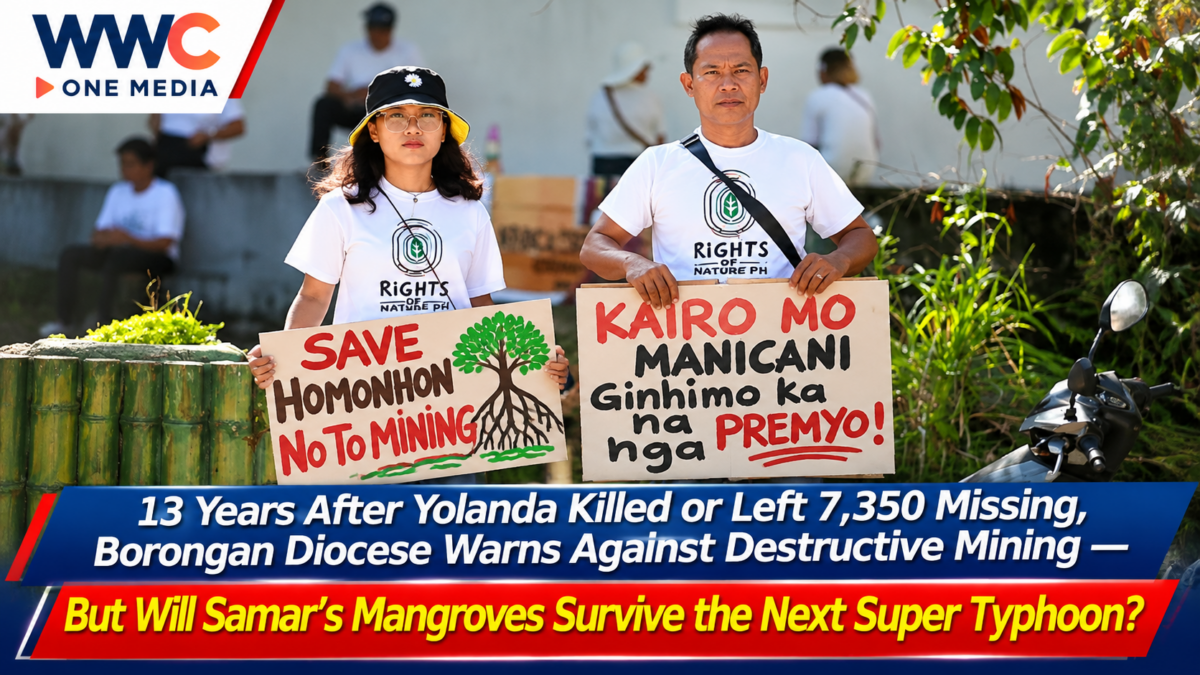
Gadicho urged Catholics to oppose destructive mining, protect trees and mangroves, reduce waste, improve disaster preparedness and support vulnerable families.
He emphasized that responsibility for the environment extends beyond government agencies.
Homes, schools, parishes and local organizations all have important roles.
The message encouraged people to recognize the connection between environmental destruction and human suffering.
Communities facing poverty are often particularly vulnerable to extreme weather because they have fewer resources to prepare, evacuate and rebuild.
The diocese therefore presented environmental protection as both a religious obligation and a matter of social justice.
Its appeal also reflects a wider discussion about whether economic development should be pursued at the expense of forests, waterways, coastlines and local livelihoods.
Yolanda’s 13th Anniversary Revives a Painful Warning
Super Typhoon Yolanda struck the Philippines on November 8, 2013, causing catastrophic destruction across Eastern Visayas and other affected regions.
Eastern Samar was among the first areas hit.
The storm brought destructive winds, heavy rainfall and dangerous coastal conditions.
Tacloban City and surrounding communities suffered some of the most devastating consequences.
The nationwide toll of 7,350 dead or missing remains a powerful reminder of the disaster’s human cost.
The effects extended far beyond immediate casualties.
Homes were destroyed.
Fishing vessels and agricultural equipment were lost.
Roads, public facilities and other essential infrastructure sustained damage.
Many families struggled for years to recover.
For communities in Eastern Samar, the anniversary is therefore not only a date on the calendar.
It recalls how environmental exposure, poverty, inadequate preparation and extreme weather can combine into a humanitarian catastrophe.
The Diocese of Borongan wants that memory to inspire stronger protection before the next disaster.
Why Mangroves Are Important to Coastal Communities
One of the clearest parts of the diocese’s message concerns mangrove conservation.
Mangroves are trees and shrubs adapted to coastal environments where saltwater and freshwater interact.
Their complex root systems help stabilize shorelines and provide habitats for marine wildlife.
They can also reduce erosion and help dissipate wave energy.
For fishing communities, mangrove ecosystems support fish, crabs and other organisms that depend on sheltered coastal habitats.
Healthy mangrove areas can therefore contribute to both biodiversity and livelihoods.
But their protective capacity has limits.
Scientific reviews published through the US Geological Survey explain that mangroves can reduce some storm-related wave impacts, while their ability to reduce large, long-lasting storm surges varies considerably with forest width, density and local conditions.
Mangroves are valuable natural coastal defenses, but they cannot guarantee protection against a super typhoon like Yolanda.
Effective disaster preparedness still requires early warnings, evacuation plans, safe shelters and appropriate infrastructure.
The strongest approach combines environmental conservation with practical emergency planning.
Philippine Research Supports the Value of Mangrove Protection
Research examining coastal communities affected by Yolanda has found evidence that mangrove cover can help reduce disaster damage.
A Philippine study of 384 coastal villages compared the impacts of the typhoon in communities with differing mangrove conditions.
The researchers reported that villages with substantial mangrove cover experienced less damage than those with reduced cover, after accounting for selected local factors.
The findings support the broader value of preserving mangrove ecosystems.
However, mangrove protection should not be reduced to planting as many seedlings as possible.
The appropriate species must be used.
Planting locations must be suitable.
And restored areas require maintenance and long-term monitoring.
As WWC ONE MEDIA reported in its coverage of four mangrove species documented on Lawak Island, scientific monitoring is essential to understanding whether mangrove vegetation can survive and regenerate naturally.
The Lawak Island discovery is separate from Eastern Samar, but it illustrates the importance of evidence-based coastal conservation.
Nearly 903 Hectares in Eastern Samar Are Covered by an Exploration Permit
The diocese’s warning also follows a specific mining controversy.
On June 22, 2026, the Mines and Geosciences Bureau approved Exploration Permit EP-2026-001-VIII.
The permit covers approximately 902.99 hectares in Giporlos and Balangiga, Eastern Samar.
It was granted to Altimas Ventures Inc. for exploration involving chromite and associated minerals.
The authorization has an initial two-year period and may be renewed under applicable rules.
The approval prompted concern from the Diocese of Borongan and the Samar Island Partnership for Peace and Development.
The Church warned that exploration could eventually lead to proposals for commercial mineral extraction.
But the distinction is essential.
The permit authorizes mineral exploration, not commercial mining operations.
A company seeking to extract minerals commercially would need further government approvals and compliance with environmental and other legal requirements.
There is no verified basis for claiming that the exploration permit alone authorizes immediate large-scale mineral production.
Three Samar Bishops Unite Against Mining Expansion
In July 2026, three Catholic bishops supported a pastoral position statement calling on local governments to oppose mining activities.
They were Borongan Bishop Crispin Varquez, Calbayog Bishop Isabelo Abarquez and Catarman Bishop Nolly Buco.
Their endorsement was made through the Samar Island Partnership for Peace and Development, a coalition involving religious organizations, civil society and other community sectors.
The bishops encouraged municipal and barangay councils to adopt or reaffirm resolutions opposing mining.
Their concerns included potential forest destruction, watershed degradation, pollution of waterways and threats to farming and fishing communities.
The Church also questioned whether short-term economic benefits would justify long-term environmental costs.
The statement did not establish that every proposed mining activity would necessarily cause unlawful environmental damage.
Instead, it argued that local governments should carefully consider the risks before supporting future extraction.
The dispute highlights the tension between mineral development and the protection of natural ecosystems.
Local Officials Say No Commercial Mining Has Started Under the Permit
Giporlos Mayor Gilbert Go previously clarified that the approved authorization concerns exploration.
He said commercial mining operations had not begun in the municipality under the permit.
He also urged residents to avoid misinformation and emphasized that any future mining proposal would need to satisfy legal requirements.
That response provides important balance to the Church’s concerns.
Mineral exploration involves investigating whether economically recoverable mineral deposits are present.
It does not automatically mean a commercially viable mine will be developed.
The company would still need to establish whether extraction is technically and economically feasible.
Government agencies would also need to evaluate environmental and social requirements.
Local communities may have opportunities to participate through applicable consultation and regulatory processes.
The central unresolved issue is whether future mineral development would be compatible with the area’s environmental conditions and local priorities.
Homonhon and Manicani Remain Important Warnings
The Diocese of Borongan’s opposition is informed partly by Samar Island’s history with mining.
Homonhon and Manicani islands in Guiuan, Eastern Samar, have experienced mining-related disputes over several decades.
Local residents and environmental organizations have raised concerns about land disturbance, pollution, fisheries and the future of community livelihoods.
Church leaders have also referred to mining-related problems in Bagacay, Hinabangan, Samar.
These experiences have shaped local attitudes toward new mineral exploration proposals.
Some mining proponents emphasize employment, infrastructure and investment.
Opponents argue that environmental damage can leave communities facing lasting costs after extraction ends.
As WWC ONE MEDIA examined in its feature on Philippine mining rehabilitation and environmental accountability, the long-term value of mining should be judged through documented environmental performance, community welfare and the condition of land after operations close.
The publication discusses Manicani Island among other Philippine mining communities.
The central lesson is that economic benefits and environmental consequences both require scrutiny.
Can Mining Affect a Province’s Disaster Vulnerability?
Mining and mineral exploration can involve vegetation removal, road construction, excavation and land disturbance.
Depending on the project’s location and management, those activities may affect drainage, soil stability, erosion and water quality.
Such environmental changes can become particularly important in regions exposed to intense rainfall and landslides.
However, it would be inaccurate to claim that any exploration permit automatically increases typhoon intensity or guarantees a future disaster.
Tropical cyclones are driven by large-scale atmospheric and oceanic conditions.
Land-use decisions affect local exposure and vulnerability, not whether a typhoon forms.
That distinction helps explain the Diocese of Borongan’s position.
The Church is concerned that weakening natural ecosystems could make some communities less resilient when severe weather arrives.
Whether a particular project would create those risks must be determined through site-specific environmental assessments.
Environmental Protection Is Also About Livelihoods
The diocese has emphasized that environmental protection should include the people whose livelihoods depend on natural resources.
Farmers rely on productive land and reliable water.
Fisherfolk depend on healthy coastal ecosystems.
Families living near rivers, steep slopes and shorelines may face heightened exposure to flooding, erosion or landslides.
Environmental damage can therefore create economic and social consequences.
If productive farmland is degraded, households may lose income.
If coastal habitats deteriorate, fishing communities may face declining resources.
If watersheds are poorly managed, downstream communities may experience additional risks.
For this reason, the Church’s argument goes beyond protecting scenery or wildlife.
It links environmental stewardship to human dignity, food security and community stability.
Other Philippine Communities Are Also Calling for Natural Coastal Defenses
The campaign to protect mangroves is not limited to Eastern Samar.
In Bulacan, coastal communities have raised concerns about recurrent flooding, damaged infrastructure and the loss of natural coastal protection.
As WWC ONE MEDIA reported in its feature on Hagonoy residents protesting amid deep floodwaters, residents and environmental advocates have called attention to the need for better flood management and restoration of natural coastal greenbelts.
The conditions in Hagonoy differ from those in Eastern Samar.
But both cases demonstrate why coastal resilience requires a combination of environmental management and infrastructure planning.
Mangrove restoration may help strengthen coastlines.
However, it must be accompanied by appropriate drainage, land-use planning, emergency preparedness and scientific monitoring.
Planting Trees Is Only the Beginning
The Borongan Diocese has called on Catholics to plant and protect trees.
The emphasis on protection is important.
A successful environmental programme does not end when seedlings are placed in the ground.
Trees need suitable growing conditions.
Young plants may require maintenance, protection from damage and monitoring.
Mangrove restoration is particularly sensitive because inappropriate planting locations can produce poor survival outcomes or damage other important coastal habitats.
As WWC ONE MEDIA reported in its coverage of Aboitiz Foundation and GCash’s one-million-tree initiative in Cebu, genuine restoration must be judged by long-term survival and ecosystem recovery, not simply the number of seedlings planted.
For Eastern Samar, community participation could help ensure that restoration projects are maintained beyond ceremonial planting activities.
Schools, parishes and local organizations may all contribute to monitoring and environmental education.
But technical planning should involve qualified environmental specialists and relevant government agencies.
The Catholic Church’s Environmental Campaign Is Not New
The Diocese of Borongan has opposed destructive mining for several years.
In January 2025, Bishop Crispin Varquez urged voters to consider candidates’ environmental records and reject political support for destructive mining operations.
He particularly highlighted concerns surrounding Homonhon Island.
In September 2026, Varquez also encouraged families to teach children environmental responsibility.
His message included proper waste disposal, respect for nature and the importance of developing values that extend beyond personal gain.
These earlier statements demonstrate that the November 8 appeal is part of an ongoing environmental campaign.
The Yolanda anniversary gives that campaign additional urgency.
It connects present-day development decisions with the province’s experience of catastrophic disaster.
What the Diocese Wants Families and Communities to Do
The November 8 message calls for action at several levels.
Families are encouraged to reduce waste and practice environmental responsibility.
Schools can help young people understand the importance of forests, mangroves and disaster preparedness.
Parishes can organize community initiatives and support vulnerable households.
Local governments can examine land-use policies, environmental risks and emergency plans.
Citizens can participate in consultations and demand evidence-based decisions from public officials.
The diocese also encourages people to speak up for policies that protect both communities and ecosystems.
The message is therefore not limited to opposing mining.
It advocates a broader approach to responsible development and disaster resilience.
What Happens Next in Eastern Samar?
The immediate future of the exploration area in Giporlos and Balangiga will depend on regulatory compliance, local consultations and any subsequent proposals.
The existing permit does not authorize commercial mineral extraction.
If a company later seeks additional approvals, relevant environmental and legal requirements will apply.
Local officials and community organizations may continue presenting their positions.
For the diocese, the immediate priority is sustaining environmental awareness beyond the Yolanda anniversary.
Mangrove conservation, responsible land use and disaster preparedness require long-term effort.
No single church statement, local resolution or tree-planting programme can eliminate the risks posed by extreme weather.
But coordinated action may help communities become better prepared.
The Bottom Line: Yolanda’s Memory Becomes a Call to Protect Samar
Thirteen years after Super Typhoon Yolanda devastated Eastern Visayas, the Diocese of Borongan is urging Catholics to reject destructive mining and strengthen environmental protection.
Diocesan administrator Fr. Jan Michael Gadicho called for the protection of trees and mangroves, reduced waste, better disaster preparedness and support for vulnerable families.
The message comes amid ongoing opposition to mineral exploration in Eastern Samar.
A permit covering approximately 902.99 hectares in Giporlos and Balangiga has raised concerns among religious leaders and civil society groups.
But the permit allows exploration rather than commercial mining, and no completed assessment establishes that the proposed activities have already caused widespread environmental destruction.
The larger issue is how Eastern Samar should balance development opportunities with the protection of communities, forests, rivers and coastlines.
Yolanda remains a painful reminder that disasters can have consequences lasting far beyond the day a storm strikes.
And as the people of Eastern Samar remember thousands of lives lost to Super Typhoon Yolanda, one question now confronts local leaders and the national government: Will they protect Samar’s remaining forests and mangroves before another major storm arrives—or will short-term development decisions leave vulnerable communities facing even greater risks?