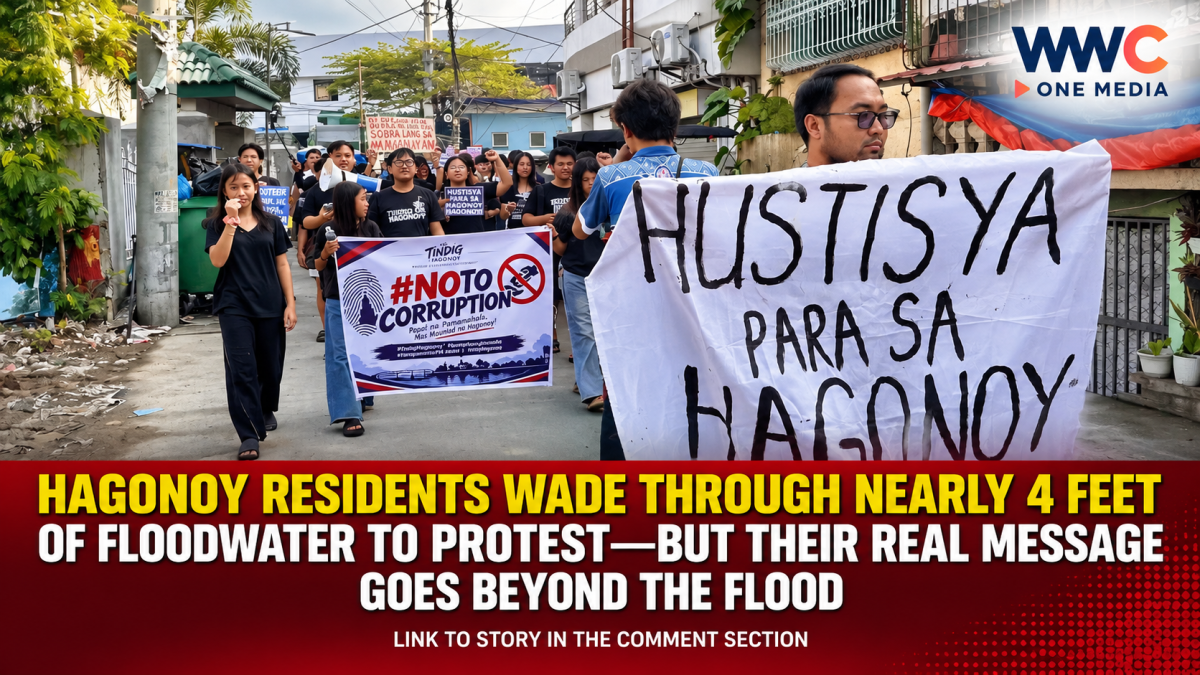
HAGONOY, BULACAN — Nearly 1,000 residents from different sectors of this flood-prone Bulacan municipality took their protest into the water on September 20, 2025, wading through floodwaters that reached about 3.9 feet during high tide as they called attention to the town’s long-running flooding problems and alleged irregularities involving government flood-control projects.
The demonstration, organized under the banner “Tindig Hagonoy,” formed part of the wider public anger over alleged anomalies in government-funded flood-control projects across Bulacan and other parts of the Philippines.
Rather than holding the protest only on dry ground, participants deliberately walked through flooded communities, turning the conditions they say they have endured for years into the backdrop of their demonstration.
The protest began with a 6 a.m. Mass at the National Shrine of Saint Anne, followed by more than an hour of “lusong”—a walk through flooded streets in parts of Barangays Sta. Monica, San Sebastian and Sto. Niño.
Fishermen, tricycle drivers, students, young professionals, church leaders, persons with disabilities, overseas Filipino workers, artists and other residents joined the activity. Hagonoy Mayor Maria Rosario “Charo” Sy-Alvarado also participated and expressed support for the concerns raised by residents.
Flooding has become a way of life
For Hagonoy residents, the demonstration was about more than a single flooding incident.
The coastal municipality has repeatedly faced inundation linked to a combination of heavy rainfall, high tides and water flowing into low-lying areas.
Recent reports illustrate the continuing scale of the problem.
In August 2026, Philstar reported that 71 Bulacan villages were inundated by backflow and high tide, with Hagonoy among the municipalities affected. The provincial disaster office reported thousands of people seeking shelter during the flooding episode.
GMA News subsequently reported that portions of Hagonoy remained submerged even after the weather improved. Eight of the municipality’s 26 barangays were still flooded at the time of the report, while 334 families, or 994 people, were staying in evacuation centers. Some residents were using boats and modified tricycles to move through the flooded communities.
The problem has also affected livelihoods.
DZRH reported in August 2026 that flooding had affected all 26 barangays of Hagonoy during a period of consecutive storms and enhanced southwest monsoon conditions. The report said fishpond operations were severely affected and that hundreds of residents had sought refuge in evacuation centers.
Government response and the flood-control controversy
The flooding has prompted repeated government inspections and relief operations.
The Philippine Information Agency reported in August 2026 that DSWD Secretary Rex Gatchalian visited Hagonoy and Calumpit to check on families displaced by prolonged flooding. The agency described the area as particularly vulnerable to backflooding, in which water from upstream areas contributes to flooding in low-lying communities.
DPWH Secretary Vince Dizon also inspected flood-control structures in Hagonoy and neighboring Paombong. According to PIA, the inspection included a damaged seawall in Paombong that had reportedly been designed for river conditions rather than the stronger wave conditions encountered along the Manila Bay coast.
The issue became particularly contentious after allegations surfaced concerning so-called ghost, incomplete or substandard flood-control projects.
In August 2026, Inquirer reported that Cabinet Secretary Benhur Abalos and Dizon inspected damaged flood-control structures in Paombong and called for contractors responsible for defective work to be held accountable. The DPWH said it was examining whether construction problems, design issues, negligence or other irregularities contributed to the failures.
From protest to a broader conversation about flooding
The Hagonoy protest also became part of a wider discussion about why flooding persists in coastal Bulacan despite billions of pesos being allocated to flood-control programs.
In April 2026, Inquirer reported that residents and environmental groups were pushing for greater protection and restoration of mangroves and coastal greenbelts, arguing that natural coastal barriers can help communities withstand flooding and other coastal hazards. The report identified several factors associated with worsening flooding, including land subsidence, silted waterways, damaged or unfinished flood-control structures and the loss of natural coastal defenses.
The Philippine government has meanwhile pursued both emergency assistance and longer-term infrastructure measures. Local authorities have also continued relief operations as residents deal with recurring inundation. Hagonoy’s municipal government has documented ongoing flood-response activities and efforts to coordinate with national agencies on longer-term solutions.
A protest that put the problem in plain sight
Back in September 2025, the message from Hagonoy residents was delivered in the most literal setting possible: in the floodwater itself.
After the “lusong” through flooded streets and the rally at the town plaza, participants held a motorcade through several barangays that were less affected by the high tide.
The protest underscored a problem that continues to confront coastal Bulacan communities: flooding is not simply an occasional inconvenience for many residents but a recurring disruption to transportation, housing, livelihoods and everyday life.
As subsequent flooding episodes in 2026 demonstrated, the challenge remains unresolved—and the debate has expanded from emergency relief to questions about the effectiveness, design, maintenance and accountability surrounding flood-control infrastructure, as well as the role of natural coastal defenses.