
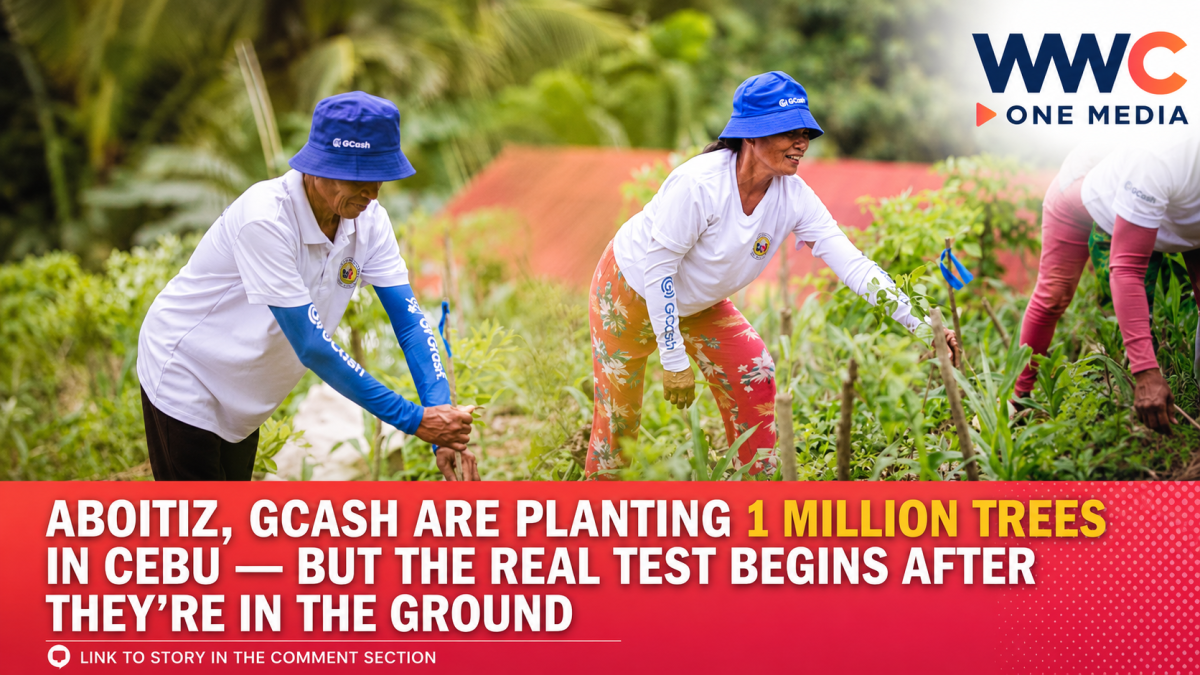
CEBU, Philippines — Aboitiz Foundation and GCash are launching an ambitious five-year environmental push in Cebu, targeting one million new trees and the restoration of about 1,200 hectares of forest and coastal ecosystems in Balamban.
But the bigger measure of success will not simply be how many seedlings make it into the ground. It will be how many survive, mature and eventually become part of functioning forests, watersheds and coastal ecosystems.
The CarbonPH x GForest Project brings together Aboitiz Foundation’s long-term nature-based climate program and GCash’s GForest digital environmental platform, with the companies targeting forest restoration, biodiversity protection, climate resilience and livelihood opportunities for communities in western Cebu.
1 million trees across 1,200 hectares
Under the five-year program, the partners plan to restore approximately 1,200 hectares in Balamban, Cebu, using a mix of agroforestry, indigenous and native tree planting, and mangrove rehabilitation.
Local communities are expected to participate not only in planting but also in nursery development, maintenance and long-term protection of the restored areas.
That detail could prove crucial.
Environmental restoration is increasingly being judged not simply by the number of seedlings planted during headline-making campaigns, but by survival rates and whether restored areas eventually provide measurable ecological benefits.
The Department of Environment and Natural Resources has similarly stressed the importance of post-planting monitoring, maintenance and protection. In July, DENR said the real measure of tree-planting campaigns should be how many seedlings continue growing years after planting rather than the initial planting count alone.
A much bigger Aboitiz climate bet
The Balamban project represents only a portion of Aboitiz Foundation’s broader CarbonPH ambitions.
Aboitiz describes CarbonPH as a large-scale, long-term nature-based solution involving afforestation, reforestation, revegetation, biodiversity conservation and agroforestry systems across Cebu.
The foundation’s CarbonPH program identifies a project area of roughly 71,000 hectares associated with Cebu’s broader forest landscape and the Central Cebu Protected Landscape, while the latest partnership announcement describes a long-term restoration ambition covering more than 40,000 to 71,000 hectares.
Aboitiz Foundation President Ginggay Hontiveros-Malvar said the strategy is intended to go beyond simply counting trees.
The foundation’s goal, she said, is to restore ecosystems capable of continuing to provide benefits to communities over generations.
The Balamban partnership is therefore positioned as an early component of a far longer environmental commitment rather than a stand-alone tree-planting campaign.
GCash is chasing a 10-million-tree target
For GCash, meanwhile, the Cebu partnership adds another major project to its GForest program.
The company says 4.9 million actual trees have already been planted through GForest, and the additional one million trees planned with Aboitiz Foundation would move the fintech platform closer to its target of 10 million actual trees by 2030.
GForest allows GCash users to accumulate so-called green energy points through eligible activities inside the app. Those points can then be used to support environmental projects linked to real-world tree planting and ecosystem restoration.
According to Mynt, the company behind GCash, the concept is designed to connect everyday digital transactions with environmental participation.
That gives the project an unusual combination: large-scale physical restoration on one side and a consumer fintech platform capable of mobilizing millions of digital users on the other.
GCash has already planted trees in Cebu — with another Aboitiz-linked foundation
The new Aboitiz Foundation project is also not GCash’s first large-scale reforestation effort in Cebu.
Since 2021, GCash has separately worked with the Ramon Aboitiz Foundation Inc. (RAFI) through GForest and RAFI’s One to Tree program.
In 2024, GCash and RAFI reported that 1.15 million mangrove and upland trees had been planted across several Cebu locations under that partnership, including projects in the Luyang Watershed in Carmen.
That earlier program provides useful context for the scale of GCash’s environmental activities in Cebu, although RAFI and Aboitiz Foundation are separate organizations and the newly announced CarbonPH x GForest initiative is a distinct project.
Why Balamban matters
The new project goes beyond conventional upland reforestation.
Plans call for native and indigenous tree species, agroforestry systems and mangrove restoration, meaning the initiative will span both terrestrial and coastal environments.
Agroforestry is expected to combine environmental restoration with income-generating opportunities for participating communities, while native forest restoration could strengthen biodiversity and watershed functions.
Mangrove rehabilitation, meanwhile, can improve coastal ecosystems while providing natural protection against erosion, storm surges and other climate-related hazards.
Aboitiz and GCash say the broader goals include stronger water security, carbon capture, biodiversity conservation, climate resilience and sustainable livelihoods.
Planting one million is the easy number to remember. Keeping them alive is harder.
The headline figure is powerful: one million trees.
But Philippine environmental agencies increasingly recognize that planting targets alone do not guarantee successful forest restoration.
DENR’s own Forests for Life program, which aims to establish at least five million indigenous trees nationwide from 2025 to 2028, explicitly budgets for planting as well as maintenance and protection for three years, illustrating how long-term care has become a central part of reforestation strategy.
That makes the five-year timeframe of the Aboitiz-GCash project particularly significant.
If the partners can translate digital GForest participation into sustained nursery operations, community stewardship, replacement planting, monitoring and ecosystem protection, the project could become considerably more important than its one-million-tree headline.
If survival, maintenance and community participation fall short, however, the number planted will tell only part of the story.
For Aboitiz Foundation and GCash, the challenge in Balamban therefore begins with planting one million trees — but success will ultimately be measured by how much forest is still standing years from now.
WWC ONE MEDIA J.M.D




Leave a Reply